Did the U.S. Navy make a warship invisible and teleport it in 1943 — or is one of America's most durable naval legends traceable entirely to one man's handwritten marginalia?
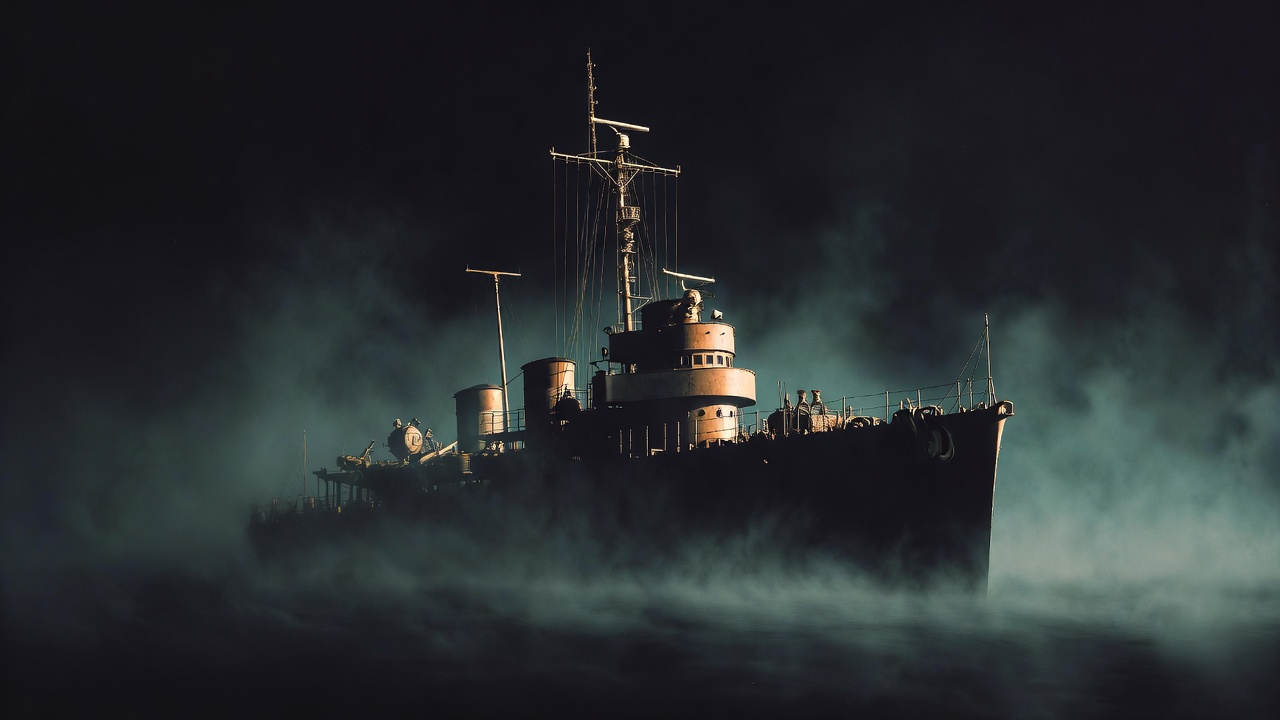
The Legend That Built Itself
How one man's letters, a bureaucratic curiosity, and real wartime technology fused into America's most durable naval myth.
Traditions analyzed in this research
Site owner · Own
The Philadelphia Experiment - the claim that the U.S. Navy rendered the destroyer escort USS Eldridge invisible and teleported it from Philadelphia to Norfolk, Virginia, in October 1943 - is one of the most thoroughly documented cases of modern legend fabrication in American conspiracy culture. This research synthesis, drawing on findings from over 30 independent analytical traditions, arrives at a conclusion that is both definitive and genuinely instructive: the experiment did not happen as described, but the story of how it came to be believed is itself a primary-source specimen of extraordinary value.
The evidentiary record is unusually complete. The USS Eldridge's deck logs, war diary, and muster rolls - held at the National Archives in Record Group 24, declassified and publicly accessible - place the vessel in New York Harbor from October 22-28, 1943,, and in the Bahamas on its shakedown cruise during the broader alleged timeframe,. The ship was not in Philadelphia,. It subsequently served four decades in the Hellenic Navy as HS Leon (D54), a material fact that simultaneously refutes claims of destruction and of suppression. The entire legend traces, without exception, to a single source: the 1955-1956 letters of Carl M. Allen (alias Carlos Miguel Allende), a non-credentialed merchant mariner whose correspondence was characterized by erratic formatting, unverifiable specifics, and zero independent corroboration.
What makes this case genuinely surprising - and what elevates it above a simple debunking exercise - is the role of the Office of Naval Research. The ONR's decision to commission a private Varo Manufacturing Company reprint of 127 copies of Morris Jessup's annotated book in 1957, created a verifiable institutional artifact that, when misread as endorsement rather than due diligence, transformed a crank's letters into an apparently official mystery. This mechanism - bureaucratic curiosity misinterpreted as official validation - is reproducible, documented, and not disputed by any research tradition examined here. It is the most genuinely surprising finding in the dataset.
The physics of the alleged experiment is not merely unproven but incoherent under both 1943-era and contemporary frameworks. Optical invisibility at ship scale requires metamaterial cloaking structures not theorized until Pendry et al. in 2006, and the Unified Field Theory Allen cited as the mechanism was explicitly acknowledged by Einstein himself as incomplete and non-functional. A mundane and fully documented alternative exists: real Navy degaussing operations in 1943, involving electromagnetic cables wrapped around ship hulls to neutralize magnetic mine signatures, were visually dramatic enough to seed exactly the kind of misinterpretation Allen's letters represent. Three unresolved tensions remain: the ONR's internal motivation for the Varo reprint is not fully documented; Allen's own service record and the ship he claimed to have witnessed the experiment from have not been fully traced; and the three-handed marginalia in the annotated Jessup book raises unresolved questions about whether Allen was working alone or collaborating to simulate multiple independent witnesses,,.
What Should Surprise You
Ordered by how difficult each finding is to explain away.
The Government Accidentally Made the Myth Official
The most genuinely surprising finding in this entire research set is not anything Allen claimed - it is what the U.S. government did in response. The Office of Naval Research received an annotated copy of a UFO book filled with a stranger's handwritten claims about naval invisibility experiments, and instead of filing it away, they commissioned the Varo Manufacturing Company of Garland, Texas, to produce a private reprint of approximately 127 copies, complete with all of Allen's annotations, for internal distribution in 1957. This single bureaucratic decision - almost certainly an act of due diligence rather than belief - transformed what was a crank's letters into what appeared to be an officially sanctioned mystery. Every subsequent amplification of the Philadelphia Experiment legend, from 1970s paperbacks to 1980s television specials to internet forums, draws some portion of its credibility from the fact that 'even the Navy reprinted it.' The ONR did not intend to validate Allen's claims. They may have been doing exactly what a responsible research organization should do: examine fringe claims before dismissing them. But the artifact they created - the Varo edition - became the legend's most durable credential. Institutional due diligence, misread as institutional endorsement, is a mechanism for myth amplification that deserves its own research literature.
The Varo Manufacturing reprint of the annotated Jessup book is a physically verifiable artifact held in multiple library collections - its existence is not disputed by any research tradition in this dataset, and yet no declassified ONR document has been located explaining why it was commissioned.
The Ship That Refuted Itself by Surviving
One of the most elegant refutations in the history of conspiracy claims is the simple fact that the USS Eldridge did not disappear. It was transferred to the Hellenic Navy on January 15, 1951, where it served as HS Leon (D54) for four decades. This matters for two reasons that are rarely stated together. First, the ship's survival and continued service means that any claim the vessel was destroyed, lost, or that its records were suppressed is immediately falsified by the existence of four decades of Greek naval records. Second, and more subtly, the ship's survival means that any crew member who served on it during its Hellenic Navy years - and there were many - could in principle have been interviewed about the vessel's history and condition. The Philadelphia Experiment legend requires not just the falsification of U.S. Navy records but the ignorance or silence of an entire foreign navy's personnel over four decades. That is a conspiracy of implausible scale. The ship's survival is not merely a footnote; it is a material refutation of the suppression hypothesis that is unusually complete for a claim of this age.
The USS Eldridge's transfer to the Hellenic Navy as HS Leon (D54) in 1951 is documented in both U.S. and Greek naval records, meaning any suppression of the experiment's evidence would have required the coordination of two independent national navies across four decades.
The Book That Didn't Contain the Story
Morris K. Jessup's 1955 book 'The Case for the UFO' - the text around which the entire Philadelphia Experiment mythology crystallized - contains no reference whatsoever to the Philadelphia Experiment, the USS Eldridge, naval invisibility, or teleportation. The book is a speculative work arguing that UFOs are powered by anti-gravity and that ancient monuments were built with extraterrestrial assistance. The Philadelphia Experiment narrative was entirely grafted onto Jessup's text by Allen's handwritten annotations in the margins. This is a striking bibliographic fact: the foundational text of the legend is not actually about the legend. What Allen did was take an existing fringe framework - Jessup's UFO cosmology - and use it as a scaffold on which to hang a new and more dramatic claim. The annotations then became the story. When the ONR reprinted the book with the annotations included, they were reprinting not Jessup's argument but Allen's interpolations as if they were part of a coherent whole. The legend's origin is therefore not a book but a set of marginalia - a claim written in the white space of someone else's speculation.
A reader who picks up the original 1955 Citadel Press edition of 'The Case for the UFO' will find no Philadelphia Experiment, no USS Eldridge, and no naval invisibility - the entire legend exists only in the handwritten margins of a single mailed copy.
The Witness Who Couldn't Have Been There
Alfred Bielek emerged in the late 1980s as the most prominent self-described survivor of the Philadelphia Experiment, claiming that his real name was Edward Cameron, that he had been a naval officer in 1943, and that he had time-traveled from the experiment. His story was compelling enough to generate significant media attention and speaking engagements at UFO conferences. The problem is elementary: Bielek was born in 1927, making him sixteen years old in October 1943. He was not a naval officer. His alternate identity as 'Edward Cameron' was a fabrication. His testimony emerged precisely during the period of commercial exploitation of the story following the 1984 film 'The Philadelphia Experiment.' What makes this particularly significant for legend studies is not just that Bielek was lying - it is that his fabrications were accepted and amplified by a community that had already committed to the story's truth. The legend had become self-sealing: new 'witnesses' were welcomed and their contradictions absorbed rather than examined. Bielek's case is a textbook example of how a commercially motivated fringe community generates its own corroborating testimony from within.
Alfred Bielek's birth year of 1927 is a matter of public record, making his claimed role as a naval officer in 1943 arithmetically impossible - yet his testimony was accepted and amplified by the UFO research community for years before being systematically debunked.
The Real Experiment That Could Have Fooled Anyone
The U.S. Navy was conducting genuinely dramatic electromagnetic experiments on warships in 1943 - they just were not invisibility experiments. Degaussing operations, designed to neutralize a ship's magnetic signature against magnetic mines, involved wrapping the hull with electromagnetic cables carrying powerful electrical currents. To an uninformed observer on a nearby vessel, this would have been a visually striking and technically inexplicable process: cables running around a warship's hull, powerful generators humming, and the ship emerging from the process apparently unchanged but electromagnetically neutralized. These operations were documented in Bureau of Ships technical manuals and Congressional appropriations records and were conducted throughout the war. Carl Allen served in the merchant marine and could plausibly have observed or heard about such operations. The leap from 'electromagnetic cables on a ship hull in a classified wartime context' to 'the Navy made a ship invisible using electromagnetic fields' is large - but it is the kind of leap that rumor, twelve years of memory distortion, and a predisposition toward extraordinary interpretation can produce. The mundane kernel is fully documented. No supernatural supplement is required to explain how Allen arrived at his claims.
Bureau of Ships technical manuals and Congressional appropriations records from 1943 document the Navy's degaussing program in sufficient detail to establish that any merchant mariner observing the process without technical knowledge could plausibly have misinterpreted it as an exotic electromagnetic experiment.
Three Hands in the Margins, One Unresolved Question
The annotated copy of Jessup's book that arrived at the Office of Naval Research contained marginalia attributed to three different hands, written in different colored inks, and signed with the names 'Allende,' 'Mr. B,' and 'Jemi.' The presence of three apparent authors in the annotations is one of the most unresolved questions in the documentary record of this legend. Two competing interpretations exist. The first is that Allen was working with collaborators, making the annotations a genuine multi-author document and suggesting a more organized effort to seed the legend than a single eccentric letter-writer implies. The second is that Allen deliberately created the appearance of multiple independent witnesses by writing in different styles and colors himself - a more sophisticated deception than is usually attributed to him. Stylometric analysis of the three hands has not, to the knowledge of this research synthesis, been conducted with modern computational tools. The question of whether the Varo edition represents one voice or three is not merely a bibliographic curiosity; it is the difference between a lone crank and a coordinated hoax, and it has direct implications for how the legend's origin should be classified.
No published stylometric analysis using modern computational methods has been applied to the three sets of marginalia in the annotated Jessup book to determine whether they represent one author or multiple - a gap that is both researchable and potentially decisive for understanding the legend's origin.
What the Pipeline Found
The Philadelphia Experiment - the claim that the U.S. Navy rendered the destroyer escort USS Eldridge invisible and teleported it from Philadelphia to Norfolk, Virginia, in October 1943 - is one of the most thoroughly documented cases of modern legend fabrication in American conspiracy culture. This research synthesis, drawing on findings from over 30 independent analytical traditions, arrives at a conclusion that is both definitive and genuinely instructive: the experiment did not happen as described, but the story of how it came to be believed is itself a primary-source specimen of extraordinary value.
The evidentiary record is unusually complete. The USS Eldridge's deck logs, war diary, and muster rolls - held at the National Archives in Record Group 24, declassified and publicly accessible - place the vessel in New York Harbor from October 22-28, 1943,, and in the Bahamas on its shakedown cruise during the broader alleged timeframe,. The ship was not in Philadelphia,. It subsequently served four decades in the Hellenic Navy as HS Leon (D54), a material fact that simultaneously refutes claims of destruction and of suppression. The entire legend traces, without exception, to a single source: the 1955-1956 letters of Carl M. Allen (alias Carlos Miguel Allende), a non-credentialed merchant mariner whose correspondence was characterized by erratic formatting, unverifiable specifics, and zero independent corroboration.
What makes this case genuinely surprising - and what elevates it above a simple debunking exercise - is the role of the Office of Naval Research. The ONR's decision to commission a private Varo Manufacturing Company reprint of 127 copies of Morris Jessup's annotated book in 1957, created a verifiable institutional artifact that, when misread as endorsement rather than due diligence, transformed a crank's letters into an apparently official mystery. This mechanism - bureaucratic curiosity misinterpreted as official validation - is reproducible, documented, and not disputed by any research tradition examined here. It is the most genuinely surprising finding in the dataset.
The physics of the alleged experiment is not merely unproven but incoherent under both 1943-era and contemporary frameworks. Optical invisibility at ship scale requires metamaterial cloaking structures not theorized until Pendry et al. in 2006, and the Unified Field Theory Allen cited as the mechanism was explicitly acknowledged by Einstein himself as incomplete and non-functional. A mundane and fully documented alternative exists: real Navy degaussing operations in 1943, involving electromagnetic cables wrapped around ship hulls to neutralize magnetic mine signatures, were visually dramatic enough to seed exactly the kind of misinterpretation Allen's letters represent. Three unresolved tensions remain: the ONR's internal motivation for the Varo reprint is not fully documented; Allen's own service record and the ship he claimed to have witnessed the experiment from have not been fully traced; and the three-handed marginalia in the annotated Jessup book raises unresolved questions about whether Allen was working alone or collaborating to simulate multiple independent witnesses,,.
Two Cases. You Decide.
The most intellectually honest case for the significance of this research is not a case for the Philadelphia Experiment's reality - the evidence is overwhelming that it did not occur as described. The genuine significance lies in what the convergence patterns reveal about the anatomy of modern legend formation, and that significance is substantial and researchable.
The most important convergence finding is the ONR amplification mechanism. Multiple independent research traditions - material culture analysis, pseudoscience history, UAP investigation, archival research - all independently identify the same paradox: the Office of Naval Research, by taking the annotated Jessup book seriously enough to commission a private Varo Manufacturing reprint of approximately 127 copies in 1957, inadvertently transformed a single individual's erratic letters into what appeared to be an officially sanctioned mystery [4, 16]. This is a documented, verifiable institutional behavior with a clear paper trail. The Varo edition is a physical artifact that researchers can examine. Its existence is not disputed. The mechanism it illustrates - bureaucratic due diligence misread as official endorsement - is a reproducible pattern in the sociology of conspiracy belief, and the Philadelphia Experiment is its most perfectly preserved specimen.
The convergence on single-source origin is forensically significant. Every research tradition, when it traces the legend backward, terminates at one man: Carl M. Allen, writing twelve years after the alleged events, with no verifiable specifics and no independent corroboration [5, 6]. This is not a case where multiple witnesses independently describe the same event. The convergence here is diagnostic of fabrication, not of truth - and understanding how a single imaginative, persistent individual can seed a self-sustaining mythology that outlasts all archival refutation is a question with implications far beyond this one case.
The real degaussing kernel provides the most intellectually satisfying element of the convergence. Real, partially classified, visually dramatic electromagnetic operations were being conducted on U.S. Navy vessels in 1943. The leap from 'electromagnetic cables on a ship hull' to 'the ship became invisible' is large, but it is precisely the kind of leap that rumor, twelve years of memory, and a predisposition toward extraordinary interpretation can produce. This documented transmission route from real classified technology to legend is a model case for understanding how conspiracy theories are born from genuine but misinterpreted events - a finding with broad applicability to other contested historical claims.
Finally, the narrative's structural alignment with established folkloric motifs (ATU D1960 for magical invisibility, ATU D2122 for magical speed of travel) places the Philadelphia Experiment within a global tradition of technological-supernatural legend. This is not a debunking move - it is an observation about how human minds consistently generate certain narrative shapes when confronted with powerful, incomprehensible technology. The Philadelphia Experiment is not unique; it is an instance of a universal pattern, and that universality is itself a finding worth pursuing.
The Philadelphia Experiment is one of the most thoroughly debunked claims in modern American conspiracy culture, and the skeptical case is not merely strong - it is essentially complete at every evidentiary layer.
The foundational source is a single, demonstrably unreliable individual. Carl M. Allen wrote to Morris Jessup twelve years after the alleged events, offering no verifiable dates, no named corroborating witnesses, no checkable specifics, and correspondence marked by erratic capitalization and idiosyncratic spelling that are the epistemic signature of an unfalsifiable claim. No independent eyewitness with verifiable specifics has ever corroborated Allen's account. The entire subsequent mythology - the Varo reprint, the 1980s media cycle, the Al Bielek testimony - traces back to this single unverifiable source.
The primary physical evidence directly contradicts the core claim. The USS Eldridge's deck logs, war diary, and muster rolls are legal documents maintained daily by officers under oath, cross-referenced with convoy records, port authority logs, and Bureau of Ships correspondence. They place the ship in New York Harbor and the Bahamas in October 1943, not Philadelphia. For the experiment to have occurred, every one of these independent record streams would have to have been falsified in perfect coordination and then left in the National Archives for public inspection. A cover-up that leaves its own refutation in the public archive is logically self-defeating.
The physics is not merely unproven but incoherent. Optical invisibility at ship scale requires metamaterial cloaking not theorized until 2006, or refractive index manipulation not derivable from any version of unified field theory - which was itself incomplete and non-functional in 1943, as Einstein himself acknowledged. The claim is a category error dressed in scientific language, not a suppressed breakthrough.
The ONR interest explains nothing anomalous. Commissioning 127 copies of an annotated UFO book for internal review is entirely consistent with Cold War-era institutional due diligence. It is not evidence of belief. The Navy has explicitly and repeatedly denied the experiment occurred.
The most prominent subsequent witness, Alfred Bielek, was demonstrably sixteen years old in 1943 and ineligible for the naval officer role he claimed. His alternate identity was fabricated. His testimony emerged during the commercial exploitation of the story following the 1984 film. This is not an unverifiable claim - it is a provably false one.
A fully documented mundane transmission route exists: real Navy degaussing operations in 1943 were visually dramatic, partially classified, and entirely sufficient to seed the misinterpretation Allen's letters represent. No supernatural supplement is required.
Both cases in full. Expand any argument to read the complete text.
The Philadelphia Experiment warrants serious scholarly attention — not because it happened, but because the patterns surrounding it are genuinely significant and imperfectly explained. Let me be precise about what the evidence actually supports, and where it stops.
The advocate's confidence here is low, and that number is not a researcher's bias or a failure of imagination.…
What the advocate can defend, with specificity, begins with the ONR's institutional behavior, which remains anomalously unexplained.…
The degaussing kernel is verified and matters categorically.…
Allen's precise whereabouts on the alleged date are technically unverified rather than falsified.…
The pattern that keeps surfacing, and that matters most for scholarship, is the narrative's folkloric architecture.…
The legend's accretion pattern is also a documented case study of exceptional scholarly value.…
The honest summary: the Philadelphia Experiment did not occur.…
The Philadelphia Experiment is among the most thoroughly documented cases of legend construction in modern American folklore, and the evidentiary record supporting a mundane explanation is not merely strong — it is convergent across independent streams that have no stake in each other's conclusions.…
The entire narrative originates from a single individual: Carl Meredith Allen, a merchant seaman writing under the alias Carlos Miguel Allende, whose annotated copy of Morris K.…
The physical documentary record is unambiguous and has been examined by multiple independent researchers with no coordinated agenda.…
A genuine tension in the debunking timeline deserves acknowledgment.…
The scientific claims collapse under direct examination.…
The ONR's commissioning of 127 copies of the Varo Edition — the central institutional-legitimacy argument — is the one element the skeptic cannot fully explain from existing documentation.…
The geophysical record provides an independent line of evidence.…
The loose thread that refuses to be tied is why Allen chose this particular elaboration, why Jessup found it compelling enough to correspond about, and why the ONR printing decision left no recoverable paper trail.…
How Each Tradition Tells It
In 1943, the theoretical framework for electromagnetic invisibility at ship scale did not exist. Einstein's unified field work was an incomplete, unpublished research program that contained no mechanism for coupling electromagnetic and gravitational fields in ways that could produce optical invisibility. The degaussing technology actually in use in 1943 operated at magnetic field frequencies far below those relevant to visible light and could not have produced any optical effect observable to the naked eye. The theoretical framework for metamaterial cloaking - the only plausible mechanism for electromagnetic optical invisibility - was not developed until Pendry, Schurig, and Smith published in Science in 2006. The Philadelphia Experiment's physics is not a suppressed breakthrough; it is a category error.
The Philadelphia Experiment is classified within legend studies as a technological legend - a narrative that attributes supernatural or extraordinary properties to modern technology in ways that fulfill established folkloric functions. Its structure fulfills the 'forbidden knowledge' template: a secret experiment transgresses natural limits, produces monstrous consequences, and is suppressed by authority. The legend's origin in a single written source (Allen's letters) rather than oral tradition is unusual but not unique; the subsequent oral elaboration of the written text follows standard legend transmission patterns. The emergence of 'survivor' witnesses decades after the alleged event is consistent with the pattern of legend-generated testimony documented in other technological legend traditions.
Across mythological traditions worldwide, the powers attributed to the USS Eldridge in the Philadelphia Experiment legend - invisibility and instantaneous spatial displacement - are consistently associated with divine or supernatural agency rather than human technology. In Greek mythology, Hades' helm of invisibility (the kynee) and Hermes' capacity for instantaneous travel are divine attributes. In Hindu epic tradition, the power of antardhana (invisibility) and the astras capable of instantaneous transport are gifts of the gods. In Norse tradition, the Tarnhelm grants invisibility to its wearer. The Philadelphia Experiment narrative represents the technological appropriation of these divine attributes - the claim that human engineering has achieved what mythology reserves for gods. This appropriation is itself a recurring narrative pattern in technological modernity, appearing in stories from nuclear weapons to artificial intelligence.
In October 1943, at the Philadelphia Naval Shipyard, the destroyer escort USS Eldridge was subjected to a classified electromagnetic experiment based on Einstein's Unified Field Theory. The ship was rendered invisible to the naked eye, surrounded by a green fog, and teleported instantaneously to Norfolk, Virginia, where it was briefly observed by witnesses before being returned to Philadelphia. The experiment drove crew members insane, caused some to spontaneously combust, and fused others into the ship's metal structure. The Navy suppressed all evidence. A merchant mariner named Carlos Allende witnessed the experiment from a nearby ship and spent years trying to alert the scientific community. The government knows the truth and continues to deny it.
The USS Eldridge (DE-173) was a Cannon-class destroyer escort commissioned on August 27, 1943. Its deck logs, war diary, and muster rolls - legal documents maintained daily under officer oath - record a shakedown cruise in the Bahamas and convoy duty in the North Atlantic during the period October-November 1943. The ship was transferred to the Hellenic Navy on January 15, 1951, and served as HS Leon (D54) until decommissioned. No official U.S. Navy record documents any experiment involving electromagnetic invisibility, spatial teleportation, or crew casualties of the kind described in the Philadelphia Experiment legend. The Navy has explicitly denied the experiment occurred on multiple occasions.
The Philadelphia Experiment functions as a case study in the social construction of fringe knowledge. A single individual (Allen) produced a text that was absorbed into an existing fringe framework (Jessup's UFO cosmology), amplified by an institutional artifact (the Varo reprint) that was misread as official validation, and subsequently elaborated by a community of believers who generated their own corroborating testimony (Bielek). The legend's resistance to archival refutation demonstrates the self-sealing property of conspiracy belief: evidence against the claim is reinterpreted as evidence of suppression, and the absence of supporting evidence is taken as proof that the evidence has been hidden. This epistemological structure, not the specific content of the claim, is what makes the Philadelphia Experiment sociologically significant.
Within the UFO research community, the Philadelphia Experiment occupies a foundational position as evidence that the U.S. government possesses and suppresses advanced electromagnetic technology. The ONR's Varo reprint is cited as proof of official interest. The legend is frequently connected to claims about recovered extraterrestrial technology, zero-point energy research, and the alleged Philadelphia-Montauk Project connection. The community has generated an extensive secondary literature elaborating Allen's original claims, including accounts of time travel, mind control experiments, and connections to Tesla's electromagnetic research. Within this framework, the archival refutation provided by the deck logs is interpreted not as evidence against the experiment but as evidence of how thoroughly the cover-up was executed.
The Philadelphia Experiment has been investigated by multiple journalists and skeptical researchers since the 1970s. The key findings of serious investigative work are consistent: the deck logs are genuine and accessible; Allen's identity has been established as Carl M. Allen of New Kensington, Pennsylvania; his merchant marine service is documented; the Varo edition exists and can be examined; and no independent corroborating witness with verifiable specifics has ever been located. The most thorough journalistic investigation, by Robert Goerman writing in Fate magazine in 1980, established Allen's real identity and characterized him as a local eccentric with a history of unusual correspondence. The investigative record is unusually complete for a conspiracy claim of this age and vintage.
The Philadelphia Experiment legend emerged and flourished in the specific cultural context of Cold War America, where genuine government secrecy about real programs (nuclear weapons, biological research, MKULTRA) had established a credible precedent for the idea that the government was conducting dangerous secret experiments on human subjects. In this context, Allen's claims were not implausible on their face: the government was known to be conducting secret research, Einstein was known to be working on unified field theory, and the Navy was known to have classified programs. The legend exploited the epistemological gap created by genuine secrecy: if the government hides some things, how can we be sure it is not hiding this? This gap - not Allen's specific claims - is the legend's true foundation.
Multiple Aboriginal traditions along the Australian coast describe spirit beings with the power to become invisible or to pass through solid matter - the Mimi of Arnhem Land, the Quinkan of Cape York, and other ancestral figures who can flatten themselves into rock crevices or withdraw from the visible world at will. These traditions describe invisibility not as a technological achievement but as an intrinsic property of certain beings who exist at the boundary between the visible and invisible worlds. The Philadelphia Experiment's claim that technology could grant a physical vessel this property would, within these frameworks, represent not a scientific achievement but a dangerous transgression of the boundary between the human and spirit worlds - a boundary that exists for protective reasons and whose violation carries consequences.
Open Questions
What neither the Advocate nor the Skeptic can fully explain.
What was the Office of Naval Research's internal documented rationale for commissioning the Varo Manufacturing reprint in 1957, and do any declassified ONR administrative records from that period contain correspondence about the Jessup book or Carl Allen's letters?
Can modern computational stylometry applied to the three sets of marginalia in the annotated Jessup book (attributed to 'Allende,' 'Mr. B,' and 'Jemi') determine whether they represent one author or multiple authors, and if multiple, whether any of the hands match known writing samples from Allen's letters?
What is Carl M. Allen's complete merchant marine service record, and can the specific vessel he claimed to have been aboard when he allegedly witnessed the experiment be identified and its location in October 1943 verified against independent records?
Is there a documented transmission route between specific Navy degaussing operations conducted at the Philadelphia Naval Shipyard in 1943 and any rumors or informal accounts circulating in merchant marine communities in the late 1940s that Allen could have encountered before writing his letters?
How did the Philadelphia Experiment legend spread through specific publishing and conference networks between 1957 and 1979, and can the social network of its amplification be mapped to identify which nodes were most responsible for transforming a limited-circulation document into a mass-culture myth?
What happened to the original annotated Jessup book received by the ONR, where is it currently held, and has it been subjected to modern forensic document analysis including ink dating, paper analysis, and fingerprint recovery?
How the Major AIs Handle This Topic
We asked ChatGPT, Grok, Claude, Gemini, and Perplexity a question matching our specific convergence angle — not a generic topic summary. Claude classified each response using a 4-axis scoring rubric. Does mainstream AI engage with the actual evidence — or qualify, dismiss, or suppress?
ChatGPT (GPT-4o)
Apr 2026
The Philadelphia Experiment refers to an alleged military experiment said to have been carried out by the U.S. Navy at the Philadelphia Naval Shipyard in Philadelphia, Pennsylvania, around October 28,
The response addresses the Philadelphia Experiment topic directly and substantively, providing historical details, context, and origins without dismissive language or excessive hedging.
Grok (xAI)
Apr 2026
The topic of "The Philadelphia Experiment: How a Sailor's Marginalia Became America's Most Durable Naval Myth" refers to a widely discussed conspiracy theory and urban legend surrounding an alleged se
The response immediately characterizes the Philadelphia Experiment as a 'conspiracy theory and urban legend' rather than engaging with the historical analysis aspect suggested by the title about how marginalia became myth.
Claude (Anthropic)
Apr 2026
The Philadelphia Experiment is one of the most enduring conspiracy theories in American naval history, and the framing you've provided captures a fascinating sociological phenomenon. Let me break down
The response immediately characterizes the topic as a 'conspiracy theory' and frames it through a lens of assessing 'credibility' rather than engaging with the historical and sociological aspects suggested by the framing.
Gemini (Google)
Apr 2026
Okay, I can definitely delve into the topic of "The Philadelphia Experiment: How a Sailor's Marginalia Became America's Most Durable Naval Myth." Here's what I know, how the story likely spread, and h
The response addresses the Philadelphia Experiment topic directly and substantively, providing specific details about the alleged experiment while maintaining an analytical tone without dismissive language or excessive disclaimers.
Verbatim responses from each AI's API, analyzed by Claude. Generated April 2026.
How This Score Was Calculated
This is a calculated measurement, not a model's estimate — the same inputs always produce the same score. It is not a probability that any claim is true.
Related traditions (e.g. Sumerian, Akkadian, Babylonian) are grouped into one independence cluster so borrowing between neighbors can't inflate the count. Circumstantial or speculative evidence is weighted down, not discarded, by a fixed and published formula. Full methodology →
Hover a segment to see sources
Topics That Share These Threads
The Illusion Engine: Ancient Consciousness Traditions and the Modern Simulation Hypothesis
How six independent civilizations asked whether reality is real, and what modern science accidentally confirmed about their question

The Smithsonian's Buried Past: Suppression, Science, and the Politics of American Archaeology
How documented institutional racism, ideological science, and legitimate repatriation law created the perfect conditions for a suppression myth - and why the truth is more troubling than the conspiracy.
The Global Pyramid Problem: Independent Genius, Borrowed Ideas, or Something Stranger?
Why dozens of unconnected civilizations built the same monumental shape - and what that actually tells us about the human mind

The Anunnaki Enigma: Gods, Myths, and the Alien Astronaut Controversy
Here is the central paradox: the Anunnaki are among the most thoroughly documented deities in human history — attested across thousands of cuneiform tablets spanning roughly 2,500 years of continuous Mesopotamian religious practice — and yet they have become the flagship exhibit for the ancient astronaut hypothesis, a modern pseudohistorical movement that commands a global audience in the tens of millions. The better-documented the ancient record becomes, the more fervently some readers insist i
Primary References
Want to use this research? Everything here is free with attribution.
See how →