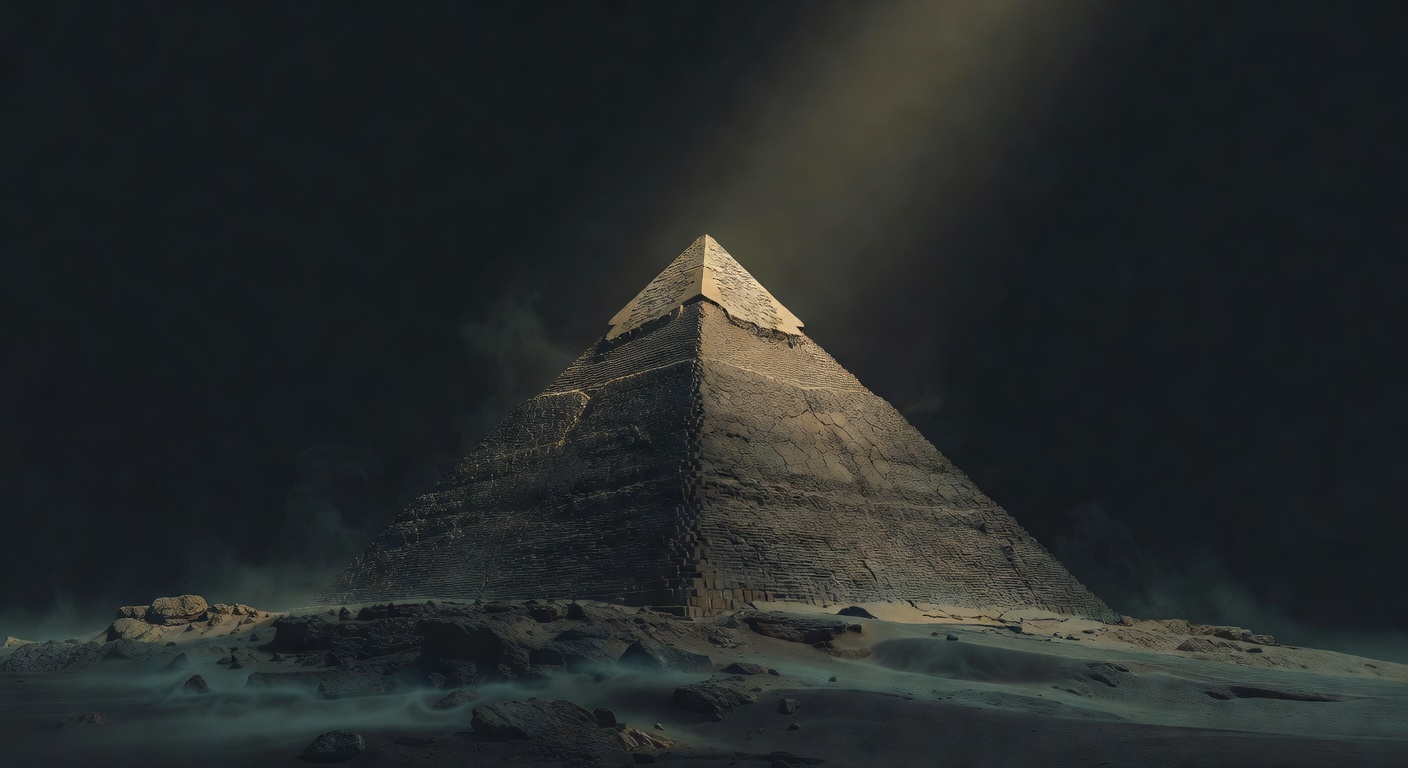
The Pyramid Convergence
Why dozens of unconnected civilizations built the same monumental shape - and what that actually tells us about the human mind
Traditions analyzed in this research
Grok Imagine / xAI · AI Generated
Why did civilizations that never met each other all build the same thing? Pyramids appear on every inhabited continent, across thousands of years, in cultures with no known contact. It feels like it should mean something.
The fringe explanations are dead. Lost civilizations, ancient astronauts, secret global networks — none survived scrutiny. The real answer is simpler and, strangely, harder to explain. Physics forces any pre-industrial builder stacking heavy materials into a pyramid shape. That covers the geometry. It does not cover why these unconnected societies wrapped the same shape in the same rituals: elite burial, mass sacrifice, cosmic symbolism, and political power.
Peru and Egypt started building monumental pyramids within two centuries of each other, separated by oceans. Nobody has quantified how unlikely that timing actually is.
The puzzle is old, but the serious version of it is surprisingly recent. For most of the twentieth century, pyramids on different continents were treated as either proof of diffusion from a single source or as a coincidence too boring to investigate. Diffusionists claimed Egyptians sailed to Mexico. Skeptics shrugged and said a pile of rocks is a pile of rocks. Neither camp did the math.
The structural inevitability argument gained traction in engineering and archaeology by the 1990s. Stack heavy things without steel or concrete, and gravity funnels you toward a pyramidal profile. That insight eliminated the need for any contact hypothesis. It also quietly killed the interesting part of the question. If the shape is just physics, there is nothing left to explain. Departments moved on.
But the convergence runs deeper than shape. Cahokia's Monks Mound has a larger base than the Great Pyramid of Giza. It also sat at the center of a society practicing elite burial, mass sacrifice, and cosmic axis symbolism in patterns that read like a checklist from Teotihuacan or Saqqara. Meanwhile, the one confirmed case of pyramid borrowing, Egypt to Nubia, happened under direct imperial rule. That control case makes every other instance harder to dismiss as cultural copying. Physics explains why the structures are triangular. It says nothing about why unconnected civilizations kept using them for the same rituals, wrapped in the same cosmological logic, at analogous moments in their political development. That gap between the structural explanation and the full pattern is where the real evidence starts to get uncomfortable.
The false leads have been cleared. What the actual archaeological record shows is a pattern that gets stranger the closer you look.
The Mound That Outranks Giza
Cahokia, in modern-day Illinois, built a mound with a bigger footprint than the Great Pyramid of Giza. It required moving 22 million cubic feet of earth by hand. Most people have never heard of it — partly because it's made of dirt, not stone, and partly because European contact nearly erased the civilization that built it.
The largest pyramidal structure in the pre-Columbian Americas is not in Mexico or Peru - it is in Illinois, and its base is bigger than the Great Pyramid of Giza.
But Cahokia isn't even the strangest part of the pattern.
Norte Chico and Egypt: The Simultaneous Invention Problem
Around 2600 BCE, coastal Peru was raising platform mounds at Caral. At almost exactly the same time, Egypt was building the Step Pyramid. Two oceans separated them. No contact route has ever been found. Physics explains why both chose a pyramid shape. It does not explain why both made that enormous investment at nearly the same moment.
Two civilizations separated by an ocean, with no documented contact, began building monumental pyramidal structures within approximately 70 years of each other.
That timing gap is puzzling. The rituals make it uncanny.
The Beaded Burial: Cahokia's Mirror of Egypt
Buried inside Cahokia's Mound 72, archaeologists found a man laid on 20,000 shell beads shaped like a falcon. Around him lay over 250 sacrificed people, mostly young women. The shells came from the Gulf Coast, hundreds of miles away. This pattern — elite burial, cosmic symbolism, mass sacrifice, exotic prestige goods — mirrors Egyptian and Mesoamerican pyramid traditions with a specificity that stacking physics cannot predict.
A burial at Cahokia - an earthen mound complex in Illinois - contains a man laid on 20,000 shell beads in the shape of a bird, surrounded by 250 sacrificed individuals, mirroring the ritual elaboration of Egyptian pyramid complexes on the other side of the world.
A falcon-shaped bead mosaic doesn't come from the angle of repose. That's the kind of detail that keeps the debate alive — because the mainstream explanation handles the shape perfectly and the rituals not at all.
The DebateTwo Cases. You Decide.
The physics explanation is solid. It just doesn't explain enough. The convergence crowd has a real pattern, but no mechanism. That gap is where the honest disagreement lives.
Independent invention is the correct answer — and it's more profound than diffusion would be. Unconnected civilizations didn't just converge on a shape. They converged on burial rites, sacrifice, cosmic symbolism, and political theater. That points to something deep in how complex societies organize power, and the academic literature hasn't fully reckoned with it.
Calling all of these structures "pyramids" is like calling sharks and dolphins the same animal because they're both streamlined. Egyptian pyramids are stone tombs. Mississippian mounds are earthen platforms. Ziggurats are mud-brick temple bases. The similarities are shallow, the differences are fundamental, and every dramatic claim of mysterious convergence — Gunung Padang, Visoko — has collapsed under scrutiny.
That tension isn't new. Cultures across history have stood on top of these structures and told stories about why they matter — stories that share almost nothing except the conviction that the answer is important.
In Their Own WordsHow Different Cultures Tell It
The Nahua described their pyramid-temples as 'teocalli' - literally 'god-houses' or 'divine homes.' The Templo Mayor at Tenochtitlan was called 'Coatepec' (Serpent Mountain) - the mythological birthplace of the war god Huitzilopochtli. Ritual texts describe the summit as the place where the sun is 'fed' with human blood (chalchiuhatl, 'precious water') to sustain its daily journey. The pyramid is described not as a monument to human achievement but as a cosmic necessity - without the blood offerings performed at its summit, the sun would stop moving and the current world-age would end.
Maya inscriptions describe pyramid-temples as 'witz' (sacred mountain) and their interiors as 'ch'en' (cave or watery underworld). The Temple of the Inscriptions at Palenque is described in its inscriptions as the burial place of K'inich Janaab' Pakal, whose sarcophagus lid depicts him falling into the jaws of the underworld at the base of the World Tree - with the pyramid itself serving as the World Tree's physical embodiment. The structure is described as the place where the king 'enters the road' to the underworld and where his descendants can communicate with him through ritual.
Extraordinary convergence
Not a truth score. This measures how consistently unconnected cultures describe the same specific narrative elements — nothing more. How it's calculated →
The full picture on The Pyramid Convergence is free.
6 findings, 9 cultural perspectives, full debate, timeline, sources with credibility ratings — everything, free with an account. No ads, no sponsors.
People & institutions referenced
Djoser
Personhistorical figure
The Step Pyramid of Djoser (c. 2670 BCE) is a documented intermediate stage in the indigenous Egyptian architectural evolution from mastaba tombs to smooth-sided pyramids, directly relevant to the independent invention argument.
Wiley
Institutionpublisher
Wiley formally retracted the Gunung Padang 'ancient pyramid' paper in March 2024 after peer review identified fatally flawed methodology.