The Smithsonian's Real Secrets
How documented institutional racism, ideological science, and legitimate repatriation law created the perfect conditions for a suppression myth - and why the truth is more troubling than the conspiracy.
Traditions analyzed in this research
Site owner · Own
Did the Smithsonian Institution hide evidence of a lost chapter in American history? Giant skeletons, buried cities, secret court orders — the internet is full of claims. But what actually happened inside the institution's vaults?
The specific conspiracy claims are fabrications. The Supreme Court cover-up story came from a satirical website. The Grand Canyon Egyptian city exists in one newspaper article and nowhere else. But here's what's real: in 1868, the U.S. government ordered soldiers to collect Native American skulls from battlefields. The Smithsonian's founding collection was built on state-organized grave robbing for racial pseudoscience. That documented history is worse than most conspiracy theories bother to imagine.
The remains that could settle the strangest questions have now been legally returned to tribes. The evidence is gone for the right reasons. But what that means for everything the institution once recorded and then explained away — that part stays unresolved.
The Smithsonian's Bureau of American Ethnology was created in 1879 with a specific mission: settle the question of who built the thousands of mysterious earthen mounds scattered across the American Midwest and South. For decades, popular theory held that a lost white civilization had constructed them. Indigenous peoples, the thinking went, were too primitive. The Bureau spent fifteen years surveying, excavating, and cataloging. Its 1894 report concluded definitively that Native Americans built the mounds. Case closed. Except the conclusion was decided before the fieldwork began, and the methods used to get there left a paper trail that would fuel suspicion for over a century.
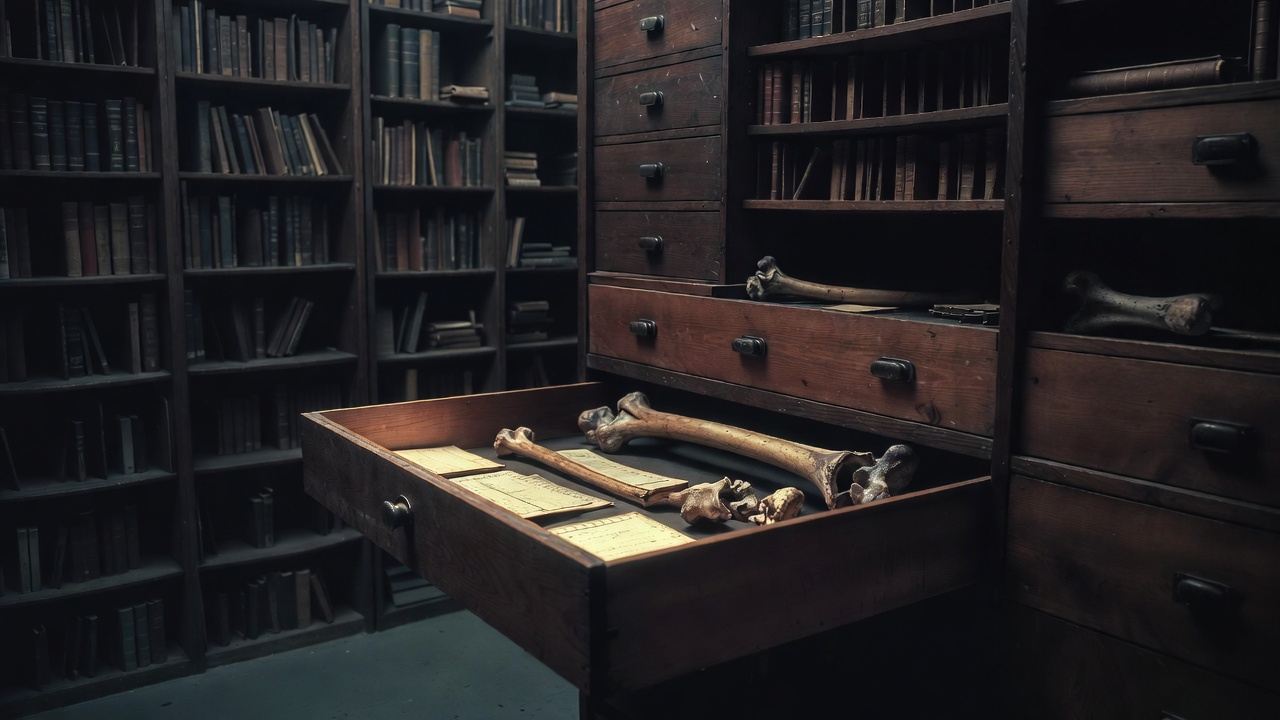
During that same era, the institution was amassing one of the largest collections of human skeletal remains on Earth. The sourcing was not subtle. Army surgeons received formal orders to harvest Native American skulls from battlefields and burial grounds. Museum agents negotiated with grave robbers. Field reports logged measurements and descriptions of thousands of remains, some of them recorded as anomalously large. These internal records sat in institutional archives for decades, rarely examined by outside researchers, while the bones themselves filled storage drawers in Washington.
When conspiracy narratives eventually took hold online, they grafted fabricated details onto this genuinely uncomfortable institutional history. The result is a topic where the real documented record and the invented claims have become almost impossible to separate in popular discussion. Understanding what actually happened requires pulling apart those layers, starting with what the Smithsonian's own paperwork says.
The real paper trail leads to three specific moments in the Smithsonian's history. Each one reveals something the institution has never fully addressed publicly.
The Government Ordered Soldiers to Collect Skulls from Battlefields
In 1868, the Army Surgeon General issued a written order: collect Native American skulls from battlefields and send them to Washington. This wasn't a rumor or a leaked memo. It was official government policy. The Smithsonian's massive skeletal collection grew directly from this program of state-directed extraction.
The Army Surgeon General's Circular No. 316 of 1868 is a publicly available government document ordering soldiers to collect Native American skulls from battlefields - this is not an inference, it is a directive.
That collection didn't just sit in storage. The institution's own records contradict its later positions.
The Smithsonian's Own Field Reports Describe the 'Giants' It Later Denied
The Smithsonian's own field agents recorded skeletons they called 'very large.' One measured seven feet six inches in the ground. These aren't tabloid headlines — they're internal institutional documents. The institution later dismissed the measurements as errors. But the physical remains that could prove who was right have been repatriated under federal law and are no longer available for independent study.
The Smithsonian's own 12th Annual Report documents 'very large' skeletons from Etowah Mounds, and an 1880s BAE field report records a skeleton measured at 7 feet 6 inches - these are the institution's own documents, not tabloid sources.
And the investigation that was supposed to settle the bigger question had a fatal flaw.
The 'Debunking' Project Was Designed to Reach Its Conclusion Before It Started
The Bureau of American Ethnology wasn't created to ask an open question. It was founded specifically to disprove the 'Mound Builder race' theory. The twelve-year investigation that followed was likely correct in its conclusion. But a project designed to reach a specific answer before it starts isn't disinterested science. It's advocacy with a federal budget.
The BAE's founding mandate was explicitly to disprove the Mound Builder theory - the 1894 report that mainstream archaeology treats as definitive was designed to reach its conclusion before a single shovel entered the ground.
These findings don't point toward a clean verdict. They sharpen a question that the physical evidence can no longer answer, which is exactly what makes the debate so persistent.
The DebateTwo Cases. You Decide.
The conspiracy version is wrong on almost every specific claim. But the documented institutional history is genuinely disturbing — and neither side knows quite what to do with a story where both things are true at once.
The Smithsonian documented anomalous skeletal measurements in its own field reports, then had its own staff explain them away. The physical remains that would allow anyone else to check have been permanently removed from scientific access. The institution has never publicly reckoned with the fact that its founding collection was built on a government grave-robbing program driven by racial pseudoscience.
Every marquee claim in the conspiracy collapses on contact with primary sources. The Supreme Court story is satirical fiction. The Grand Canyon city has zero institutional corroboration. The repatriation law that supposedly hid evidence actually forced the Smithsonian to publish inventories of everything it held — making concealment harder, not easier.
That tension didn't start with the internet. Communities across centuries have been telling very different stories about who built what in America — and whose version gets called history.
In Their Own WordsHow Different Cultures Tell It
The tupuna - the ancestors - are not separate from us. They are present in the whakapapa, the genealogical connections that link every living person to the first beings. When the museums held the koiwi tangata - the human bones - they held the ancestors captive. The return of the koiwi is the return of the ancestors to their proper place in the whakapapa. It is not sentiment. It is the restoration of the order of the world.
The Si-Te-Cah were a people who came from across the water, red-haired and cannibalistic, who preyed upon the people of the Great Basin. The tribes came together and drove them to a cave, piled brush at the entrance, and burned them. The cave is a real place. The bones are there. This is not a story - it is what happened.
Extraordinary convergence
Not a truth score. This measures how consistently unconnected cultures describe the same specific narrative elements — nothing more. How it's calculated →
The full picture on The Smithsonian's Real Secrets is free.
6 findings, 10 cultural perspectives, full debate, timeline, sources with credibility ratings — everything, free with an account. No ads, no sponsors.