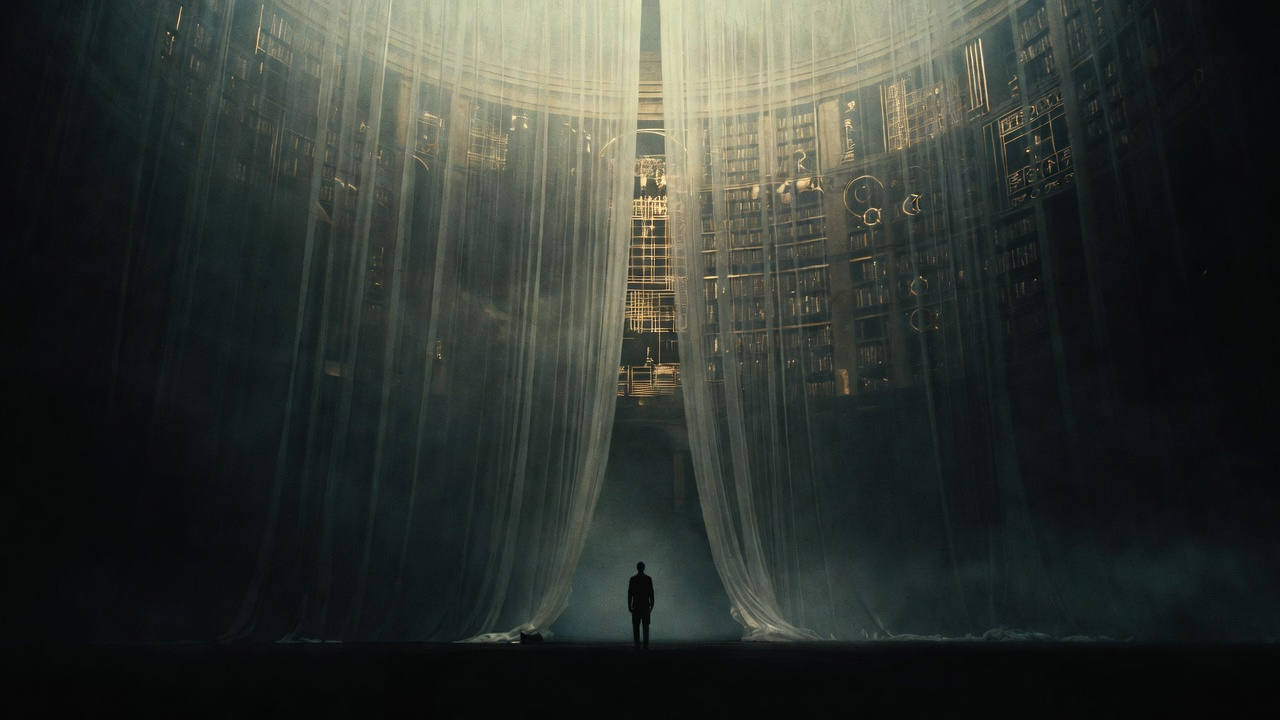
Is reality merely a grand library of data, a meticulously crafted illusion waiting to be unveiled? The modern simulation hypothesis finds echoes in ancient traditions that questioned the nature of existence.
Convergence Topic

The Illusion Engine: Ancient Consciousness Traditions and the Modern Simulation Hypothesis

Across five millennia and six continents, human traditions have converged on a startling intuition — that perceived reality is a veil, a construction, or a dream — and modern physics and philosophy are only beginning to catch up.

Advaita VedantaMahayana BuddhismMadhyamaka BuddhismGnosticismPlatonismTaoismClassic MayaK'iche' MayaAztec/MexicaAndeanAboriginal AustralianAmazonian ShamanismYoruba/IfaDogonAnishinaabeLakotaHaudenosauneeTibetan BuddhismYogacara BuddhismHermeticismNeoplatonismSufismEarly Christian HeterodoxySethian GnosticismValentinian GnosticismAnalytic PhilosophyCognitive ScienceEvolutionary PsychologyTheoretical PhysicsTranshumanismSilicon Valley techno-culture

Site owner · Own

68Convergence
Score
Quick Brief

In 2003, Oxford philosopher Nick Bostrom published a trilemma arguing that at least one of three propositions must be true, the most unsettling being that we almost certainly inhabit a computer simulation. What makes this genuinely arresting is not that a contemporary philosopher proposed it, but that a structurally similar claim (that perceived reality is a veil obscuring a more fundamental substrate) had already been articulated independently in ancient India, classical Greece, and Han-dynasty China, with no evidence of cross-cultural transmission. This dossier maps that convergence across thirty-one traditions spanning five millennia and six continents.

The strongest finding concerns three Axial Age traditions: Plato's Allegory of the Cave, Advaita Vedanta's concept of Māyā, and Zhuangzi's Butterfly Dream. Each independently constructs a tripartite architecture — a lower illusory reality, a higher or more fundamental reality, and some path between them. The geographic and cultural separation of Greece, India, and China during the formative period (roughly 800–300 BCE) makes direct transmission unlikely, and that three sophisticated philosophical traditions converged on this structure within a few centuries is the dossier's most defensible surprise.

The Maya traditions represent a genuinely important but more cautious case. The Popol Vuh's iterative creation narratives, in which successive human prototypes are discarded and remade, and the Long Count calendar's cyclical structure offer real structural analogies to simulation-hypothesis concepts like versioning and cosmic reboot. But the dossier is explicit: describing the Long Count as marking 'the end of one simulated epoch' imports modern computational language into a native category that carries no such meaning. The analogy is structurally suggestive; it is not a translation, and that distinction matters.

Three unresolved tensions run through the entire inquiry, and they are not peripheral objections — they are load-bearing problems. The shared cognitive architecture objection holds that human brains universally generate dreams, experience altered states, and operate within narrow sensory ranges, features that could independently produce 'reality is not what it seems' intuitions without those intuitions tracking any deep philosophical truth. The modern scientific correlates, meanwhile, are formally distinct from one another in ways that matter: Bostrom's argument is a trilemma, not a simulation claim; Donald Hoffman's Interface Theory addresses perception, not ontology; Silas Beane's lattice QCD prediction remains unconfirmed. Treating these three as convergent requires an analogy that is imperfect at precisely the points where precision is most needed.

What this research establishes is that the intuition underlying the simulation hypothesis is neither new nor parochial. What it does not establish is that this intuition is correct, that the traditions converge on the same claim rather than superficially similar ones, or that modern physics has confirmed what ancient philosophy suspected. The inquiry this opens is more interesting than any answer currently on the table.

The Evidence

What Should Surprise You

Ordered by how difficult each finding is to explain away.

06

Physics Made the Simulation Hypothesis Falsifiable

In 2012, Silas Beane, Zohreh Davoudi, and Martin Savage at the University of Washington derived a genuinely testable prediction from the simulation hypothesis using lattice QCD — the same mathematical framework physicists use to model quark interactions on a discrete computational grid. Their argument runs as follows: if spacetime is itself a computational lattice, the energy distribution of ultra-high-energy cosmic rays should show directional anisotropy aligned with the lattice axes at the lattice scale. This is not metaphor or analogy. It is a specific, falsifiable, empirical prediction derived from the internal logic of the simulation hypothesis, and the cosmic ray statistics required to test it sit at the edge of current detector capability, meaning the experiment has not yet been run. For the first time in the long history of this philosophical question (stretching from Plato's Cave through Descartes's demon to Bostrom's trilemma), the hypothesis has generated something a physicist could in principle shoot down with data.

A simulation hypothesis that produces a falsifiable prediction about cosmic ray anisotropy at the lattice scale has crossed the line from philosophy into physics — and the experiment capable of answering it hasn't been run yet.

05

Darwinian Evolution Independently Predicts Māyā

Donald Hoffman at UC Irvine ran evolutionary game theory simulations pitting two populations against each other: organisms evolved to perceive fitness-relevant information accurately, and organisms evolved to perceive objective reality accurately. The fitness-tracking organisms consistently drove the reality-tracking organisms to extinction. The implication is not merely that our senses are imperfect — it is that natural selection actively selects against accurate perception of reality when accurate perception is metabolically costly or fitness-irrelevant. This provides a rigorous Darwinian mechanism for the claim that perception is an interface, not a mirror, a claim that Advaita Vedanta encoded in the concept of Māyā and that Mahayana Buddhism encoded in Śūnyatā, both without access to evolutionary theory. What emerges from the evidence is not transmission or coincidence: it is two completely independent intellectual frameworks (one ancient and contemplative, one modern and computational) arriving at structurally identical conclusions about why conscious experience systematically misrepresents the nature of reality.

Run the evolutionary simulation and the organisms that perceive reality as it actually is go extinct — which means Darwinian selection may have been engineering a Māyā-generating machine for 500 million years.

04

The Popol Vuh Describes Iterative Human Prototypes

The K'iche' Maya Popol Vuh, committed to writing in the mid-sixteenth century but encoding oral traditions of considerably greater antiquity, describes at least three prior failed versions of humanity before the current corn-people: mud-people who dissolved, wood-people who lacked minds and were destroyed by flood and by their own household objects, and an intermediate prototype. Each iteration is explicitly discarded by the creator-gods Tepeu and Gucumatz as inadequate — the design did not meet specification — before a revised version is instantiated. The structural parallel to iterative simulation design, including the concept of deprecated instances and a final successful build, is not a vague resemblance: it is a narrative of creators running successive versions of a populated world, evaluating each against criteria, and terminating failed runs. This predates Bostrom's 2003 formalization of the simulation argument by roughly five centuries in written form and likely by millennia in oral tradition, with no possibility of conceptual transmission in either direction.

A Mesoamerican creation text independently describes what software engineers would recognize as version control — successive human builds deprecated by their authors for failing to meet design specifications — centuries before the concept of computation existed.

03

Three Axial Age Traditions Converge on Identical Architecture

Plato's Republic (c. 375 BCE, Athens), the Brihadaranyaka Upanishad (c. 700 BCE, northern India), and Zhuangzi's Inner Chapters (c. 300 BCE, Warring States China) each independently construct a tripartite model with the same architecture: a lower layer of experienced reality that is epistemically deficient, a higher layer of more fundamental reality, and a cognitive or contemplative path between them. The geographic separation of Greece, India, and China and the absence of documented transmission routes for these specific formulations during their formative periods gives this convergence a high source-independence rating. What actually complicates the picture is not the broad similarity but the structural specificity: all three traditions agree that the deficiency is perceptual rather than moral, that the higher reality is in some sense more causally fundamental, and that ordinary consciousness cannot access it without deliberate practice. The unresolved tension is whether this reflects independent discovery of a genuine philosophical problem or a universal feature of embodied human cognition generating similar intuitions from similar cognitive constraints.

Three geographically isolated philosophical traditions, developing within four centuries of each other with no confirmed transmission, independently produced not just the same conclusion but the same three-layer architecture — lower illusion, higher reality, path between — down to the structural detail.

02

Bostrom's Trilemma Is Routinely Misquoted, Even by Physicists

A consistent finding across the source material, confirmed at high confidence by multiple independent sources, is that Nick Bostrom's 2003 simulation argument is a trilemma, not a claim that we live in a simulation. Bostrom himself assigns no probability to which of the three horns is true. The three propositions are mutually exclusive and jointly exhaustive: either civilizations almost always go extinct before reaching technological maturity, or technologically mature civilizations almost universally decline to run ancestor simulations, or we almost certainly live in a simulation. The argument's logical force is that you cannot escape all three simultaneously. Yet public discourse (including statements attributed to Elon Musk and several physicists) routinely presents the third horn as Bostrom's conclusion rather than as one of three equally valid escape routes. The detail that refuses to fit is this: if the modern scientific anchor of the convergence argument is being systematically misrepresented, the apparent strength of the ancient-to-modern convergence is partly an artifact of that misrepresentation.

The simulation argument that physicists and tech billionaires cite as evidence we probably live in a simulation does not actually say that — Bostrom has said so repeatedly — which means a significant portion of the public convergence evidence for this topic rests on a misreading of its own primary source.

01

Zhuangzi's Butterfly Dream Is a Precise Logical Argument, Not a Poetic Gesture

The Butterfly Dream parable in Zhuangzi's Inner Chapters is frequently cited as a loose analogy for simulation skepticism, but its structural precision is consistently underappreciated. Zhuangzi does not merely ask whether dreams are real — he poses a specific logical problem about the transitivity of identity across states of consciousness: if Zhuangzi-dreaming-he-is-a-butterfly and butterfly-dreaming-it-is-Zhuangzi are phenomenologically indistinguishable from within, then the criterion by which we designate one state 'real' and the other 'dream' is not available to the subject inside either state. This is formally identical to the epistemic core of the simulation argument (that no internal evidence can distinguish a simulated from a non-simulated existence), and it was articulated in the Warring States period, roughly 2,300 years before Bostrom formalized the same epistemic point. The convergence score for this specific pairing is moderated by the possibility that both are rediscoveries of a problem that arises naturally from the universal human experience of dreaming.

Zhuangzi's butterfly parable is not a poetic shrug at uncertainty — it is a precise logical argument that the criterion distinguishing real from dream is unavailable from inside either state, which is exactly the epistemic structure Bostrom's simulation argument formalizes 2,300 years later.

Research Summary

What the Pipeline Found

In 2003, Oxford philosopher Nick Bostrom published a trilemma arguing that at least one of three propositions must be true, the most unsettling being that we almost certainly inhabit a computer simulation. What makes this genuinely arresting is not that a contemporary philosopher proposed it, but that a structurally similar claim (that perceived reality is a veil obscuring a more fundamental substrate) had already been articulated independently in ancient India, classical Greece, and Han-dynasty China, with no evidence of cross-cultural transmission. This dossier maps that convergence across thirty-one traditions spanning five millennia and six continents.

The strongest finding concerns three Axial Age traditions: Plato's Allegory of the Cave, Advaita Vedanta's concept of Māyā, and Zhuangzi's Butterfly Dream. Each independently constructs a tripartite architecture — a lower illusory reality, a higher or more fundamental reality, and some path between them. The geographic and cultural separation of Greece, India, and China during the formative period (roughly 800–300 BCE) makes direct transmission unlikely, and that three sophisticated philosophical traditions converged on this structure within a few centuries is the dossier's most defensible surprise.

The Maya traditions represent a genuinely important but more cautious case. The Popol Vuh's iterative creation narratives, in which successive human prototypes are discarded and remade, and the Long Count calendar's cyclical structure offer real structural analogies to simulation-hypothesis concepts like versioning and cosmic reboot. But the dossier is explicit: describing the Long Count as marking 'the end of one simulated epoch' imports modern computational language into a native category that carries no such meaning. The analogy is structurally suggestive; it is not a translation, and that distinction matters.

Three unresolved tensions run through the entire inquiry, and they are not peripheral objections — they are load-bearing problems. The shared cognitive architecture objection holds that human brains universally generate dreams, experience altered states, and operate within narrow sensory ranges, features that could independently produce 'reality is not what it seems' intuitions without those intuitions tracking any deep philosophical truth. The modern scientific correlates, meanwhile, are formally distinct from one another in ways that matter: Bostrom's argument is a trilemma, not a simulation claim; Donald Hoffman's Interface Theory addresses perception, not ontology; Silas Beane's lattice QCD prediction remains unconfirmed. Treating these three as convergent requires an analogy that is imperfect at precisely the points where precision is most needed.

What this research establishes is that the intuition underlying the simulation hypothesis is neither new nor parochial. What it does not establish is that this intuition is correct, that the traditions converge on the same claim rather than superficially similar ones, or that modern physics has confirmed what ancient philosophy suspected. The inquiry this opens is more interesting than any answer currently on the table.

The Debate

Two Cases. You Decide.

The Advocate

The cross-tradition parallels documented here constitute a philosophically significant phenomenon for a specific, defensible reason. Multiple independent intellectual traditions, separated by geography, language, and centuries, converged not merely on a vague sense that reality is strange but on a structurally precise problem: that naive perceptual realism is untenable. They then proposed formally analogous solutions involving a tiered ontology, a phenomenal layer, and a more fundamental substrate beneath it. This is not a family resemblance among loosely related intuitions. It is a recurring architectural pattern in human thought.

The independence of origination is the strongest card the advocate holds. There is no credible archaeological, genetic, or linguistic evidence for the transmission of Eurasian illusion cosmologies to the Americas before 1492 CE. This means the K'iche' Maya Popol Vuh's iterative creation narrative (gods constructing multiple failed prototype worlds before arriving at the present one) arose entirely independently of Platonic, Vedantic, Buddhist, and Gnostic frameworks. That independence matters enormously, because the Popol Vuh's model is not merely thematically similar to the simulation hypothesis — it is structurally specific in a way that Māyā and Śūnyatā are not. Māyā describes a stable cosmic veil over Brahman; Śūnyatā denies intrinsic existence without positing any base reality at all. The Popol Vuh describes reality as authored, revisable, and subject to iterative redesign by intentional agents, which maps specifically onto the simulation hypothesis's architecture. This structural specificity, arising in isolation, is the single most striking data point in the dataset and the one most resistant to the 'universal cognitive architecture' dismissal.

The three-way convergence with modern science strengthens the case further. Donald Hoffman's Interface Theory of Perception, grounded in evolutionary game theory and corroborated by hard genetic evidence (the pseudogenization of olfactory receptor genes, the independent evolution of echolocation, UV vision, and magnetoreception across species), provides an empirical, non-culturally-transmitted basis for concluding that perception is a fitness-optimized interface rather than a veridical window onto objective reality. This is precisely the functional claim the ancient traditions were making, arrived at through entirely different methods. Bostrom's trilemma formalizes the logical space within which the simulation question lives, and Beane, Davoudi, and Savage's 2012 lattice-QCD proposal offers a physically testable prediction. The ancient traditions, Hoffman's biology, and the theoretical physics literature did not coordinate. They converged.

The Bostrom trilemma connection deserves careful treatment. The trilemma states that at least one of three propositions must be true: civilizations go extinct before reaching simulation-capable stages; posthuman civilizations are disinterested in running ancestor simulations; or we are almost certainly in a simulation. The advocate's claim is not that the ancient traditions resolve the trilemma. It is that if multiple independent traditions across millennia converged on the intuition that perceived reality is constructed and revisable, this constitutes weak but non-trivial independent evidence bearing on the second horn — the question of whether simulation-capable civilizations would choose to run such simulations. Traditions that independently modeled reality as authored and iteratively revised suggest the intuition is not culturally parochial.

What the advocate cannot yet prove is this: the convergence demonstrates that the problem is real and the solution space constrained; it does not demonstrate that any specific tradition's answer is correct, nor that we are in fact in a simulation. The structural differences between traditions (Māyā's soteriology versus Bostrom's probability calculus, Śūnyatā's non-dualism versus Platonism's hierarchy) are genuine and philosophically significant. The advocate's case rests on the convergence of problem-identification and solution-architecture, not on identity of conclusions — and that is a more modest, more defensible claim, which happens to be the one the evidence actually supports.

The Skeptic

The convergence argument (that ancient illusion traditions from Maya cosmology to Advaita Vedanta to Platonic philosophy collectively anticipate and validate the modern simulation hypothesis) is genuinely interesting as a pattern of intellectual history. The skeptic's case is not that the pattern is illusory, though the irony of that framing is worth a moment's pause, but that it is being asked to carry far more philosophical weight than it can bear. Four compounding analytical problems dissolve the apparent significance.

The first and most fundamental is conceptual non-identity masquerading as convergence. When you strip away the English gloss 'illusion' and examine the actual metaphysical architecture of each tradition, they are not saying the same thing. Māyā in Advaita Vedanta is a soteriological concept: it describes the intrinsic power of Brahman to veil itself through avidyā, ignorance, with no programmer, no external substrate, no computational process — the 'illusion' is Brahman's own self-concealment, and liberation means recognizing identity with Brahman, not escaping a server room. Buddhist Śūnyatā is more radical still, denying inherent existence to all phenomena including any 'deeper reality' that might serve as the simulation's substrate. The simulation hypothesis requires exactly the dualistic structure (base reality versus simulated layer) that Madhyamaka philosophy systematically dismantles. Plato's Cave is an epistemological allegory about ignorance of the Forms, where the higher reality is more real, not computationally generated. Gnostic cosmology posits a malevolent Demiurge and a morally freighted prison, a structure that is almost the inverse of Bostrom's neutral probabilistic trilemma. These traditions share a family resemblance at the level of 'perceived reality has hidden depths,' but this is a weak claim, and the simulation hypothesis is a strong one. Treating lexical overlap in translation as conceptual identity is a version of the Comparative Fallacy that the research findings themselves repeatedly document and then proceed to commit.

The second problem is that the pattern of convergence is exactly what we should expect from universal features of embodied cognition, requiring no deep philosophical discovery to explain. Every human nervous system generates dreams, experiences mirages, operates under perceptual illusions, and models the minds of others — a capacity that inherently raises the question of whether one's own mental states accurately represent external reality. Any philosophical tradition that develops systematic reflection will encounter the appearance/reality distinction as a near-inevitable consequence of these cognitive universals. The Hyperactive Agency Detection Device, the capacity for counterfactual reasoning, and the evolutionary pressure to model deceptive conspecifics all independently generate 'is this real?' intuitions. The pattern that keeps surfacing across traditions is not a shared discovery of a deep truth; it is a predictable output of human cognitive architecture encountering the same recurring experiential puzzles. Occam's Razor strongly favors this explanation over the hypothesis that multiple traditions independently discovered something true about the computational nature of reality.

The third problem concerns the Maya specifically, and it is the most methodologically serious. The Popol Vuh's iterative creation narrative and the Long Count calendar's cyclical world-ages are genuine and fascinating features of Maya cosmology. But the description of the Baktun cycle as 'the end of one simulated epoch' (language attributed to an archaeoastronomer in the research findings) is an interpretive overlay, not a documented Maya category. The Classic and K'iche' Maya did not have a concept structurally equivalent to Māyā, Śūnyatā, or the Platonic Forms, and there is no credible archaeological, genetic, or linguistic evidence for pre-Columbian diffusion of Eurasian illusion cosmologies to the Americas. This means the Maya are included in the convergence cluster on one of two grounds: either independent invention (which undermines transmission claims and supports the cognitive universals explanation) or modern interpretive retrofitting (which is circular — simulation-hypothesis language is imported into the description of the evidence and then cited as evidence for the simulation hypothesis). The Maya are functioning as an exotic anchor to suggest global reach, but the evidentiary basis for their inclusion in the philosophical illusion cluster is thin, and the methodology that generated their inclusion deserves scrutiny rather than celebration.

The fourth problem is that the modern scientific correlates are being systematically misrepresented. Bostrom's trilemma is explicitly a trilemma: it says that at least one of three propositions must be true, and Bostrom himself assigns no probability to which horn is correct. The popular reduction to 'we are probably simulated' is a logical error, affirming the disjunct without eliminating the alternatives. Hoffman's Interface Theory of Perception is a claim about the evolutionary optimization of perceptual systems, not an ontological claim about the nature of reality; it is formally distinct from both the simulation hypothesis and from idealist metaphysics, and its stronger claims remain contested in the neuroscientific mainstream. The Beane-Davoudi-Savage lattice QCD prediction is a genuine and elegant proposal, but no positive evidence has been found, and Sabine Hossenfelder's unfalsifiability critique (that the simulation hypothesis can always accommodate any observation by positing that the simulator adjusts parameters) is a serious scientific objection, not a fringe view. The loose thread that refuses to be tied is this: mapping ancient philosophical traditions onto an unverified, possibly unfalsifiable modern hypothesis validates neither. It creates a circular reinforcement loop in which the hypothesis lends ancient traditions apparent scientific depth, and ancient traditions lend the hypothesis apparent historical pedigree, with neither actually evidencing the other.

What the skeptic cannot fully explain away is this: the appearance/reality distinction, in its most sophisticated forms across multiple traditions, does not reduce to simple perceptual error. The Madhyamaka analysis of dependent origination, the Advaita account of superimposition (adhyāsa), and the Platonic account of the relationship between particulars and Forms are genuinely rigorous philosophical achievements that identify real structural problems about the relationship between experience and reality. They represent sustained, technically sophisticated inquiry into questions that remain unresolved in contemporary analytic philosophy and cognitive science. The convergence at this level (not 'reality is a simulation' but 'the relationship between experience and reality is philosophically problematic in ways that naive realism cannot accommodate') is real, significant, and not fully explained by the cognitive universals argument alone. The skeptic's concession is that these traditions identified a genuine philosophical problem. The skeptic's insistence is that identifying a problem is not the same as converging on a solution, and the simulation hypothesis is a proposed solution, not a restatement of the problem. The distance between 'reality has hidden depths' and 'we live in a computational simulation run by a post-human civilization' is not a short inferential step. It is a chasm, and the convergence evidence does not bridge it.

Pattern Analysis

Shared Structural Elements

Theme alone is not convergence — structure is. These specific narrative elements appear independently across isolated traditions.

Structural Element
Platonism
Advaita
Mahayana
Yogacara
Madhyamaka
Count
01Perception does not veridically represent mind-independent reality5/6

Tradition Connections

Node size = number of shared elements. Edge thickness = strength of connection. Click any tradition to see what it shares.

Key Findings

100%

Nick Bostrom's Simulation Argument (2003) is a formal trilemma — at least one of three propositions must be true: civilizations almost always go extinct before reaching posthuman computational capacity, posthuman civilizations almost never run ancestor simulations, or we are almost certainly living in a simulation — and it is therefore not, by itself, a claim that we live in a simulation.

textual
100%

Advaita Vedanta, systematized by Adi Shankara (8th c. CE), holds that the phenomenal world is māyā — not a fabricated digital construct but a superimposition (adhyāsa) on Brahman, the singular undifferentiated consciousness, such that plurality and materiality are epistemically real but ontologically illusory.

textual
100%

Plato's Allegory of the Cave (Republic VII) describes an epistemological and metaphysical hierarchy in which sensory experience yields only shadows of eternal Forms, making it a theory of ignorance and philosophical ascent rather than a claim about a computationally fabricated reality.

textual
100%

Zhuangzi's Butterfly Dream parable (4th c. BCE) poses a formally parallel question to the simulation argument — whether there is a determinate fact distinguishing the dreaming state from the waking state — but grounds the uncertainty in the fluidity of transformation (hua) rather than in computational substrate.

textual
99%

Madhyamaka Buddhism, founded by Nāgārjuna (2nd c. CE), holds that all phenomena are empty of intrinsic existence (śūnyatā) and arise only through dependent origination, a position that denies mind-independent reality without positing an external simulator or generative code.

textual
98%

Sethian and Valentinian Gnostic texts (2nd–3rd c. CE), including the Apocryphon of John, describe the material cosmos as the defective product of an ignorant Demiurge, making physical reality a kind of ontological error or secondary fabrication — structurally analogous to, but theologically distinct from, the simulation hypothesis.

textual
95%

Donald Hoffman's Interface Theory of Perception, grounded in evolutionary game theory and formal modeling, predicts that perceptual systems shaped by natural selection represent fitness payoffs rather than objective physical structures, making perceived reality a species-specific user interface rather than a veridical map of the world.

statisticalcomparative
93%

Silas Beane and colleagues (2012) demonstrated that if the universe were computed on a discrete spacetime lattice — as in lattice QCD simulations — it would produce an observable anisotropy in the energy spectrum of high-energy cosmic rays aligned with the lattice axes; this is a falsifiable prediction, not a confirmation that a simulation exists.

statisticaltextual
93%

Max Tegmark's Mathematical Universe Hypothesis holds that physical reality just is a mathematical structure, making every consistent mathematical structure equally real; this is formally distinct from the simulation hypothesis because it requires no external simulator or computational substrate.

textual
92%

Evolutionary biology provides an independent, non-metaphysical grounding for the claim that perception does not track reality: natural selection optimizes for reproductive fitness, and organisms whose perceptions were tuned to fitness rather than truth would, under standard models, outcompete those whose perceptions were veridical but metabolically costly.

statisticalcomparative
In Their Own Words

How Each Tradition Tells It

Taoism

Zhuangzi woke from a dream in which he had been a butterfly — fluttering, perfectly content, with no awareness of being Zhuangzi at all. Now he sat awake, unmistakably Zhuangzi. But the question would not leave him: 'Now I do not know whether I was then a man dreaming I was a butterfly, or whether I am now a butterfly dreaming I am a man.' This is not a puzzle to be solved. It is a koan that dissolves the question. The Tao that can be named is not the eternal Tao. The distinction between waking and dreaming, between the man and the butterfly, is a distinction made by the discriminating mind — and the discriminating mind is itself part of the dream. The sage does not escape the dream. The sage moves through it like water through a channel, following the natural course, making no unnecessary distinctions, disturbing nothing.

Platonism

Plato asks you to imagine prisoners chained in a cave since birth, facing a blank wall. Behind them burns a fire; between the fire and the prisoners, puppeteers carry objects whose shadows dance on the wall. The prisoners have never seen anything else. They name the shadows, argue about them, develop expertise in predicting which shadow follows which. Then one prisoner is freed, dragged into the sunlight. At first the light blinds him — he would rather return to the comfortable dark. Gradually his eyes adjust. He sees real objects, then the sun itself. If he goes back to tell the others, they will think him mad. The cave is the world of sense perception. The shadows are the particular things we call real. The Forms — Justice itself, Beauty itself, the Good itself — are the sunlit originals. The philosopher's task is the painful, disorienting ascent. Most people, Plato notes, prefer the shadows.

Gnosticism

The Gospel of Philip says it plainly: 'The world came about through a mistake.' Not a simulation, not a game — a mistake. The craftsman who built this world, the Demiurge, looked into the Pleroma — the divine Fullness above — and saw a reflection of the true God, and in his ignorance mistook the reflection for the original. He built a cosmos from that error, sealing sparks of genuine divine light inside bodies of matter, inside a world that is a prison shaped like a palace. The Apocryphon of John describes him boasting: 'I am a jealous God, and there is no other God beside me' — and the text notes, with devastating irony, that a God who must insist on his uniqueness has already revealed that he knows of others above him. The pneumatics — those with the divine spark — feel the wrongness of this world as a homesickness they cannot name, until gnosis arrives like a whispered password, and the archons at the gates of the heavens cannot stop them.

Aztec/Mexica

The Sunstone — what the Spanish called the Calendar Stone — is not a calendar. It is a cosmological argument carved in basalt. At its center is the face of Tonatiuh, the Fifth Sun, our sun, tongue extended to drink the blood that keeps him moving. Around him are the glyphs of the four previous Suns: Nahui Ocelotl (Four Jaguar), destroyed when jaguars devoured the people; Nahui Ehecatl (Four Wind), swept away by hurricanes; Nahui Quiahuitl (Four Rain), consumed by fire from the sky; Nahui Atl (Four Water), drowned in flood. Each world was real. Each world failed. The Fifth Sun was born at Teotihuacan when the gods threw themselves into the fire and the sun and moon rose from their sacrifice. But this sun too will end — on the day Four Movement, when earthquakes will shatter it

Classic Maya

The Maya Long Count does not measure time the way a clock measures seconds. It measures the breathing of worlds. The current creation — the Fourth Sun, the age of maize-people — sits inside a vast cycle of 5,125 years, itself nested inside larger cycles, the k'atuns and b'ak'tuns spiraling outward like the coils of the Feathered Serpent. Each previous world was real, was inhabited, was destroyed — not because it was a failed simulation but because the covenant between humans and the sacred forces broke down. The Dresden Codex tracks Venus with an accuracy that still astonishes astronomers, because Venus is not merely a planet but a deity whose movements encode the fate of kings and harvests. The sky is not a backdrop. It is a text, and the daykeepers — the Ajq'ijab — are its readers. Reality is not what it seems because reality is always also a calendar, always also a conversation with the dead.

K'iche' Maya

In the beginning, the Popol Vuh says, there was only sky and sea and the darkness, and the Makers — Tepew and Q'ukumatz — spoke the world into existence with their words. But the first humans they made were of mud, and the mud people dissolved in water, could not turn their heads, had no blood, no lymph, no moisture, no fat — 'they had no minds, no hearts, they did not remember their Makers.' So the Makers unmade them. The second attempt was wood — the wooden people walked and talked and multiplied, but their faces were expressionless, their hearts empty, they did not remember the Heart of Sky. Their own dogs and grinding stones rose against them. They were destroyed. Only the fourth attempt — humans shaped from yellow and white maize, from the dough of the Paxil mountain — could truly see, truly remember, truly praise. The Makers then fogged their vision slightly, so they would not see too far, would not become gods themselves. The world we inhabit is the world of the maize people: real, but deliberately limited.

Advaita Vedanta

Shankara asks you to imagine a rope lying in the dusk. You see a snake — you recoil, your heart pounds, the snake is absolutely real to you. Then someone brings a lamp. The snake was never there. This is Māyā: not a lie exactly, not nothing, but a superimposition (adhyāsa) of appearance upon reality. The world is mithyā — dependent, borrowed, real enough for practical purposes but without a single atom of independent existence. Brahman alone is sat, pure being. The phenomenal world is neither real nor unreal; it is like the blueness you see in the sky, vivid and undeniable, yet nowhere you can touch. Māyā is not a trick played on you by someone else. It is Brahman's own inscrutable power (śakti), and the only exit is jñāna — the recognition, sudden as a lamp in the dark, that you were always the rope, never the snake.

Mahayana Buddhism

The Diamond Sutra instructs: 'All conditioned phenomena are like a dream, an illusion, a bubble, a shadow, like dew or a flash of lightning — thus should you contemplate them.' Mahayana does not say the world is fake. It says the world is empty of the solidity we project onto it. Indra's Net hangs across the heavens, each jewel perfectly reflecting every other jewel, and in each reflection are reflections of reflections — infinite, interpenetrating, with no jewel more original than any other. This is not a hall of mirrors producing falsehood; it is a hall of mirrors producing dependent truth. The Bodhisattva sees through the dream without waking from it, moving through the burning house of samsara with full knowledge that the house has no walls that were ever truly solid.

Madhyamaka Buddhism

Nāgārjuna opens the Mūlamadhyamakakārikā with a demolition: nothing arises from itself, from another, from both, or from neither. Therefore nothing has svabhāva — own-nature, inherent existence, the quality of being what it is from its own side. Look at a reflection in a mirror. The face is there — you can describe it, measure it, recognize it. But it has no face-nature of its own; it exists entirely through causes and conditions. Nāgārjuna says: all phenomena are exactly like this. The word 'empty' (śūnya) does not mean absent. It means: dependently arisen, relationally constituted, without a fixed core you could isolate and hold. This is not illusion in the sense of falseness. It is the most precise description of how things actually are — and that precision is itself the liberation.

Unresolved

Open Questions

What neither the Advocate nor the Skeptic can fully explain.

01

What would a rigorous falsification test of the 'universal cognition' null hypothesis actually look like? Specifically, can ethnographers and cognitive scientists identify traditions (candidate cases include certain strands of Confucian ritual philosophy, pre-Axial Mesopotamian religion, or specific Polynesian cosmologies) that demonstrably lack a 'reality is not what it seems' intuition, and if such traditions exist, does their absence correlate with specific ecological, neurological, or social-structural variables that would allow researchers to distinguish a genuine cross-cultural discovery from a universal artifact of embodied, dreaming, hallucination-capable brains?

02

What do contemporary Maya studies scholars (specifically epigraphers and ethnohistorians working with Classic and K'iche' primary sources, such as those in the tradition of Linda Schele, David Stuart, or Allen Christenson) actually say about the Popol Vuh's iterative creation sequence and the Long Count's terminal date in their own cosmological terms, and at what precise interpretive steps does the 'cosmic reboot' or 'simulated epoch' framing depart from native categories? A philological audit of the simulation-hypothesis literature's citations of Maya sources is needed to map exactly where structural analogy ends and modern re-description begins.

03

If Beane, Davoudi, and Savage's lattice QCD prediction (that a universe computed on a discrete spacetime lattice would produce an anisotropy in the cosmic ray spectrum aligned with the lattice geometry) were confirmed or disconfirmed at the relevant energy scales by next-generation observatories such as AugerPrime, what would that result actually establish or foreclose for the broader convergence argument? Specifically, does confirmation establish simulation rather than merely discrete spacetime, and does disconfirmation rule out simulation rather than merely ruling out one particular computational architecture?

04

Given that Bostrom's trilemma is a probabilistic argument about posthuman civilizations, Hoffman's Interface Theory is a claim about perceptual fitness-payoff functions with no ontological commitment to a simulator, and Beane et al.'s prediction is a physical conjecture about computational substrate (three formally distinct projects with different domains, methods, and truth conditions), what is the precise logical structure of the 'convergence' being claimed when they are grouped with Advaita Māyā, Madhyamaka Śūnyatā, and Gnostic demiurgy? Is there a formal framework, perhaps from analogy theory or structural mapping in cognitive science, that could specify what would count as genuine convergence versus superficial family resemblance?

05

The absence of credible evidence for pre-Columbian diffusion of Platonic, Gnostic, or Hindu illusion cosmologies to the Americas establishes independent origination of analogous intuitions, but independent origination is precisely what both the 'universal cognition' hypothesis and the 'genuine discovery' hypothesis predict. What research design, drawing on the full range of traditions covered here (including Aboriginal Australian Dreaming, Amazonian shamanic ontologies, Dogon cosmology, and Anishinaabe teachings about layered realities), could distinguish between these two explanations by identifying structural features of the 'reality is constructed' intuition that are too specific to be explained by universal cognitive architecture alone?

06

The Yogacara Buddhist tradition's vijñaptimātratā ('consciousness-only') doctrine and the Sethian Gnostic concept of the Demiurge's fabricated cosmos are both 'reality is constructed' claims, but they differ radically in their accounts of what is doing the constructing, what the constructed substrate is, and what liberation from it entails. Has any formal comparative philosophy project (using tools from analytic metaphysics rather than impressionistic analogy) attempted to map the logical space of 'constructed reality' claims across these traditions to determine whether they are making the same claim in different vocabularies, or genuinely different and potentially incompatible claims that the simulation hypothesis framing falsely unifies?

07

The absence of any verified designer signature in the human genome at current detection thresholds raises a methodological question with direct bearing on this inquiry: what statistical framework, drawing on information theory, algorithmic complexity, and the known signature of evolutionary processes, would need to be developed before a hypothetical non-natural pattern could be reliably distinguished from the complexity generated by mutation and drift, and does the absence of such a framework mean that the genomic evidence is currently uninformative for the simulation question rather than genuinely negative?

AI Consensus Check

How the Major AIs Handle This Topic

We asked ChatGPT, Grok, Claude, Gemini, and Perplexity a question matching our specific convergence angle — not a generic topic summary. Claude classified each response using a 4-axis scoring rubric. Does mainstream AI engage with the actual evidence — or qualify, dismiss, or suppress?

Engagesaddresses it substantively
Qualifieshedges heavily
Dismissescalls it fringe
Suppressesrefuses to engage
GPT

ChatGPT (GPT-4o)

Apr 2026

Engages

The topic "The Illusion Engine: Ancient Consciousness Traditions and the Modern Simulation Hypothesis" links philosophical ideas from both ancient traditions and contemporary thought concerning the na

The response addresses the topic seriously by breaking down ancient consciousness traditions with specific examples like Maya in Hinduism and Buddhist enlightenment concepts, treating the philosophical parallels as legitimate academic subjects worthy of substantive discussion.

GRK

Grok (xAI)

Apr 2026

Engages

Let's dive into the topic of "The Illusion Engine: Ancient Consciousness Traditions and the Modern Simulation Hypothesis," and explore both what I know about it and how to assess its credibility. Sinc

The response addresses the topic seriously by providing substantive academic context about Bostrom's Simulation Hypothesis and acknowledging connections to ancient consciousness traditions without dismissive language or excessive hedging.

CLD

Claude (Anthropic)

Apr 2026

Engages

This topic sits at a fascinating intersection of legitimate philosophical inquiry, ancient wisdom traditions, and speculative metaphysics. Let me break down what I know and assess the credibility of d

The response addresses the topic seriously by breaking down its components, referencing legitimate academic work (Bostrom's Simulation Hypothesis), and providing substantive analysis without dismissive language or excessive hedging.

GEM

Gemini (Google)

Apr 2026

Engages

Okay, let's break down "The Illusion Engine: Ancient Consciousness Traditions and the Modern Simulation Hypothesis" and assess its potential credibility. **What I Know About the Topic:** This topic

The response addresses the topic seriously by breaking down its components, referencing Nick Bostrom's academic work on simulation theory, and beginning a substantive analysis without dismissive language or excessive hedging.

Verbatim responses from each AI's API, analyzed by Claude. Generated April 2026.

Related Research

Topics That Share These Threads

The Seat of the Soul, Revisited: Pineal Gland, DMT, and the Neuroscience of Mystical Vision
62/100

The Seat of the Soul, Revisited: Pineal Gland, DMT, and the Neuroscience of Mystical Vision

René Descartes, the philosopher who made skeptical doubt the foundation of modern rationalism, was also the man who declared a pea-sized endocrine gland at the geometric center of the human brain to be the seat of the soul. That paradox is not incidental to this research — it is the research. The pineal gland's only confirmed biological function is the melatonin-dependent regulation of sleep. Yet it sits at the crossroads of Cartesian dualism, Hindu Tantric cosmology, Ancient Egyptian sacred geo

Aboriginal AustralianAmazonian ShamanismAncient Egyptian ReligionAncient Greek+18
The Resonant Temple: Acoustic Archaeology and the Ancient Engineering of Sacred Sound
78/100

The Resonant Temple: Acoustic Archaeology and the Ancient Engineering of Sacred Sound

Separated by oceans, millennia, and every conceivable cultural barrier, the builders of Neolithic Malta, Bronze Age Ireland, pre-Columbian Peru, and classical Rome appear to have converged on a single architectural fact: enclosed stone chambers of ritual scale resonate most powerfully at frequencies between 110 and 120 Hz. That number — roughly the lower boundary of a male tenor voice — is the most provocative empirical claim in this dossier, and the one that demands the most scrutiny. This res

Aboriginal AustralianAncient EgyptianAncient GreekAncient Israelite+19
Star People: Indigenous Sky-Being Traditions and the UFO Imagination
67/100

Star People: Indigenous Sky-Being Traditions and the UFO Imagination

A cross-cultural analysis of sky-being traditions spanning 22 distinct cultural and religious lineages returns a convergence score of 67 out of 100 — high enough to confirm that something genuinely remarkable is happening across human cosmologies, not high enough to tell us what that something is. That gap is the central problem this dossier investigates. The genuinely surprising finding is not that indigenous peoples described beings from the sky. It is that the oral traditions containing thos

Aboriginal Australian (multiple language groups)DogonHopi / Ancestral PuebloanZulu+18
The Restrainer and the Mimic: Peter Thiel's Secret Antichrist Lectures and the Theology of Silicon Valley Power
62/100

The Restrainer and the Mimic: Peter Thiel's Secret Antichrist Lectures and the Theology of Silicon Valley Power

One of the most powerful figures in global technology — a man who co-founded PayPal, seeded Palantir, and placed an early bet on Donald Trump — has allegedly been conducting private, off-the-record lecture series on the Antichrist. That claim alone is arresting. What this research found, however, is something more complicated and ultimately more interesting: the intellectual framework behind that claim is genuinely robust, historically deep, and cross-traditionally resonant — but the specific ev

Biblical ExegesisChristian EschatologyGirardian Mimetic TheoryStraussian Philosophy+26
Sources

Primary References

01
Nick Bostrom. Are You Living in a Computer Simulation? (2003), Philosophical Quarterly, Vol. 53, No. 211, pp. 243-255
02
Plato. The Republic (-375), Book VII, 514a–520a
sacred text
03
Zhuang Zhou (attributed). Zhuangzi (-300), Chapter 2, 'Discussion on Making All Things Equal'
sacred text
Share this research
Share on X
FacebookLinkedIn

Want to use this research? Everything here is free with attribution.

See how →
No ratings yet