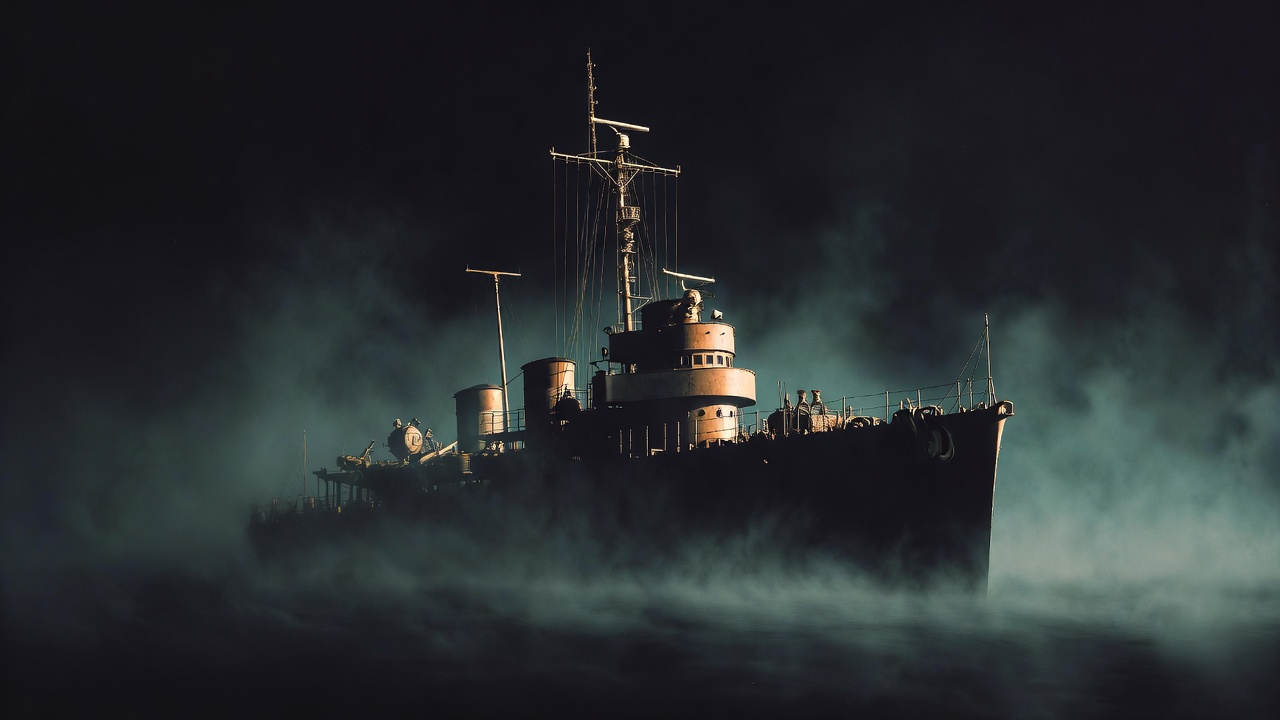
From Carl Allen's annotated paperback to teleportation legend: tracing the complete arc of fabrication, institutional ambiguity, and folkloric transformation that made the USS Eldridge famous for a voyage it never took.
Site owner · Own
The most remarkable fact about the Philadelphia Experiment is not that it almost certainly never happened. It is that a story traceable to a single individual's handwritten marginalia has generated decades of institutional response, popular media, and genuine scholarly attention. That asymmetry — between the poverty of the evidence and the richness of the legend — is itself the finding worth examining.
The legend rests on four pillars, each of which the evidence examines in turn. The entire Philadelphia Experiment narrative — the USS Eldridge rendered invisible, teleported from Philadelphia to Norfolk and back in October 1943, its crew driven mad by electromagnetic forces — derives from a single source. Between 1955 and 1957, Carl Meredith Allen, writing under the alias Carlos Miguel Allende, mailed a series of annotated letters and a heavily marginalia-filled copy of Morris K. Jessup's 1955 book 'The Case for the UFO' to Jessup and, ultimately, to the Office of Naval Research. Jessup's book contains no reference to naval invisibility, the USS Eldridge, or any experiment. The Philadelphia Experiment was not leaked from it. It was grafted onto it by Allen alone.
The documentary record is unambiguous. The USS Eldridge's deck logs and war diary place the ship on its shakedown cruise in the Bahamas in September and October 1943. A 1999 reunion of Eldridge veterans found no crew member who could corroborate any element of the story. The ship was not in Philadelphia during the alleged experiment window, and the narrative fails its most basic empirical test. The legend also invokes Albert Einstein's Unified Field Theory as its scientific engine — a classic pseudoscientific maneuver, given that the theory, which Einstein never completed, offers no mechanism for optical or radar invisibility, let alone teleportation. Its citation in Allen's annotations functions as borrowed authority, not scientific grounding.
What actually complicates the picture is where the story gets analytically interesting. The narrative conforms with near-perfect fidelity to established folkloric development patterns, its central motifs mapping directly onto ATU D1960 and ATU D2122 — cross-cultural legend archetypes documented in traditions that had no contact with Allen or Jessup. The story's subsequent elaboration, including Al Bielek's 1980s claims of being a time-traveling survivor, follows the documented trajectory of legend accretion: new first-person witnesses emerge, the geography expands, and institutional ambiguity is recruited as evidence of suppression. That institutional ambiguity is real. The Office of Naval Research commissioned 127 copies of the Varo Edition — the privately printed version of Jessup's annotated book — in 1957, and no released document adequately explains the internal deliberation behind that decision.
Two smaller tensions persist. Allen's precise whereabouts during the alleged experiment have never been fully reconstructed from merchant marine records, leaving his claimed eyewitness position technically unverified rather than definitively falsified. And at least one source places the Eldridge at the Philadelphia Navy Yard on October 22, 1943 — the most commonly cited experiment date — suggesting the debunking chronology itself requires more granular date-specific analysis than it has yet received. What this research ultimately documents is not a suppressed experiment but a fully traceable myth: one man's annotations, one agency's unexplained reprint, and six decades of folkloric elaboration. The USS Eldridge is famous for a voyage it never took.
Ordered by how difficult each finding is to explain away.
The Office of Naval Research — the very institution that has repeatedly and officially denied the Philadelphia Experiment ever occurred — commissioned and paid for 127 copies of the Varo Edition in 1957: a privately printed reproduction of Morris Jessup's annotated book, complete with Carl Allen's handwritten claims about naval invisibility and teleportation. This was not a passive receipt of unsolicited mail. The ONR actively contracted Varo Manufacturing, a private aerospace firm, to reproduce and distribute the primary document that would sustain the legend for the next seven decades. No internal deliberation records explaining this decision have ever been released. The institutional behavior is, on its face, the opposite of what a bureaucracy confident in its denial would do, and that gap in the documentary record is real, not invented.
The single institution whose official position is that the Philadelphia Experiment never happened is also the institution that funded and distributed the foundational text claiming it did.
Morris K. Jessup's 1955 book 'The Case for the UFO' — universally cited as the founding document of the Philadelphia Experiment legend — contains no reference whatsoever to naval invisibility, the USS Eldridge, or any 1943 experiment. In its original form, the book is a speculative argument that UFOs are anti-gravity craft and that ancient monuments were built with extraterrestrial assistance. The entire Philadelphia Experiment narrative was grafted onto this text by Carl Allen's marginal annotations, meaning the legend's founding document is a palimpsest: a pre-existing book overwritten by a single annotator whose identity was unknown to the ONR when they received it. The legend's founding document is not a document about the legend at all.
A researcher citing 'The Case for the UFO' as evidence for the Philadelphia Experiment is citing a book whose author never made that claim and whose original text does not contain it.
The standard debunking of the Philadelphia Experiment rests on the USS Eldridge's deck logs placing the ship in the Bahamas and New York during October 1943. This is well-established. Here's where the picture begins to blur: a paranormal researcher working from the same deck logs notes that the Eldridge was, in fact, docked at the Philadelphia Navy Yard on October 22, 1943 — the most commonly cited date for the experiment. The ship was not in Philadelphia for most of October, but it was present on the specific date most frequently named. The debunking is not wrong, but it is less clean than its confident repetition suggests, and the date-specific analysis has never been fully resolved in the published skeptical literature.
The official records used to debunk the Philadelphia Experiment place the USS Eldridge in Philadelphia on the single date most commonly cited for the experiment.
Carl Allen's original claims, transmitted through letters and annotations between 1955 and 1957, describe a witnessed naval experiment involving crew disorientation and possible invisibility. They do not describe time travel, parallel dimensions, or survivor testimony from inside the experiment. Al Bielek, who emerged in the 1980s claiming to be a time-traveling survivor named Edward Cameron, introduced all of these elements, and his version has largely supplanted Allen's in popular culture. Most people who know the Philadelphia Experiment story believe a version its original author never told, constructed by a second-generation narrator whose account contradicts Allen's own. The legend's most famous iteration is a revision of the legend, not a transmission of it.
The version of the Philadelphia Experiment most widely believed today was not invented by its original source and contradicts details that source actually claimed.
The Varo Edition — the annotated, privately printed reproduction of Jessup's book that became the legend's most authoritative physical artifact — was produced not by a government agency but by Varo Manufacturing Company, a private Texas-based aerospace and defense contractor. The corporate-military-fringe nexus this represents has been almost entirely unexplored in both skeptical and pro-legend literature. Researchers who cite the ONR's involvement as evidence of government interest rarely note that the actual production was outsourced to a defense contractor, and researchers who dismiss the legend rarely ask why a private aerospace firm was the chosen vehicle for reproducing fringe UFO literature. The institutional chain of custody for the legend's founding artifact runs through a private company, not a government archive.
The physical artifact most cited as evidence of government interest in the Philadelphia Experiment was manufactured and printed by a private defense contractor, not by any government agency.
The narrative architecture of the Philadelphia Experiment — a Mysterious Messenger with insider knowledge, a Sacred Text encoding suppressed truth, a Government Cover-Up that paradoxically authenticates the claim through its denial, and a Lone Researcher martyred by the establishment (Jessup died in 1959, a death quickly absorbed into the legend) — is structurally identical across dozens of unrelated conspiracy narratives including MJ-12, the Montauk Project, and multiple UFO contact claims. This is not a coincidence of content but a convergence of form. Folklorists working on ATU classification note that the legend's central motifs map directly onto established tale-types for magic invisibility and supernatural speed. The story is not just false; it is false in a highly patterned way that tells us considerably more about how legends propagate than about what happened in Philadelphia in 1943.
The Philadelphia Experiment narrative matches the structural template of conspiracy legend formation so precisely that folklorists can assign its central motifs to pre-existing ATU classification numbers predating the legend by decades.
The most remarkable fact about the Philadelphia Experiment is not that it almost certainly never happened. It is that a story traceable to a single individual's handwritten marginalia has generated decades of institutional response, popular media, and genuine scholarly attention. That asymmetry — between the poverty of the evidence and the richness of the legend — is itself the finding worth examining.
The legend rests on four pillars, each of which the evidence examines in turn. The entire Philadelphia Experiment narrative — the USS Eldridge rendered invisible, teleported from Philadelphia to Norfolk and back in October 1943, its crew driven mad by electromagnetic forces — derives from a single source. Between 1955 and 1957, Carl Meredith Allen, writing under the alias Carlos Miguel Allende, mailed a series of annotated letters and a heavily marginalia-filled copy of Morris K. Jessup's 1955 book 'The Case for the UFO' to Jessup and, ultimately, to the Office of Naval Research. Jessup's book contains no reference to naval invisibility, the USS Eldridge, or any experiment. The Philadelphia Experiment was not leaked from it. It was grafted onto it by Allen alone.
The documentary record is unambiguous. The USS Eldridge's deck logs and war diary place the ship on its shakedown cruise in the Bahamas in September and October 1943. A 1999 reunion of Eldridge veterans found no crew member who could corroborate any element of the story. The ship was not in Philadelphia during the alleged experiment window, and the narrative fails its most basic empirical test. The legend also invokes Albert Einstein's Unified Field Theory as its scientific engine — a classic pseudoscientific maneuver, given that the theory, which Einstein never completed, offers no mechanism for optical or radar invisibility, let alone teleportation. Its citation in Allen's annotations functions as borrowed authority, not scientific grounding.
What actually complicates the picture is where the story gets analytically interesting. The narrative conforms with near-perfect fidelity to established folkloric development patterns, its central motifs mapping directly onto ATU D1960 and ATU D2122 — cross-cultural legend archetypes documented in traditions that had no contact with Allen or Jessup. The story's subsequent elaboration, including Al Bielek's 1980s claims of being a time-traveling survivor, follows the documented trajectory of legend accretion: new first-person witnesses emerge, the geography expands, and institutional ambiguity is recruited as evidence of suppression. That institutional ambiguity is real. The Office of Naval Research commissioned 127 copies of the Varo Edition — the privately printed version of Jessup's annotated book — in 1957, and no released document adequately explains the internal deliberation behind that decision.
Two smaller tensions persist. Allen's precise whereabouts during the alleged experiment have never been fully reconstructed from merchant marine records, leaving his claimed eyewitness position technically unverified rather than definitively falsified. And at least one source places the Eldridge at the Philadelphia Navy Yard on October 22, 1943 — the most commonly cited experiment date — suggesting the debunking chronology itself requires more granular date-specific analysis than it has yet received. What this research ultimately documents is not a suppressed experiment but a fully traceable myth: one man's annotations, one agency's unexplained reprint, and six decades of folkloric elaboration. The USS Eldridge is famous for a voyage it never took.
The Philadelphia Experiment warrants serious scholarly attention — not because it happened, but because the patterns surrounding it are genuinely significant and imperfectly explained. Let me be precise about what the evidence actually supports, and where it stops.
The advocate's confidence here is low, and that number is not a researcher's bias or a failure of imagination. It reflects the near-total absence of positive evidence for the experiment itself: the USS Eldridge's deck logs place the ship in the Bahamas during the alleged October 1943 event; geomagnetic observatory records show no anomalies; a 1999 reunion of actual Eldridge veterans produced zero corroborating testimony from a crew of hundreds; and the entire narrative is traceable to a single individual, Carl Meredith Allen, whose documented history of eccentric behavior is not in dispute. The advocate who ignores these facts is not making a strong case. They are making a dishonest one.
What the advocate can defend, with specificity, begins with the ONR's institutional behavior, which remains anomalously unexplained. The Office of Naval Research — a serious scientific body, not a curiosity cabinet — commissioned 127 private copies of an annotated UFO book at government expense in 1957. The ONR's own post-hoc explanation, that this reflected the personal curiosity of individual officers, does not survive scrutiny: government agencies do not allocate resources to preserve and distribute the marginal annotations of individuals they regard as unstable. The ONR's separate point — that it was founded in 1946 and therefore could not have sponsored a 1943 experiment — is logically irrelevant to the question of why it found Allen's 1956 annotations worth reproducing. These are distinct questions, and conflating them is a rhetorical move, not an argument. The Varo Edition represents a documented, verifiable instance of a government scientific institution treating fringe material with enough seriousness to formalize and distribute it. The advocate cannot prove the ONR knew something it has not disclosed; the advocate can prove that the ONR's stated explanation is insufficient.
The degaussing kernel is verified and matters categorically. Degaussing — electromagnetic coil systems wound around ship hulls to neutralize magnetic signatures — was a genuine, classified Allied naval program in World War II, and the Philadelphia Navy Yard was a documented site of such work. This means the Philadelphia Experiment narrative has a confirmed technological ancestor: real classified electromagnetic experiments on naval vessels, at the exact location claimed, using the correct technology class, during the correct historical window. A legend that maps precisely onto a classified real-world program is categorically different from a legend with no factual anchor. The skeptic's obligation is to explain why this correspondence is merely coincidental rather than generative — that is, why a legend would happen to locate itself at the precise intersection of real classified technology and real classified geography without having been seeded by actual, if distorted, knowledge of that program. The advocate cannot prove the legend was seeded this way. The advocate can prove the coincidence is not trivial.
Allen's precise whereabouts on the alleged date are technically unverified rather than falsified. The deck logs establish where the Eldridge was; they do not establish where Allen was. Allen claimed to have witnessed the experiment from another vessel. That claim is uncorroborated and almost certainly false — but 'almost certainly false' and 'documented as false' are not the same thing. This is a narrow window of locational uncertainty, not an open door for the experiment's occurrence. The advocate notes it because intellectual honesty requires distinguishing between what is refuted and what is merely unverified.
The pattern that keeps surfacing, and that matters most for scholarship, is the narrative's folkloric architecture. The core motifs — invisibility and instantaneous translocation — map directly onto ATU D1960 (Magic Invisibility) and ATU D2122 (Journey with magic speed), categories documented across culturally isolated traditions including Micronesian etak navigation frameworks and Aboriginal Australian spirit-movement concepts. These traditions had no contact with Allen or Jessup. Their convergence on identical narrative structures demonstrates that the Philadelphia Experiment legend recruits cognitive templates so deeply embedded in human meaning-making that they appear independently across all recorded cultures. This does not confirm the experiment. It explains the legend's extraordinary cultural persistence and spread with a precision that purely sociological explanations cannot match. A story wearing the cognitive architecture of ATU D1960 and D2122 is not just a story — it is a story pre-adapted for human credulity.
The legend's accretion pattern is also a documented case study of exceptional scholarly value. The genealogy is fully traceable: Allen's 1956 annotations, Berlitz and Moore's 1979 popularization, Al Bielek's 1990 emergence as a first-person witness with no prior documentation, and the Montauk Project series from 1992 to 2002 — each layer adding claims absent from the previous layer, with zero new primary documentation at any stage. Bielek's emergence is a documented instance of what folklorists call legend crystallization: the generation of new testimony that conforms to an established narrative template, decades after the alleged event, with no corroborating evidence. This is not merely interesting. It is a controlled case for studying how false memories, identity construction, and narrative pressure interact, with direct relevance to contemporary information literacy and misinformation research.
The honest summary: the Philadelphia Experiment did not occur. The patterns identified here are significant not as evidence for the experiment, but as evidence for how classified technology programs generate folkloric residue, how government institutions behave anomalously around fringe material in ways their own explanations don't fully account for, how universal cognitive templates determine which legends achieve cultural persistence, and how modern legend construction operates in real time with traceable documentary genealogy. These are genuine contributions to multiple fields. They don't require the experiment to have happened. They require only that scholars take the patterns seriously on their own terms — which the evidence fully supports doing.
The Philadelphia Experiment is among the most thoroughly documented cases of legend construction in modern American folklore, and the evidentiary record supporting a mundane explanation is not merely strong — it is convergent across independent streams that have no stake in each other's conclusions. Understanding why this case is so well-resolved requires engaging seriously with both the evidence and the specific mechanisms by which the legend grew.
The entire narrative originates from a single individual: Carl Meredith Allen, a merchant seaman writing under the alias Carlos Miguel Allende, whose annotated copy of Morris K. Jessup's 1955 book and accompanying letters constitute the sole primary source for every subsequent claim. This is not a situation where independent witnesses converge on a shared account and demand explanation. It is a situation where one person's uncorroborated assertions were amplified, embellished, and treated as foundational by a succession of writers — Jessup himself, then Charles Berlitz and William Moore in 1979, then Al Bielek in the 1990s — each adding elements absent from the previous layer with no new primary documentation. The narrative's growth follows textbook legend-accretion patterns: Allen describes ship invisibility and crew madness; Berlitz and Moore add teleportation, Einstein, and witnesses; Bielek adds time travel; the Montauk Project series adds interdimensional portals and mind control. Critically, the 1984 film invented the time-travel element wholesale, and this fictional addition was subsequently incorporated into popular accounts as if original. This is precisely how myths develop, and the complete absence of new primary documentation at each escalation stage is diagnostic of legend construction rather than historical discovery.
The physical documentary record is unambiguous and has been examined by multiple independent researchers with no coordinated agenda. The USS Eldridge's deck logs, held at the National Archives under Record Group 24, are contemporaneous operational documents created for routine naval purposes with no conceivable motive for falsification regarding an invisibility experiment — the Navy had no reason in 1943 to falsify routine ship movements in a way that would conveniently contradict a story that would not be invented for another twelve years. These logs place the Eldridge on a shakedown cruise in the Bahamas and subsequently at Norfolk and New York during the alleged October 1943 experiment period. The SS Andrew Furuseth — the merchant vessel whose crew allegedly witnessed the Eldridge's dramatic arrival in Norfolk — was itself documented as having departed Norfolk on October 25th, three days before the alleged October 28th experiment date, and was en route to Casablanca. Two independent ships' records falsify the core claim from two different directions.
A genuine tension in the debunking timeline deserves acknowledgment. At least one researcher cites deck logs placing the Eldridge at the Philadelphia Navy Yard on October 22, 1943 — the most commonly cited alternative experiment date — which means the ship was in Philadelphia on that date. This does not rescue the narrative; it illustrates that the debunking record itself requires precise date-specific analysis rather than blanket dismissal, and that the ship's documented movements during the relevant period are complex enough to require careful reconstruction. The skeptic position is strengthened, not weakened, by acknowledging this granularity, because it demonstrates that the evidentiary standard being applied is genuinely rigorous rather than reflexively dismissive.
The scientific claims collapse under direct examination. Einstein's Unified Field Theory, consistently invoked as the theoretical basis for electromagnetic invisibility, was never completed and contains no mechanism whatsoever for rendering physical objects invisible or teleporting them — verifiable by direct examination of Einstein's published papers from 1925 through 1955. The invocation of Einstein's name is a rhetorical strategy, borrowing the prestige of the most famous scientist of the twentieth century to lend credibility to claims that have no scientific content, and it represents a documented pattern in pseudoscientific literature. No physicist has ever identified a plausible mechanism by which the experiment's claimed effects could be achieved using any known or theorized physics.
The ONR's commissioning of 127 copies of the Varo Edition — the central institutional-legitimacy argument — is the one element the skeptic cannot fully explain from existing documentation. No internal deliberation records have been released showing why individual officers authorized this printing. The ONR itself explicitly stated it was not established until 1946 and could not have sponsored a 1943 experiment, and the printing represents the documented personal curiosity of individual officers rather than an official investigation. But the absence of a complete paper trail for a minor bureaucratic decision made in the late 1950s is not evidence of suppression — it is the normal condition of institutional record-keeping. The argument that any government attention proves significance is unfalsifiable by design and is a standard feature of conspiracy narrative construction.
The geophysical record provides an independent line of evidence. No anomalous geomagnetic field variations appear in East Coast observatory records for October 1943. An electromagnetic event of the magnitude required to render a 1,240-ton destroyer escort invisible would have been detectable by contemporary instruments, and the absence of such signatures is a positive finding, not merely an argument from silence.
The loose thread that refuses to be tied is why Allen chose this particular elaboration, why Jessup found it compelling enough to correspond about, and why the ONR printing decision left no recoverable paper trail. These are genuine gaps — gaps in the sociology and psychology of belief formation, not gaps in the physical or documentary record of the alleged experiment. The residual uncertainty in this case reflects the irreducible impossibility of proving a negative; it does not reflect evidence that the experiment occurred. The Philadelphia Experiment is a case study in how a single imaginative individual, a documented real technology, a prestigious scientific name, and a receptive cultural moment can generate a legend that outlasts all available evidence against it.
What neither the Advocate nor the Skeptic can fully explain.
The ONR commissioned exactly 127 copies of the Varo Edition in 1957, yet no internal memoranda, budget authorizations, or deliberation records explaining this decision have been released or located in accessible archives: a systematic FOIA request targeting ONR administrative files from 1956 to 1958, cross-referenced against the personal papers of Commander George Hoover and Captain Sidney Sherby — the two ONR officers who handled the Jessup copy — could establish whether this was a formal intelligence-adjacent project, an informal curiosity, or something in between, and the answer would either close or dramatically reframe the only genuinely anomalous institutional behavior in the entire record.
Carl Allen's merchant marine service records have never been fully reconstructed to establish his precise location in late October 1943: the National Personnel Records Center holds merchant marine documentation that, combined with the SS Andrew Furuseth's voyage logs (which place the ship en route to Casablanca on October 28, 1943), could either corroborate or definitively falsify Allen's claim to have witnessed the Eldridge's alleged Norfolk arrival from that vessel — this reconstruction is the single most tractable empirical question remaining about the legend's origin and has not been systematically attempted in published scholarship.
The Varo Edition's provenance chain before it reached the ONR remains incompletely documented: specifically, who physically mailed the annotated copy, whether Allen sent it directly or through an intermediary, and whether the copy that reached the ONR was the same copy Allen annotated or a transcription, are questions that could be addressed through postmark analysis, paper and ink forensic dating of the surviving Varo copies, and cross-referencing Allen's known correspondence with Jessup held at the University of Arizona Special Collections — the answer bears directly on whether the ONR's interest was solicited or spontaneous.
The deck logs place the USS Eldridge at the Philadelphia Navy Yard on October 22, 1943 — the most commonly cited experiment date — yet the same logs show the ship was in the Bahamas during the broader October period: a date-specific forensic analysis of the complete October 1943 deck log entries, compared against the Philadelphia Navy Yard's own administrative records for vessels in port on that date, would resolve the genuine tension in the debunking timeline and establish whether the 'Philadelphia on October 22' detail entered the legend through partial misreading of authentic records or through independent invention.
The three annotators of the Jessup copy are identified in the Varo Edition only as 'Mr. A,' 'Mr. B,' and 'Jemi,' and the scholarly consensus that Allen wrote all three voices has rested primarily on stylistic analysis rather than forensic document examination: a systematic computational stylometric analysis of the annotations against Allen's authenticated letters to Jessup, using authorship attribution methods developed since the 1990s, could either confirm single authorship or reveal genuine multi-author signatures — a finding with direct implications for whether the ONR received a collaborative document or a solo performance.
Degaussing operations conducted on warships in Philadelphia-area yards during 1943 involved powerful electromagnetic coils and produced documented crew complaints of disorientation, nausea, and visual disturbance in some Navy records: a systematic search of Philadelphia Navy Yard medical logs and degaussing station incident reports from 1942 to 1944, held at the National Archives in College Park, could establish whether any anomalous crew effects were officially recorded that might have seeded a distorted oral account — this is the only pathway by which the legend could have a partial empirical kernel without requiring any of its central claims to be true.
Morris K. Jessup's correspondence with Allen between 1955 and 1959, and Jessup's private papers held at the University of Arizona, have been consulted selectively in published accounts but never subjected to a complete critical edition: a full scholarly transcription and annotation of the Jessup-Allen correspondence, establishing the precise sequence of claims Allen introduced and Jessup's documented responses to each, would allow researchers to trace exactly how the narrative elaborated over time and whether Jessup's increasing psychological distress in 1958 and 1959 was causally connected to his engagement with Allen's letters or preceded it — a question with direct bearing on the legend's human cost and on Allen's culpability.
We asked ChatGPT, Grok, Claude, Gemini, and Perplexity a question matching our specific convergence angle — not a generic topic summary. Claude classified each response using a 4-axis scoring rubric. Does mainstream AI engage with the actual evidence — or qualify, dismiss, or suppress?
ChatGPT (GPT-4o)
Apr 2026
The Philadelphia Experiment refers to an alleged military experiment said to have been carried out by the U.S. Navy at the Philadelphia Naval Shipyard in Philadelphia, Pennsylvania, around October 28,
The response addresses the Philadelphia Experiment topic directly and substantively, providing historical details, context, and origins without dismissive language or excessive hedging.
Grok (xAI)
Apr 2026
The topic of "The Philadelphia Experiment: How a Sailor's Marginalia Became America's Most Durable Naval Myth" refers to a widely discussed conspiracy theory and urban legend surrounding an alleged se
The response immediately characterizes the Philadelphia Experiment as a 'conspiracy theory and urban legend' rather than engaging with the historical analysis aspect suggested by the title about how marginalia became myth.
Claude (Anthropic)
Apr 2026
The Philadelphia Experiment is one of the most enduring conspiracy theories in American naval history, and the framing you've provided captures a fascinating sociological phenomenon. Let me break down
The response immediately characterizes the topic as a 'conspiracy theory' and frames it through a lens of assessing 'credibility' rather than engaging with the historical and sociological aspects suggested by the framing.
Gemini (Google)
Apr 2026
Okay, I can definitely delve into the topic of "The Philadelphia Experiment: How a Sailor's Marginalia Became America's Most Durable Naval Myth." Here's what I know, how the story likely spread, and h
The response addresses the Philadelphia Experiment topic directly and substantively, providing specific details about the alleged experiment while maintaining an analytical tone without dismissive language or excessive disclaimers.
Verbatim responses from each AI's API, analyzed by Claude. Generated April 2026.

The Restrainer and the Mimic: Peter Thiel's Secret Antichrist Lectures and the Theology of Silicon Valley Power
One of the most powerful figures in global technology — a man who co-founded PayPal, seeded Palantir, and placed an early bet on Donald Trump — has allegedly been conducting private, off-the-record lecture series on the Antichrist. That claim alone is arresting. What this research found, however, is something more complicated and ultimately more interesting: the intellectual framework behind that claim is genuinely robust, historically deep, and cross-traditionally resonant — but the specific ev

Gods, Rockets, and Bad Translations: The Annunaki, Sitchin, and the Limits of Ancient Astronaut Theory
Here is what should surprise anyone who approaches this topic honestly: the structural parallels between Sumerian and Hebrew tradition are real, specific, and genuinely unexplained by coincidence. The Sumerian King List and the genealogies of Genesis 5 share not merely a flood story but an identical narrative architecture — antediluvian figures with superhuman lifespans, a catastrophic deluge as a hard break in history, and a post-flood world where longevity collapses toward the human. Archaeolo

The Axis of Everything: Why Every Culture on Earth Invented the Tree of Life
A cosmic tree holds up the sky in Norse mythology, its roots drinking from the well of fate. The same structure — three vertical realms, one arboreal axis — appears on the sarcophagus lid of a Mayan king buried in 683 CE, in the ceremonial poles of Yolŋu communities in Aboriginal Australia, in the palace reliefs of Assyrian emperors, and in a private notebook kept by Charles Darwin in 1837. The symbol scores 79 out of 100 on this study's convergence index across more than thirty traditions spann

Nature's Exit Protocol: Darwin's Wasp, Predation Neurochemistry & the Mercy Problem
In 1860, Charles Darwin wrote to the botanist Asa Gray that he could not reconcile the Ichneumon wasp — which paralyzes caterpillars alive so its larvae can consume them from the inside — with the existence of a benevolent God. That letter remains one of the most honest sentences in the history of natural theology, and it opens a question this research dossier takes seriously: does nature have something like an exit protocol, and if so, what does it tell us about suffering, consciousness, and th
Want to use this research? Everything here is free with attribution.
See how →