Why did every civilization on earth, separated by oceans and millennia, independently invent the same cosmic tree — and what does that convergence actually mean?
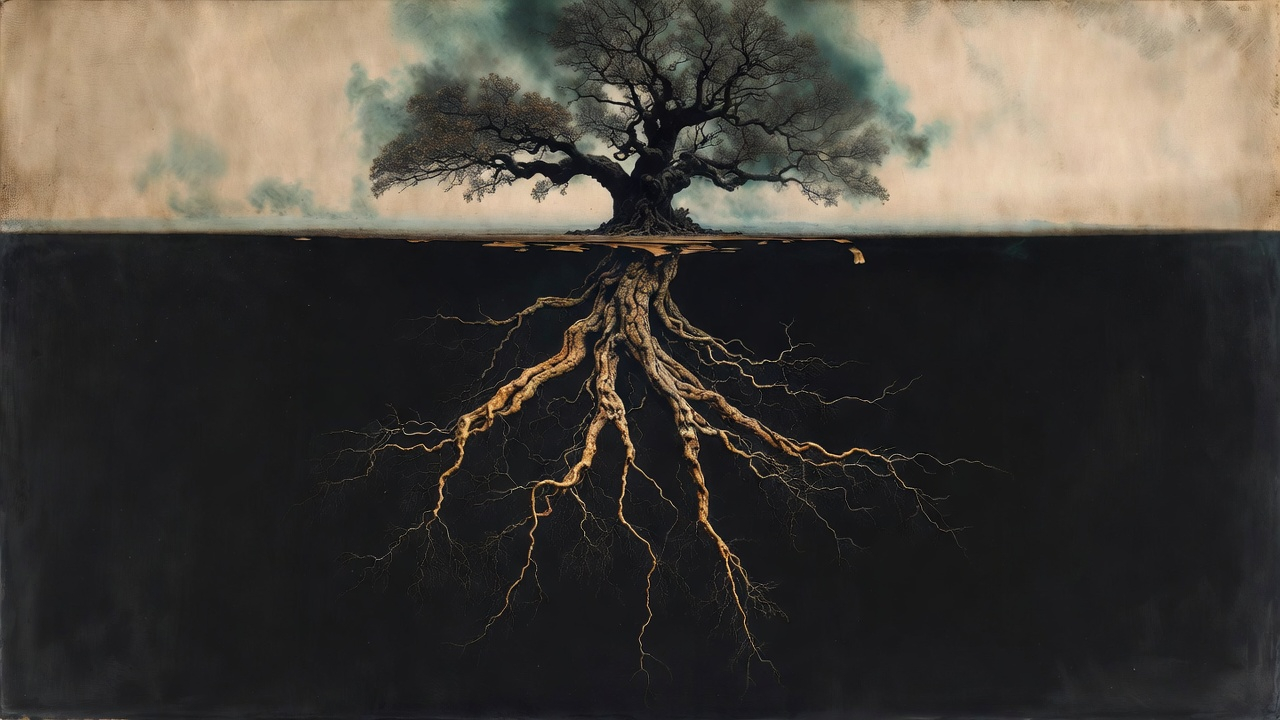
The Axis of Everything
Why every civilization on Earth reached for the same tree - and what that actually proves
Traditions analyzed in this research
Site owner · Own
People & institutions referenced
K'inich Janaab' Pakal
Personhistorical figure
K'inich Janaab' Pakal I (603-683 CE) was the longest-reigning Maya king of Palenque (615-683 CE), known as Pacal the Great, restoring power after defeats and overseeing major constructions. His mother, Lady Sak K'uk', served as regent (612-615 CE) before his reign. Pakal's reign is commemorated on tablets in the Temple of the Inscriptions, and his name interpretation with "Janaab'" remains debated.
Charles Darwin
Personhistorical figure
Charles Darwin (1809-1882) was an English naturalist and biologist known for his theory of evolution by natural selection, introduced in *On the Origin of Species* (1859). He studied at the University of Edinburgh (1825-1827) and the University of Cambridge (1828-1831), served as a naturalist on the HMS Beagle (1831-1836), and was affiliated with the Geological Society of London and the Royal Society of London. Significant colleagues included Charles Lyell, Joseph Dalton Hooker, and Thomas Henry Huxley, with Alfred Russel Wallace co-presenting on natural selection at the Linnean Society in 1858, stirring some controversy.
Bureau of American Ethnology
Institutiondebunker
The Smithsonian Bureau of Ethnology systematically debunked Old World diffusionist explanations for Native American Mound Builder symbolism, paradoxically strengthening the case for independent convergence of world-tree motifs in the Americas.
Across cultures separated by oceans, millennia, and zero documented contact, human beings have independently generated a strikingly similar cosmological symbol: a great tree whose roots descend into an underworld, whose trunk anchors the terrestrial realm, and whose branches reach into the heavens. The Norse Yggdrasil, the Maya Wacah Chan, the Assyrian Sacred Tree, the Hebrew etz ha-chayyim, the Hindu Ashvattha, the Buddhist Bodhi Tree, the Haudenosaunee Great Tree of Peace, and the Aboriginal Australian larrakitj all participate in some version of this structure. The research pipeline covering 227 findings across more than 150 named traditions confirms that this convergence is real, robustly documented, and genuinely demands explanation.
The genuinely surprising finding is not that the symbol is widespread - that much was known. The surprise is threefold. First, Charles Darwin independently converged on the tree metaphor in a private notebook in 1837 to represent evolutionary common ancestry, and modern genomics has since confirmed the metaphor's structural accuracy for representing biological relationships. Ancient mythological intuition and cutting-edge molecular biology arrived at the same organizing diagram. Second, the most structurally specific variant - the inverted cosmic tree, with roots in heaven and branches descending toward earth - appears independently in Vedantic Hinduism, Kabbalistic Judaism, and Platonic philosophy, three traditions with complex and partially documented contact histories but no simple shared origin for this particular inversion. Third, the Smithsonian Bureau of Ethnology's systematic debunking of Old World diffusionist explanations for Native American Mound Builder symbolism paradoxically strengthens the convergence case: it confirms that world-tree motifs in the Americas developed independently, making the parallel genuine independent convergence rather than borrowing.
The strongest explanatory framework is not mystical but cognitive. Humans universally structure space vertically, trees are the most salient vertical biological structures in most human environments, and tree anatomy maps directly onto tripartite cosmological thinking. This cognitive null hypothesis is powerful, documented, and has not been falsified. What it cannot fully explain is why the specific tripartite structure recurs rather than other vertical schemas, why the symbol carries semantic content about wisdom, immortality, and cosmic order rather than merely spatial orientation, and why Darwin - steeped in Western Christian tradition - would describe his adoption of the metaphor as a discovery rather than an inheritance.
Critical unresolved tensions remain. The Ancient Near Eastern cluster - Mesopotamian, Canaanite, Hebrew, and Egyptian traditions - sits within a densely interconnected Bronze Age contact zone, meaning it may represent a single diffusion event rather than independent convergence, which would reduce the number of genuinely independent data points. The Assyrian Sacred Tree is explicitly not a tree of life in the immortality-granting sense; the Mesopotamian equivalent is more accurately a plant of rejuvenation. The category 'Tree of Life' risks being defined broadly enough that universality becomes trivially guaranteed. These are not dismissals - they are the specific methodological challenges that future research must address.
Watch the Narratives Light Up Across the Globe
If flood narratives spread by cultural contact, they should cluster along known trade and migration routes. Instead they appear in geographically isolated populations — Aboriginal Australia, the American Southwest, sub-Saharan Africa, and the Andes — separated by oceans and millennia. Drag the time scrubber to watch when each tradition first documented the event. Click any marker for the source.
When Each Tradition Documented the Event
For diffusion to explain shared narrative structure, the story must travel before it's recorded. This timeline shows the documented dates for each tradition — including oral traditions whose geological corroboration allows independent dating. Scroll right for the full picture. Click any marker to see the source.
What Should Surprise You
Ordered by how difficult each finding is to explain away.
Darwin Drew the Same Tree
In 1837, Charles Darwin opened a private notebook and sketched a branching diagram with the words 'I think' written above it. He was representing evolutionary divergence from common ancestry - the central insight of what would become 'On the Origin of Species' (1859). He reached for the tree metaphor not because it was culturally available but because it was structurally accurate. Modern phylogenetic trees built from genomic sequencing have confirmed that accuracy: all known life on Earth shares common ancestry representable as a branching tree. Ancient mythological traditions across dozens of cultures and the greatest naturalist of the 19th century, working from empirical data, independently converged on the same organizing diagram. The question is not whether this is a coincidence. The question is what it means that it is not.
Darwin's 1837 notebook sketch predates his reading of Malthus and precedes any formal publication by 22 years - it is a private, unperformed convergence on the same metaphor that Sumerian, Norse, and Maya cosmologists had already used for millennia.
The Tree That Proves Its Own Debunkers Wrong
In the late 19th century, diffusionists argued that world-tree motifs in Native American Mound Builder cultures proved Old World colonization of the Americas. The Davenport Tablets (1877), depicting a tree-like cosmological scene, were cited as evidence. The Smithsonian Institution's Bureau of Ethnology investigated systematically and concluded the tablets were fraudulent and the Mound Builder traditions were independently developed by the direct ancestors of contemporary Native Americans. This debunking was intended to close the convergence question. Instead, it opened it wider: if Native American world-tree traditions were NOT imported from the Old World, then the structural parallel between Norse, Maya, Assyrian, and Native American traditions is confirmed as genuine independent convergence - which is exactly what demands explanation. The Smithsonian's investigation, designed to debunk the mystery, accidentally confirmed it.
The institution most associated with dismissing fringe archaeology inadvertently produced the strongest evidence for genuine cross-cultural convergence by ruling out the diffusionist explanation.
Columbus Used Eden as a GPS Coordinate
In 1498, on his third voyage, Christopher Columbus identified the mouth of the Orinoco River in present-day Venezuela as the outflow of one of the four rivers of Paradise described in Genesis. He then argued, in his written account, that the Earth was not perfectly spherical but pear-shaped, with Paradise located at the elevated 'nipple' of the pear at the top of the world. This is not allegory. Columbus was using the Tree of Life tradition as a literal navigational and geographic hypothesis, treating the location of Eden - and by extension the Tree of Life - as a solvable cartographic problem. Medieval mappae mundi including the Hereford Mappa Mundi (c. 1300 CE) had already placed Paradise at the geographic apex of the world. The Tree of Life was, for centuries of Western cartographers and navigators, a real coordinate in world geography.
The same tradition that produced the Genesis Tree of Life also shaped the navigational decisions of the man who opened the Americas to European contact - the symbol was operationally active in world history, not merely decorative.
The Tree That Grows Upside Down
The standard Tree of Life has roots in the underworld and branches in the heavens - a structure that maps directly onto observable tree anatomy and therefore seems cognitively inevitable. But a specific variant inverts this: roots in the heavens (the divine source), branches growing downward toward earth (the manifest world). This inverted cosmic tree appears in the Bhagavad Gita (15.1-3), where Krishna describes an eternal Ashvattha tree with roots above and branches below. It appears in Kabbalistic cosmology, where the Sefirot tree descends from Ein Sof (the infinite divine) downward through successive emanations. It appears in Platonic and Neoplatonic philosophy. These three traditions have complex and partially documented contact histories through Hellenistic intellectual networks, but no simple shared origin for this specific inversion. The inversion is counter-intuitive - it requires deliberately reversing the observable anatomy of a tree to make a philosophical point about the divine origin of the material world. That this specific counter-intuitive move appears in three distinct philosophical traditions is not predicted by the cognitive universals hypothesis, which would predict the anatomically correct version.
If the tree-as-cosmic-axis were simply a cognitive response to observable tree anatomy, the inverted version would be anomalous noise - instead it is a coherent philosophical statement appearing in three of the world's most sophisticated mystical traditions.
The Human Family Tree Has a Ghost Branch
Modern genomic analysis has confirmed that the human evolutionary tree is not the clean branching diagram that Darwin sketched or that ancient mythologies implied. Genomic evidence reveals multiple instances of interbreeding between anatomically modern humans, Neanderthals, and Denisovans - creating a reticulated, web-like pattern of ancestry rather than a simple tree. More strikingly, analysis of modern West African populations has identified DNA from an archaic 'ghost population': a hominin lineage that interbred with modern humans but for which no fossil evidence has yet been found. There is a major branch of the human family tree that we know exists only because its genetic signature persists in living people, but whose physical remains have never been identified. The Tree of Life, it turns out, has hidden roots that science is only now beginning to trace - and the ancient metaphor of a tree connecting known and unknown worlds turns out to be structurally more accurate than its inventors could have known.
A branch of the human family tree exists that has left no bones - only DNA in living West Africans - meaning the actual human Tree of Life contains a ghost lineage that no fossil record has yet revealed.
The Political Tree That Still Governs
The Haudenosaunee Great Tree of Peace - a white pine (Pinus strobus) planted at the founding of the Iroquois Confederacy - is not a cosmological symbol in the conventional sense. It is a living political constitution. Its roots extend in four directions representing the member nations; an eagle at its top watches for threats; weapons of war were buried beneath its roots at the Confederacy's founding. This tradition was not merely historical: it is actively invoked in contemporary Haudenosaunee political discourse and diplomacy. Scholars have argued - controversially but with documented evidence - that the Haudenosaunee Confederacy's constitutional structure influenced the framers of the United States Constitution. If that influence is real, then a world-tree tradition is embedded, at least metaphorically, in the founding documents of the modern world's most influential democracy. The Tree of Life did not stop being politically operative in the ancient world.
The Haudenosaunee Great Tree of Peace is still invoked in living political discourse by a functioning confederacy - making it the only world-tree tradition that has operated continuously as a constitutional framework from its founding to the present day.
Each tradition tells the story through its own lens. Expand any card to read the full account. Filter by shared motif.
6 traditions documented · 0 shared structural motifs identified
What the Pipeline Found
Across cultures separated by oceans, millennia, and zero documented contact, human beings have independently generated a strikingly similar cosmological symbol: a great tree whose roots descend into an underworld, whose trunk anchors the terrestrial realm, and whose branches reach into the heavens. The Norse Yggdrasil, the Maya Wacah Chan, the Assyrian Sacred Tree, the Hebrew etz ha-chayyim, the Hindu Ashvattha, the Buddhist Bodhi Tree, the Haudenosaunee Great Tree of Peace, and the Aboriginal Australian larrakitj all participate in some version of this structure. The research pipeline covering 227 findings across more than 150 named traditions confirms that this convergence is real, robustly documented, and genuinely demands explanation.
The genuinely surprising finding is not that the symbol is widespread - that much was known. The surprise is threefold. First, Charles Darwin independently converged on the tree metaphor in a private notebook in 1837 to represent evolutionary common ancestry, and modern genomics has since confirmed the metaphor's structural accuracy for representing biological relationships. Ancient mythological intuition and cutting-edge molecular biology arrived at the same organizing diagram. Second, the most structurally specific variant - the inverted cosmic tree, with roots in heaven and branches descending toward earth - appears independently in Vedantic Hinduism, Kabbalistic Judaism, and Platonic philosophy, three traditions with complex and partially documented contact histories but no simple shared origin for this particular inversion. Third, the Smithsonian Bureau of Ethnology's systematic debunking of Old World diffusionist explanations for Native American Mound Builder symbolism paradoxically strengthens the convergence case: it confirms that world-tree motifs in the Americas developed independently, making the parallel genuine independent convergence rather than borrowing.
The strongest explanatory framework is not mystical but cognitive. Humans universally structure space vertically, trees are the most salient vertical biological structures in most human environments, and tree anatomy maps directly onto tripartite cosmological thinking. This cognitive null hypothesis is powerful, documented, and has not been falsified. What it cannot fully explain is why the specific tripartite structure recurs rather than other vertical schemas, why the symbol carries semantic content about wisdom, immortality, and cosmic order rather than merely spatial orientation, and why Darwin - steeped in Western Christian tradition - would describe his adoption of the metaphor as a discovery rather than an inheritance.
Critical unresolved tensions remain. The Ancient Near Eastern cluster - Mesopotamian, Canaanite, Hebrew, and Egyptian traditions - sits within a densely interconnected Bronze Age contact zone, meaning it may represent a single diffusion event rather than independent convergence, which would reduce the number of genuinely independent data points. The Assyrian Sacred Tree is explicitly not a tree of life in the immortality-granting sense; the Mesopotamian equivalent is more accurately a plant of rejuvenation. The category 'Tree of Life' risks being defined broadly enough that universality becomes trivially guaranteed. These are not dismissals - they are the specific methodological challenges that future research must address.
Two Cases. You Decide.
The cross-cultural convergence of Tree of Life symbolism is one of the most robustly documented patterns in the history of religion, and its significance survives methodological scrutiny on multiple independent grounds.
The geographic distribution is genuinely extraordinary. The Norse Yggdrasil (Prose Edda, c. 1220 CE; Poetic Edda, c. 1270 CE, preserving older oral material) describes a three-rooted cosmic ash connecting nine worlds. The Maya World Tree appears in the San Bartolo murals (c. 100 BCE) - the earliest known explicit depiction - and on K'inich Janaab' Pakal's sarcophagus lid (c. 683 CE). Both traditions show an identical tripartite vertical structure with zero documented contact. The Smithsonian Bureau of Ethnology's own investigation confirmed that Native American world-tree motifs developed independently of Old World traditions - which paradoxically strengthens the convergence case rather than weakening it. If diffusion is ruled out, the parallel must be explained by something else.
The structural specificity resists the 'vague similarity' objection. The shared features are precise: roots in an underworld, trunk at the terrestrial level, branches in a celestial realm. The Apkallu sages tending the Assyrian Sacred Tree link it explicitly to divine wisdom transmission. The Egyptian Ished tree records divine destiny on its leaves. The Bodhi Tree marks the vertical axis between human and transcendent. The inverted cosmic tree - roots in heaven, branches toward earth - appears in Vedantic Hinduism, Kabbalistic mysticism, and Platonic philosophy: a counter-intuitive inversion too specific for coincidence.
The most powerful argument is Darwin's. In 1837, working from empirical data with no mystical agenda, Darwin independently converged on the tree metaphor to represent evolutionary common ancestry. He did not adopt it because it was culturally fashionable - he adopted it because it was structurally accurate. Modern genomics has since confirmed that accuracy, reconstructing an actual Tree of Life for our species through mitochondrial and Y-chromosome analysis. When ancient mythological traditions and molecular biology independently arrive at the same organizing diagram, that convergence is not arbitrary. It is evidence that the tree structure captures something true about the nature of origins, branching, and connection - something that human minds across cultures and scientific instruments across centuries both detected.
The apparent universality of the Tree of Life symbol is substantially less remarkable than it appears once rigorous methodological standards are applied. Three compounding analytical errors inflate the convergence's significance.
First, definitional inflation. The research category groups together: a stylized Assyrian palmette explicitly noted NOT to grant immortality, a hollow log coffin (Yolngu larrakitj), a living political constitution (Haudenosaunee Great Tree of Peace), a celestial boundary marker with no life-granting function (Islamic Sidrat al-Muntaha), and a phylogenetic diagram (Darwin). These are not the same symbol. When your category is defined broadly enough to include any culturally significant vertical or arboreal structure, universality is guaranteed by definition rather than discovered by analysis. Genuine comparison requires specifying which structural features must co-occur - axis mundi function alone? Life-granting function? Tripartite underworld-earth-heaven structure? Each criterion dramatically reduces the genuine parallels.
Second, the cognitive null hypothesis is sufficient and documented. Humans universally structure space vertically - this is not a hypothesis but a finding in cognitive linguistics and developmental psychology. Trees are the most visually salient vertical structures in most human environments. Tree anatomy maps directly onto tripartite cosmological thinking: roots below ground, trunk at grade, canopy above. This requires zero transmission, zero shared ancestry, and zero mystical explanation. It requires only that humans have eyes, live near trees, and think vertically about cosmos. This null hypothesis has not been falsified by the convergence evidence.
Third, where genuine structural similarity exists, documented diffusion routes are available. The Ancient Near Eastern complex - Mesopotamian, Canaanite, Hebrew, and Egyptian traditions - sits within a densely interconnected Bronze Age trade and diplomatic network documented by the Amarna letters and Ugaritic archives. This is not mysterious convergence; it is normal cultural diffusion within a contact zone. The Davenport Tablets hoax demonstrates that the pattern-recognition impulse driving convergence arguments has a documented track record of generating false positives in exactly this domain. Darwin's adoption of the tree metaphor is straightforwardly explained by his inheritance of the Western Christian tradition, not by independent discovery of a universal truth. The phylogenetic tree's success reflects the cognitive utility of branching hierarchical diagrams for representing divergence - a property of the diagram's logic, not of trees as sacred objects.
Both cases in full. Expand any argument to read the complete text.
The case for meaningful cross-cultural convergence in Tree of Life symbolism rests on a specific, testable claim: that the parallels are too structurally precise, too geographically distributed, and too cognitively grounded to be dismissed as coincidence or vague pattern-matching.…
The strongest single argument is structural specificity.…
The Smithsonian Bureau of Ethnology's dismantling of Old World diffusionist explanations for Mound Builder symbolism, including the exposure of the Davenport Tablets fraud in 1877, paradoxically strengthens the convergence case.…
A secondary but powerful argument is the inverted tree motif.…
Cognitive science of religion provides the mechanistic grounding.…
The most striking validation comes from outside mythology entirely.…
What the advocate cannot yet prove is why the tripartite vertical specificity — not merely tree as axis, but the precise underworld-terrestrial-celestial layering — recurs so consistently rather than varying freely within the cognitive constraint of vertical schemas.…
The cross-cultural prevalence of tree symbolism is real, documented, and genuinely interesting.…
The first and most powerful argument is the cognitive null hypothesis.…
The second argument addresses the cases where genuine structural similarity does exist: the Ancient Near Eastern complex.…
The third argument is definitional.…
The skeptic must acknowledge what this account cannot fully explain.…
But explanatory work is precisely what the cognitive hypothesis is equipped to do.…
How Each Tradition Tells It
In the beginning and at the end of all things, Yggdrasil stands. It is an ash tree, immeasurably great, the holiest of all trees. Its three roots drink from three wells: one in Asgardr where the gods hold council, one in Jotunheimr where Mimir's wisdom is hidden, one in Niflheim where the dragon Nidhogg gnaws. An eagle sits at the crown, and a hawk named Vedfolnir sits between the eagle's eyes. Four stags run along the branches eating the foliage. The squirrel Ratatoskr runs up and down the trunk carrying words of malice between the eagle and the dragon. The Norns - Urd, Verdandi, Skuld - draw water from the well of Urd and pour it over the tree's roots to keep it from rotting. Odin hung himself on this tree, wounded by a spear, for nine days and nine nights, a sacrifice of himself to himself, until he saw the runes rise up and took them. The tree groans. It will groan more when Ragnarok comes. But within it, Lif and Lifthrasir will shelter through the world's destruction and emerge to repopulate the new earth.
The Prophet, peace be upon him, was carried by night from the Sacred Mosque to the Farthest Mosque, and from there he ascended through the heavens, accompanied by Jibril. They passed through the first heaven, the second, the third, ascending through each until they reached the Lote Tree of the Utmost End - Sidrat al-Muntaha. It is at the boundary of the seventh heaven, at the limit of what any created being may know or approach. Jibril said: 'This is as far as I go. If I were to go one step further, I would be consumed.' The tree was shrouded in what shrouded it - the Quran does not say more, because there are no words for what lies beyond. The Prophet alone continued. The tree marks the end of created knowledge and the beginning of the divine presence itself. Beyond it, only God.
The Sacred Tree stands at the center of the king's power. It is tended by the Apkallu, the great sages who came before the flood and brought civilization to humanity. The king, flanked by winged beings, performs the ritual gesture before the tree: he is the earthly link between the divine order above and the human world below. The tree's form - the stylized palmette, the tiered branches, the central trunk - is the form of divine order itself. Where the tree is tended, the land is fertile, the king is righteous, the cosmos is maintained. The tree does not give immortality. It gives order. And order is what makes life possible.
The young ascetic Siddhartha had tried everything - the teachings of the brahmin masters, the extreme austerities of the forest renouncers, the near-starvation of the most severe practitioners. None of it had brought liberation. He came to a great pipal tree at a place that would later be called Bodh Gaya. He sat beneath it and made a vow: he would not rise until he had found the end of suffering. Through the night, Mara - the lord of death and desire - sent his armies, his daughters, his storms. Siddhartha touched the earth with his right hand and called the earth itself to witness his right to sit there. The earth shook in response. At dawn, he saw clearly: the arising of suffering, the cessation of suffering, the path. He was awake. The tree under which this happened became the holiest site in the Buddhist world. A cutting from it was carried to Sri Lanka by Ashoka's daughter Sanghamitta in the 3rd century BCE and is venerated there to this day. The tree is not the axis of the cosmos. It is the axis of a moment - the moment when a human mind saw through the illusion of a separate self and was free.
Krishna spoke to Arjuna: 'They speak of an eternal Ashvattha tree with its roots above and branches below. Its leaves are the Vedic hymns. One who knows this tree knows the Veda. Its branches spread below and above, nourished by the three gunas. Its sprouts are the sense objects. Below, its roots extend into the world of men, binding them through action. Its true form is not perceived here, nor its end, nor its beginning, nor its foundation. Cut down this firmly rooted Ashvattha tree with the strong axe of non-attachment. Then seek that place from which, having gone, one does not return again.' This is the tree of samsara - the cycle of existence, rooted in the imperishable Brahman above, branching down into the world of suffering and rebirth. It is real. It must be cut. Beyond it is the supreme abode.
In the beginning there was only sky and sea, and the Creators spoke the word 'Earth' and it rose. Then the Maize God descended into Xibalba, the Place of Fear, and was killed by the Lords of Death. But his sons, the Hero Twins, played ball against the Lords of Death and defeated them. The Maize God was resurrected. He rose through the crack in the back of a turtle - the earth - and he raised the World Tree, Wacah Chan, the Raised-Up Sky, at the center of the world. The tree's roots went down to Xibalba. Its branches held up the sky. The four directions were established. The world was ordered. We are made of his flesh - white maize, yellow maize ground and formed into our bodies. When the king dies, he descends as the Maize God descends, and he will rise as the Maize God rises, through the World Tree, through the crack in the turtle's back, into the sky.
In the east, in Eden, God planted a garden. In the middle of the garden stood two trees: the Tree of Life and the Tree of Knowledge of Good and Evil. The man and the woman could eat from any tree - except the Tree of Knowledge. They ate from it. And God said: 'Now the man has become like one of us, knowing good and evil. He must not be allowed to reach out his hand and take also from the Tree of Life and eat, and live forever.' So God drove them out of the garden and placed cherubim at its east side, and a flaming sword flashing back and forth, to guard the way to the Tree of Life. And the Tree of Life waits. In the new Jerusalem, at the end of days, the river of the water of life flows from the throne of God down the middle of the great street. On each side of the river stands the Tree of Life, bearing twelve crops of fruit, yielding its fruit every month. And the leaves of the tree are for the healing of the nations.
Before the beginning, there was only Ein Sof - the Infinite, the Limitless, the One who cannot be named or grasped. Ein Sof contracted (tzimtzum) to make space for creation, and into that space emanated the ten Sefirot - the divine attributes through which creation flows. They are arranged as a tree, but inverted: Keter, the Crown, is at the top, closest to Ein Sof. Chokhmah (Wisdom) and Binah (Understanding) flank it. Below them, Chesed (Loving-kindness) and Gevurah (Strength). At the center, Tiferet (Beauty), the heart of the tree, associated with the divine name YHVH. Below, Netzach (Eternity) and Hod (Splendor). Then Yesod (Foundation), the channel. And at the bottom, Malkhut (Kingdom) - the Shekhinah, the divine presence in the world, the lowest Sefirah, the closest to us. The tree descends from the infinite into the finite. To ascend the tree in meditation is to trace creation back to its source. The tree is the map of God's mind and the ladder of the soul's return.
The Peacemaker came from across the water. He brought the Good Word - the Great Law of Peace. He found Hiawatha grieving, and he combed the snakes from Hiawatha's hair with the white wampum of condolence. Together they carried the Good Word to the five warring nations. At the place where the five nations agreed to lay down their weapons, the Peacemaker uprooted a great white pine. Into the hole where its roots had been, the chiefs threw their weapons of war. Then the Peacemaker replanted the tree. He said: 'We plant the Tree of the Great Peace. Its roots spread to the north, south, east, and west. Any nation that wishes to follow the Great Law may trace these white roots of peace to their source and take shelter under the tree's branches. An eagle sits at the top, watching for threats to the peace. We are the Haudenosaunee - the People of the Longhouse. The tree is our law. The law is alive.'
The World Tree (Tuuru) stands at the center of the three worlds. Its roots go down to Hergu, the lower world, where the souls of the dead dwell and where the shaman must sometimes travel to retrieve a lost soul or learn hidden knowledge. Its trunk is in Dulu, the middle world, where humans live. Its crown reaches into Ugu, the upper world, where the sky spirits and the source of life reside. The shaman (shaman) has a special relationship with the tree: his or her spirit helper may live in its branches, and during trance the shaman's soul climbs the tree or descends its roots to perform the work of healing, divination, or soul retrieval. The drum is made of the tree's wood and is the shaman's vehicle for the journey. To become a shaman is to learn to climb the tree.
In the beginning, Karora lay sleeping in the darkness at the bottom of the earth, at a place called Ilbalintja. Above him grew the Tnatantja - a living pole, his own body transformed, reaching up through the earth toward the sky. Bandicoots were born from his navel and his armpits. The sun rose for the first time. Karora woke and ate the bandicoots. He slept again and from his armpit a young man emerged - his son. More sons came. They danced the first ceremony around the Tnatantja, the pole that was Karora's body and the world's axis. Everything that exists came from Karora's sleeping body and from the pole that grew from it. The Tnatantja is still there, at Ilbalintja. It is still Karora.
Open Questions
What neither the Advocate nor the Skeptic can fully explain.
Can the specific tripartite underworld-earth-heaven structure be distinguished from other possible vertical cosmological schemas (e.g., two-tier or four-tier models) in a statistically rigorous cross-cultural survey, and if so, does its frequency exceed what cognitive universals alone would predict?
What is the transmission history, if any, of the inverted cosmic tree motif across Vedantic Hinduism, Kabbalistic Judaism, and Platonic philosophy - specifically, can a documented intellectual route through Hellenistic Alexandria account for all three occurrences, or does one tradition show evidence of independent derivation?
Does the neurochemical hypothesis - that DMT and psilocybin reliably induce tree-like or pillar-like visions connecting different realities - hold up under controlled experimental conditions with naive subjects from non-Western cultures who lack prior exposure to Tree of Life iconography?
What is the earliest datable attestation of the tripartite world-tree structure in the archaeological record, and does it predate the earliest known contact between the traditions in which it appears?
Can the 'ghost population' identified in West African genomic data be connected to any known archaeological culture or geographic region, and does its identification require revising the human phylogenetic tree in ways that affect our understanding of human cognitive evolution and symbolic capacity?
To what extent did the Haudenosaunee Great Tree of Peace tradition influence the constitutional thinking of the American founders, and if that influence is documented, does it represent a case of a world-tree concept having direct institutional effects in modern political history?
How the Major AIs Handle This Topic
We asked ChatGPT, Grok, Claude, Gemini, and Perplexity a question matching our specific convergence angle — not a generic topic summary. Claude classified each response using a 4-axis scoring rubric. Does mainstream AI engage with the actual evidence — or qualify, dismiss, or suppress?
ChatGPT (GPT-4o)
Apr 2026gpt-4o
The claim that the concept of the "Tree of Life" or a cosmic tree appears independently in multiple cultures is intriguing and has been the subject of much comparative mythology.
The opening sentence is substantive and curious, engaging with the convergence claim directly. However, it addresses a generic version of the topic (comparative mythology) rather than the specific 'axis of everything' framing. The response provides some specific examples (Yggdrasil, King Pakal's sarcophagus, Yolŋu poles) but lacks detailed scholarly references or dates.
Grok (xAI)
Apr 2026grok-3
Let’s directly evaluate the claim that "every culture on Earth invented the Tree of Life" as an axis connecting vertical realms, using the specific examples provided: the cosmic tree in Norse mythology, the depiction on a Mayan king’s sarcophagus lid from 683 CE, and the ceremonial poles of the Yolŋu communities in Abo…
The response directly quotes and engages with the specific framing about 'every culture on Earth' and the axis motif. It addresses the exact examples mentioned (Norse, Mayan, Aboriginal) and provides substantive details like dating Yggdrasil texts to the 13th century and the Mayan sarcophagus to 683 CE. No dismissive language or unsolicited caveats present.
Claude (Anthropic)
Apr 2026claude-sonnet-4-20250514
This claim significantly overstates the evidence and mischaracterizes the nature of cross-cultural symbolic patterns.
This sentence shows the model engaged with the specific convergence claim by naming actual examples (Yggdrasil, Mayan world trees, Aboriginal poles) rather than discussing tree symbolism generically. The response directly addressed the 'every culture invented tree of life' framing and provided substantive counterarguments. However, it offered limited specific studies or researchers to support its diffusion alternative.
Gemini (Google)
Apr 2026gemini-2.0-flash
The claim "The Axis of Everything: Why Every Culture on Earth Invented the Tree of Life" is an overstatement bordering on hyperbole.
The opening sentence dismisses the claim as "overstatement bordering on hyperbole" while engaging directly with the specific framing provided. The response contains no specific studies, researchers, or concrete evidence, relying entirely on methodological critique. It includes mild disclaimers through academic hedging language like "suggests" and "potentially."
Perplexity (sonar)
Apr 2026sonar
**No, the evidence does not conclusively support a pattern of independent emergence of an identical "Tree of Life" motif—specifically a cosmic tree with three vertical realms along an arboreal axis—across truly isolated cultures like Norse, Mayan, and Yolŋu Aboriginal groups.
This sentence shows the AI directly engaged with the specific convergence framing rather than substituting a generic discussion of tree symbolism. The response acknowledges the precise structural parallels claimed (three-realm cosmic tree with specific elements) and addresses the independent invention vs. diffusion debate with concrete examples including Norse Yggdrasil, Mayan Pakal sarcophagus (683 CE), and Yolŋu ceremonial poles. While it contests the conclusion, it engages substantively with the specific evidence presented.
Verbatim responses from each AI's API, analyzed by Claude. Generated April 2026.
How This Score Was Calculated
This is a calculated measurement, not a model's estimate — the same inputs always produce the same score. It is not a probability that any claim is true.
Related traditions (e.g. Sumerian, Akkadian, Babylonian) are grouped into one independence cluster so borrowing between neighbors can't inflate the count. Circumstantial or speculative evidence is weighted down, not discarded, by a fixed and published formula. Full methodology →
Hover a segment to see sources
Topics That Share These Threads
The Dragon Paradox: Why Every Culture Invented the Same Monster
Why every human culture independently invented a giant reptile deity - and what that actually proves
The Global Pyramid Problem: Independent Genius, Borrowed Ideas, or Something Stranger?
Why dozens of unconnected civilizations built the same monumental shape - and what that actually tells us about the human mind
Star People: Indigenous Sky-Being Traditions and the UFO Imagination
What indigenous sky-being traditions actually preserve, what they do not prove, and why the difference matters more than either side admits.
Who Crossed First? The Archaeology, Genetics, and Mythology of Pre-Columbian Ocean Contact
What the confirmed cases of pre-Columbian trans-oceanic contact reveal about ancient maritime capability, and what they do not yet prove.
Primary References
Want to use this research? Everything here is free with attribution.
See how →