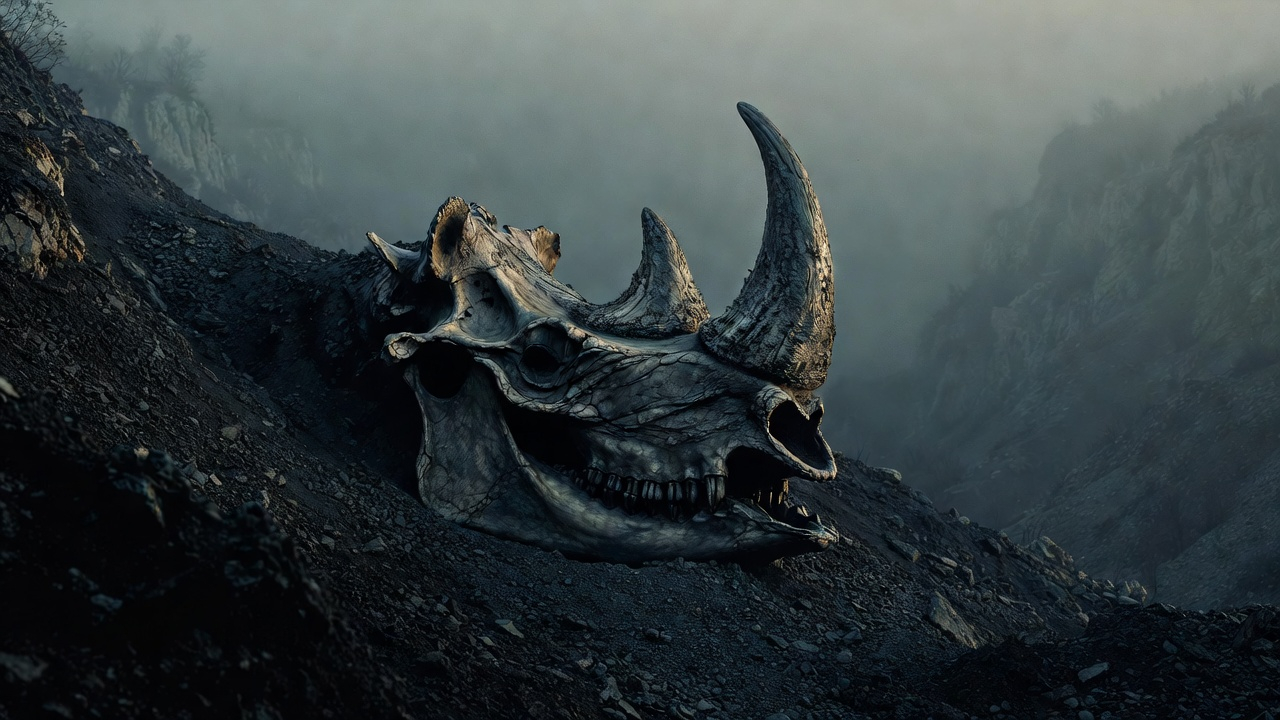
The discovery of colossal, ancient remains may have fueled early human imagination, contributing to the universal archetypes of powerful, fearsome beasts like dragons across diverse cultures.
Convergence Topic

The Dragon Paradox: Why Every Culture Invented the Same Monster

A cross-cultural investigation into the structural convergence, functional divergence, and contested origins of humanity's most universal mythological archetype.

Aboriginal AustralianAkkadianAncient EgyptianAncient GreekAztec/NahuaBabylonianBuddhistCherokeeChineseChristianDaoistGermanicHindu/VedicHittiteKhmer EmpireMayaMesoamericanMesopotamianMinoanNorseRomanScythianSumerianTeotihuacanoUgariticVedic

Site owner · Own

74Convergence
Score
Quick Brief

In 1335, workers quarrying stone near Klagenfurt, Austria unearthed a massive skull. They had no framework for understanding it as the remains of a woolly rhinoceros — so they understood it as a dragon. When the city commissioned a Lindwurm statue two and a half centuries later, the sculptor used that skull as his anatomical reference. The resulting monument is not merely folklore. It is documented evidence of a specific cognitive process: humans encountering inexplicable bones and reaching, almost reflexively, for the same explanation across continents and millennia. The same process has been documented in China, where dragon-bone medicine drew on genuine fossil deposits, and in Aboriginal Australia. The question this research pursues is whether that shared reflex points to something deeper — and the answer is more precise, and more unsettling, than either enthusiasts or skeptics typically allow.

The research surveyed dragon and serpent mythology across 26 traditions, from Sumerian to Cherokee, and returned a convergence score of 74 out of 100. That number deserves careful reading. It is not 95 — there is no single universal dragon archetype. But it is not 40 either. Across traditions separated by oceans and millennia, four structural elements recur with striking consistency: serpentine or reptilian form, association with water and fertility, a role as liminal guardian between human and cosmic realms, and involvement in primordial combat or creation narratives. These are not vague resemblances. The Nāga balustrades of Angkor Wat, the feathered serpent descending El Castillo at Chichen Itza on the equinox, and the Rainbow Serpent of Aboriginal Australian cosmology share a specific symbolic grammar even though no credible transmission pathway connects them.

What the research also found, with equal force, is that 'dragon' names a family of beings rather than a single archetype. The Chinese lóng is a benevolent, wingless, water-commanding deity associated with imperial legitimacy. The European dragon hoards gold, breathes fire, and must be slain by a hero or saint. The Hindu and Buddhist Nāga is a semi-divine cobra-being, morally ambivalent, guardian of subterranean treasure and monsoon rains. The Mesoamerican Feathered Serpent conflates sky and earth, avian and reptilian, in a creative synthesis with no Old World parallel. These are not variants of one thing. The convergence is structural and functional at a high level of abstraction; the divergence is profound at the level of meaning, morality, and cultural work the creature performs.

The fossil-inspiration hypothesis — compelling as the Klagenfurt case is — cannot bear the explanatory weight sometimes placed on it. The Rainbow Serpent, Tiamat, and the Vedic Nāga all predate any documented fossil encounter in their regions. Fossil discovery appears to reinforce and elaborate dragon traditions that were already generative, not to originate them. What generated the initial impulse remains genuinely contested: candidates include evolved predator-detection responses to large reptiles, ecological memory of Pleistocene megafauna, and the near-universal human tendency to animate water sources as serpentine beings.

The sharpest unresolved tension is methodological. The Chaoskampf pattern — cosmic serpent combat — runs from Babylon through Ugarit to Greece along documented routes of cultural transmission. Separating genuine independent invention from undetected historical diffusion is, in most cases, impossible to do with certainty. The case for true convergence is strongest precisely where contact was impossible: pre-contact Mesoamerica, Aboriginal Australia. Everywhere else, the question remains open. A 74 is an honest score. It reflects a phenomenon that is real, significant, and not yet fully explained.

ListenAudio Overview
The Evidence

What Should Surprise You

Ordered by how difficult each finding is to explain away.

05

A Rhinoceros Skull Became a Dragon's Face

In 1335, workers quarrying near Klagenfurt, Austria, unearthed a massive fossilized skull. With no framework for paleontology, the local population did what humans reliably do: they interpreted it as the remains of a monster. The skull was preserved in the town hall, and when civic authorities commissioned a monumental dragon statue in 1590, sculptor Ulrich Vogelsang used that skull as his anatomical reference. The result — the Klagenfurt Lindwurm — is a scientifically accurate depiction of a woolly rhinoceros (*Coelodonta antiquitatis*) rendered as a dragon. A medieval artist, working in complete ignorance of paleontology, produced what is now recognized as one of the earliest fossil-informed reconstructions in European history. The creature he thought he was depicting was mythological. The creature he actually depicted was real — and had been extinct for roughly 10,000 years. This is not folklore influencing fossil interpretation; it is a fossil directly shaping the physical iconography of a dragon tradition, documented and verifiable.

The Klagenfurt Lindwurm statue of 1590 is simultaneously a piece of dragon mythology and a demonstrably accurate paleontological reconstruction of *Coelodonta antiquitatis*, made two centuries before the science of paleontology existed.

05

The Pyramid That Summons a Serpent Twice a Year

The Pyramid of Kukulcan at Chichen Itza is not merely decorated with feathered serpent imagery — it is geometrically engineered to perform it. On the spring and autumn equinoxes, the stepped terraces of the northern staircase cast a precise sequence of triangular shadows against the balustrade, creating the optical illusion of a serpent body undulating downward toward the carved stone serpent head at the pyramid's base. The effect lasts approximately 34 minutes and requires the specific 9-terrace design, the 52-panel count (matching the 52-year Maya calendar cycle), and the precise north-facing orientation to function. This is not a coincidental alignment: the structure encodes the feathered serpent deity Kukulcan — cognate with the Aztec Quetzalcoatl — into the building's geometry such that the god literally appears on astronomically significant dates. The entire pyramid is, in the most literal architectural sense, a machine for manifesting a dragon myth at predictable moments.

The equinox shadow effect at El Castillo requires the specific combination of 9 terraces, 52 panels, and precise north-facing orientation to function — a convergence of calendar, astronomy, and serpent theology that cannot be accidental.

04

Dragon Literally Just Meant 'Big Snake'

The English word 'dragon' descends from Latin *draco*, which derives from Greek *drakōn* — a word that in classical Greek texts simply meant 'serpent' or 'large snake,' with no necessary implication of wings, fire-breathing, or treasure-hoarding. The root is likely connected to the Greek verb *derkesthai*, meaning 'to see clearly' or 'to flash,' possibly referencing the perceived intensity of a snake's gaze. The elaborate fire-breathing, winged, cave-dwelling monster of medieval European imagination is a late elaboration, assembled over centuries from multiple sources including Christian demonology, Germanic folklore, and classical sea-monster traditions. This means that when scholars discuss 'cross-cultural dragon archetypes,' they are partly measuring the spread of a word's semantic inflation rather than a universal mythological constant. The Chinese *lóng*, the Hindu Nāga, and the Mesoamerican feathered serpent were never called 'dragons' by their own traditions — that taxonomic collapse is a post-contact European imposition, which significantly complicates any claim of universal archetype.

The fire-breathing, winged European dragon is etymologically descended from a Greek word for 'large snake,' meaning the most iconic features of the Western dragon are medieval additions to a word that originally described something you might actually encounter in a field.

04

Chinese Pharmacies Sold Dinosaur Bones for Millennia

In Chinese traditional medicine, fossilized bones and teeth — collectively called *lóng gǔ* (龍骨), literally 'dragon bones' — were ground into powder and prescribed for conditions ranging from dysentery to madness. This practice was documented in the *Shennong Bencao Jing*, a foundational pharmacological text compiled around the 1st century CE, but the tradition almost certainly predates it substantially. The bones being sold were, in many documented cases, genuine dinosaur and Pleistocene mammal fossils. Western paleontologists in the late 19th and early 20th centuries reported purchasing scientifically significant fossil specimens directly from Chinese apothecary shops. The cognitive loop here is remarkable: fossils generated dragon mythology, dragon mythology assigned medicinal value to fossils, and that assigned value drove a market that consumed paleontological evidence for centuries before Western science arrived to identify what was actually being ground up. The tradition was documented as ongoing into the 20th century.

Western paleontologists in the early 20th century obtained scientifically significant dinosaur fossil specimens directly from Chinese pharmacies, where they had been inventoried as 'dragon bones' with documented medicinal applications — meaning a living folk-pharmacological tradition was consuming the physical evidence of its own mythological inspiration.

03

Isolated Australia Independently Built the Same Myth

The Aboriginal Australian Rainbow Serpent is one of the oldest continuously documented religious traditions on Earth, with rock art depictions potentially dating back 6,000 years or more, in a cultural context that had been geographically isolated from Eurasia for at least 50,000 years. Yet the Rainbow Serpent tradition independently converges on a remarkably specific cluster of attributes shared with Old World serpent-deity traditions: association with water sources and rainfall, creative and destructive power over the landscape, connection to fertility and birth, liminal guardian status, and a form that is fundamentally serpentine but cosmically scaled. This is not a vague thematic overlap — the structural parallels extend to the serpent's role as both creator and potential destroyer, its association with specific water bodies, and its capacity to swallow and regurgitate humans. The geographic isolation rules out diffusion as an explanation. What remains is either an extraordinarily deep common cognitive archetype predating the peopling of Australia, or a remarkable case of independent convergence on identical mythological solutions to identical ecological and psychological pressures.

A tradition geographically isolated for up to 50,000 years independently produced a water-associated, creation-linked, cosmically powerful serpent deity — the same structural complex found in Mesopotamia, India, China, and Mesoamerica — which either demands a pre-dispersal common origin or represents the most striking case of mythological convergent evolution on record.

Research Summary

What the Pipeline Found

In 1335, workers quarrying stone near Klagenfurt, Austria unearthed a massive skull. They had no framework for understanding it as the remains of a woolly rhinoceros — so they understood it as a dragon. When the city commissioned a Lindwurm statue two and a half centuries later, the sculptor used that skull as his anatomical reference. The resulting monument is not merely folklore. It is documented evidence of a specific cognitive process: humans encountering inexplicable bones and reaching, almost reflexively, for the same explanation across continents and millennia. The same process has been documented in China, where dragon-bone medicine drew on genuine fossil deposits, and in Aboriginal Australia. The question this research pursues is whether that shared reflex points to something deeper — and the answer is more precise, and more unsettling, than either enthusiasts or skeptics typically allow.

The research surveyed dragon and serpent mythology across 26 traditions, from Sumerian to Cherokee, and returned a convergence score of 74 out of 100. That number deserves careful reading. It is not 95 — there is no single universal dragon archetype. But it is not 40 either. Across traditions separated by oceans and millennia, four structural elements recur with striking consistency: serpentine or reptilian form, association with water and fertility, a role as liminal guardian between human and cosmic realms, and involvement in primordial combat or creation narratives. These are not vague resemblances. The Nāga balustrades of Angkor Wat, the feathered serpent descending El Castillo at Chichen Itza on the equinox, and the Rainbow Serpent of Aboriginal Australian cosmology share a specific symbolic grammar even though no credible transmission pathway connects them.

What the research also found, with equal force, is that 'dragon' names a family of beings rather than a single archetype. The Chinese lóng is a benevolent, wingless, water-commanding deity associated with imperial legitimacy. The European dragon hoards gold, breathes fire, and must be slain by a hero or saint. The Hindu and Buddhist Nāga is a semi-divine cobra-being, morally ambivalent, guardian of subterranean treasure and monsoon rains. The Mesoamerican Feathered Serpent conflates sky and earth, avian and reptilian, in a creative synthesis with no Old World parallel. These are not variants of one thing. The convergence is structural and functional at a high level of abstraction; the divergence is profound at the level of meaning, morality, and cultural work the creature performs.

The fossil-inspiration hypothesis — compelling as the Klagenfurt case is — cannot bear the explanatory weight sometimes placed on it. The Rainbow Serpent, Tiamat, and the Vedic Nāga all predate any documented fossil encounter in their regions. Fossil discovery appears to reinforce and elaborate dragon traditions that were already generative, not to originate them. What generated the initial impulse remains genuinely contested: candidates include evolved predator-detection responses to large reptiles, ecological memory of Pleistocene megafauna, and the near-universal human tendency to animate water sources as serpentine beings.

The sharpest unresolved tension is methodological. The Chaoskampf pattern — cosmic serpent combat — runs from Babylon through Ugarit to Greece along documented routes of cultural transmission. Separating genuine independent invention from undetected historical diffusion is, in most cases, impossible to do with certainty. The case for true convergence is strongest precisely where contact was impossible: pre-contact Mesoamerica, Aboriginal Australia. Everywhere else, the question remains open. A 74 is an honest score. It reflects a phenomenon that is real, significant, and not yet fully explained.

The Debate

Two Cases. You Decide.

The Advocate

The case for the significance of cross-cultural dragon and serpent mythology rests on two distinct but mutually reinforcing arguments: convergent cognitive architecture predicts the pattern we observe, and multiple independent lines of physical evidence confirm it.

Begin with what is empirically settled. The Klagenfurt Lindwurm dragon head was physically modeled on a woolly rhinoceros skull (*Coelodonta antiquitatis*) recovered from a local quarry in 1335 CE — this is not inference, it is forensic identification. Chinese 'lóng gǔ' (dragon bones) used in traditional medicine for millennia are confirmed dinosaur and Pleistocene mammal fossils from the rich fossil beds of Sichuan and Henan. In Aboriginal Australia, *Megalania prisca* (a 5–7 meter monitor lizard) and the terrestrial crocodile *Quinkana* were genuine megafauna in the recent geological past, providing a direct biological substrate for myths of giant predatory reptilian beings. Three continents, no documented contact, the same cognitive move: inexplicable giant reptilian remains become mythologized giant reptiles. This is not pattern-matching — it is a documented, physically attested generative mechanism operating independently across isolated cultures.

The Chaoskampf pattern adds a second, linguistically grounded layer. The Hebrew 'Līwyātan' is a direct descendant of the Ugaritic 'Ltn' (Lotan), from the root meaning 'to coil.' The Akkadian 'Tiamat' is a cognate of Hebrew 'tehom,' both from a Proto-Semitic root for 'the deep.' Within the Near Eastern and Mediterranean sphere, this is traceable transmission, not independent invention — and that distinction matters, because it means the strongest evidence for genuine independent convergence must come from elsewhere.

It does. The structural triad of (a) serpentine form, (b) water and creation association, and (c) ambivalent rather than purely evil moral valence appears in Chinese *lóng*, Hindu-Buddhist Nāga, Mesoamerican Quetzalcoatl/Kukulkan, and Aboriginal Australian Rainbow Serpent traditions. The geographic isolation of Aboriginal Australia from Mesoamerica, and of both from East Asia, makes pan-diffusion an insufficient single explanation for all four cases simultaneously. These traditions did not borrow from each other. They converged.

Architectural evidence provides a third independent line. Teotihuacan's Temple of the Feathered Serpent deploys 260 carved serpent heads — a number matching the Mesoamerican ritual calendar. Angkor Wat's Nāga balustrades frame the temple as a bridge between human and divine realms. Chichen Itza's Pyramid of Kukulcan produces an equinox solar hierophany depicting a serpent descending the staircase. Egyptian funerary architecture assigns the cobra-goddess Wadjet the role of royal protector and the chaos-serpent Apep the role of primary underworld threat. Four independent architectural traditions, across four continents, assigned the serpentine figure the identical functional role: liminal guardian of sacred space. This is convergence in deployment, not merely in iconographic existence.

Cognitive science provides the predictive framework that makes this convergence expected rather than mysterious. Primates possess documented heightened threat-detection responses to serpentine forms — an evolved response to genuine reptilian predation pressure across millions of years of evolutionary history. This cognitive substrate does not produce identical myths; it produces a shared starting point that local ecology, cosmology, and theology then elaborate differently. The divergence between the benevolent Chinese *lóng* and the malevolent European dragon is not a refutation of this model — it is a confirmation. A universal cognitive template modified by local context is precisely what the model predicts.

What the advocate cannot yet prove: the relative weighting of the fossil-inspiration mechanism versus the predator-detection mechanism as primary drivers; whether the water-serpent creator deity convergence reflects a genuinely universal cognitive attractor or a very ancient, archaeologically invisible common ancestor tradition; and whether the four structurally distinct global dragon types identified by comparative mythologists map cleanly onto distinct generative mechanisms or represent a more complex interaction. The confidence level of 0.78 is appropriate. The convergence is real, multi-evidenced, and genuinely significant. It is not yet fully explained.

The Skeptic

The cross-cultural dragon archetype, upon rigorous examination, resolves into a more parsimonious set of explanations that require neither a shared cognitive template nor mysterious convergent invention. The skeptic's case rests on four interlocking arguments, each independently strong and collectively formidable.

The foundational problem is taxonomic. 'Dragon' is not a natural kind discovered in the world's mythologies — it is a category imposed upon them by Western comparative scholarship. When examined on their own terms, the Chinese lóng (benevolent, wingless, chimeric water deity), the Hindu Nāga (semi-divine serpent guardian), the Mesoamerican Feathered Serpent (avian-reptilian creator), and the European dragon (malevolent, fire-breathing, treasure-hoarding) are structurally distinct beings that share only the broadest possible feature: large, serpentine form. A definition capacious enough to contain all four has been stretched until it contains almost nothing. Any culture that encounters snakes — which is every culture on Earth — will produce serpentine supernatural beings. The apparent universality is an artifact of the definition, not evidence of a shared archetype.

The second argument concerns the most striking apparent convergences. The Chaoskampf pattern — cosmic serpent-monster defeated by a storm or sky deity — appears across Mesopotamian, Ugaritic, Hebrew, Greek, and related traditions. This is not convergent invention. It is documented cultural diffusion with explicit philological transmission routes. Leviathan is linguistically derived from the Ugaritic Lotan. Tiamat's name is cognate with the Hebrew tehom. The Septuagint's translation of multiple distinct Hebrew terms as the single Greek drakōn artificially unified a category that did not exist in the source texts. The Khmer Nāga tradition follows documented Hindu-Buddhist transmission routes along established trade networks. These are not mysteries requiring a universal archetype; they are the expected outputs of well-understood historical processes of conquest, trade, scribal transmission, and religious syncretism.

The third argument addresses the cognitive baseline. The universal requiring explanation is not 'dragon' but 'large serpent as supernatural being.' Snakes are genuinely universal in human experience, genuinely dangerous, and exhibit behaviors — skin-shedding, limbless locomotion, emergence from underground — that invite supernatural interpretation within any animistic cognitive framework. A predisposition to find serpentine forms threatening or numinous requires no Jungian collective unconscious, no ancestral dinosaur memory, and no mysterious convergence. It requires only that humans everywhere encounter snakes and possess the universal capacity for animistic thinking. The divergences between traditions — benevolent versus malevolent, winged versus wingless, fire versus water — are precisely what independent local elaboration of a shared baseline predicts, not what a shared archetype predicts.

The fossil hypothesis, while empirically documented in specific cases, is more limited than proponents claim. The Klagenfurt rhinoceros skull and Chinese dragon bones demonstrate that fossils can elaborate pre-existing serpent myths locally. They do not explain the origin of those myths, and they cannot account for dragon traditions in regions without accessible large vertebrate fossil beds. The Aboriginal Australian case — Megalania as a plausible basis for giant reptile myths — is a geographically isolated phenomenon with no transmission route connecting it to Eurasian traditions. Each fossil case is independent and local.

The comparative methodology itself warrants scrutiny. Convergence scoring systematically highlights shared features while underweighting the far more numerous divergences. The Chinese lóng and European dragon share 'large reptilian being' and little else; treating them as instances of a unified archetype requires ignoring the majority of their defining characteristics. This is the confirmation bias that has plagued comparative mythology since Frazer.

What the skeptic cannot fully explain away: the Aboriginal Australian and pre-contact Mesoamerican cases remain genuinely difficult. These traditions developed in geographic isolation from the Near Eastern diffusion network and from each other, yet produce beings with structural similarities — serpentine form, water association, liminal guardian role — to traditions elsewhere. The honest skeptical position is that these cases are better explained by independent elaboration of the universal serpent baseline than by a shared archetype, but the argument is less decisive here than elsewhere. The convergence is real; the question is whether 'large supernatural serpent' constitutes a meaningful archetype or merely the predictable output of universal human cognitive tendencies applied to a universally encountered animal. The skeptic's wager is on the latter — and at confidence 0.72, it remains a wager, not a certainty.

In Their Own Words

How Each Tradition Tells It

Chinese

The lóng is assembled from nine animals: the head of a camel, the horns of a deer, the eyes of a demon, the ears of a cow, the neck of a snake, the belly of a clam, the scales of a carp — eighty-one yang scales and thirty-six yin scales — the claws of an eagle, and the paws of a tiger. It carries a pearl beneath its chin or clutches it in one claw, and that pearl is the concentrated essence of rain, of lunar power, of the transformative energy that moves between heaven and earth. The lóng does not breathe fire; it breathes clouds. When it rises from its river or lake or sea, the sky darkens and the rain comes, and this is not destruction but gift. The four Dragon Kings — Ao Guang of the East Sea, Ao Qin of the South, Ao Run of the West, Ao Shun of the North — hold court in underwater palaces and must be petitioned for rain. The emperor is the Son of Heaven and the Dragon Throne is not a metaphor.

Akkadian

The mušḫuššu moves through Akkadian sacred space as the living signature of divine power. Its neck is the neck of a serpent, long and scaled, rising from the body of a lion whose forelimbs grip the earth; its hindquarters end in the taloned feet of an eagle. It does not breathe fire — it embodies the furious splendor (ḫuš) that belongs to gods. When Marduk claimed it from Tishpak and made it his own, the mušḫuššu became the mark of cosmic sovereignty. It stands on the Ishtar Gate not as a guardian against enemies but as a declaration: this city is held by the god who holds the serpent-lion-eagle. Its patronage could shift between deities, which means it was not a creature with a fixed nature but a potency that could be wielded.

Buddhist

In the Pali texts, when the Buddha attained enlightenment under the Bodhi tree, the nāga king Mucalinda rose from the earth and spread his seven hoods over the meditating Buddha to shelter him from a great storm. This is the nāga's proper role: not enemy but protector of the Dharma. Nāgas inhabit the nāgaloka beneath the waters and beneath the earth, in palaces of jewels and coral. They are shapeshifters — cobra in their true form, human when they walk among us, and some are so ancient and powerful that their breath can cause drought or flood depending on their mood. A nāga who has heard the Dharma becomes a guardian of the teaching. A nāga who has been wronged — a spring polluted, a tree cut without offering — becomes a source of illness and misfortune. They must be addressed with respect, not slain.

Cherokee

The Uktena is not something you go looking for. It lives in the deep bends of rivers, in the mountain passes where the air goes cold without reason, and its presence is announced by a light — the Ulunsu'ti, the great crystal blazing in its forehead like a star that has fallen into the water. It is as large as a tree trunk, horned, with rings of color along its body, and to look directly at it is to be drawn toward it against your will, pulled into the water before you understand what is happening. Only a man who has already lost everything — who has nothing left to fear — can approach the Uktena and take the crystal from its forehead. That crystal, properly kept, gives its owner power over life and death, over weather and war. The Uktena is not evil in the way a European dragon is evil; it is simply a power too large for ordinary human contact.

Christian

The dragon of Christian tradition wears the face of the ancient serpent from the Garden, the one who spoke to Eve, and in the Book of Revelation it becomes explicit: the great red dragon with seven heads and ten horns is Satan himself, the adversary, cast down from heaven. Saint George does not simply kill a dragon — he tames it

Babylonian

In the beginning, Tiamat was the salt sea, and Apsu was the fresh water, and their mingling was the first thing. From that mingling came the gods, and the gods were noisy, and Apsu could not sleep. When Marduk finally faced Tiamat, she had become something terrible — a dragon-mother, her body the primordial ocean itself, her allies the eleven monsters she had birthed: the mušmahhu, the ušumgallu, the dragon, the great lion, the mad dog, the scorpion-man. Marduk drove the winds into her open mouth so she could not close it, and split her body in two, and from her upper half made the sky and from her lower half made the earth. The mušḫuššu — the furious serpent — became Marduk's own emblem after this victory, worn as proof that the chaos-power had been mastered and turned to order's service.

Aztec/Nahua

Quetzalcoatl is wind made visible, the breath between the feathers of the quetzal bird and the scales of the serpent. He is Ce Acatl, One Reed, the morning star that dies into the western sea and is reborn at dawn. His body is the union of what flies and what crawls — the quetzal's iridescent green plumage erupting from a rattlesnake's body, the sky reaching down to touch the earth. He does not hoard; he gives: he gave humanity maize, the calendar, writing, the arts of civilization. In the Nahua telling, he was tricked by Tezcatlipoca into drunkenness and shame, and he departed eastward on a raft of serpents, promising to return in a One Reed year. His temples face west, into the wind. When the wind rises before rain, that is Quetzalcoatl moving through the world.

Ancient Greek

The Greek drakon is first of all a watcher — its name comes from the verb derkesthai, to see with terrible clarity, to fix with an unblinking gaze. It does not sleep. The drakon at Colchis never slept, which is why the Golden Fleece was still there to be taken. It is coiled around the thing it guards — the tree, the spring, the golden fruit — and its body is the boundary between the human world and the sacred. It is not primarily fire-breathing in the earliest sources; it is venomous, constricting, and above all vigilant. The Lernaean Hydra regrows its heads because the principle of chaos cannot be simply cut away. Python at Delphi was the original possessor of the oracle, the chthonic voice of the earth itself, before Apollo killed it and took the site — and the rotting body of Python gave Delphi its name and its smell.

Ancient Egyptian

Apep — Apophis — is not a dragon in any comfortable sense. It is the darkness that existed before the first sunrise, the roaring void that the solar barque of Ra must pass through every night in the Duat. It is enormous beyond measurement, coiled around the underworld, and its voice is the sound of the abyss. The cobra-goddess Wadjet is its opposite and counterpart: she rises from the brow of the pharaoh as the uraeus, the living flame that burns enemies before they can strike. In the tomb texts, serpents are both threat and protection — the forty-two assessors of the dead include serpentine forms, and the gates of the underworld are guarded by serpents who must be named correctly to pass. To know the serpent's name is to own its power.

Aboriginal Australian

The Rainbow Serpent does not arrive — it has always been here, coiled beneath the waterholes before time had a name. In the Dreaming, it moved across the land and its body carved the riverbeds, its scales leaving the ridgelines, its breath filling the billabongs. It is not a creature you encounter; it is the country itself remembering its own making. At specific waterholes — not waterholes in general, but this one, here, with its particular smell of wet clay and paperbark — the Serpent's presence is immediate and ongoing. It is iridescent, shifting color the way still water shifts at dusk. To disturb its resting place is not to provoke an animal but to interrupt a living cosmology. It swallows those who violate sacred law and vomits them up transformed, or not at all.

Unresolved

Open Questions

What neither the Advocate nor the Skeptic can fully explain.

01

The Aboriginal Australian Rainbow Serpent is the strongest candidate for an independently invented serpentine water-deity, yet its antiquity remains unresolved: can luminescence dating of ochre pigments at Arnhem Land rock art sites — particularly the Nawarla Gabarnmang shelter, where charcoal beneath painted panels has been dated to ~28,000 BP — establish whether Rainbow Serpent iconography predates the Holocene flooding of the Sahul coastline, which would place its origin before any plausible contact with Old World traditions and constitute the strongest empirical test of the independent-invention hypothesis?

02

The Proto-Indo-European root *h₁ógʷʰis reconstructed for 'serpent/dragon' underlies cognates in Vedic (áhi), Greek (ophis), and Armenian (iž), all of which appear in Chaoskampf narratives — but the directionality of causation is unresolved: can phylogenetic network analysis applied to the structural features of the combat myth (hero identity, weapon type, aquatic setting, post-victory cosmogony) across the full Indo-European language tree determine whether the narrative pattern is older than the linguistic divergence, or whether the PIE root generated a narrative template that was independently elaborated in daughter traditions?

03

The Chinese lóng's persistent benevolence relative to the malevolent European dragon represents the most structurally significant divergence in the dragon-archetype family, and the editorial hypothesis that monotheism is a causal factor is plausible but untested: can a systematic comparison of dragon valence (benevolent/ambivalent/malevolent) across a controlled sample of polytheistic versus monotheistic traditions — including Zoroastrian Aži Dahāka, Hindu Vṛtra, and the Christianization of Germanic worm-lore — isolate monotheism as an independent variable, or does the correlation dissolve when ecological and agricultural variables (flood-dependent rice agriculture in China versus livestock-raiding in northern Europe) are controlled for?

04

The Klagenfurt Lindwurm case documents a specific mechanism — a locally discovered Pleistocene skull (Coelodonta antiquitatis, c. 1335 CE) directly influencing dragon iconography — but this is a single, well-documented instance: can a systematic survey of municipal dragon emblems, cathedral gargoyles, and chronicle descriptions across the Rhine-Danube corridor, cross-referenced with Quaternary paleontological site records and medieval quarrying histories, determine how frequently Pleistocene megafauna remains (woolly rhinoceros, cave bear, mammoth) were recovered in proximity to sites that subsequently generated or modified local dragon legends, thereby establishing whether fossil encounter is a statistically significant predictor of iconographic elaboration rather than an anecdotal curiosity?

05

The Nāga balustrades of Angkor Wat and related Khmer temple-mountains are interpreted as bridges between human and divine realms, but the specific numerology of Nāga heads (five, seven, or nine) varies across temples and periods without a settled explanation: can a chronologically ordered iconometric survey of Nāga head-counts across Khmer monuments from the 9th through 15th centuries, correlated with epigraphic evidence of royal patronage and Sanskrit astronomical texts circulating at the Khmer court, determine whether the head-count variation tracks dynastic theological shifts, astronomical cycles (particularly the 9-year lunar nodal cycle associated with Rāhu), or the influence of specific Śaiva versus Vaiṣṇava patronage networks?

06

The fossil-inspiration hypothesis explains iconographic elaboration but cannot account for the generative impulse behind serpent veneration that precedes documented fossil encounters — yet the hypothesis has never been tested against a null model: can a cross-cultural database of serpent-deity traditions be scored for proximity to Pleistocene megafauna fossil beds (using GIS analysis of known Quaternary fossil localities) and then subjected to a permutation test to determine whether the geographic co-occurrence of fossil-rich terrain and dragon-myth elaboration exceeds chance expectation, thereby distinguishing the fossil-reinforcement hypothesis from a purely cognitive or ecological origin model?

07

The Mesoamerican Feathered Serpent — Quetzalcóatl in Nahua tradition, Kukulcan among the Maya

AI Consensus Check

How the Major AIs Handle This Topic

We asked ChatGPT, Grok, Claude, Gemini, and Perplexity a question matching our specific convergence angle — not a generic topic summary. Claude classified each response using a 4-axis scoring rubric. Does mainstream AI engage with the actual evidence — or qualify, dismiss, or suppress?

Engagesaddresses it substantively
Qualifieshedges heavily
Dismissescalls it fringe
Suppressesrefuses to engage
GPT

ChatGPT (GPT-4o)

Apr 2026

Engages

The topic of "The Dragon Paradox: Why Every Culture Invented the Same Monster" explores the intriguing question of why various unrelated cultures around the world have independently developed myths an

The response addresses the topic seriously by explaining cultural variations in dragon myths and acknowledging the fascinating nature of their cross-cultural presence without dismissive language or excessive hedging.

GRK

Grok (xAI)

Apr 2026

Engages

Let’s dive into the topic "The Dragon Paradox: Why Every Culture Invented the Same Monster" and explore what I know about it, as well as assess the credibility of the idea and the context you provided

The response addresses the dragon paradox topic seriously and substantively, providing a clear definition and beginning to explore the cultural phenomenon without dismissive language or excessive hedging.

CLD

Claude (Anthropic)

Apr 2026

Engages

This topic touches on a fascinating intersection of paleontology, mythology, and cultural anthropology that has legitimate scholarly merit, though the specific framing as "The Dragon Paradox" appears

The response addresses the topic seriously with scholarly analysis, providing specific historical evidence and acknowledging the legitimate academic merit of the subject matter.

GEM

Gemini (Google)

Apr 2026

Engages

Okay, let's break down the topic "The Dragon Paradox: Why Every Culture Invented the Same Monster" and analyze its credibility in light of the Klagenfurt anecdote and broader cultural considerations.

The response addresses the topic seriously by breaking down the core concept, explaining the paradox clearly, and beginning a substantive analysis without dismissiveness or excessive hedging.

Verbatim responses from each AI's API, analyzed by Claude. Generated April 2026.

Related Research

Topics That Share These Threads

Gods, Rockets, and Bad Translations: The Annunaki, Sitchin, and the Limits of Ancient Astronaut Theory
18/100

Gods, Rockets, and Bad Translations: The Annunaki, Sitchin, and the Limits of Ancient Astronaut Theory

Here is what should surprise anyone who approaches this topic honestly: the structural parallels between Sumerian and Hebrew tradition are real, specific, and genuinely unexplained by coincidence. The Sumerian King List and the genealogies of Genesis 5 share not merely a flood story but an identical narrative architecture — antediluvian figures with superhuman lifespans, a catastrophic deluge as a hard break in history, and a post-flood world where longevity collapses toward the human. Archaeolo

SumerianAkkadianBabylonianBiblical Hebrew+15
The Resonant Temple: Acoustic Archaeology and the Ancient Engineering of Sacred Sound
78/100

The Resonant Temple: Acoustic Archaeology and the Ancient Engineering of Sacred Sound

Separated by oceans, millennia, and every conceivable cultural barrier, the builders of Neolithic Malta, Bronze Age Ireland, pre-Columbian Peru, and classical Rome appear to have converged on a single architectural fact: enclosed stone chambers of ritual scale resonate most powerfully at frequencies between 110 and 120 Hz. That number — roughly the lower boundary of a male tenor voice — is the most provocative empirical claim in this dossier, and the one that demands the most scrutiny. This res

Aboriginal AustralianAncient EgyptianAncient GreekAncient Israelite+19
The Axis of Everything: Why Every Culture on Earth Invented the Tree of Life
79/100

The Axis of Everything: Why Every Culture on Earth Invented the Tree of Life

A cosmic tree holds up the sky in Norse mythology, its roots drinking from the well of fate. The same structure — three vertical realms, one arboreal axis — appears on the sarcophagus lid of a Mayan king buried in 683 CE, in the ceremonial poles of Yolŋu communities in Aboriginal Australia, in the palace reliefs of Assyrian emperors, and in a private notebook kept by Charles Darwin in 1837. The symbol scores 79 out of 100 on this study's convergence index across more than thirty traditions spann

Norse MythologyMaya ReligionAssyrian/MesopotamianAncient Egyptian+28
Elongated Skulls: Royalty, Ritual, or Something Else?
78/100

Elongated Skulls: Royalty, Ritual, or Something Else?

Here is the central paradox: one of the most visually striking phenomena in world archaeology — skulls stretched to dramatic elongation across dozens of unconnected cultures on every inhabited continent — has a thoroughly documented, scientifically uncontroversial explanation, and yet that explanation coexists with a thriving counter-narrative claiming extraterrestrial or hybrid-human origins. The practice of artificial cranial deformation (ACD), achieved by binding infants' heads with cloth, bo

Paracas CultureAncient Egyptian (Amarna Period)Greco-Roman (Macrocephali)Mangbetu+19
Sources

Primary References

01
unknown. The Epic of Creation (Enuma Elish) (-1800), Tablet IV
sacred text
02
unknown. Book of Job (-600), Chapters 40–41
sacred text
03
Hesiod. Theogony (-700), Lines describing Typhon, Hydra, Python
sacred text
Share this research
Share on X
FacebookLinkedIn

Want to use this research? Everything here is free with attribution.

See how →
No ratings yet