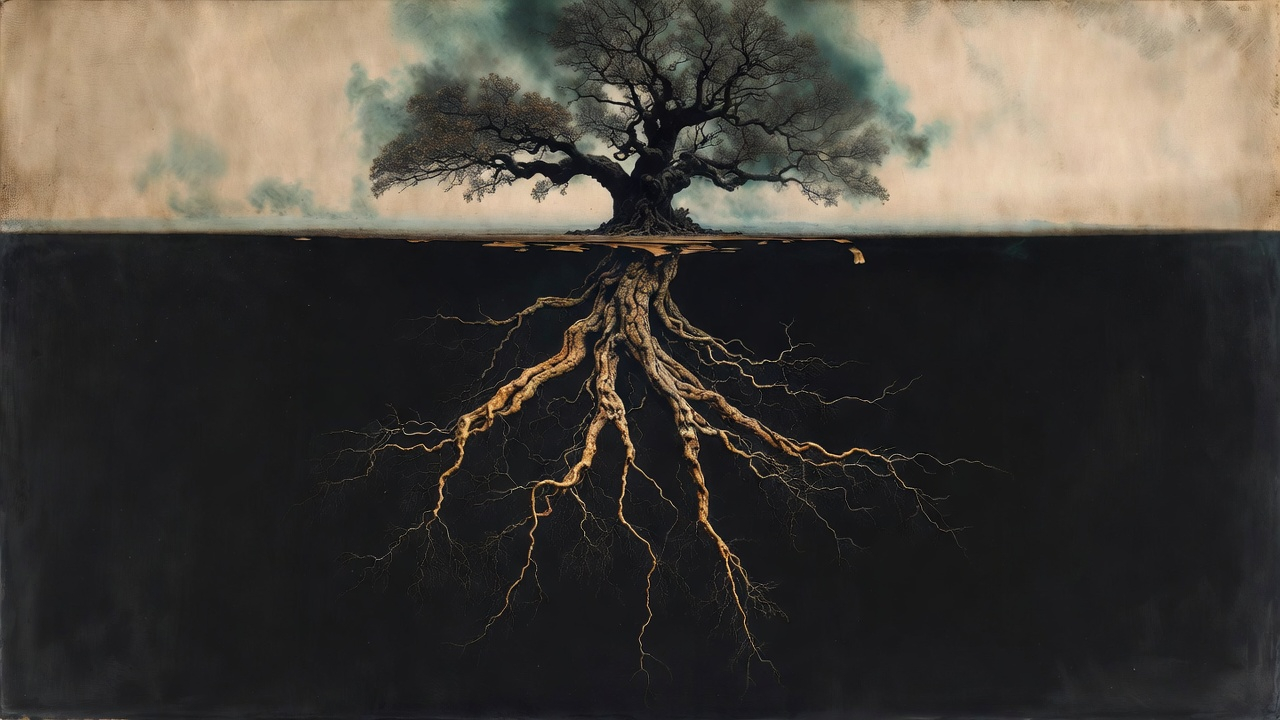
A symbolic depiction of the Tree of Life, illustrating its profound connection between the celestial and chthonic realms, a universal motif across diverse cultures.
Convergence Topic

The Axis of Everything: Why Every Culture on Earth Invented the Tree of Life

From Yggdrasil to Yaxche to the phylogenetic tree, a single symbol has organized human cosmology, politics, and science across five continents and ten thousand years — and the reasons why are stranger than the coincidence.

Norse MythologyMaya ReligionAssyrian/MesopotamianAncient EgyptianJudaism / KabbalahChristianityIslamHinduism / VedicBuddhismCanaanite ReligionHaudenosaunee (Iroquois)Lakota / Plains IndigenousOjibwe (Anishinaabe)HopiAboriginal Australian (Yolŋu, Arrernte, Tiwi)MāoriAmazonian Shamanism (Shipibo-Conibo, Asháninka, Kayapó)Siberian Shamanism (Evenki, Yakut/Sakha, Buryat)African (Yoruba, Dogon, Bantu, Mandinka)Chinese (Fusang, Taoist)ZoroastrianismAztec / NahuaAndean / QuechuaCeltic / DruidicGermanic / Norse-GermanicSumerianBabylonianAkkadianPlatonism / Greek Mystery ReligionModern Evolutionary BiologyCognitive Science of ReligionComparative Mythology

Site owner · Own

79Convergence
Score
Quick Brief

A cosmic tree holds up the sky in Norse mythology, its roots drinking from the well of fate. The same structure — three vertical realms, one arboreal axis — appears on the sarcophagus lid of a Mayan king buried in 683 CE, in the ceremonial poles of Yolŋu communities in Aboriginal Australia, in the palace reliefs of Assyrian emperors, and in a private notebook kept by Charles Darwin in 1837. The pattern that keeps surfacing across more than thirty traditions, five continents, and ten millennia is strong enough to be statistically improbable under any null hypothesis of random cultural variation. It is also, if we're being honest, strong enough to attract exactly the kind of overreach that serious scholarship should resist.

The structural parallels are genuine, and the genuine outliers matter just as much. Islam's Sidrat al-Muntaha — the Lote Tree at the boundary of divine knowledge — functions not as a life-giving axis but as a celestial stop sign, beyond which no created thing may pass. The Assyrian Sacred Tree, rendered in meticulous stone relief across Neo-Assyrian palaces from 911 to 609 BCE, appears to have served primarily as an instrument of royal ideology rather than a source of immortality. These are not minor variations on a theme. They are the data points that refuse to be tidied away.

Three tensions run through this research and will not be resolved here. The cognitive science explanation — that human brains universally map abstract hierarchy onto vertical spatial schemas, making tree-shaped cosmologies cognitively inevitable — is powerful, but potentially too powerful: it predicts the general pattern without explaining why the specific tripartite structure of underworld, earth, and heaven recurs rather than other vertical arrangements. The Ancient Near Eastern cluster presents a serious methodological problem, because if the Mesopotamian, Egyptian, Canaanite, and Hebrew traditions represent a single diffusion event, the number of genuinely independent data points drops sharply and the geographic argument for cognitive universals weakens considerably. And 'Tree of Life' may itself be an imposed interpretive category, a label applied retrospectively to symbols whose original semantic content varied enough that grouping them together tells us more about modern comparative mythology than about ancient cosmology.

The detail that refuses to fit neatly into any of these frameworks is also the most arresting one. Darwin sketched his first evolutionary tree in a private notebook in 1837, labeled it 'I think,' and published it formally twenty-two years later in On the Origin of Species. The man who spent his career dismantling teleological thinking about nature chose, as his central organizing metaphor for all of life's history, a symbol that had organized human cosmology since before writing existed. Whether that choice was strategic, unconscious, or simply the only shape that fit the data is a question this research raises without answering — which is, arguably, where the most interesting questions live.

ListenAudio Overview
The Evidence

What Should Surprise You

Ordered by how difficult each finding is to explain away.

05

The Upside-Down Universe: Three Traditions That Independently Flipped the Tree

The intuitive image of a cosmic tree grows upward. Yet three traditions — the Kabbalistic Sefirot of Jewish mysticism, the Vedantic Ashvattha described in the Bhagavad Gita (15.1: 'roots above, branches below'), and Plato's description in the Timaeus of humans as 'inverted plants' whose roots are in heaven — all independently depict the cosmic tree growing downward from a divine source. This is a counter-intuitive inversion of the natural image, and it carries a consistent theological payload: the divine is the root, the material world is the peripheral foliage. The Ashvattha appears in texts predating Platonic philosophy, and the Kabbalistic Sefirot, while later in its systematized form, draws on imagery that Simo Parpola has argued traces to Assyrian sacred tree iconography. Three traditions, separated by geography and largely by time, chose the same paradoxical image to make the same metaphysical point: reality is upside-down from how we perceive it. The cognitive universals hypothesis, which explains the upright tree rather elegantly, has considerably more trouble with this one.

The Bhagavad Gita's 'roots above, branches below' Ashvattha, Plato's 'inverted plant' in the Timaeus, and the Kabbalistic Sefirot all independently chose the same counter-intuitive inversion — and all three deploy it to make structurally identical claims about the relationship between the divine and the material world.

05

Darwin's 'I Think': The Moment a Sacred Symbol Became Science

In 1837, twenty-two years before On the Origin of Species, Charles Darwin sketched a branching diagram in his private Notebook B and wrote above it: 'I think.' This was the first evolutionary tree, and Darwin explicitly used the phrase 'great Tree of Life' in the published work to describe it. What actually complicates the picture is not merely that Darwin borrowed an ancient archetype, but that this single act of secular appropriation made the Tree of Life the most empirically consequential diagram in the history of biology. Every phylogenetic tree produced by modern genomics — including those that revealed Neanderthal and Denisovan admixture in modern human ancestry — descends from that 1837 sketch. The sacred symbol did not fade when science replaced religion; it became the organizing metaphor of evolutionary biology and has since been confirmed, at the molecular level, to be literally true: all known life shares common ancestry traceable through branching lineages. Darwin set out to explain nature without recourse to myth, and ended up vindicating mythology's central image.

The most influential scientific diagram of the nineteenth century is a secularized Tree of Life, first sketched privately in 1837, and modern genomics has since confirmed that the metaphor is, at the molecular level, structurally accurate.

04

Pakal's Sarcophagus: The King Whose Body Became the World Tree

When K'inich Janaab' Pakal was buried at Palenque in 683 CE, his sarcophagus lid — a five-tonne limestone bas-relief — depicted him at the moment of death reclining at the base of the Wacah Chan, the Mayan World Tree, which grows directly from his body. The tree rises through the cosmic levels to the celestial bird at its apex. This is not a king being honored beside a sacred symbol; the iconographic program makes Pakal's body the generative root of the cosmic axis. The San Bartolo murals of Guatemala (c. 100 BCE), the earliest known explicit Mesoamerican World Tree depiction, show the Maize God raising the tree to establish world order, meaning the Palenque tradition has at least 800 years of iconographic precedent behind it. Pakal's burial is the most archaeologically precise instance anywhere of a human being ritually identified as the World Tree at the moment of death. The sarcophagus lid doesn't show a king worshipping the cosmos — it shows the cosmos growing out of a corpse.

The sarcophagus lid does not show a king worshipping the World Tree — it shows the World Tree growing from the king's body, making his corpse the literal cosmic axis in a tradition with 800 years of iconographic precedent.

04

The Great Tree of Peace: When Mythology Became a Constitution

Most Tree of Life traditions are mythological or cosmological — stories about the structure of the universe. The Haudenosaunee (Iroquois) Great Tree of Peace is something categorically different: it is a political institution. The white pine under which the five founding nations buried their weapons to form the Iroquois Confederacy — with its roots extending to the four cardinal directions and an eagle perched at the top to watch for threats — is not a narrative about cosmic structure. It is the founding charter of one of the longest-surviving confederate governments in human history, one whose influence on the framers of the U.S. Constitution has been formally acknowledged by the U.S. Senate in a 1988 resolution. The Tree of Life here is not a symbol of cosmic order; it is the mechanism by which cosmic order — peace, law, shared governance — is made politically real. No other tradition in the global dataset collapses the mythological and the institutional into a single living object in this way. The tree didn't represent the law. It was the law.

The Haudenosaunee Great Tree of Peace is the only Tree of Life in the global dataset that functions not as myth or symbol but as a constitutional instrument — the literal founding act of a confederacy whose governance structure influenced Enlightenment political theory, as acknowledged by the U.S. Senate in 1988.

03

The Tree That Says Stop: Islam's Cosmic Boundary Marker

Every major Tree of Life tradition in the dataset functions as a source — of life, wisdom, cosmic order, or ancestral connection. The Islamic Sidrat al-Muntaha (Lote Tree of the Utmost End), described in Surah An-Najm (53:14–16) as the tree at the boundary of the seventh heaven, does something structurally different: it marks the limit of what any created being can know or approach. During the Prophet Muhammad's Night Journey (Isra and Mi'raj), even the angel Jibreel stops at this tree, unable to proceed further. The tree is not a source of life flowing downward into the world; it is a cosmic firewall, the outermost edge of accessible divine reality. This inversion of the tree's usual function — from generative center to prohibitive boundary — within a tradition that otherwise shares the Abrahamic Tree of Life inheritance is a genuinely anomalous data point that the convergence literature rarely addresses with the seriousness it deserves. The loose thread that refuses to be tied is this: if the tree symbol is cognitively or theologically universal, why does one of the world's largest religious traditions use it to mean the opposite of what everyone else does?

In every other major tradition the World Tree is a source or axis; the Sidrat al-Muntaha is the one instance in the global dataset where the cosmic tree functions explicitly as a boundary beyond which even angelic beings cannot pass — a structural inversion that sits largely unaddressed in the comparative literature.

02

The Yolŋu Larrakitj: The Coffin That Is the Tree

In Yolŋu mortuary practice from Arnhem Land in northern Australia, the larrakitj is a hollow log coffin into which the bones of the deceased are placed after secondary burial. The object is not decorated to resemble a tree or placed beside a tree — it is a section of eucalyptus trunk, minimally worked, whose hollow interior becomes the passage through which the deceased travels back to the ancestral realm. The tree is not a symbol of the journey; it is the vehicle of the journey, and the deceased literally travels inside it. Given that Aboriginal Australian cultures have continuous occupation records of at least 40,000 years, the larrakitj tradition represents one of the oldest potentially dateable instances of tree-as-cosmic-conduit in the dataset. It is also the only one in which the symbolic and the literal are entirely collapsed: the coffin does not represent the World Tree. It simply is one. Every other tradition in this study uses the tree as metaphor, monument, or narrative. The Yolŋu dispensed with the metaphor entirely.

The Yolŋu larrakitj is the only instance in the global dataset where the Tree of Life is not a symbol, metaphor, or monument — it is the literal hollow trunk inside which the dead person's bones are placed for the journey to the ancestral realm, in a tradition with a 40,000-year occupation record.

Research Summary

What the Pipeline Found

A cosmic tree holds up the sky in Norse mythology, its roots drinking from the well of fate. The same structure — three vertical realms, one arboreal axis — appears on the sarcophagus lid of a Mayan king buried in 683 CE, in the ceremonial poles of Yolŋu communities in Aboriginal Australia, in the palace reliefs of Assyrian emperors, and in a private notebook kept by Charles Darwin in 1837. The pattern that keeps surfacing across more than thirty traditions, five continents, and ten millennia is strong enough to be statistically improbable under any null hypothesis of random cultural variation. It is also, if we're being honest, strong enough to attract exactly the kind of overreach that serious scholarship should resist.

The structural parallels are genuine, and the genuine outliers matter just as much. Islam's Sidrat al-Muntaha — the Lote Tree at the boundary of divine knowledge — functions not as a life-giving axis but as a celestial stop sign, beyond which no created thing may pass. The Assyrian Sacred Tree, rendered in meticulous stone relief across Neo-Assyrian palaces from 911 to 609 BCE, appears to have served primarily as an instrument of royal ideology rather than a source of immortality. These are not minor variations on a theme. They are the data points that refuse to be tidied away.

Three tensions run through this research and will not be resolved here. The cognitive science explanation — that human brains universally map abstract hierarchy onto vertical spatial schemas, making tree-shaped cosmologies cognitively inevitable — is powerful, but potentially too powerful: it predicts the general pattern without explaining why the specific tripartite structure of underworld, earth, and heaven recurs rather than other vertical arrangements. The Ancient Near Eastern cluster presents a serious methodological problem, because if the Mesopotamian, Egyptian, Canaanite, and Hebrew traditions represent a single diffusion event, the number of genuinely independent data points drops sharply and the geographic argument for cognitive universals weakens considerably. And 'Tree of Life' may itself be an imposed interpretive category, a label applied retrospectively to symbols whose original semantic content varied enough that grouping them together tells us more about modern comparative mythology than about ancient cosmology.

The detail that refuses to fit neatly into any of these frameworks is also the most arresting one. Darwin sketched his first evolutionary tree in a private notebook in 1837, labeled it 'I think,' and published it formally twenty-two years later in On the Origin of Species. The man who spent his career dismantling teleological thinking about nature chose, as his central organizing metaphor for all of life's history, a symbol that had organized human cosmology since before writing existed. Whether that choice was strategic, unconscious, or simply the only shape that fit the data is a question this research raises without answering — which is, arguably, where the most interesting questions live.

The Debate

Two Cases. You Decide.

The Advocate

The case for meaningful cross-cultural convergence in Tree of Life symbolism rests on a specific, testable claim: that the parallels are too structurally precise, too geographically distributed, and too cognitively grounded to be dismissed as coincidence or vague pattern-matching. The advocate's confidence is substantial without being certain.

The strongest single argument is structural specificity. What emerges from the evidence is not merely that trees appear in many cultures, but that a particular configuration recurs with remarkable consistency: roots in an underworld, trunk at the terrestrial level, branches in a celestial realm. The Norse Yggdrasil, preserved in the Prose Edda (c. 1220 CE) from older oral material, describes a three-rooted ash connecting nine worlds across exactly this tripartite vertical axis. The Maya World Tree, Wacah Chan, depicted on the sarcophagus lid of K'inich Janaab' Pakal at Palenque (c. 683 CE) and in the San Bartolo murals (c. 100 BCE), shows the same structure: underworld roots, terrestrial trunk, celestial canopy, with the Ceiba serving as its living embodiment. These two civilizations had zero documented contact. If diffusion is ruled out — and the geographic and chronological separation makes it implausible — then independent invention of the same precise cosmological architecture demands a serious explanation, not a shrug.

The Smithsonian Bureau of Ethnology's dismantling of Old World diffusionist explanations for Mound Builder symbolism, including the exposure of the Davenport Tablets fraud in 1877, paradoxically strengthens the convergence case. When the most credulous explanations are eliminated and the parallels survive, what remains is genuine independent convergence. The Aboriginal Australian axis mundi traditions — Yolŋu larrakitj, Arrernte Tnatantja — represent cultures with at least 40,000 years of continuous occupation and no conceivable Old World transmission vector, yet they instantiate the same vertical cosmic axis principle. That breadth, spanning Maya, Norse, Assyrian, Haudenosaunee, Yolŋu, Arrernte, Egyptian, and Abrahamic traditions, is not easily hand-waved away.

A secondary but powerful argument is the inverted tree motif. The counter-intuitive inversion — roots in heaven, branches toward earth — appears independently in Vedantic Hinduism (Bhagavad Gita 15.1–3, the Ashvattha tree), Kabbalistic mysticism (the inverted Sefirot), and Platonic philosophy. An inverted tree is cognitively effortful, not default. Its independent appearance in three traditions with distinct intellectual genealogies suggests either transmission (Simo Parpola has argued for a Mesopotamian-Kabbalistic link, though this remains contested) or a shared cognitive logic operating on the same vertical spatial schema but inverting it to represent transcendence or divine origin. Either interpretation is significant, and neither is trivial.

Cognitive science of religion provides the mechanistic grounding. Universal human vertical spatial schemas, combined with trees as the most visually dominant vertical biological structures in most human environments, predict the axis mundi pattern. This does not deflate the convergence; it explains why independent invention keeps producing the same structure. The pattern tracks genuine features of human cognition and its relationship to the natural world, which is itself a finding worth taking seriously.

The most striking validation comes from outside mythology entirely. Charles Darwin, working from empirical data in 1837 (first in a private notebook sketch, then formally in On the Origin of Species in 1859), independently converged on the tree metaphor to represent the most important biological insight of the nineteenth century: common ancestry and evolutionary divergence. He did not adopt the metaphor because it was culturally convenient; he adopted it because it was structurally accurate. Modern phylogenetic trees, constructed from genomic data, confirm this accuracy. Human genealogical lineages traced via mtDNA and Y-chromosome analysis converge on Mitochondrial Eve and Y-chromosomal Adam — a literal scientific Tree of Life for our species. The fact that ancient mythological traditions and modern genomics independently arrive at the same organizing metaphor is not coincidence. It is evidence that the tree structure captures something true about the nature of origins, branching, and connection.

What the advocate cannot yet prove is why the tripartite vertical specificity — not merely tree as axis, but the precise underworld-terrestrial-celestial layering — recurs so consistently rather than varying freely within the cognitive constraint of vertical schemas. The cognitive science explanation predicts axis mundi trees; it does not fully predict the specific three-tier architecture. That gap remains open, and the advocate's confidence reflects this honestly. The convergence is real, documented, and significant. Its ultimate explanation — cognitive universals, deep cultural transmission, or some combination — remains a genuinely open question worth pursuing with rigor.

The Skeptic

The cross-cultural prevalence of tree symbolism is real, documented, and genuinely interesting. What it does not require is a mysterious explanation. The skeptic's case rests on three interlocking arguments that, taken together, account for the observed pattern without invoking shared ancestry, Jungian archetypes, or any form of mystical transmission.

The first and most powerful argument is the cognitive null hypothesis. Humans are vertical creatures who organize space along an up-down axis — this is not a hypothesis but a documented finding in cognitive linguistics, where image schemas of verticality and centrality appear as universal features of human spatial cognition across unrelated language families. Trees are, in most Holocene human environments, the most visually dominant vertical structures available. Their anatomy maps with near-perfect fidelity onto the tripartite cosmological structure that the convergence case treats as remarkable: roots penetrate below ground, the trunk occupies the human-scale world, and the canopy extends into the sky. Any culture that develops vertical cosmological thinking (which is to say, virtually every culture, because humans are vertical and the sky is up) will find the tree an available and apt metaphor. This requires no transmission, no shared cognitive inheritance beyond ordinary human neurology, and no explanation beyond the observation that people have eyes and live near trees. This is the null hypothesis. It has not been falsified.

The second argument addresses the cases where genuine structural similarity does exist: the Ancient Near Eastern complex. The Mesopotamian Sacred Tree, the Canaanite Asherah pole, the Hebrew etz ha-chayyim, and the Egyptian Ished tree are not independent data points. They sit within a densely interconnected Bronze Age contact zone documented by the Amarna diplomatic archive, the Ugaritic literary corpus, and the material culture of the Levantine coast — traditions that exchanged gods, royal iconography, scribal conventions, and mythological narratives continuously across the second and first millennia BCE. The Babylonian exile then placed Jewish communities in direct contact with Mesopotamian symbolic traditions for generations. When the convergence case counts Mesopotamian, Canaanite, Hebrew, and Islamic traditions as separate witnesses to a universal symbol, it is overcounting a single transmission cluster. The number of genuinely independent data points is substantially lower than the raw tradition count suggests.

The third argument is definitional. The category 'Tree of Life symbol' as deployed in convergence arguments is elastic enough to include a hollow log coffin used in Yolŋu mortuary practice, a living white pine tree that serves as a political constitution metaphor among the Haudenosaunee, the Islamic Sidrat al-Muntaha (which the Quran explicitly describes as a boundary marker rather than a life-source), the Bodhi Tree under which a historical person achieved enlightenment, and Darwin's 1837 notebook sketch of evolutionary divergence. These objects share an arboreal or branching form and some vertical cosmological or organizational function. They do not share theological content, ritual function, or cultural meaning in any precise sense. Here's where the picture begins to blur: when a category is defined broadly enough to guarantee cross-cultural prevalence, that prevalence is a property of the definition, not a discovery about the world. Rigorous comparison requires specifying which structural features must co-occur — axis mundi function, life-granting function, tripartite cosmological structure, serpent antagonist, divine residence — and then counting only traditions where those features genuinely co-occur. Each additional criterion dramatically reduces the number of genuine parallels.

The skeptic must acknowledge what this account cannot fully explain. The specific recurrence of the serpent-at-the-roots motif across Norse, Mesopotamian, and Hindu traditions is more structurally specific than the general tree-as-axis pattern, and the cognitive universals hypothesis predicts the general pattern more comfortably than it predicts this particular detail. The inverted tree motif — roots in heaven, branches descending — is anomalous on the cognitive account, since it inverts the observable anatomy that supposedly generates the metaphor; its presence in Vedanta, Kabbalah, and Platonism requires a separate explanation, and the most available one is transmission through Hellenistic intellectual networks, which is a diffusion argument rather than a cognitive one. The sheer geographic breadth of the pattern, including traditions in Aboriginal Australia and Amazonia with no plausible contact with the Near Eastern complex, does require the cognitive hypothesis to do significant explanatory work.

But explanatory work is precisely what the cognitive hypothesis is equipped to do. The Davenport Tablets episode is instructive: nineteenth-century diffusionists, motivated by the same pattern-recognition impulse that drives convergence arguments, fabricated and misidentified evidence to connect Native American symbolic traditions to Old World origins, and the Smithsonian's systematic investigation concluded those traditions were independently developed. The history of this specific domain of inquiry includes a documented track record of false positives generated by symbolic similarity alone. That history should calibrate our prior probability downward for any claim that similar symbols imply historical connection, and upward for the hypothesis that similar cognitive architectures, similar environments, and similar cosmological problems generate similar symbolic solutions independently. The pattern is real. The mystery is not.

In Their Own Words

How Each Tradition Tells It

Christianity

In the beginning was the Tree of Life at the center of Eden, and at the end of all things it stands again in the New Jerusalem — 'the tree of life, bearing twelve kinds of fruit, yielding its fruit every month, and the leaves of the tree were for the healing of the nations' (Revelation 22:2). Between these two trees stands the Cross. The early Church Fathers saw this clearly: the wood of the Cross is the wood of the Tree of Life, and Christ crucified upon it is the fruit that restores what Adam lost. Irenaeus of Lyon wrote that Christ 'recapitulated' all of human history, reversing the fall by hanging on the tree as Adam had fallen through the tree. The Cross stands at Golgotha — the Place of the Skull — which medieval tradition identified as the burial place of Adam himself, so that Christ's blood drips down through the rock onto Adam's skull below, baptizing the first man in the blood of the last Adam. The lignum vitae, the wood of life, is the Cross; the lignum crucis, the wood of the Cross, is the Tree. In Christian iconography, the Cross is often depicted with living branches, with

Maya Religion

At the center of the world stands the Yaxche, the great Ceiba, the first tree that rose when the sky was lifted from the earth. Its name is Wacah Chan — Six Sky, the raised-up sky — and it is the axis around which the thirteen heavens turn above and the nine levels of Xibalba descend below. The roots of the Ceiba drink from the waters of the underworld, where the lords of death hold court. Its trunk is the middleworld, the place of maize and human breath. Its branches hold the celestial bird, the Itzam-Ye, the Principal Bird Deity, who perches at the crown and whose presence marks the sky's highest reach. A king's death is his descent into the roots of this tree, his body becoming seed in the dark wet earth of Xibalba. His resurrection — like the Maize God Hun Hunahpu, decapitated and reborn — is his emergence through the canopy into the light. The sarcophagus lid of K'inich Janaab' Pakal at Palenque shows this precisely: the king falling into the maw of the earth monster, the Ceiba rising from his body, the celestial bird above. Four directional trees stand at the corners of the world — red in the east, white in the north, black in the west, yellow in the south — but the green Ceiba at the center is the axis that holds them all in relation. To stand at the base of a great Ceiba is to stand at the navel of the world.

Norse Mythology

The ash Yggdrasil stands at the center of all that is, its crown brushing the highest heaven, its three roots drinking from three wells — the well of Urðr where the Norns weave fate, the spring of Mímir where wisdom costs an eye, and the realm of Níðhöggr in the frost of Niflheim. Yet Yggdrasil does not stand in serenity. The Grímnismál speaks plainly: the tree suffers more than men know. The stag Eikþyrnir gnaws its upper branches. Its sides rot. The serpent Níðhöggr and countless worms chew perpetually at its roots from below. The squirrel Ratatoskr carries slander between the eagle at the crown and the dragon below, keeping the tree in a state of perpetual internal conflict. Four stags browse its foliage; the goat Heiðrún feeds from it. The Norns water it daily with white clay from Urðarbrunnr to slow its decay. When Yggdrasil shudders and groans, the worlds tremble with it. At Ragnarök, Níðhöggr will finally succeed — the tree will fall, and the nine worlds with it. Odin hung himself upon it nine nights, wounded by his own spear, sacrificing himself to himself to wrest the runes from the void. The tree is not a symbol of life's abundance; it is a suffering, embattled being whose endurance is the only thing holding all of existence together.

Ancient Egyptian

The Ished tree grows in Heliopolis, the city of the sun, and it is upon its leaves that the gods inscribe the name of the pharaoh and the length of his reign. Ra himself rests in its shade. When the gods write a king's name on the Ished's leaves, they are not recording a fact — they are creating a destiny, fixing it into the fabric of divine time. The sycamore fig is the tree of the goddess Nut, and in the funerary papyri she emerges from its branches — her arms extending from the wood itself — to offer the deceased cool water and bread, the food of eternal life. Isis and Hathor also inhabit this tree; the dead approach it thirsty and are given to drink. The tree is a threshold: on one side the desert of death, on the other the green abundance of the Field of Reeds. The Djed pillar — the backbone of Osiris, raised upright at the festival of Sokar — is the tree made into pure axis, the spine of the resurrected god standing vertical against the horizontal of death. To raise the Djed is to raise Osiris, to assert that the vertical principle of life overcomes the horizontal fact of the corpse. Egypt does not have one sacred tree; it has a family of sacred trees, each one a different face of the same truth: that life rises, that the divine is rooted in the earth and reaches toward the light.

Judaism / Kabbalah

In the beginning, before the world was made, the Torah was already there — and the Torah is called a tree. 'She is a tree of life to those who hold fast to her,' says Proverbs, and this is not metaphor but ontology: the etz ha-chayyim, the tree of the lives, is the structure of divine reality itself. In the Garden of Eden, the Tree of Life stood at the center, and to eat of it was to live forever; when Adam and Eve were expelled, the Cherubim and the flaming sword were set to guard the way back. But in Kabbalistic understanding, the exile from the Garden is not merely a historical event — it is the present condition of every soul, and the return to the Tree is the work of tikkun olam, the repair of the world. The Kabbalistic Etz Chayyim is the diagram of the ten Sefirot — Keter at the crown, Malkhut at the roots — connected by twenty-two paths corresponding to the letters of the Hebrew alphabet. This is not a tree one looks at; it is a tree one inhabits, one traverses through prayer, study, and righteous action. The Ein Sof, the infinite divine light, pours down through Keter and flows through each Sefirah, stepping down in intensity until it reaches Malkhut, the Shekhinah, the divine presence dwelling in the world. The mystic's task is to climb back up, to reunite the scattered sparks, to heal the break between the upper and lower waters that occurred at the moment of creation's rupture — the Shevirat ha-Kelim, the shattering of the vessels.

Assyrian/Mesopotamian

On the walls of Assyrian palaces, carved in relief and painted in lapis and carnelian, stands the Sacred Tree — a stylized date palm or composite tree of impossible symmetry, its trunk a column of interlocking chevrons and palmettes, its branches reaching in perfect bilateral balance. Flanking it always are the apkallu, the seven antediluvian sages, fish-cloaked or eagle-headed, their hands raised in the gesture of blessing, their pinecones and buckets performing the ritual of fertilization. Above the tree, the winged disk of Aššur watches. The tree is not named in most of these images; it does not need to be. It is the axis of divine order, the point where the king's legitimacy is renewed, where the waters of the Abzu below and the heavens above are brought into alignment. Simo Parpola has argued that this tree encodes a system of divine attributes — a structured map of the cosmos's governing principles — that would later find expression in the Kabbalistic Sefirot. Whether or not that transmission occurred, the Assyrian Sacred Tree is clearly more than decoration: it is the visual grammar of cosmic order, the image that makes kingship sacred and the world legible.

Watch & Listen

Documentaries, Interviews & Podcasts

Curated videos and podcast episodes on this topic. Watch in-page or open on the platform.

FeaturedVideo45m

200+ Flood Myths — What They All Have in Common

Universe Inside You

Unresolved

Open Questions

What neither the Advocate nor the Skeptic can fully explain.

01

The cognitive science 'vertical spatial schema' hypothesis elegantly predicts a general axis mundi, but does it actually account for the specific tripartite underworld-earth-heaven structure found in Norse cosmology (Yggdrasil's three roots), Maya cosmology (Xibalba, Middleworld, Upperworld), and Siberian shamanic traditions among the Evenki and Yakut? Or does the tripartite structure require a separate explanatory mechanism — a shared archaic narrative template, perhaps, or independent convergence on a three-domain model of embodied experience? A rigorous test would survey whether tripartite vertical cosmologies are statistically overrepresented relative to bipartite or quadripartite ones across a stratified sample of minimally-contacted traditions, using the Human Relations Area Files as a baseline — and if they are, the cognitive hypothesis needs a more specific account of why three tiers rather than two or four.

02

Simo Parpola's argument that the Assyrian Sacred Tree, as depicted in Neo-Assyrian palace reliefs from 911 to 609 BCE, is a structural and semantic precursor to the Kabbalistic Sefirot has remained largely peripheral to the comparative mythology literature. What is the current state of the philological and iconographic evidence for or against a direct transmission chain from Assyrian court religion through Babylonian exile Judaism to early Kabbalistic texts? Specifically, can the branching numerology of the ten Sefirot be reconciled with or falsified against the Assyrian tree's documented symmetrical register count through a systematic iconographic audit of the relevant Neo-Assyrian relief corpus held at the British Museum and the Louvre — and if the numerologies cannot be aligned, does that constitute a falsification of Parpola's thesis or merely a gap in the transmission record?

03

The inverted tree motif — roots above, branches descending, representing divine origin flowing into matter — appears in the Katha Upanishad, the Kabbalistic Etz Chayyim, and Platonic and Neoplatonic cosmology (the Timaeus and Plotinus), but is conspicuously absent from Norse, Maya, and Siberian shamanic traditions that otherwise share the axis mundi structure. Is this absence a genuine cultural distinction reflecting a specific theological move that emerged within literate, philosophically self-conscious traditions, or is it a sampling artifact produced by the relative scarcity of esoteric textual records from oral cultures? Systematic ethnographic re-examination of Yakut and Sakha or Buryat shamanic cosmology might reveal functionally inverted tree imagery not captured in existing literature — and if it does, the 'literate traditions only' hypothesis collapses.

04

Charles Darwin sketched the first phylogenetic tree in his private notebook in 1837, two years after returning from the Beagle voyage and twenty-two years after completing his formal education in a deeply biblical intellectual culture. What archival evidence survives in Darwin's correspondence, marginalia, and reading notebooks to determine whether his choice of the tree metaphor was a conscious appropriation of the Genesis Tree of Life, an inheritance from the Linnaean branching diagram tradition, or a borrowing from geological stratigraphic column conventions? And does the semantic inversion at the heart of his usage — the sacred tree as a source of immortality versus the scientific tree as a record of extinction and death — constitute a deliberate or unconscious subversion of the symbol's original valence, one that Darwin, given his theological training, could hardly have failed to notice?

05

The Ancient Near Eastern cluster — Sumerian, Babylonian, Akkadian, Assyrian, Egyptian, Canaanite, and Hebrew Tree of Life traditions — is routinely treated in comparative mythology as providing multiple independent data points for global convergence. But if these represent a single diffusion event radiating from a proto-Semitic or early Bronze Age Near Eastern source, the number of genuinely independent attestations drops dramatically and the geographic argument for cognitive universals weakens in proportion. Could a Bayesian phylogenetic analysis of the specific semantic features of each tradition's tree symbol — axis mundi function, tripartite cosmology, immortality or rejuvenation motif, royal ideology association, serpent antagonist — modeled on the methods applied to Indo-European myth by d'Huy and Julien, reconstruct whether the Near Eastern cluster is monophyletic (single origin) or polyphyletic (multiple independent origins)? And if the analysis returned a monophyletic topology, what would that imply for the global convergence argument's effective sample size?

06

The Davenport Tablets of 1877 deployed a tree-like cosmological motif in a mound context to argue for Old World colonization of North America — a claim the Smithsonian Bureau of Ethnology systematically dismantled, concluding the underlying traditions were independently developed. Yet the deeper methodological question that episode raised has never been formally answered: is there a principled, pre-registered set of structural criteria — specifying which features of a tree symbol must co-occur across traditions before those traditions count as genuine parallel cases — that would allow the convergence literature to distinguish real independent invention from definitional overcounting? Without such criteria, the field risks perpetually regenerating the same false-positive dynamic the Davenport case illustrated, with better intentions but identical logical structure.

AI Consensus Check

How the Major AIs Handle This Topic

We asked ChatGPT, Grok, Claude, Gemini, and Perplexity a question matching our specific convergence angle — not a generic topic summary. Claude classified each response using a 4-axis scoring rubric. Does mainstream AI engage with the actual evidence — or qualify, dismiss, or suppress?

Engagesaddresses it substantively
Qualifieshedges heavily
Dismissescalls it fringe
Suppressesrefuses to engage
GPT

ChatGPT (GPT-4o)

Apr 2026

Engages

The topic "The Axis of Everything: Why Every Culture on Earth Invented the Tree of Life" touches on a fascinating aspect of comparative mythology and cultural anthropology. The concept of a "Tree of L

The response addresses the topic seriously by treating it as a legitimate subject of comparative mythology and cultural anthropology, providing specific examples from different cultures without hedging or disclaimers.

GRK

Grok (xAI)

Apr 2026

Engages

The topic "The Axis of Everything: Why Every Culture on Earth Invented the Tree of Life" refers to the recurring motif of a cosmic or world tree in various cultural mythologies and belief systems acro

The response addresses the topic seriously by explaining the concept of the World Tree/Tree of Life across cultures, providing scholarly context about its symbolic meaning, and beginning a structured analysis of the topic's credibility.

CLD

Claude (Anthropic)

Apr 2026

Qualifies

This topic touches on a fascinating area of comparative mythology and anthropology, but requires careful analysis to separate legitimate scholarly observations from potentially oversimplified claims.

The response engages with the topic by providing scholarly examples and references, but immediately frames it with cautionary language about 'oversimplified claims' and emphasizes the need to separate legitimate scholarship from potentially problematic interpretations.

GEM

Gemini (Google)

Apr 2026

Engages

Okay, let's break down the topic "The Axis of Everything: Why Every Culture on Earth Invented the Tree of Life" and assess its credibility. **What I Know About the Tree of Life Motif** I have a sign

The response directly addresses the topic by systematically breaking down the Tree of Life motif across cultures with specific examples and demonstrates substantive knowledge without dismissive language or excessive hedging.

Verbatim responses from each AI's API, analyzed by Claude. Generated April 2026.

Related Research

Topics That Share These Threads

Gods, Rockets, and Bad Translations: The Annunaki, Sitchin, and the Limits of Ancient Astronaut Theory
18/100

Gods, Rockets, and Bad Translations: The Annunaki, Sitchin, and the Limits of Ancient Astronaut Theory

Here is what should surprise anyone who approaches this topic honestly: the structural parallels between Sumerian and Hebrew tradition are real, specific, and genuinely unexplained by coincidence. The Sumerian King List and the genealogies of Genesis 5 share not merely a flood story but an identical narrative architecture — antediluvian figures with superhuman lifespans, a catastrophic deluge as a hard break in history, and a post-flood world where longevity collapses toward the human. Archaeolo

SumerianAkkadianBabylonianBiblical Hebrew+15
The Dragon Paradox: Why Every Culture Invented the Same Monster
74/100

The Dragon Paradox: Why Every Culture Invented the Same Monster

In 1335, workers quarrying stone near Klagenfurt, Austria unearthed a massive skull. They had no framework for understanding it as the remains of a woolly rhinoceros — so they understood it as a dragon. When the city commissioned a Lindwurm statue two and a half centuries later, the sculptor used that skull as his anatomical reference. The resulting monument is not merely folklore. It is documented evidence of a specific cognitive process: humans encountering inexplicable bones and reaching, alm

Aboriginal AustralianAkkadianAncient EgyptianAncient Greek+22
The Resonant Temple: Acoustic Archaeology and the Ancient Engineering of Sacred Sound
78/100

The Resonant Temple: Acoustic Archaeology and the Ancient Engineering of Sacred Sound

Separated by oceans, millennia, and every conceivable cultural barrier, the builders of Neolithic Malta, Bronze Age Ireland, pre-Columbian Peru, and classical Rome appear to have converged on a single architectural fact: enclosed stone chambers of ritual scale resonate most powerfully at frequencies between 110 and 120 Hz. That number — roughly the lower boundary of a male tenor voice — is the most provocative empirical claim in this dossier, and the one that demands the most scrutiny. This res

Aboriginal AustralianAncient EgyptianAncient GreekAncient Israelite+19
The Seat of the Soul, Revisited: Pineal Gland, DMT, and the Neuroscience of Mystical Vision
62/100

The Seat of the Soul, Revisited: Pineal Gland, DMT, and the Neuroscience of Mystical Vision

René Descartes, the philosopher who made skeptical doubt the foundation of modern rationalism, was also the man who declared a pea-sized endocrine gland at the geometric center of the human brain to be the seat of the soul. That paradox is not incidental to this research — it is the research. The pineal gland's only confirmed biological function is the melatonin-dependent regulation of sleep. Yet it sits at the crossroads of Cartesian dualism, Hindu Tantric cosmology, Ancient Egyptian sacred geo

Aboriginal AustralianAmazonian ShamanismAncient Egyptian ReligionAncient Greek+18
Sources

Primary References

01
Snorri Sturluson. The Prose Edda (1220), Gylfaginning
sacred text
02
The Book of Genesis (-600), Genesis 2:9, 3:22, 3:24
sacred text
03
Bhagavad Gita (-400), Chapter 15, Verses 1-3
sacred text
Share this research
Share on X
FacebookLinkedIn

Want to use this research? Everything here is free with attribution.

See how →
No ratings yet