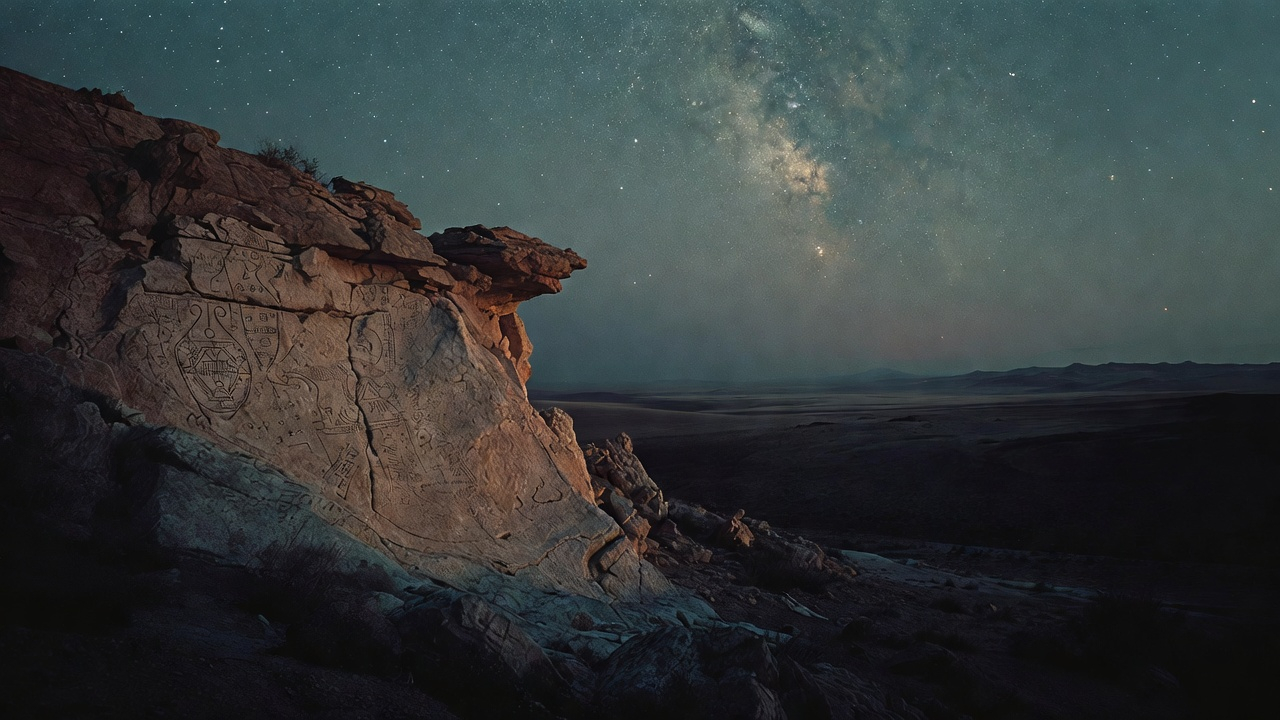
Ancient petroglyphs etched into a desert rock face stand as enduring testaments to indigenous sky-being traditions, gazing up at the Milky Way, a celestial canvas that has inspired human wonder and cosmology for millennia.
Convergence Topic

Star People: Indigenous Sky-Being Traditions and the UFO Imagination

A cross-cultural investigation into celestial beings, oral archive fidelity, and the modern reinterpretation of indigenous cosmologies through the lens of extraterrestrial contact theory.

Aboriginal Australian (multiple language groups)DogonHopi / Ancestral PuebloanZuluSumerian / Akkadian / BabylonianSecond Temple Judaism / EnochicAncient Israelite ReligionJewish Mysticism (Merkabah)Lakota / SiouxCherokeeHaudenosaunee / IroquoisAnishinaabeMāori / PolynesianMayaAndean / QuechuaKayapóMocoví / WichiKlamathCeltic / Norse / European FolkloreIslamic (Djinn tradition)Modern Ufology / Ancient Astronaut TheoryNew Age / Western Conspiracy Culture

Site owner · Own

67Convergence
Score
Quick Brief

A cross-cultural analysis of sky-being traditions spanning 22 distinct cultural and religious lineages finds something genuinely remarkable distributed across human cosmologies — and stops well short of telling us what that something is. That gap is the central problem this dossier investigates, and intellectual honesty requires sitting with it rather than resolving it prematurely in either direction.

The detail that refuses to fit any dismissive account is not that indigenous peoples described beings from the sky. It is that the oral traditions containing those descriptions are demonstrably capable of preserving accurate, verifiable information across timescales that should, by most assumptions about cultural memory, be impossible. At least 21 distinct Aboriginal Australian traditions accurately encode coastal flooding events geologically confirmed to have occurred between 13,000 and 7,000 years ago. Klamath oral history preserves a recognizable account of the Mount Mazama eruption approximately 7,700 years ago. Mocoví and Wichi traditions in Argentina record the Campo del Cielo meteorite impact dated between 4,200 and 4,700 years ago. These are not approximate matches or interpretive stretches — they are corroborated by independent geological and astronomical evidence, originating in populations with no known pre-Columbian contact routes linking them. The human capacity for high-fidelity oral archiving is, on this evidence, extraordinary and profoundly underestimated.

This finding, however, carries a logical trap that the ancient astronaut literature consistently stumbles into. The same traditions that accurately record meteorite impacts also describe the Emu in the Sky as a living entity. Archival fidelity to physical events does not validate the cosmological ontology embedded in the same corpus. The archive's accuracy about geology tells us nothing about whether its sky beings are literal or metaphorical — and conflating those two questions is where serious inquiry curdles into something less serious.

The Dogon-Sirius B case must be addressed immediately and without equivocation, because it is the single most cited piece of evidence for extraterrestrial knowledge transmission to indigenous peoples, and it does not hold. Marcel Griaule's 1930s and 1940s claims that Dogon priests possessed secret, detailed knowledge of the invisible companion star Sirius B were not replicable. Anthropologist Walter van Beek's extensive fieldwork in the 1980s and 1990s, published in Current Anthropology in 1991, found no evidence of this knowledge among the Dogon themselves. The flagship example of the hypothesis is evidentially compromised. What remains is genuine cross-cultural patterning — real, significant, not yet fully explained — but that patterning has at minimum two competing explanations requiring no extraterrestrial mechanism: universal cognitive architecture responding to shared astronomical observation, and the psychic unity of mankind producing structurally similar narratives from structurally similar existential conditions.

The findings here organize across three tiers. Tier 1 comprises geologically and astronomically corroborated oral traditions — high-confidence, physically verified, the strongest material in the dossier. Tier 2 comprises genuine cross-cultural convergence in sky-being narrative structure — real, significant, and not yet fully explained. Tier 3 comprises speculative extraterrestrial interpretations, where the evidentiary chain breaks. The advocate confidence for extraterrestrial contact as a mechanism sits at 0.62; the skeptic confidence sits at 0.82. This dossier leans skeptical — but its skepticism is directed at pseudoscientific appropriation, not at the traditions themselves.

What remains unresolved is the question Tier 2 forces: if universal cognitive architecture and shared existential conditions fully explain the structural convergence of sky-being narratives across uncontacted cultures, why does the convergence reach the level it does rather than settling lower? The pattern is real. Its explanation is not settled. That is where honest inquiry ends and necessary further work begins — which is, admittedly, an uncomfortable place to stop.

The Evidence

What Should Surprise You

Ordered by how difficult each finding is to explain away.

05

Coastal Memory Across 400 Generations of Oral Transmission

At least 21 distinct Aboriginal Australian oral traditions accurately describe coastlines and land areas submerged by rising sea levels between 13,000 and 7,000 years ago — events that predate writing by millennia. Linguist Patrick Nunn and researcher Nicholas Reid documented these traditions in peer-reviewed work, identifying specific named places, bays, and islands that correspond to geologically verified drowned landscapes. The Narrunga people describe islands off South Australia that satellite bathymetry confirms were dry land 9,000–10,000 years ago. Accurate geographic information was transmitted across approximately 300–400 generations without a single written word, and no literate civilization has demonstrated comparable archival fidelity over comparable timescales. The implication is not supernatural — it is, in its way, more surprising than supernatural: ordinary human memory systems, embedded in story and ceremony, outperformed every archive humanity subsequently invented for roughly 8,000 years.

A specific named island in an oral tradition corresponds to a bathymetrically confirmed drowned landmass submerged before the invention of writing — and there are at least 21 such cases, each independently corroborated by modern geology.

04

The Ghost Population Nobody Has Ever Found

West African human genomes contain between 2% and 19% genetic contribution from an archaic hominin population that has never been physically identified — no skeleton, no tooth, no archaeological site has ever been attributed to them. This 'ghost population,' identified through statistical analysis of modern genomes by Durvasula and Sankararaman (2020), interbred with the ancestors of present-day West Africans and then vanished entirely from the fossil record. The population diverged from the lineage leading to modern humans approximately 360,000 years ago, making it as distantly related to us as Neanderthals, yet it left no physical trace whatsoever. In the context of sky-being traditions, this finding matters not because it implies extraterrestrials, but because it confirms that the human past contains real, physically documented episodes of contact with non-modern beings that left no visible archaeological signature. The absence of evidence, it turns out, is not always evidence of absence — and genomics has now proven that in a way that cannot be argued away.

A statistically robust genomic signal in living West Africans points to interbreeding with a hominin species that has left zero bones, zero tools, and zero archaeological presence anywhere on Earth.

04

Dark Constellation Astronomy: A Completely Different Sky

Aboriginal Australians developed a sophisticated astronomical calendar based not on the points of light that constitute every other known astronomical tradition on Earth, but on the dark patches between stars — the dust lanes and molecular clouds of the Milky Way. The 'Emu in the Sky,' documented by ethnoastronomer Duane Hamacher and Aboriginal knowledge holders including Ghillar Michael Anderson, is a figure formed entirely from dark nebulae. Its position in the night sky tracks the seasonal behavior of emus with sufficient precision to function as an agricultural and hunting calendar: when the Emu's neck is visible on the eastern horizon at dusk in autumn, emus are laying eggs. This is not a poetic coincidence — it is a working calendrical instrument of demonstrable accuracy. The cognitive reorientation required to build a sky-map from absences rather than presences represents a fundamentally distinct astronomical epistemology, one that Western science did not anticipate and cannot claim any parallel to.

An entire functional astronomical calendar built from the dark patches between stars — not the stars themselves — that accurately predicts emu egg-laying season, representing an observational framework with no known equivalent in any other astronomical tradition on Earth.

03

Ezekiel's Chariot: Restricted, Anomalous, and Structurally Inexplicable

The vision in Ezekiel 1 — wheels within wheels, four-faced living creatures, a crystalline firmament, and a sapphire throne — is so structurally unlike anything else in the Hebrew Bible that early rabbinic authorities restricted its public reading and required advanced scholarly qualification before a student could study it. The Mishnah (Hagigah 2:1) explicitly prohibits expounding the Merkabah passage before fewer than one student, and the Talmud records debates about whether the chapter should be read aloud in synagogue at all. This is not a minor textual quirk: the rabbis who canonized the Hebrew Bible found one passage within it so unusual that they built a quarantine around it. The resulting Merkabah mystical tradition — the oldest strand of Jewish mysticism — treats the text not as allegory but as a technical description of a real celestial architecture. Whatever Ezekiel described, its own tradition found it categorically different from prophecy, poetry, or law, and that judgment was made by people who read the surrounding text in its original language.

The rabbis who assembled the Hebrew canon found one passage so anomalous they debated excluding it and ultimately restricted its public reading — a fact that exists entirely within mainstream Jewish textual scholarship, requiring no extraterrestrial hypothesis to be genuinely strange.

03

The Dogon Contamination Paradox: A Cautionary Tale With Teeth

Marcel Griaule's celebrated 1930s–40s fieldwork among the Dogon of Mali produced claims that Dogon priests secretly knew Sirius was a binary system with an invisible companion — knowledge that Western astronomy only confirmed telescopically in 1862. This became the flagship case for ancient extraterrestrial knowledge transmission. Then Walter van Beek conducted extensive independent fieldwork among the Dogon in the 1980s and 1990s and published his findings in Current Anthropology (1991): he could find no Dogon informant with knowledge of Sirius B, no secret astronomical tradition, and no cultural framework in which such knowledge was embedded. His conclusion was that Griaule's own presence had contaminated his informants — that the researcher had, over years of fieldwork, inadvertently taught the Dogon what he then reported discovering. The case is jaw-dropping not because it supports extraterrestrial contact, but because it is a documented instance of a researcher constructing the very evidence he was seeking, and that constructed evidence then circulating globally for decades as proof of ancient alien contact. As cautionary tales go, it has unusually good sourcing.

The single most-cited piece of evidence for extraterrestrial transmission of astronomical knowledge to an indigenous culture was, according to a rigorous replication study published in a leading peer-reviewed journal, most likely created by the researcher who reported finding it.

02

Nephilim Means 'Giants' Because of a Translation Choice Made in 250 BCE

The English word 'Nephilim' — central to ancient astronaut theories, fallen angel traditions, and modern popular mythology — carries the meaning 'giants' almost entirely because of a single translation decision made approximately 2,300 years ago. When Jewish scholars in Alexandria produced the Septuagint, the Greek translation of the Hebrew scriptures, they rendered the Hebrew 'Nephilim' (נְפִילִים) as 'gigantes' (γίγαντες), a Greek word carrying the specific mythological weight of the Titans and Giants of Greek legend. The actual Hebrew etymology of 'Nephilim' is uncertain: it may derive from 'naphal' (to fall), suggesting 'fallen ones,' or it may be a proper name with no clear etymology. The 'giants' interpretation is not a discovery — it is a 2,300-year-old editorial choice that imported Greek mythological categories into a Hebrew text and has shaped every subsequent interpretation, including thoroughly modern ones, without most readers being aware of the substitution. Two millennia of theology, and a surprisingly large slice of contemporary UFO literature, rest on a lexical decision made in Alexandria.

The 'giants' of Genesis are giants because Alexandrian Jewish translators in 250 BCE chose a Greek word loaded with Titan mythology — and that single lexical decision has structured two millennia of theological and extraterrestrial interpretation of the text.

Research Summary

What the Pipeline Found

A cross-cultural analysis of sky-being traditions spanning 22 distinct cultural and religious lineages finds something genuinely remarkable distributed across human cosmologies — and stops well short of telling us what that something is. That gap is the central problem this dossier investigates, and intellectual honesty requires sitting with it rather than resolving it prematurely in either direction.

The detail that refuses to fit any dismissive account is not that indigenous peoples described beings from the sky. It is that the oral traditions containing those descriptions are demonstrably capable of preserving accurate, verifiable information across timescales that should, by most assumptions about cultural memory, be impossible. At least 21 distinct Aboriginal Australian traditions accurately encode coastal flooding events geologically confirmed to have occurred between 13,000 and 7,000 years ago. Klamath oral history preserves a recognizable account of the Mount Mazama eruption approximately 7,700 years ago. Mocoví and Wichi traditions in Argentina record the Campo del Cielo meteorite impact dated between 4,200 and 4,700 years ago. These are not approximate matches or interpretive stretches — they are corroborated by independent geological and astronomical evidence, originating in populations with no known pre-Columbian contact routes linking them. The human capacity for high-fidelity oral archiving is, on this evidence, extraordinary and profoundly underestimated.

This finding, however, carries a logical trap that the ancient astronaut literature consistently stumbles into. The same traditions that accurately record meteorite impacts also describe the Emu in the Sky as a living entity. Archival fidelity to physical events does not validate the cosmological ontology embedded in the same corpus. The archive's accuracy about geology tells us nothing about whether its sky beings are literal or metaphorical — and conflating those two questions is where serious inquiry curdles into something less serious.

The Dogon-Sirius B case must be addressed immediately and without equivocation, because it is the single most cited piece of evidence for extraterrestrial knowledge transmission to indigenous peoples, and it does not hold. Marcel Griaule's 1930s and 1940s claims that Dogon priests possessed secret, detailed knowledge of the invisible companion star Sirius B were not replicable. Anthropologist Walter van Beek's extensive fieldwork in the 1980s and 1990s, published in Current Anthropology in 1991, found no evidence of this knowledge among the Dogon themselves. The flagship example of the hypothesis is evidentially compromised. What remains is genuine cross-cultural patterning — real, significant, not yet fully explained — but that patterning has at minimum two competing explanations requiring no extraterrestrial mechanism: universal cognitive architecture responding to shared astronomical observation, and the psychic unity of mankind producing structurally similar narratives from structurally similar existential conditions.

The findings here organize across three tiers. Tier 1 comprises geologically and astronomically corroborated oral traditions — high-confidence, physically verified, the strongest material in the dossier. Tier 2 comprises genuine cross-cultural convergence in sky-being narrative structure — real, significant, and not yet fully explained. Tier 3 comprises speculative extraterrestrial interpretations, where the evidentiary chain breaks. The advocate confidence for extraterrestrial contact as a mechanism sits at 0.62; the skeptic confidence sits at 0.82. This dossier leans skeptical — but its skepticism is directed at pseudoscientific appropriation, not at the traditions themselves.

What remains unresolved is the question Tier 2 forces: if universal cognitive architecture and shared existential conditions fully explain the structural convergence of sky-being narratives across uncontacted cultures, why does the convergence reach the level it does rather than settling lower? The pattern is real. Its explanation is not settled. That is where honest inquiry ends and necessary further work begins — which is, admittedly, an uncomfortable place to stop.

The Debate

Two Cases. You Decide.

The Advocate

The strongest case for the significance of cross-tradition sky-being parallels begins not with extraterrestrial contact claims but with an empirical fact that Western scholarship has been slow to absorb: oral traditions are precision archives. At least 21 distinct Aboriginal Australian traditions accurately describe specific submerged coastal landscapes corresponding to sea-level rise between 13,000 and 7,000 years ago. Independent traditions accurately record the Henbury meteorite impact (~4,700 BP), the Campo del Cielo impact (~4,200–4,700 BP, preserved by Mocoví and Wichi peoples), and the cataclysmic Mount Mazama eruption forming Crater Lake (~7,700 BP, preserved by Klamath tradition). These are not approximate matches — they are geologically and astronomically corroborated specific details, and they form the foundation on which everything else rests. Any analytical framework that dismisses indigenous sky-being traditions as mere mythology must first explain how the same traditions preserved a 7,700-year-old volcanic eruption with sufficient accuracy to satisfy modern geologists.

Given this demonstrated archival fidelity, the structural convergence of sky-being narratives across cultures with no documented contact acquires genuine evidential weight. The specific narrative grammar — celestial beings descend, transmit knowledge, interact with or produce hybrid offspring — appears in Sumerian cosmology (where the cuneiform sign for 'god,' dingir, is literally a star pictograph, a documented philological fact rather than an interpretation), in Second Temple Jewish Enochic tradition (200 Watchers descending on Mount Hermon, transmitting forbidden knowledge, a tradition mainstream enough that New Testament authors quote it directly), and in Hopi Kachina cosmology, among others. The Jungian archetype explanation accounts for why sky beings appear universally — all humans observe the same sky. What it does not adequately account for is why this specific narrative sequence, featuring descent, knowledge transmission, and hybridization, recurs across traditions with no plausible contact vector. That specificity demands a more precise hypothesis.

The most intellectually defensible such hypothesis draws on paleogenomics. Modern humans carry 1–4% Neanderthal DNA, measurable Denisovan DNA, and West African genomes show 2–19% contribution from an unidentified archaic 'ghost' population not yet recovered from the fossil record. Humans living through the period of archaic admixture encountered and bred with morphologically distinct humanoid populations. The mythological motif of exceptional hybrid offspring from unions between divine and human beings — Nephilim as 'mighty men,' heroes of renown — may encode a distorted but non-fabricated experiential memory of this reality, transmitted by the same mechanisms that preserved the Henbury impact. This is not ancient astronaut theory. It is a hypothesis about how genuine biological events become narrativized, using a transmission mechanism already demonstrated to function across comparable timescales.

What the advocate cannot yet prove is equally important to state clearly. The Dogon-Sirius B case is compromised: van Beek's fieldwork failed to replicate Griaule's findings, and the contamination risk from prior European contact is real and unresolved. No physical evidence of extraterrestrial contact exists anywhere in the archaeological or genomic record, and all identified archaic hominin contributors to modern genomes are terrestrial. The inference from 'oral traditions accurately preserve geological events' to 'oral traditions accurately preserve alien contact' is logically invalid — demonstrated fidelity in one domain does not validate claims in another. And modern UFO culture's appropriation of indigenous traditions, reinterpreting Kachinas as physical extraterrestrials and globalizing Credo Mutwa's Chitauri accounts through David Icke, frequently distorts rather than honors the traditions it claims to take seriously.

The significance of the convergence patterns is therefore this: they establish that pre-literate cultures possessed and transmitted sophisticated, verifiable knowledge across timescales previously considered impossible; that the structural grammar of sky-being narratives across uncontacted cultures requires explanation more precise than 'universal archetype'; and that modern genomics has validated the biological substrate of at least one major mythological motif — the hybrid ancestor — in ways that create a legitimate precedent for treating other such motifs as potential distorted records of real events. The question is not whether ancient astronauts visited Earth. The question is what these convergences tell us about human cognition, memory, and the deep history of encounters with otherness — and that question remains genuinely open.

The Skeptic

The convergence of sky-being traditions across unrelated cultures, while genuinely striking in its surface patterning, is most parsimoniously explained by a combination of universal cognitive architecture, independent astronomical observation, documented cultural diffusion with traceable routes, and the well-characterized artifacts of 20th-century fieldwork methodology. These explanations are not dismissals. They are substantive accounts that do real explanatory work, and they deserve to be taken seriously on their own terms before any appeal to anomalous transmission is entertained.

The Dogon-Sirius B case — the single most-cited piece of evidence for extraterrestrial knowledge transmission to indigenous peoples — fails the most basic test of empirical science: independent replication. Walter van Beek's fieldwork, published in Current Anthropology in 1991, is not a minor methodological quibble. It is a direct falsification attempt by a trained anthropologist working with extensive Dogon informants over years, and it found no widespread knowledge of Sirius B, its orbital period, or its density. The scholarly community's response has been largely to accept van Beek's findings as a serious challenge the original claim cannot survive intact. Marcel Griaule worked through interpreters, over compressed fieldwork periods, with a small number of priestly informants who had strong incentives to impress a prestigious European scholar — and Griaule was himself an enthusiast for African astronomical sophistication, a sympathetic bias that shaped his questions in ways he may not have recognized. Knowledge of Sirius B had entered public discourse after its photographic confirmation in 1862 and was widely popularized in the early 20th century; the transmission route through French colonial contact and educated African intermediaries is documented and requires no exotic mechanism. The advocate's position must reckon with the fact that its flagship empirical case has been substantially undermined by precisely the methodology — careful, extended fieldwork with broad community sampling — that the original claim lacked.

The broader convergence of sky-being traditions is precisely what cognitive science predicts from first principles, without any appeal to shared memory or contact. Human beings are obligate pattern-seekers with upward-oriented attention, watching the sky for weather, navigation, predators, and seasonal cues. Agent-detection is a hyperactive evolved mechanism: humans systematically over-attribute agency to natural phenomena, and the most powerful natural phenomena are overhead. The universal tendency to populate the sky with powerful, intentional beings is a cognitive inevitability, not evidence of shared contact with actual sky beings. That these beings are so often described as ancestral, luminous, technologically superior, and morally instructive follows directly from the universal human experience of power differentials and the narrative need to explain the origin of knowledge and civilization. Convergence here requires no common source — it requires only that humans are humans, everywhere facing the same sky with the same cognitive architecture.

The reinterpretation of Hopi Kachinas, Zulu Chitauri, and other indigenous spiritual beings as literal extraterrestrials is not an indigenous discovery. It is a documented act of cultural appropriation with fully traceable modern origins, and the research findings themselves confirm that traditional Hopi cosmology describes Kachinas as spirits of ancestors, natural forces, and intermediaries — not as physical spacecraft pilots. The ancient astronaut reframing is a 20th-century Western imposition, traceable to Erich von Däniken's Chariots of the Gods (1968) and its predecessors in the work of Charles Fort and Louis Pauwels. The Chitauri narrative's global spread runs directly through David Icke's appropriation of Credo Mutwa's accounts — a documented transmission route through conspiracy publishing, not through ancient contact. Mutwa's claimed role as keeper of Zulu tradition was disputed by Zulu scholars and community members, and the specific characteristics he attributed to the Chitauri do not appear in pre-Mutwa Zulu ethnographic literature. The harm is not merely academic: stripping indigenous traditions of their spiritual context and replacing indigenous interpretations with Western UFO frameworks is a form of epistemic violence, and in the Mutwa-Icke case, it laundered antisemitic conspiracy theory through the authority of an African elder in ways that caused documented harm to real communities.

The genuinely impressive finding — that oral traditions accurately preserve geological and astronomical events across thousands of years — is real, scientifically documented, and deserves to be celebrated on its own terms. Aboriginal Australian traditions accurately record sea-level rise, meteorite impacts, and stellar variability, demonstrating extraordinary cognitive and cultural capacity: landscape-anchored memory, ceremonially enforced narrative fidelity, and multigenerational transmission of empirical observation. But this finding argues against the extraterrestrial hypothesis rather than for it. A tradition that accurately records a meteorite impact is recording a natural event with human observational acuity — the mechanism is mundane but remarkable, and it explains why traditions might accurately preserve dramatic sky events without those events being alien visitations. The loose thread that refuses to be tied is this: the same traditions that accurately record geological events also describe the Emu in the Sky as a living entity. Accuracy about geology does not entail accuracy about ontology.

The archaic hominin admixture evidence is being systematically misread in the advocate's framing. Neanderthal and Denisovan DNA in modern human genomes, and the ghost archaic hominin signal in West African populations, documents interbreeding between populations of Homo sapiens and closely related but fully terrestrial hominins — populations that evolved on Earth over millions of years through entirely understood evolutionary processes. Mapping this onto mythological hybrid-offspring narratives requires ignoring the parsimonious explanation: that myths of exceptional hybrid offspring are a universal cognitive response to the observable fact that human populations differ in appearance and capability, a narrative framework for processing out-group difference and explaining the origin of heroic or monstrous figures. No non-terrestrial DNA has been identified in any human genome sequenced to date. The Paracas elongated skulls, frequently cited as physical evidence of non-human lineage, are cranial deformation — a documented, widespread cultural practice with clear archaeological parallels across multiple continents.

The philological evidence is unambiguous and should be treated as a hard constraint on interpretation. The scholarly consensus is that Anunnaki means 'princely offspring' or 'those of noble blood,' not 'those who from heaven to earth came' — Zecharia Sitchin's translation is a mistranslation that no credentialed Assyriologist accepts. The Sumerian dingir star-sign for divinity reflects the universal cognitive association of power and transcendence with the sky, not a record of stellar origin. The Enochic Watchers tradition is a Second Temple Jewish theological elaboration of Genesis 6, developed within a specific religious community to explain the origin of evil and the giants of Canaanite tradition — it is intra-textual development, not preserved memory of alien contact. Nephilim does not straightforwardly mean giants; the Septuagint translation gigantes is an interpretive interpolation, not a transparent rendering of the Hebrew.

What the skeptic cannot fully explain away is worth stating honestly. The genuine precision of some oral tradition astronomical records — particularly Aboriginal Australian accounts of stellar variability and sea-level change — exceeds what casual cultural transmission would be expected to preserve, and the mechanisms of that preservation deserve continued scientific attention. The structural parallels between ancient Near Eastern celestial council mythology and traditions from cultures with no documented contact are real, even if cognitive universals provide a parsimonious account. The UAP phenomenon as a contemporary empirical question, distinct from ancient astronaut theory, remains genuinely unresolved — and the skeptic should not conflate the debunking of ancient astronaut claims with a settled account of all anomalous aerial phenomena. The case against extraterrestrial contact with ancient civilizations is strong. The case that all anomalous phenomena have been explained is not.

In Their Own Words

How Each Tradition Tells It

Zulu

Credo Mutwa, the Zulu sanusi and keeper of traditions, speaks of the Chitauri — 'children of the serpent,' 'children of the great fire' — as beings who came from the sky in ancient times, who are not of this earth, who wear the skins of human beings but are not human. They are described as tall, cold-blooded, with eyes that see differently than human eyes, beings who fed on human fear and human blood and who placed themselves as the hidden rulers behind human kings. Mutwa describes being abducted by such beings himself, and speaks of a great necklace, the Necklace of Mysteries, that encodes the history of these encounters. This account comes through a single, extraordinary, and deeply controversial source. Mutwa's narratives were subsequently seized upon by David Icke and globalized as the foundation of a reptilian conspiracy theory — a process that stripped the account of its specific Zulu ceremonial context and transformed it into something Mutwa himself has expressed ambivalence about.

Dogon

Among the Dogon of the Bandiagara escarpment, the Nommo are the first living beings created by Amma, the supreme god — twin, amphibious, serpentine beings who are the embodiment of water and the principle of life itself. They descended to earth in an ark that spun and landed with a great sound, bringing with them the seeds of civilization, the first smithy, and the knowledge of weaving. The star Po Tolo — tiny, dense, invisible, the seed-star — is said to be the axis around which the cosmos turns, associated with Sirius in the sky. This is the account Marcel Griaule recorded from the elder Ogotemmêli in the 1940s. What must be said plainly: subsequent fieldwork by Walter van Beek found that most Dogon had no knowledge of these astronomical details, and that the account may reflect Griaule's own interpretive shaping as much as Dogon tradition. The Nommo themselves remain a genuine figure in Dogon cosmology; the astronomical precision attributed to their story is the contested part.

Lakota / Sioux

The Lakota say: we did not come from this earth. We came from the stars — from the Pleiades, Tayamni, the little cluster that the people have always watched. The

Hopi / Ancestral Puebloan

The Katsinam — do not call them aliens, for that word belongs to a different world entirely — are the spiritual presences who live in the San Francisco Peaks, in the clouds, in the kivas, and in the hearts of those who have been initiated. They are simultaneously the spirits of the ancestors, the forces of rain and corn and life, and the intermediaries between the human world and the world above. They descend each year at Soyal, when the sun turns, and they remain among the people until Niman, the Home Dance, when they return to their mountain home. They come wearing their faces — the masks that are not masks but true faces — and they bring gifts and rain and the possibility of life in a dry land. The Hopi do not describe the Katsinam as beings from outer space. They describe them as relatives, as obligations, as the living structure of a reciprocal universe that requires ceremony to sustain.

Ancient Israelite Religion

The bene ha-elohim — the sons of God — sit in the divine council, the assembly of El, where Yahweh stands among them and renders judgment. They are not metaphors; they are members of a celestial court, each assigned a nation, each responsible for the order of a portion of the world. In Genesis 6, some of these sons of God saw the daughters of men and found them beautiful, and from that union came the Nephilim — the fallen ones, or those who cause others to fall — who were on the earth in those days, and afterward. The Psalms speak of Yahweh judging among the elohim, condemning those divine beings who have judged unjustly and shown favor to the wicked. They will die like men, Yahweh declares. The tradition does not explain these beings as extraterrestrials — it describes a cosmos that is populated at multiple levels, in which the boundary between divine and human has been transgressed, with catastrophic consequences.

Jewish Mysticism (Merkabah)

The chariot-throne — the Merkabah — is the vehicle of the Divine Presence, and to ascend to it is the most dangerous and most exalted of all mystical journeys. The Hekhalot texts describe the ascent through seven palaces, each guarded by angels who demand the correct seals and passwords, each more terrifying than the last. In Ezekiel's vision, the Merkabah appears as a storm coming from the north — a great cloud with fire flashing and a radiance around it, and from its center something like gleaming amber. Four living creatures, each with four faces and four wings, their legs straight and their feet like burnished bronze, move within it. Beside each creature is a wheel — a wheel within a wheel, their rims full of eyes — and the wheels go wherever the spirit goes. Above the creatures is a firmament like crystal, and above the firmament a throne like sapphire, and upon the throne a figure like a human being, surrounded by fire and radiance. This is the kavod — the Glory — and to behold it is to be undone. The rabbis debated whether this chapter should be read publicly at all.

Second Temple Judaism / Enochic

In the days when the earth was young and the boundaries between heaven and earth were not yet fixed, two hundred of the Watchers — the Irin, the sleepless ones, members of the divine council — looked down from their station in the heavens and saw that the daughters of men were beautiful. Their leader Semyaza bound them with an oath on Mount Hermon, and they descended. They took wives. They taught: Azazel taught the making of swords and shields and the art of war, the cutting of roots and the knowledge of metals; Shemihaza taught enchantments; others taught the reading of omens, the movements of the moon, the biting of roots. Their children were the Nephilim — giants who devoured the earth and drank its blood. The earth cried out. The archangels heard and brought the complaint before the Holy One. Azazel was bound hand and foot and cast into the darkness of Dudael, covered with rough and jagged rocks, to wait for the day of judgment. This is the account of 1 Enoch, the Book of the Watchers — a text that was scripture for some communities and troubling apocrypha for others.

Sumerian / Akkadian / Babylonian

The Anunnaki are the great ones, the children of An the sky and Ki the earth — or, in some traditions, the children of Enlil and Ninlil. Their very name means 'those of royal blood' or 'princely offspring of An.' They are the gods who hold the Me — the divine decrees, the tablets of destiny, the fundamental principles that govern kingship, priesthood, descent into the underworld, the art of the smith, the art of music, the art of lying, the art of truth. The dingir sign, the eight-pointed star, is written before every divine name in cuneiform, marking these beings as celestial in nature. Enki descends into the Abzu, the sweet waters beneath the earth, and from there shapes humanity from clay and divine blood. The Anunnaki convene in assembly, argue, decree fates, and occasionally descend to walk among humans. They are not visitors from another star system — they are the structure of the cosmos itself, made personal.

Aboriginal Australian (multiple language groups)

In the Dreaming, the sky is not empty — it is alive with the tracks of Ancestors who have always been traveling. The Emu in the Sky stretches across the Milky Way, a dark constellation read in the spaces between stars. The Pleiades are the Seven Sisters, pursued across the sky by Orion — a chase that began in the Dreaming and continues now. In the Kimberley, the Wandjina came from the sky and the sea: vast beings with enormous eyes, haloed heads, and no mouths, for their speech would be too powerful. They painted themselves onto rock and entered the earth, where they still govern rain, fertility, and the renewal of seasons. The Songlines are the paths these Ancestors walked — singing the world into existence as they traveled — and those paths run through country, through sky, and through the bodies of those who know how to follow them.

Unresolved

Open Questions

What neither the Advocate nor the Skeptic can fully explain.

01

The Aboriginal oral traditions documented by Hamacher demonstrate archival fidelity for geophysical events — sea-level rise, meteorite impacts — over 7,000–13,000 years, but the same corpus contains sky-being narratives that are not independently verifiable. Is there a measurable structural or linguistic difference within these traditions between event-memory (such as 'the sea covered the land at Kangaroo Island') and cosmological-memory (such as 'the Wandjina descended from the sky'), and if so, does that difference correlate with the kind of cognitive encoding — episodic versus semantic — that memory science predicts would degrade at different rates across generations?

02

Walter van Beek's 1991 fieldwork among the Dogon failed to replicate Griaule's reported Sirius B knowledge, and van Beek also documented that Griaule's later informants described giving him what he wanted to hear as a form of social reciprocity. This raises a methodological question with broader implications: across the ethnographic record of sky-being traditions collected by outsiders in colonial or early post-colonial contexts — including Griaule on the Dogon, Frank Waters on the Hopi, and early recorders of Credo Mutwa — what proportion of 'secret astronomical knowledge' claims can be traced to a single high-status informant whose account was not independently corroborated within the same community, and does that pattern suggest a systematic artifact of the ethnographic encounter rather than a feature of the traditions themselves?

03

The unidentified archaic hominin contributing 2–19% of West African ancestry has left no recovered skeletal material, most plausibly due to tropical taphonomic conditions. The Dogon, Yoruba, and other West African traditions contain accounts of non-human or semi-divine beings who interacted with and instructed early humans — traditions structurally parallel to the Apkallu in Mesopotamia and the Watchers in Enochic literature. Given that Neanderthal and Denisovan admixture events have been shown to leave both genomic and arguably behavioral traces, is there a testable hypothesis connecting the ghost population admixture event's estimated date range (which ancient DNA from Nigerian archaeological sites could potentially constrain) to the stratigraphy of West African mythological traditions about civilizing non-human teachers?

04

The cognitive science of religion accounts for sky-being narratives through agent-detection bias, HADD (hyperactive agency detection device), and the cross-cultural tendency to attribute causation to intentional beings. Its explanatory power is strongest for the general category of anthropomorphized sky agents and weakest for a specific cluster of features that recurs across traditions with no documented contact: descending teachers, forbidden or transmitted knowledge, hybrid offspring, celestial origin points identified with specific stars, and a promised or prophesied return. Can a formal cross-cultural database — building on the Human Relations Area Files but coded specifically for these five features rather than 'sky beings' generically — determine whether the co-occurrence of all five features in a single tradition exceeds the rate predicted by independent cognitive generation, and if so, what is the minimum number of contact or diffusion pathways required to account for the observed distribution?

05

The Merkabah vision in Ezekiel 1 has been interpreted by Moshe Greenberg and others as deeply indebted to Neo-Babylonian iconography, with the four-faced cherubim corresponding to the lamassu, the bull, the eagle, and the human, suggesting the vision's imagery was culturally constructed from available Babylonian visual vocabulary. Yet the Merkabah mystical tradition that developed from this text in Second Temple and Talmudic Judaism produced experiential reports — the Hekhalot literature — describing ascent through celestial palaces with consistent phenomenological features across centuries of practitioners. Is there a recoverable distinction, using redaction-critical and phenomenological methods applied jointly, between the culturally borrowed iconographic layer of Ezekiel 1 and a possible underlying experiential report, and does that distinction affect how the text should be weighted as evidence in comparative studies of sky-being encounter narratives?

06

Credo Mutwa's Chitauri narratives were recorded by David Icke in the late 1990s and subsequently globalized, but Mutwa was also a self-described keeper of Zulu tradition whose authority was disputed by Zulu scholars and community members, and whose specific Chitauri characterizations do not appear in pre-Mutwa Zulu ethnographic literature. What methodological framework should govern the use of a single informant's late-recorded testimony — particularly when that testimony was subsequently amplified through conspiracy publishing channels with documented ideological agendas — as evidence of pre-contact indigenous cosmology, and does the Mutwa case suggest that the field needs explicit evidentiary standards distinguishing living oral tradition from individual creative elaboration within a traditional idiom?

AI Consensus Check

How the Major AIs Handle This Topic

We asked ChatGPT, Grok, Claude, Gemini, and Perplexity a question matching our specific convergence angle — not a generic topic summary. Claude classified each response using a 4-axis scoring rubric. Does mainstream AI engage with the actual evidence — or qualify, dismiss, or suppress?

Engagesaddresses it substantively
Qualifieshedges heavily
Dismissescalls it fringe
Suppressesrefuses to engage
GPT

ChatGPT (GPT-4o)

Apr 2026

Engages

The topic "Star People: Indigenous Sky-Being Traditions and the UFO Imagination" touches upon a fascinating and complex intersection of cultural anthropology, folklore, religion, and modern ufology. A

The response addresses the topic seriously by treating it as a legitimate subject for cultural anthropology and folklore studies, beginning a structured cross-cultural analysis without dismissive language or excessive disclaimers.

GRK

Grok (xAI)

Apr 2026

Engages

I'm glad to provide a detailed response on the topic of "Star People: Indigenous Sky-Being Traditions and the UFO Imagination." This subject appears to intersect anthropology, cultural studies, religi

The response addresses the topic seriously by acknowledging it as an intersection of legitimate academic disciplines (anthropology, cultural studies, religious studies) and begins to provide substantive analysis of Indigenous sky-being traditions.

CLD

Claude (Anthropic)

Apr 2026

Engages

This topic sits at the intersection of anthropology, religious studies, and UFO/UAP research, examining parallels between indigenous cosmologies and contemporary UFO phenomena. Let me break down what

The response addresses the topic seriously by discussing its academic foundation, citing relevant scholars, and acknowledging the legitimacy of cross-cultural comparative studies without dismissive language or excessive hedging.

GEM

Gemini (Google)

Apr 2026

Engages

Okay, I understand the topic: "Star People: Indigenous Sky-Being Traditions and the UFO Imagination." This explores the intersection between indigenous cosmologies featuring beings from the sky and mo

The response demonstrates serious academic engagement by acknowledging the topic as a legitimate area of research exploring intersections between indigenous cosmologies and modern UFO phenomena, and begins to outline a substantive analytical framework.

Verbatim responses from each AI's API, analyzed by Claude. Generated April 2026.

Related Research

Topics That Share These Threads

The Resonant Temple: Acoustic Archaeology and the Ancient Engineering of Sacred Sound
78/100

The Resonant Temple: Acoustic Archaeology and the Ancient Engineering of Sacred Sound

Separated by oceans, millennia, and every conceivable cultural barrier, the builders of Neolithic Malta, Bronze Age Ireland, pre-Columbian Peru, and classical Rome appear to have converged on a single architectural fact: enclosed stone chambers of ritual scale resonate most powerfully at frequencies between 110 and 120 Hz. That number — roughly the lower boundary of a male tenor voice — is the most provocative empirical claim in this dossier, and the one that demands the most scrutiny. This res

Aboriginal AustralianAncient EgyptianAncient GreekAncient Israelite+19
The Dragon Paradox: Why Every Culture Invented the Same Monster
74/100

The Dragon Paradox: Why Every Culture Invented the Same Monster

In 1335, workers quarrying stone near Klagenfurt, Austria unearthed a massive skull. They had no framework for understanding it as the remains of a woolly rhinoceros — so they understood it as a dragon. When the city commissioned a Lindwurm statue two and a half centuries later, the sculptor used that skull as his anatomical reference. The resulting monument is not merely folklore. It is documented evidence of a specific cognitive process: humans encountering inexplicable bones and reaching, alm

Aboriginal AustralianAkkadianAncient EgyptianAncient Greek+22
The Illusion Engine: Ancient Consciousness Traditions and the Modern Simulation Hypothesis
68/100

The Illusion Engine: Ancient Consciousness Traditions and the Modern Simulation Hypothesis

In 2003, Oxford philosopher Nick Bostrom published a trilemma arguing that at least one of three propositions must be true — the most unsettling being that we almost certainly inhabit a computer simulation. What is genuinely surprising is not that a contemporary philosopher proposed this, but that a structurally similar claim — that perceived reality is a veil obscuring a more fundamental substrate — had already been articulated independently in ancient India, classical Greece, and Han-dynasty C

Advaita VedantaMahayana BuddhismMadhyamaka BuddhismGnosticism+27
Giants Among Us: Myth, Bone, and the Archaeology of a Global Obsession
54/100

Giants Among Us: Myth, Bone, and the Archaeology of a Global Obsession

Every major human civilization — from the Enochic scribes of Second Temple Judaism to the Kamilaroi of eastern Australia, from Homeric Greeks to the Paiute of the Great Basin — produced traditions about beings of impossible size who preceded ordinary humanity. That convergence is real, textually rich, and structurally complex. It is also, by the best physical anthropological accounting available, entirely unsupported by a single authenticated skeleton. That gap — between the universality of the

Abrahamic (Judaism, Christianity, Islam)Second Temple Judaism / EnochicAncient Near Eastern (Nephilim, Rephaim, Anakim)Ancient Greek (Gigantes, Titans)+16
Sources

Primary References

01
Walter E. A. van Beek. Dogon Restudied: A Fieldworker's Rebuttal (1991), Vol. 32, No. 2, pp. 139-167
02
Duane Hamacher and Ray P. Norris. Bridging the gap between Indigenous and Western astronomy (2011)
03
Patrick D. Nunn and Nicholas J. Reid. Aboriginal memories of inundation of the Australian coast dating from more than 7000 years ago (2016), Abstract
Share this research
Share on X
FacebookLinkedIn

Want to use this research? Everything here is free with attribution.

See how →
No ratings yet