Before Columbus, two civilizations definitely crossed an ocean to reach the Americas — so why does the real story remain so much stranger and more contested than the myths that replaced it?
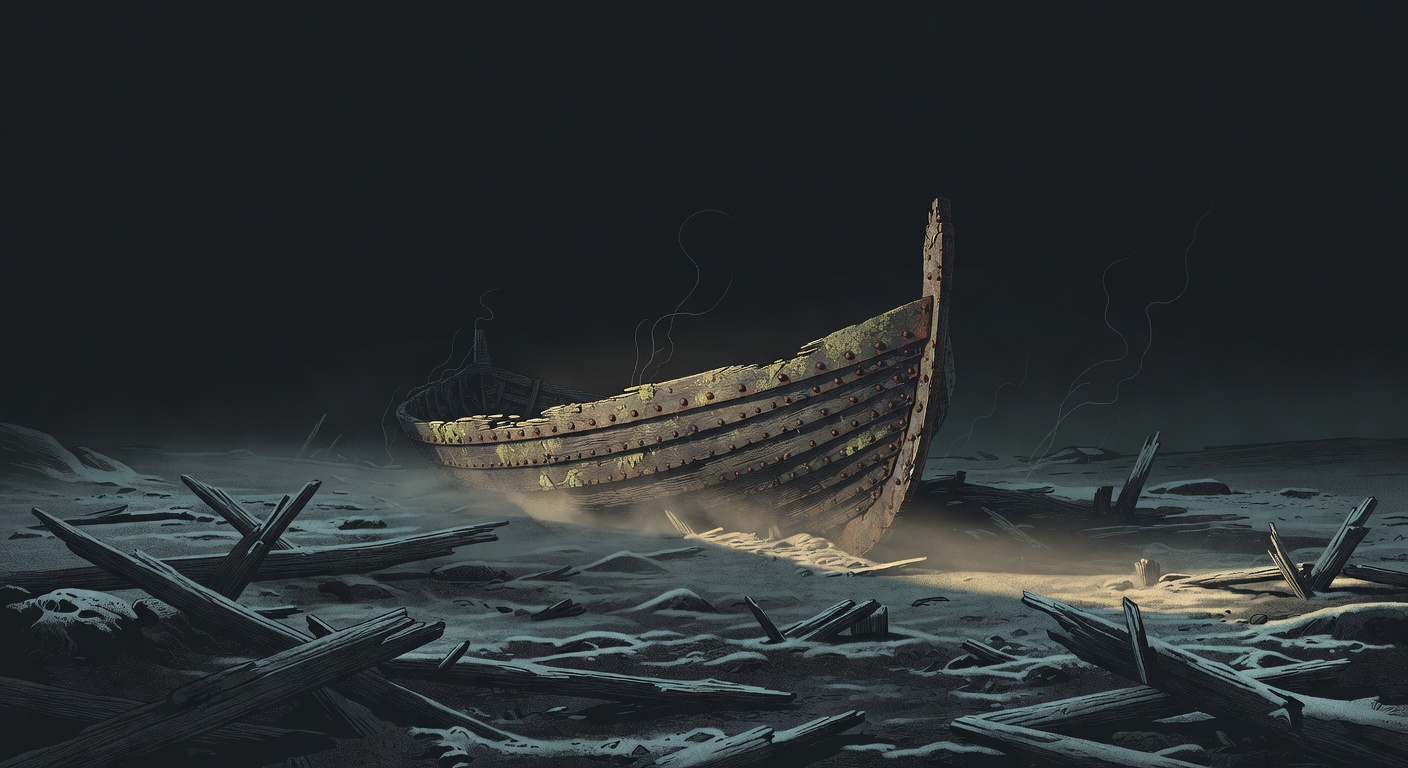
Oceans Were Never Walls
What the confirmed cases of pre-Columbian trans-oceanic contact reveal about ancient maritime capability, and what they do not yet prove.
Traditions analyzed in this research
Grok Imagine / xAI · AI Generated
People & institutions referenced
Gavin Menzies
Personresearcher
Authored the 2002 book '1421: The Year China Discovered the World', claiming a Ming Dynasty fleet discovered the Americas; the thesis was universally rejected by professional historians and sinologists for lack of primary evidence and misinterpretation of sources.
Mau Piailug
Personhistorical figure
Navigated the Hōkūleʻa's 1976 Hawaii-to-Tahiti voyage using traditional Micronesian non-instrument wayfinding, empirically validating that such techniques were sufficient for intentional trans-oceanic voyaging.
Svetla Balabanova
Personresearcher
Conducted a 1992 toxicological study reporting cocaine and nicotine in Egyptian mummies, a finding met with institutional rejection from Egyptologists who cited potential modern contamination and absence of supporting archaeological evidence for pre-Columbian trans-Atlantic trade.
Anne Stine Ingstad
Personresearcher
Anne Stine Ingstad was a Norwegian archaeologist known for co-leading the excavations at L'Anse aux Meadows from 1961-1968, providing evidence of Norse pre-Columbian contact with North America. She studied at the University of Oslo in the 1950s, earning her Master's in 1960, and later held a curatorial position at the Norwegian Forest Museum before resigning in 1961. She collaborated closely with her husband, Helge Ingstad, on the L'Anse aux Meadows expedition, and received an honorary doctorate from Memorial University in 1979.
Thor Heyerdahl
Personhistorical figure
Norwegian adventurer, ethnographer, and experimental archaeologist known for the 1947 Kon-Tiki expedition and theories about ancient trans-oceanic contact between civilizations.
Helge Ingstad
Personresearcher
One of the Ingstads whose excavations at L'Anse aux Meadows confirmed the Norse pre-Columbian settlement in Newfoundland, validating the Vinland Sagas.
Parks Canada
Institutionresearcher
Confirmed and managed the L'Anse aux Meadows archaeological site, contributing to the dendrochronological dating and official recognition of the Norse settlement.
Nature
Institutionpublisher
Published the landmark 2020 genomic study documenting the genetic admixture signal confirming pre-Columbian contact between Polynesian voyagers and Native Americans.
Genomic, archaeobotanical, and linguistic evidence have independently confirmed that Polynesians made contact with South America before Columbus - and dendrochronology has pinned the Norse arrival at L'Anse aux Meadows to the precise year of 1021 CE. Two pre-Columbian trans-oceanic contacts are not hypothesis. They are closed cases.
That clarity matters because everything adjacent to it is considerably messier. The evidentiary standard those two cases set - independent, falsifiable, physical corroboration across multiple disciplines - is the only standard that has ever actually worked. Kennewick Man demonstrated the failure mode when that standard is abandoned: morphological pattern-matching produced a confident, widely circulated conclusion of non-Native origin that ancient DNA then demolished completely. The lesson is not subtle. Superficial resemblance across iconography, artifact style, or skeletal morphology generates false positives at high rates and low cost. Genetic and unambiguous archaeological evidence does not.
Gavin Menzies's Ming Dynasty thesis is not a live debate. Professional historians and sinologists have closed it. The Ra II expedition proved papyrus boats can cross the Atlantic; it proved nothing about Phoenician contact, because navigational capacity and documented motive are necessary conditions, not sufficient ones. The same logic applies to every unresolved case - West African, Micronesian, or otherwise. Plausibility is not evidence.
What remains genuinely open is worth taking seriously: the directionality of Polynesian-South American contact is still under active genomic investigation, and additional pre-Columbian contacts cannot be ruled out on theoretical grounds alone. But the field's persistent vulnerability to overclaiming stems from a single recurring error - treating the confirmed cases as proof that the unconfirmed ones are merely awaiting discovery, when in fact the confirmed cases are extraordinary precisely because the evidence for them is overwhelming and the evidence for most alternatives remains absent. The two facts we actually have are remarkable enough to demand rigorous company, not credulous.
What Should Surprise You
Ordered by how difficult each finding is to explain away.
The Oral Traditions Were Right
The Vinland Sagas - the Graenlendinga saga and Eiríks saga rauda - described Norse voyages to a land called Vinland [1, 12] for centuries before anyone took them seriously as historical documents. Institutional consensus classified them as literary mythology. Then Helge and Anne Stine Ingstad excavated L'Anse aux Meadows beginning in 1960 [10, 11, 12], and every major artifact - the bronze cloak pin, the soapstone spindle whorl, the bog-iron smelting furnace - matched the Norse cultural signature described in the sagas [10, 11, 12]. Dendrochronology subsequently dated the settlement to 1021 CE. The oral traditions had preserved an accurate memory of a real voyage for at least 500 years before anyone believed them. This is not a minor footnote. It is a documented case of institutional overconfidence failing against preserved oral memory - and it demands that we examine what other oral traditions about long-distance voyaging we may be too quickly dismissing.
The Vinland Sagas were classified as mythology by professional historians until a physical site matched their descriptions in every archaeologically testable detail.
Three Independent Sciences Agree: Polynesians Reached South America
The pre-Columbian contact between Polynesian voyagers and Native Americans is confirmed not by one line of evidence but by three fully independent scientific disciplines that cannot have contaminated each other's conclusions. Botanists established that the sweet potato - a plant with an unambiguous South American origin - was widespread across Polynesia before any European arrival. Linguists identified the specific cognate between Quechua 'kumar' and Polynesian 'kumara,' a lexical correspondence too precise to be coincidental. And a 2020 genomic study published in Nature identified genetic admixture between Polynesian and Native American populations from the Colombian region, dated to approximately 1200 CE, appearing first in the South Marquesas Islands and spreading outward. When three independent methodologies with no shared assumptions converge on the same event, the event happened. This is the evidentiary standard that makes the Polynesian-South American contact one of the most robustly confirmed events in pre-Columbian history - and it means that the largest ocean on Earth was crossed intentionally, in both directions, eight centuries before Columbus.
A plant, a word, and a genome all independently point to the same voyage at the same time to the same region - and none of the three scientists needed the others to reach that conclusion.
Navigation Without Instruments Across 2,400 Miles
The most persistent objection to ancient trans-oceanic contact has always been navigational: how could pre-modern peoples find their way across featureless ocean without compasses, sextants, or charts? The Hokule'a project answered this question empirically. In 1976, master navigator Mau Piailug of Satawal navigated a traditional Polynesian voyaging canoe from Hawaii to Tahiti - approximately 2,400 miles - using only a mental 32-point star compass, systematic reading of ocean swell patterns, and observation of migratory birds and cloud formations over land. No instruments. No charts. No GPS. He arrived. The Micronesian stick charts (mattang, meddo, rebbelib) of the Marshall Islands demonstrate that this knowledge was not idiosyncratic genius but a systematic, teachable, transmissible body of science encoded in physical objects [5, 6]. The 'navigational impossibility' argument is not weakened by this evidence - it is empirically refuted.
A navigator from a small Pacific island crossed 2,400 miles of open ocean without a single instrument, using a knowledge system that had been encoded in woven stick charts for generations.
A Reed Boat Crossed the Atlantic - But That Is Not the Surprising Part
Thor Heyerdahl's Ra II expedition in 1970 successfully crossed the Atlantic Ocean from Morocco to Barbados in a papyrus reed boat, demonstrating that Atlantic crossings were technically feasible with Bronze Age materials. This is the headline. The genuinely surprising part is what it did not prove - and why that distinction matters. Heyerdahl himself acknowledged that demonstrating feasibility is not the same as demonstrating occurrence. The Ra II crossing proves that the technology existed. It does not establish that any ancient Mediterranean civilization actually used it to reach the Americas, or that any cultural transfer resulted. The experiment is a necessary condition for the hypothesis, not a sufficient one. This distinction - between 'it was possible' and 'it happened' - is the methodological fault line that separates rigorous contact research from popular diffusionism, and it is a distinction that even the most enthusiastic proponents of ancient maritime connectivity must respect.
Heyerdahl crossed the Atlantic in a papyrus boat and then spent the rest of his career insisting this did not prove ancient Egyptians actually did it.
The Skull That Fooled Everyone - Until the Genome Spoke
When the skeleton known as Kennewick Man or 'The Ancient One' was discovered in Washington State in 1996, its skull morphology was interpreted by several physical anthropologists as suggesting non-American, possibly Polynesian or South Asian, origin. This interpretation was used to argue that the earliest Americans were not ancestral to modern Native American populations - a claim with significant political and scientific implications. Genetic analysis subsequently confirmed that Kennewick Man's ancestry is most closely related to modern Native American populations. The morphological interpretation was wrong. This case is a methodological cautionary tale of direct relevance to every contact claim in this research: physical or iconographic similarities that appear to suggest external contact are repeatedly explained by local population variation, stylistic convention, or convergent evolution when genetic evidence is applied rigorously. The Olmec-African hypothesis follows the same pattern. The lesson is not that contact claims are always wrong - the Polynesian-South American case proves they can be right [2, 4, 9, 13]. The lesson is that the evidentiary bar must be cleared by multiple independent methodologies, not by pattern-matching alone.
Skull morphology convinced trained physical anthropologists that a 9,000-year-old skeleton was not Native American - until his genome proved it was.
The Cocaine Mummies: A Finding That Has Not Gone Away, and Has Not Been Confirmed
In 1992, forensic scientist Svetla Balabanova published a toxicological study reporting the presence of cocaine and nicotine in ancient Egyptian mummies. If accurate, this would be extraordinary: both substances derive from plants (coca and tobacco) that are native to the Americas, and their presence in pre-Columbian Egyptian tissue would constitute direct biochemical evidence of trans-Atlantic trade. Egyptologists rejected the findings primarily on contamination grounds, noting that modern tobacco use in storage facilities and handling environments could account for nicotine traces. No independent laboratory has replicated the finding under controlled conditions with a documented chain of custody excluding modern contamination. The finding has not been definitively debunked - it has been credibly challenged and not confirmed. This ambiguous status is itself significant: it illustrates why a single anomalous finding, however dramatic, cannot bear the weight of a contact hypothesis without independent corroboration. The cocaine mummy study remains one of the most tantalizing unresolved questions in this field, and the absence of a rigorous replication study is a genuine gap in the literature.
A peer-reviewed toxicology study reported cocaine in Egyptian mummies in 1992 - and no independent laboratory has run the definitive controlled replication study in the three decades since.
What the Pipeline Found
The question of pre-Columbian trans-oceanic contact is no longer a binary debate between believers and skeptics. It is a graduated evidentiary landscape in which some contact events are now established science, others remain plausible hypotheses awaiting physical confirmation, and still others have been systematically falsified. The research synthesized here covers more than 200 findings across dozens of traditions and disciplines, and its most important result is not a single dramatic discovery but a clarification of the evidentiary hierarchy.
Two contact events are now confirmed beyond reasonable scholarly dispute. The Norse settlement at L'Anse aux Meadows, Newfoundland, dendrochronologically dated to 1021 CE, is the only pre-Columbian European contact site in the Americas with unambiguous physical, textual, and chronometric corroboration. More surprisingly, pre-Columbian contact between Polynesian voyagers and Native Americans from the region of modern Colombia is confirmed by three fully independent evidentiary streams: the genetic admixture signal documented in a landmark 2020 Nature genomic study, the botanical transfer of the sweet potato from South America across the Pacific, and the linguistic cognate between Quechua 'kumar' and Polynesian 'kumara.' These are not contested findings at the frontier of knowledge - they are settled science that has already reshaped the mainstream.
What remains genuinely unresolved is the question of Phoenician and broader Mediterranean trans-Atlantic contact. The Phoenicians and their Ugaritic predecessors demonstrably possessed ocean-going ships, institutional maritime knowledge, and the motive of trade. Thor Heyerdahl's Ra II expedition proved that a papyrus reed boat can cross the Atlantic under favorable conditions. Yet across every independent evidentiary channel - genetic, artifactual, linguistic, and textual - the signal for actual Phoenician contact with the Americas is currently absent. The Paraiba Stone is a probable forgery. The cocaine-and-nicotine mummy study has not been independently replicated under controlled conditions. No Phoenician artifact has survived peer review from a pre-Columbian American context.
The deepest intellectual contribution of this synthesis is methodological: the L'Anse aux Meadows case established that oral traditions about trans-oceanic voyaging can encode genuine historical events that institutional skepticism dismissed for centuries. The Polynesian case established that non-instrumental navigation was capable of planned, intentional, two-way contact across the largest ocean on Earth. Both findings demand epistemic humility. But epistemic humility cuts both ways - it also demands that we not mistake demonstrated feasibility for demonstrated occurrence, or borrow credibility from confirmed cases to prop up unconfirmed ones.
Two Cases. You Decide.
The case for ancient maritime connectivity rests not on a single dramatic claim but on a pattern of confirmed contacts that has already forced mainstream scholarship to revise its priors multiple times. The Norse case is the methodological keystone: for centuries, the Vinland Sagas were categorized as literary mythology, and the institutional consensus was that pre-Columbian European contact with the Americas was a romantic fantasy. The Ingstads' excavations at L'Anse aux Meadows,, confirmed by Parks Canada and refined by dendrochronology to the precise year 1021 CE, proved the oral traditions right and the skeptics wrong. This is not a minor correction - it is a documented instance of institutional overconfidence failing against the preserved memory of a real voyage.
The Polynesian-South American case extends this pattern into the Pacific and achieves an even higher evidentiary standard. Three fully independent methodologies - botanical, linguistic, and genomic - converge on the same conclusion: intentional contact between Polynesian voyagers and Native Americans from the Colombian region occurred around 1200 CE. The sweet potato transfer is not explicable by ocean drift or bird dispersal at the scale observed. The 'kumar'/'kumara' cognate is a specific, non-trivial lexical item that crossed the Pacific along with the plant. The 2020 Nature genomic study provides the biological confirmation, identifying the admixture signal first in the South Marquesas and tracing its spread across Polynesia. This is the gold standard of historical evidence: independent convergence.
The Hokule'a project demolished the 'navigational impossibility' objection that has been the most common institutional defense against contact claims. Master navigator Mau Piailug's 1976 Hawaii-to-Tahiti voyage, using only a mental star compass, ocean swell reading, and biological observation, proved that planned, intentional, two-way trans-oceanic voyaging was achievable without any instrument. The Micronesian stick charts - physical encodings of ocean swell patterns and island locations - demonstrate that this knowledge was systematic and transmissible, not accidental,. Heyerdahl's Ra II crossing proved that even Atlantic crossings were technically feasible with period-appropriate materials.
The Ugaritic cuneiform record and Egyptian iconographic evidence, establish that pre-Phoenician Levantine maritime cultures already possessed the institutional vocabulary, technology, and organizational capacity for extended open-water voyaging. The question for Phoenician Atlantic contact is not capability - it is confirmed occurrence. And here the advocate must be honest: the evidence for confirmed Phoenician trans-Atlantic contact is currently insufficient. But the pattern of confirmed contacts across the Norse and Polynesian cases, combined with demonstrated navigational capability, means the prior probability of ancient maritime connectivity is far higher than institutional conservatism historically acknowledged. The burden of proof has shifted - not to the point of confirming Phoenician contact, but to the point where dismissing it as inherently implausible is no longer a defensible position.
The convergence analysis presented in this research conflates three epistemically non-equivalent categories of evidence, and disaggregating them reveals a far more conservative picture than the framing suggests. The confirmed cases - Norse contact and Polynesian-South American contact - are already accepted by mainstream scholarship. They do not constitute evidence for the broader fringe hypothesis; they set the evidentiary bar that other contact claims must clear.
L'Anse aux Meadows achieved universal acceptance because it met an extraordinarily high standard: unambiguous Norse-style architecture, iron bog-smelting technology absent from all indigenous North American traditions, a bronze cloak pin of distinctly Norse typology, a soapstone spindle whorl matching Greenlandic Norse examples, and dendrochronological dating to a specific year. The lesson of L'Anse aux Meadows is not 'oral traditions about trans-oceanic contact are probably true' - it is 'contact claims require this level of physical, datable, culturally unambiguous evidence.' Invoking L'Anse aux Meadows to lend credibility to Phoenician contact claims is evidential laundering.
The Polynesian-South American genetic and linguistic evidence documents a specific Pacific-basin contact event circa 1200 CE. It is geographically, culturally, and temporally irrelevant to Phoenician Atlantic contact claims. The Pacific and Atlantic are different oceans with different current systems, wind patterns, and maritime traditions. Using Pacific evidence to support Atlantic hypotheses requires an inferential leap the data does not authorize.
Experimental archaeology demonstrates feasibility, not occurrence. The Hokule'a project validates Polynesian wayfinding for Polynesian voyagers in the Pacific. Heyerdahl's Ra II crossing proves a reed boat can cross the Atlantic under favorable conditions - it does not establish that any ancient Mediterranean civilization actually did so, or that cultural transfer resulted. Heyerdahl himself acknowledged this distinction.
The Phoenician contact hypothesis lacks evidence across every independent channel: no peer-reviewed Phoenician artifact from a pre-Columbian American context, no American artifact from a Phoenician context, no genetic signal of Semitic or North African admixture in pre-Columbian American populations, no Phoenician text plausibly describing American geography. The Paraiba Stone is a probable 19th-century forgery. The Balabanova cocaine-and-nicotine mummy study has not been independently replicated under controlled conditions. The Bat Creek Stone is widely considered a forgery. The Kennewick Man case demonstrates the methodological pattern: physical similarities suggesting external contact are repeatedly explained by local population variation when genetic evidence is applied rigorously. The prior probability of any given 'contact artifact' being a forgery, misidentification, or contaminated sample is empirically high in this field. Absence of evidence across all these independent channels is a positive finding, not merely an argument from silence.
How Each Tradition Tells It
The Vinland Sagas describe the Norse discovery of North America in the same register as other Norse historical accounts - matter-of-fact, genealogically anchored, and specific about navigational details. Leif Eriksson's voyage is described as following the route of Bjarni Herjolfsson, who had sighted the land but not landed. The sagas name three distinct lands: Helluland (flat stone land, identified with Baffin Island), Markland (forest land, identified with Labrador), and Vinland (wine land, identified with Newfoundland or further south). The encounters with 'Skraelings' (indigenous peoples) are described with the same practical interest as encounters with any trading partner or adversary. The Norse tradition does not frame the Vinland voyages as heroic exploration but as practical attempts at resource extraction and colonization that ultimately failed because of conflict with the indigenous population.
Marshallese navigators describe the ocean as a system of intersecting swell patterns that can be felt through the hull of the canoe and through the navigator's body. The stick charts (mattang for learning, meddo for specific routes, rebbelib for the whole island chain) are not maps in the Western sense - they are three-dimensional models of ocean dynamics that are studied on land and then left behind when the voyage begins, because the knowledge must be internalized in the body, not consulted as a reference. The shells on the charts represent islands; the curved sticks represent swell patterns bending around islands; the straight sticks represent primary swell directions. A navigator who has mastered the mattang can feel the island before seeing it, through the change in swell pattern as the canoe approaches land.
Rapa Nui tradition describes the founding of the island by Hotu Matu'a, a chief from a homeland called Hiva who received a vision that his homeland would be submerged. He sent scouts ahead in two canoes to find the new land, then led his people in a great double-hulled canoe following the star path to the east. The tradition specifies the duration of the voyage (several weeks), the direction (following the setting sun), and the season (summer, when the winds were favorable). The moai are described not as monuments to the dead but as embodiments of the mana (spiritual power) of specific ancestors, positioned to look inland over their living descendants and protect them. The tradition preserves memory of a period of conflict between two groups on the island (the 'Long Ears' and the 'Short Ears') that some researchers have connected to the genetic evidence of Polynesian-South American contact, though this identification is disputed.
Maori tradition describes the settlement of Aotearoa (New Zealand) as a series of great canoe voyages from Hawaiki, the ancestral homeland. Hawaiki is simultaneously a geographic place (identified by some scholars with Ra'iatea in the Society Islands), a spiritual realm of the ancestors, and a genealogical reference point from which all Maori trace their descent. The great canoes of the migration - Tainui, Te Arawa, Mataatua, Kurahaupo, Tokomaru, Aotea, Takitimu - are named in oral tradition with their captains, their routes, and the specific regions of Aotearoa where they landed. These traditions are not understood by Maori as mythology but as whakapapa (genealogy) - a precise record of ancestral relationships that has legal and social force in determining land rights and tribal identity. The voyages are described in matter-of-fact navigational terms: the stars followed, the winds encountered, the duration of the voyage.
Polynesian navigators do not describe themselves as 'crossing the ocean' - they describe the ocean as moving beneath a stationary canoe while the stars and islands rotate around them. This is the etak concept: the navigator is the fixed point, and the world moves. The stars are not abstract coordinates but named ancestors whose rising and setting positions encode the relationships between islands. The ocean swells are not obstacles but messages - each swell pattern has a name and a direction, and their intersections mark specific locations. A navigator does not 'find' an island; the island 'comes to' the navigator who has prepared correctly. The knowledge is transmitted through chants that encode star paths, swell signatures, and biological indicators in narrative form - so that the voyage is simultaneously a physical journey and a recitation of ancestral knowledge.
The people of Pohnpei describe the construction of Nan Madol - a megalithic city built on 92 artificial islands in a lagoon, using basalt columns weighing up to 50 tons - as the work of twin sorcerers named Olisihpa and Olosohpa who arrived by canoe from a distant land called Kanamwayso. The sorcerers used magic to fly the massive basalt logs through the air and place them in the water. After establishing Nan Madol as the seat of the Saudeleur dynasty, Olisihpa died of old age and Olosohpa became the first Saudeleur ruler, taking a local wife and founding the royal lineage. The oral tradition is specific about the political structure established at Nan Madol and the ritual obligations of the Saudeleur dynasty. Archaeological analysis confirms that the basalt columns were quarried from a location on the opposite side of Pohnpei - a genuine engineering achievement that the tradition encodes as supernatural.
Many Aboriginal Australian language groups maintain oral traditions about 'sea country' - the ocean territories that were part of their ancestral domain before rising sea levels at the end of the last Ice Age (approximately 10,000-7,000 years ago) submerged coastal and island territories. These traditions describe specific geographic features - hills, rivers, and camping places - that are now underwater, and they have been partially corroborated by bathymetric surveys showing submerged landscapes consistent with the oral descriptions. The Yolngu people of Arnhem Land maintain traditions of contact with Makassan (Indonesian) traders who visited the northern Australian coast for trepang (sea cucumber) harvesting - a contact that is archaeologically confirmed by tamarind trees, stone arrangements, and Makassan vocabulary in Yolngu languages. This confirmed contact tradition provides context for evaluating other Aboriginal Australian oral traditions about distant maritime contact.
Andean oral traditions preserved in colonial-era chronicles describe the Inca ruler Tupac Yupanqui as having led a great ocean expedition westward from the Ecuadorian coast, returning after many months with dark-skinned people, gold, a bronze throne, and the skin and jawbone of a horse. The expedition is described as reaching islands called 'Avachumbi' and 'Ninachumbi.' Some researchers have identified these with Pacific islands, though the identification is contested. The Quechua tradition does not frame this as a contact with Polynesians but as an Inca imperial expansion into the ocean - consistent with the expansionist ideology of the Inca state. The balsa-wood sailing rafts of the Ecuadorian coast (documented by Spanish observers as capable of extended Pacific voyaging with sails and centerboards) are the plausible technology for such a voyage.
The Phoenicians left no surviving first-person accounts of their voyages, but Greek sources preserve fragments of Phoenician maritime tradition. Hanno the Navigator's periplus describes the West African coast in terms of specific geographic features - a great river full of hippopotami and crocodiles, a burning mountain (possibly Mount Cameroon), an island inhabited by hairy creatures called 'gorillas' (the first recorded description of gorillas or chimpanzees). The account is written in the first person and uses specific Carthaginian administrative vocabulary. Herodotus's account of the Necho circumnavigation describes the Phoenician sailors stopping to plant and harvest grain during the voyage - a detail consistent with a multi-year expedition requiring food production rather than carried provisions. These accounts frame Phoenician voyaging as purposeful commercial activity, not exploration for its own sake.
Open Questions
What neither the Advocate nor the Skeptic can fully explain.
Was the Polynesian-South American contact event of c. 1200 CE a single voyage or multiple independent contacts, and can ancient DNA from pre-contact Andean populations resolve the directionality question definitively?
Can a rigorous, double-blind, chain-of-custody-controlled replication of the Balabanova cocaine-and-nicotine mummy study be conducted on a new sample of well-provenanced Egyptian mummies to definitively resolve the contamination hypothesis?
Do any pre-Columbian archaeological sites in coastal Ecuador or Peru contain material evidence (tool types, fiber technologies, ceramic traditions) consistent with Polynesian contact that has not yet been systematically surveyed?
What is the full extent of the Polynesian-South American genetic admixture signal across Polynesia, and do any Pacific island populations show admixture signatures suggesting multiple independent contact events rather than a single founding event?
Can experimental archaeology using period-accurate Phoenician or Carthaginian vessel reconstructions, combined with oceanographic modeling of Bronze Age current and wind patterns, establish or rule out plausible Atlantic crossing routes with intermediate waypoints?
Are there undiscovered or unanalyzed Phoenician or Carthaginian texts in museum collections that might describe Atlantic voyages beyond the Pillars of Hercules in terms interpretable as American geography?
What is the archaeological and genetic status of the Huancavilca and Manta maritime cultures of coastal Ecuador, whose balsa-wood sailing technology was documented by early Spanish observers as capable of extended Pacific voyaging?
How the Major AIs Handle This Topic
We asked ChatGPT, Grok, Claude, Gemini, and Perplexity a question matching our specific convergence angle — not a generic topic summary. Claude classified each response using a 4-axis scoring rubric. Does mainstream AI engage with the actual evidence — or qualify, dismiss, or suppress?
ChatGPT (GPT-4o)
Apr 2026gpt-4o
The question of pre-Columbian trans-oceanic contact engages multiple disciplines, including archaeology, genetics, and mythology, to evaluate whether ancient peoples crossed oceans before the time of Columbus.
The opening sentence directly mirrors the convergence framing by acknowledging archaeology, genetics, and mythology as valid investigative approaches. The response engages with the specific framing rather than substituting a generic version, provides concrete examples like L'Anse aux Meadows and specific genetic findings, and avoids dismissive language or unsolicited caveats throughout.
Grok (xAI)
Apr 2026grok-3
The Archaeology, Genetics, and Mythology of Pre-Columbian Ocean Contact" and the associated context suggests that there is clear, evidence-backed support for pre-Columbian trans-oceanic contact in at least two cases, and that this is not a fringe hypothesis.
The response directly engages with the specific convergence framing by analyzing the claim that there are 'at least two cases' with 'clear, evidence-backed support' for pre-Columbian contact. It names specific examples (Norse/Vinland, Polynesian-South American contact) showing factual engagement. The response treats the topic as legitimate scholarly inquiry rather than fringe speculation.
Claude (Anthropic)
Apr 2026claude-sonnet-4-20250514
Let me evaluate it against the available evidence: **The "Two Clear Cases" Assessment:** The claim suggests there are two definitively proven cases of pre-Columbian ocean crossing.
Opens with dismissive language claiming the topic 'overstates' consensus without engaging the specific convergence framing of archaeology, genetics, and mythology. Provides some factual details (L'Anse aux Meadows, ~15,000 years ago) but mischaracterizes Beringia crossing as not 'ocean crossing' and adds heavy disclaimers about 'conflating evidence types' without addressing the convergence claim structure.
Gemini (Google)
Apr 2026gemini-2.0-flash
The Archaeology, Genetics, and Mythology of Pre-Columbian Ocean Contact," coupled with the assertion that clear, evidence-backed answers exist for at least two cases of pre-Columbian trans-oceanic contact, is a strong statement that needs careful unpacking.
This sentence shows the AI directly engaging with the specific framing that positions pre-Columbian contact as having 'clear, evidence-backed answers' rather than treating it generically. The response provides some specific examples (Roman artifacts, sweet potato) and discusses methodological criteria, but hedges by questioning the strength of evidence and using qualifying language throughout.
Perplexity (sonar)
Apr 2026sonar
**No, the claim does not hold up under scrutiny.** Mainstream archaeological, genetic, and historical evidence supports **independent cultural emergence** in the Americas as the dominant pattern, with only **two limited, well-documented cases** of pre-Columbian ocean contact (Norse in Newfoundland ~1000 CE and Polynesi…
The response directly quotes and analyzes the specific framing about "clear, evidence-backed answer" and rehabilitation from "fringe status." It provides substantial specifics including L'Anse aux Meadows (~1000 CE), Polynesian-South American genetic admixture (~1200 CE), and references DNA studies from 2007-2014. However, it reframes the evidence as supporting "independent cultural emergence" rather than engaging with the convergence implications.
Verbatim responses from each AI's API, analyzed by Claude. Generated April 2026.
How This Score Was Calculated
This is a calculated measurement, not a model's estimate — the same inputs always produce the same score. It is not a probability that any claim is true.
Related traditions (e.g. Sumerian, Akkadian, Babylonian) are grouped into one independence cluster so borrowing between neighbors can't inflate the count. Circumstantial or speculative evidence is weighted down, not discarded, by a fixed and published formula. Full methodology →
Topics That Share These Threads
The Global Pyramid Problem: Independent Genius, Borrowed Ideas, or Something Stranger?
Why dozens of unconnected civilizations built the same monumental shape - and what that actually tells us about the human mind
The Dragon Paradox: Why Every Culture Invented the Same Monster
Why every human culture independently invented a giant reptile deity - and what that actually proves

The Illusion Engine: Ancient Consciousness Traditions and the Modern Simulation Hypothesis
How six independent civilizations asked whether reality is real, and what modern science accidentally confirmed about their question
The Axis of Everything: Why Every Culture on Earth Invented the Tree of Life
Why every civilization on Earth reached for the same tree - and what that actually proves
Primary References
Want to use this research? Everything here is free with attribution.
See how →