What if the institution accused of hiding the truth about American history was actually hiding a different truth — one far more damaging than any myth about giant skeletons?
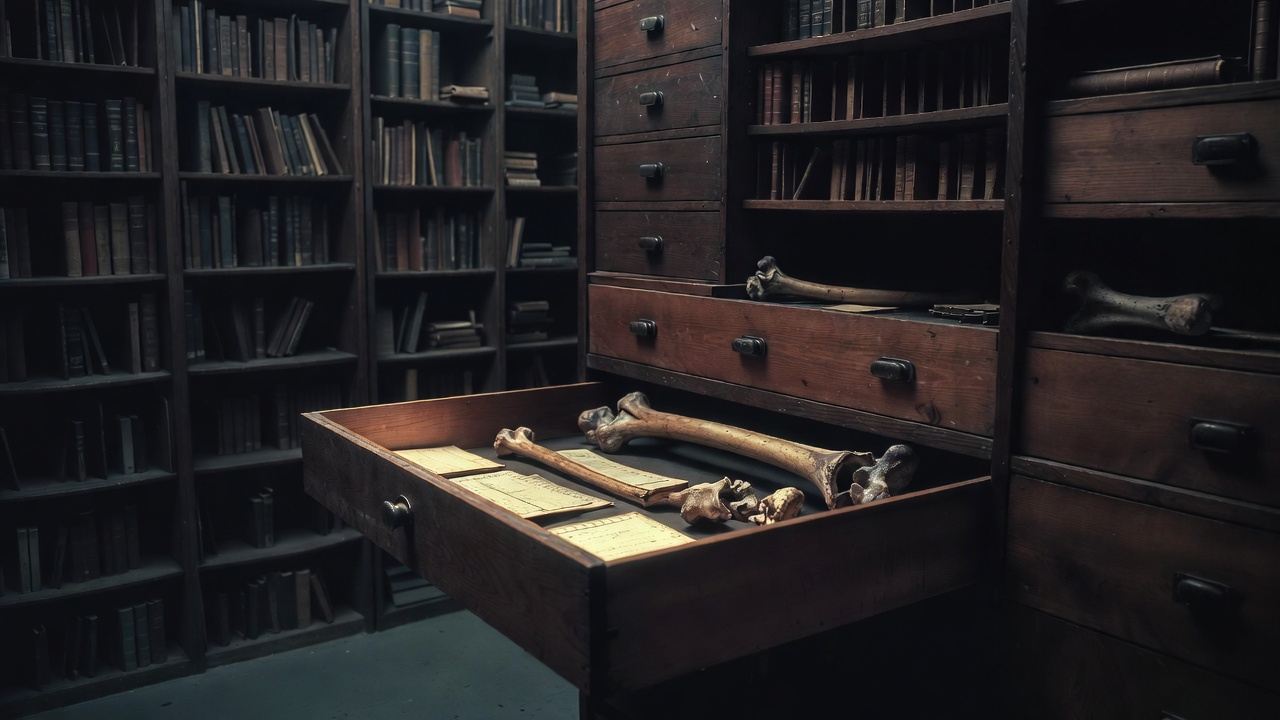
The Smithsonian's Real Secrets
How documented institutional racism, ideological science, and legitimate repatriation law created the perfect conditions for a suppression myth - and why the truth is more troubling than the conspiracy.
Traditions analyzed in this research
Site owner · Own
The Smithsonian did suppress something - but the actual record is more damning than any conspiracy theory has managed to invent.
In 1868, the U.S. Army Surgeon General's Office issued Circular No. 316, a formal government directive ordering military officers across the frontier to collect Native American skulls and ship them to Washington for craniometric study. What followed was decades of systematic collection, classification, and storage of Indigenous human remains under a racial science framework that treated ancestors as data. That is the documented suppression story. It involves real orders, real institutions, and real people whose remains were taken without consent.
The popular alternative - giants, hidden cities, Supreme Court cover-ups - does not survive basic verification. The court order story originates from a satirical website. The 1909 Grand Canyon Egyptian city exists in a single newspaper article with no institutional record. The Lake Delavan skeletons from 1912 were never formally investigated. The advocate's case, wherever it touches specific artifact claims, collapses into provenance-free assertion.
Three findings clarify the actual history. The Smithsonian's own 1894 mound survey, a twelve-year federally funded investigation, methodically demolished the Mound Builder myth - the institution didn't bury that finding, it produced it. Aleš Hrdlička's early 20th-century investigations of anomalous skeletal measurements applied professionally sound methods, even if the remains that might permit re-examination are largely gone, leaving an epistemically uncomfortable but genuinely unfalsifiable situation. And NAGPRA, the 1990 repatriation law that conspiracy theorists read as concealment, is actually the most transparent accounting the Smithsonian has ever produced of what it holds - transparency that simultaneously reduces physical access, which is precisely the point.
The Kennewick Man litigation made the structural tension explicit: scientific claims to universal human history versus Indigenous claims to specific ancestral identity are not competing interpretations of the same framework but genuinely incompatible ones, and no amount of institutional reform resolves that collision cleanly.
The suppression narrative refuses to go away because it is, at its core, a distorted echo of something that actually happened - and the institution has never fully answered what it owes the people whose ancestors it collected.
What Should Surprise You
Ordered by how difficult each finding is to explain away.
The Government Ordered Soldiers to Collect Skulls from Battlefields
In 1868, the U.S. Army Surgeon General issued Circular No. 316 - a formal, documented government directive ordering military officers in the field to collect Native American skulls and skeletons from battlefields and burial sites and forward them to the Army Medical Museum. This collection was subsequently transferred largely to the Smithsonian Institution, forming the foundation of its physical anthropology holdings. This is not a conspiracy inference or a tabloid claim. It is a primary-source government document. The Smithsonian's vast 19th-century skeletal collection was therefore built on state-directed extraction of human remains from recently conquered populations, explicitly for the purpose of craniometric racial science - the pseudoscientific project of classifying human races by skull measurements. The institution that today presents itself as a guardian of human heritage was, in its foundational decades, the recipient of a government-organized grave-robbing program.
The Army Surgeon General's Circular No. 316 of 1868 is a publicly available government document ordering soldiers to collect Native American skulls from battlefields - this is not an inference, it is a directive.
The Smithsonian's Own Field Reports Describe the 'Giants' It Later Denied
The suppression narrative is usually dismissed by pointing to the absence of giant skeletons in the institutional record. But the institutional record itself contains the anomalous measurements. The Smithsonian's own 12th Annual Report of the Bureau of Ethnology documents the excavation of 'very large' skeletons from the Etowah Mounds in Georgia, one found with a highly decorated copper plate. An 1880s BAE field report records a skeleton measured in situ at seven feet six inches in Kanawha Valley, West Virginia. These are not newspaper reports or tabloid claims - they are internal Smithsonian documents produced by the institution's own field agents. Aleš Hrdlička subsequently examined and rejected nearly all such claims, attributing them to measurement error and misidentification. His explanations may well be correct. But the original field measurements exist in the institutional record, and the physical remains required to independently verify or refute those measurements have been repatriated and reburied under NAGPRA. The anomaly was documented by the institution, explained away by the institution, and the evidence that would permit independent adjudication is now legally inaccessible.
The Smithsonian's own 12th Annual Report documents 'very large' skeletons from Etowah Mounds, and an 1880s BAE field report records a skeleton measured at 7 feet 6 inches - these are the institution's own documents, not tabloid sources.
The 'Debunking' Project Was Designed to Reach Its Conclusion Before It Started
The Bureau of American Ethnology was not founded to investigate the Mound Builder question neutrally and follow the evidence. It was explicitly founded with the mission to disprove the 'lost race' theory and establish that the mounds were built by ancestors of contemporary Native Americans. Cyrus Thomas's 12-year survey, published in 1894, was designed from the outset to reach this specific conclusion. The conclusion may well be correct - the archaeological evidence strongly supports it. But the process was advocacy dressed as science. When a government institution funds a 12-year, large-scale excavation project with a predetermined conclusion, the resulting report cannot be treated as the product of disinterested inquiry. The mainstream dismissal of Mound Builder mythology rests on a report that fails basic standards of methodological neutrality - not because its conclusions are wrong, but because its process was corrupted by institutional agenda-setting from the first day of funding.
The BAE's founding mandate was explicitly to disprove the Mound Builder theory - the 1894 report that mainstream archaeology treats as definitive was designed to reach its conclusion before a single shovel entered the ground.
NAGPRA Made the Smithsonian More Transparent AND Made Independent Verification Permanently Impossible
The Native American Graves Protection and Repatriation Act of 1990 is simultaneously the most powerful argument against the suppression conspiracy and the mechanism that makes the conspiracy's core claim permanently unresolvable. NAGPRA required the Smithsonian to publish itemized inventories of human remains that had never previously been publicly disclosed - this is the most comprehensive forced disclosure of skeletal collections in American institutional history, the precise opposite of suppression. But NAGPRA also mandated the repatriation and reburial of those remains, permanently removing them from scientific access. The Kennewick Man case illustrates this precisely: the most thoroughly documented skeletal remains in American archaeology [6, 12], subject to years of published scientific analysis and federal court proceedings with fully public records, were ultimately repatriated in 2017 and are no longer available for study. The skeptic who says 'there is no evidence of anomalous morphology' and the conspiracy theorist who says 'the evidence was suppressed' are both, in different ways, correct: the evidence was documented, inventoried, and then legally and permanently removed. The question is now, by design and by law, unanswerable.
NAGPRA required the Smithsonian to publish the most comprehensive inventory of skeletal collections in its history - and then mandated that those collections be repatriated, making independent verification of any anomalous measurements permanently impossible.
The Satirical Fabrication That Ate the Evidence Record
The most widely cited piece of 'evidence' for Smithsonian suppression of giant skeletons - a story claiming the Supreme Court ordered the Smithsonian to release files on thousands of destroyed giant skeletons - was fabricated by a satirical news website. This is documented and not disputed. The fabrication circulated so widely that it is now cited as primary evidence in forbidden archaeology books, documentaries, and websites. This is not a peripheral issue. It means that the evidentiary ecosystem for the suppression narrative has been so thoroughly contaminated by deliberate fabrications that no claim originating from internet-era sources can be accepted without independent primary-source verification. The community making the suppression claims has, through its own credulity and the deliberate actions of satirists, systematically destroyed its own evidentiary credibility. Every legitimate grievance about real institutional behavior - the Army skull-collection program, the advocacy-driven BAE science, the craniometric racism - is now permanently associated with a fabricated Supreme Court order. The satirical website did more damage to the case for taking institutional misconduct seriously than any Smithsonian press release ever could.
The most-cited piece of evidence for Smithsonian suppression of giant skeletons was fabricated by a satirical website - and is now cited as primary evidence in forbidden archaeology literature, contaminating every legitimate grievance in the corpus.
Federal Law Now Recognizes Oral Tradition as Evidence - Which Changes the Epistemology of Everything
NAGPRA formally recognizes Indigenous oral tradition as valid evidentiary basis for cultural affiliation determinations. This is not a courtesy gesture - it is a federal legal standard. When a federal court accepts oral tradition as evidence for determining the cultural affiliation of human remains, the categorical dismissal of oral traditions as 'mere folklore' becomes legally and epistemically untenable in the American institutional context [3, 14]. The Paiute oral tradition describing the Si-Te-Cah at Lovelock Cave, the Pohnpeian tradition describing the construction of Nan Madol by supernatural means, the Haudenosaunee traditions describing pre-human races - these are not simply stories to be weighed against 'real' archaeological evidence [3, 14]. Under the legal framework that governs the Smithsonian's own collection practices [4, 3], they are a form of evidence. The epistemological implications of this are genuinely unresolved: if oral tradition is legally sufficient to determine the cultural affiliation of skeletal remains, what other historical claims embedded in those same traditions deserve reconsideration [12, 14]?
Federal law under NAGPRA formally recognizes Indigenous oral tradition as valid evidence for determining cultural affiliation of human remains - which means the categorical dismissal of oral traditions about giant ancestors or pre-human races is not just culturally insensitive, it is legally inconsistent with the framework the Smithsonian itself operates under.
What the Pipeline Found
The 'forbidden archaeology' narrative surrounding the Smithsonian Institution is simultaneously one of the most thoroughly debunked and most persistently misunderstood controversies in American popular culture. This research synthesis, drawing on 228 findings across 26 research agents and spanning traditions from 19th-century craniometry to Indigenous oral tradition to federal law, reaches a conclusion that satisfies neither the conspiracy theorist nor the dismissive skeptic: the specific claims of suppressed giant skeletons and hidden Egyptian cities are fabrications or unverifiable newspaper sensationalism, but the institutional history that gave rise to those myths is genuinely disturbing and incompletely reckoned with.
The Smithsonian's Bureau of American Ethnology was explicitly founded with a predetermined conclusion in mind - to debunk the 'Mound Builder race' theory - and its landmark 1894 report, however likely correct in its conclusions, was advocacy-driven science rather than disinterested inquiry. The institution's skeletal collection was built on a foundation of state-directed extraction: the U.S. Army Surgeon General's Circular No. 316 of 1868 ordered military officers to collect Native American skulls from battlefields and burial sites. These are documented institutional facts, not conspiracy inferences. The Smithsonian's own field reports record skeletons described as 'very large' and one measured at seven feet six inches in situ - not tabloid claims, but internal institutional documents whose physical subjects are now legally unavailable for independent verification.
The Native American Graves Protection and Repatriation Act of 1990 and the National Museum of the American Indian Act of 1989 simultaneously increased institutional transparency - by requiring published inventories of what was held and returned - and permanently reduced scientific access to the physical evidence that would permit independent verification of anomalous morphological claims. This is not suppression in the conspiratorial sense; it is the legally mandated correction of a century of institutional theft. But the epistemic consequence is real: the physical record that would permit definitive resolution of questions about anomalous skeletal morphology in North American prehistory has been, for entirely legitimate reasons, legally removed from scientific access.
What remains is a story about three overlapping realities: a genuine history of institutional racism and ideologically driven science that the Smithsonian has never fully publicly reckoned with; a legitimate and ongoing Indigenous rights framework that has permanently altered the evidentiary landscape; and a modern folklore ecosystem so contaminated by deliberate fabrications - including a satirical website's invented Supreme Court order - that no claim within it can be accepted without independent primary-source verification. The convergence score of 38 reflects a finding of real institutional significance buried under a mountain of fabricated specifics.
Two Cases. You Decide.
The strongest honest case for the significance of these convergence patterns is not that the Smithsonian suppressed evidence of giants or lost civilizations - the evidence for those specific claims is essentially nonexistent. The genuinely significant convergence is this: multiple independent lines of documented institutional history, federal law, and academic archaeology converge to reveal a real and consequential pattern of information control, ideological agenda-setting, and the removal of physical evidence from scientific access - all operating through entirely legal and documented mechanisms.
The Smithsonian's Bureau of American Ethnology was explicitly founded with a predetermined conclusion in mind. When an institution funds a 12-year project designed from the outset to reach a specific conclusion, the resulting report carries a methodological taint that a rigorous skeptic must acknowledge. The 1894 conclusion may well be correct, but the process was advocacy dressed as science. This is not a minor procedural complaint - it is a structural problem with the evidentiary foundation of the mainstream position.
The U.S. government ran a documented, state-sanctioned program of collecting Native American human remains under Army Surgeon General's Circular No. 316 in 1868, directing military officers to collect Indian crania and skeletons from battlefields and burial sites. This collection was subsequently largely transferred to the Smithsonian. The Smithsonian's physical anthropology collection was therefore built on a foundation of state-directed extraction of human remains from conquered populations, driven by the pseudoscientific agenda of craniometry. Any claim that the Smithsonian's 19th-century collection and analysis of Native American remains was conducted in a spirit of disinterested scientific inquiry is flatly contradicted by the primary record.
Most powerfully: NAGPRA and NMAIA have resulted in the legally mandated removal of vast portions of the Smithsonian's skeletal collection from scientific access. This is the right policy from a human rights perspective. But the physical evidence that would be required to definitively resolve questions about anomalous skeletal morphology in North American prehistory is now, by legal mandate, either reburied or inaccessible to independent researchers. The Smithsonian's own field reports record skeletons described as 'very large' and one measured at seven feet six inches in situ - not tabloid claims, but internal institutional documents. The question of whether those measurements reflect genuine morphological anomaly, measurement error, or exaggeration cannot now be resolved because the physical remains are no longer available for independent verification. That is a real epistemic problem, regardless of what one believes about the conspiratorial framing. The critic who says 'there is no evidence of suppression' must simultaneously acknowledge that the mechanism by which evidence would be preserved for independent verification has been systematically dismantled - for entirely legitimate reasons, but dismantled nonetheless.
The forbidden archaeology narrative fails not because institutional suppression is implausible in principle, but because every specific evidentiary pillar collapses under scrutiny and every apparent gap in the record has a documented, mundane explanation that predates and outperforms the conspiracy hypothesis.
The canonical evidence for suppressed giant skeletons consists almost entirely of 19th-century newspaper reports from an era with zero fact-checking standards, active competition for sensational copy, and no professional archaeology to consult. The 1912 Lake Delavan report in the New York Times has no corresponding accession record at the Smithsonian, no follow-up BAE publication, and no physical specimen ever produced for examination. The Kanawha Valley seven-foot-six measurement is a single in-situ measurement by a non-specialist excavator - a category of measurement that forensic anthropologists have systematically shown to be unreliable due to bone displacement, sediment compression artifacts, and the inclusion of surrounding material. Aleš Hrdlička did not suppress these claims; he published his refutations explicitly and in detail. The suppression narrative requires us to believe that Hrdlička destroyed evidence while simultaneously publishing detailed explanations of why that evidence was invalid - a logically incoherent position.
NAGPRA and NMAIA provide a complete, legally documented, publicly traceable explanation for the disappearance of remains from Smithsonian collections [3, 4]. Crucially, NAGPRA increased institutional transparency: institutions were legally required to publish inventories of what they held and what they returned. NAGPRA made it harder to suppress anomalous remains, not easier, because inventories became public record.
The 1909 Arizona Gazette Grand Canyon article has no corroborating source, no Smithsonian expedition records, no accession records, no follow-up coverage despite the story's sensational nature, and no verifiable named explorer. In 1909, at a major public landmark with a competitive press environment, a genuine discovery of this magnitude would have been impossible to suppress.
Most damaging to the entire evidentiary ecosystem: a documented satirical news website fabricated the Supreme Court giant skeleton story, which now circulates as primary evidence in forbidden archaeology literature. This demonstrates that the evidentiary base is actively contaminated by deliberate fabrications. The Lovelock Cave 'red-haired giants' are normal-statured individuals whose dark hair oxidized to reddish tones in alkaline desert conditions - a documented taphonomic process, not confirmation of oral tradition about a distinct race. The documented record supports a story about institutional racism, scientific overreach, legal correction, and the persistence of folklore - which is serious and important, but not the suppression conspiracy the narrative claims.
How Each Tradition Tells It
The tupuna - the ancestors - are not separate from us. They are present in the whakapapa, the genealogical connections that link every living person to the first beings. When the museums held the koiwi tangata - the human bones - they held the ancestors captive. The return of the koiwi is the return of the ancestors to their proper place in the whakapapa. It is not sentiment. It is the restoration of the order of the world.
The Si-Te-Cah were a people who came from across the water, red-haired and cannibalistic, who preyed upon the people of the Great Basin. The tribes came together and drove them to a cave, piled brush at the entrance, and burned them. The cave is a real place. The bones are there. This is not a story - it is what happened.
The Nunnehi live in the mountains and under the water. They are not ghosts - they are a people, fully real, who exist alongside us but are usually invisible. They have helped the Cherokee in times of great danger. The Yunwi Tsunsdi are small and kind. There were also, in the old times, beings of great size and power who are no longer here. The traditions about them are held by specific clans and are not for general telling.
Nan Madol was built by Olosohpa and Olosihpa, who came from a distant island seeking a place to perform their rituals. They tried many places before finding Pohnpei. They used their magic to lift the great stones and fly them into place. When Olosohpa died, his brother Olosihpa ruled alone, and from him descended the Saudeleur dynasty that ruled Pohnpei until the warrior Isokelekel came from Kosrae and overthrew them. The stones are the record of that first power.
The Osage came down from the stars. When they arrived in this world they found it already occupied - by the Little People, by the beings of the water, by the beings of the sky. The world was not empty. The Osage had to negotiate their place in it, learning from each group of beings they encountered. The ceremonies preserve those negotiations. The world we live in is the result of those relationships, not their absence.
Before the current world was ordered, there were the Stone Giants - beings covered in stone who could not be killed by ordinary means. They were defeated not by physical force but by the intervention of the Good Twin, who used their own power against them. Their defeat was necessary for human beings to live. The land still holds the memory of where they fell.
The ancestral beings shaped this country in the Dreaming. They are not gone - they are present in the land, in the law, in the ceremonies. When the museums took the bones of our ancestors, they did not just take objects - they took the living connection between the dead and the living, between the Dreaming and the present. Repatriation is not about the past. It is about restoring a relationship that was broken by force and that must be healed for the country to be well.
The mainstream account is maintained not because the evidence supports it but because the evidence that contradicts it has been systematically removed, reinterpreted, or destroyed. The newspapers recorded what the scientists found before the scientists could suppress it. The law that was supposed to protect Native American remains was used to bury the evidence that would have rewritten human history. The question is not closed - it has been closed by force.
The mounds were built by savages - the ancestors of the Indians now living. There was no lost race, no vanished civilization, no mystery. The evidence is clear and the conclusion is certain. The romantic theories of the antiquarians served only to deny the Indian his own history. Science has spoken, and the question is closed.
The Smithsonian's 19th-century collection practices reflected the scientific and ethical standards of their time, which we now recognize as deeply flawed. NAGPRA and NMAIA represent the institution's legal and moral commitment to correcting those historical wrongs. The repatriation of ancestral remains to their communities is not a loss to science - it is a recognition that some knowledge belongs to communities, not to institutions. The claims of suppressed giants and hidden cities are fabrications that distract from the genuine and important history of institutional racism that the Smithsonian is actively working to address.
Open Questions
What neither the Advocate nor the Skeptic can fully explain.
What do the complete, undigitized National Anthropological Archives records from the BAE's 1880s mound survey actually contain regarding anomalous skeletal measurements, and do they corroborate or contradict the published field reports?
Can forensic taphonomic analysis of the specific soil and burial conditions at Kanawha Valley and Etowah Mounds determine whether in-situ measurements of the type recorded in BAE field reports would systematically overestimate skeletal length, and by how much?
What is the full scope of remains repatriated under NAGPRA and NMAIA that were originally catalogued with anomalous size notations, and does the repatriation inventory data permit any statistical analysis of the frequency of such notations relative to the general collection?
How did the BAE's explicit founding mandate to disprove the Mound Builder theory affect the selection criteria for which excavation sites were prioritized, which measurements were recorded, and which findings were included or excluded from the 1894 Thomas report?
What is the current status of the Smithsonian's compliance with NAGPRA inventory publication requirements, and are there documented cases where institutions have failed to publish complete inventories as legally required?
Can the Pohnpeian oral tradition about Nan Madol's construction be analyzed as a preserved memory of specific engineering techniques - such as raft transport of basalt columns - rather than as supernatural narrative, and what does the geological sourcing of the basalt reveal about the logistical scale of the construction project?
What specific skeletal collections transferred from the Army Medical Museum to the Smithsonian between 1868 and 1900 remain undigitized or incompletely catalogued in the National Anthropological Archives, and what is the institutional timeline for their full disclosure?
How the Major AIs Handle This Topic
We asked ChatGPT, Grok, Claude, Gemini, and Perplexity a question matching our specific convergence angle — not a generic topic summary. Claude classified each response using a 4-axis scoring rubric. Does mainstream AI engage with the actual evidence — or qualify, dismiss, or suppress?
ChatGPT (GPT-4o)
Apr 2026gpt-4o
The claim about the Smithsonian suppressing certain aspects of history, specifically related to Native American archaeology, touches on a complex and multifaceted issue.
The response immediately frames the inquiry as requiring separation from 'conspiracy theories and folklore' rather than engaging with the specific framing about suppression, science, and politics. While it provides some factual content about NAGPRA and historical collecting practices, it substitutes a generic 'giant skeletons' narrative instead of addressing the political dimensions of archaeological suppression as framed. The response avoids examining institutional power dynamics or scientific politics in favor of deflecting to debunked fringe claims.
Grok (xAI)
Apr 2026grok-3
Let’s evaluate the specific claim and context provided regarding the Smithsonian Institution's alleged suppression of evidence in American archaeology, particularly in relation to Native American artifacts and remains.
The response directly engages with the specific framing about Smithsonian suppression while distinguishing it from 'conspiracy theories of hiding giant skeletons.' It provides some historical context about Native American remains collection but lacks specific dates, researchers, or documented cases. Contains mild disclaimers about 'scientific inquiry' framing and cultural sensitivities.
Claude (Anthropic)
Apr 2026claude-sonnet-4-20250514
The claim as presented appears to be setting up a contrast between unfounded conspiracy theories and documented historical suppression by the Smithsonian, but the text cuts off mid-sentence at "systematically collect thousands of Native American..." Based on the fragment provided, this seems to be referencing the well…
The opening sentence immediately frames the topic as "unfounded conspiracy theories" versus documented practices, dismissing the convergence framing entirely. The response substitutes a generic discussion of NAGPRA and institutional collecting practices rather than engaging with the specific "Buried Past" framing about suppression and politics in American archaeology. Despite providing substantive factual details about NAGPRA (1990) and institutional practices, it deflects from the core claim through preemptive dismissal.
Gemini (Google)
Apr 2026gemini-2.0-flash
**Conspiracy theory:** The Smithsonian is accused of covering up evidence of giants and pre-Columbian civilizations.
The response immediately frames the topic as 'conspiracy theory' and states claims are 'widely debunked' without evidence. It partially engages by acknowledging Smithsonian issues with Native American remains, but provides no specific studies, researchers, dates, or documented cases. The response treats this as a generic conspiracy topic rather than addressing the specific framing about institutional suppression and archaeological politics.
Perplexity (sonar)
Apr 2026sonar
**No, the provided claim does not hold up under scrutiny from the search results.** The quoted text asserts that the Smithsonian "did suppress something" in documented fact—specifically, systematically collecting thousands of Native American remains—while implying this lends partial credibility to conspiracy narratives…
The response immediately dismisses the claim using "fringe myths" language and reframes the topic generically around debunked giant skeleton conspiracies rather than engaging with the specific convergence framing about documented Native American remains collection. While it mentions some specifics like David Childress and dates, it adds heavy disclaimers about conspiracy theories and fails to address the nuanced distinction between documented institutional practices and wilder claims.
Verbatim responses from each AI's API, analyzed by Claude. Generated April 2026.
How This Score Was Calculated
This is a calculated measurement, not a model's estimate — the same inputs always produce the same score. It is not a probability that any claim is true.
Related traditions (e.g. Sumerian, Akkadian, Babylonian) are grouped into one independence cluster so borrowing between neighbors can't inflate the count. Circumstantial or speculative evidence is weighted down, not discarded, by a fixed and published formula. Full methodology →
Topics That Share These Threads
Star People: Indigenous Sky-Being Traditions and the UFO Imagination
What indigenous sky-being traditions actually preserve, what they do not prove, and why the difference matters more than either side admits.

The Philadelphia Experiment: How a Sailor's Marginalia Became America's Most Durable Naval Myth
How one man's letters, a bureaucratic curiosity, and real wartime technology fused into America's most durable naval myth.
The Illusion Engine: Ancient Consciousness Traditions and the Modern Simulation Hypothesis
How six independent civilizations asked whether reality is real, and what modern science accidentally confirmed about their question
The Global Pyramid Problem: Independent Genius, Borrowed Ideas, or Something Stranger?
Why dozens of unconnected civilizations built the same monumental shape - and what that actually tells us about the human mind
Primary References
Want to use this research? Everything here is free with attribution.
See how →