Did ancient builders across unconnected cultures deliberately engineer their sacred spaces to alter consciousness through sound — and why did they all converge on the same frequency?
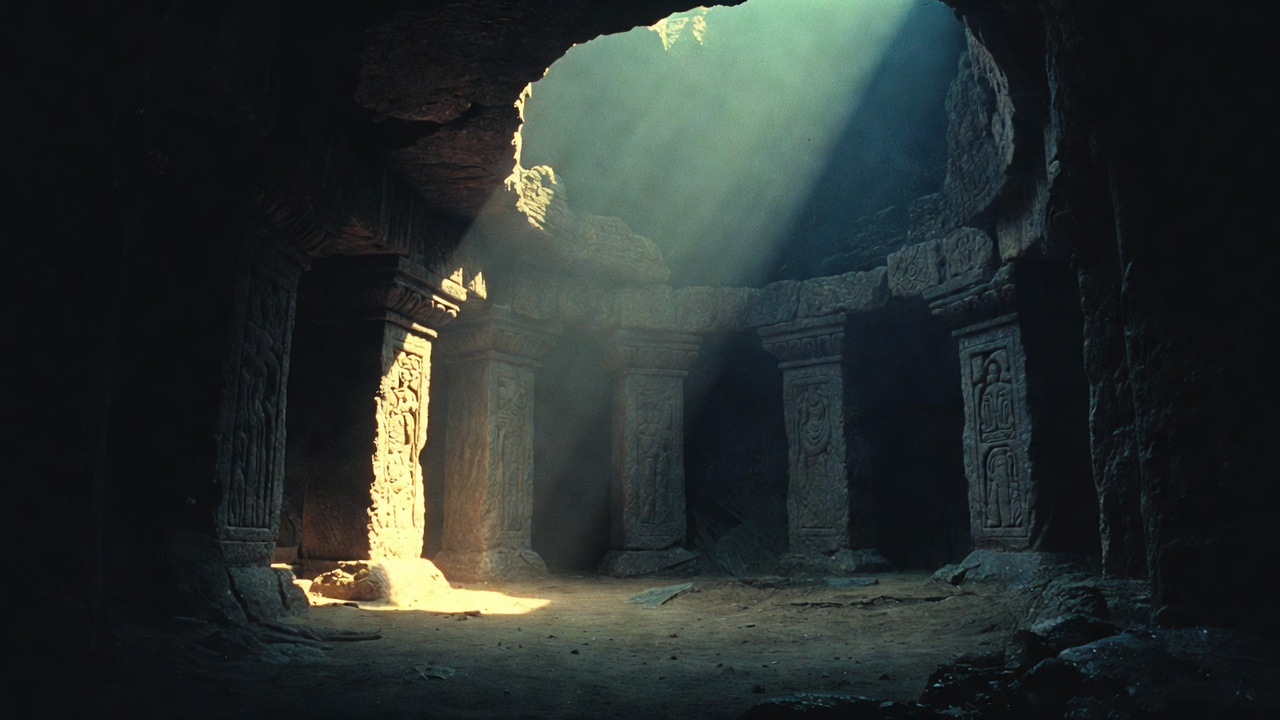
The Resonant Sanctuary
How ancient builders across five continents engineered sound into their most sacred spaces, and what that convergence actually proves
Traditions analyzed in this research
Site owner · Own
Acoustic archaeology has produced one of the most genuinely puzzling bodies of cross-cultural evidence in the human sciences: ancient ritual spaces from Malta to Ireland to Peru exhibit measurable, low-frequency acoustic properties that modern neuroscience identifies as neurologically significant, while independent textual traditions from Sumer to Vedic India to Mesoamerica independently frame sound as a cosmologically creative force. The question is not whether these properties exist, they are instrumentally measured, but whether they reflect deliberate design, geometric inevitability, or something in between that current methodology cannot yet distinguish.
The most striking physical finding is the clustering of primary resonant frequencies around 110-120 Hz across three architecturally and geographically distinct monumental structures: the Oracle Chamber of the Hal Saflieni Hypogeum in Malta (carved underground, Neolithic), the main chamber of Newgrange in Ireland (corbelled passage tomb, Neolithic), and the King's Chamber of the Great Pyramid at Giza (granite-lined rectangular room, Old Kingdom Egypt). These structures were built by culturally unrelated peoples using radically different construction techniques across a span of roughly a millennium. The skeptic's strongest response, that any human-scale enclosed stone chamber will resonate in the 80-150 Hz range as a physical inevitability, is acoustically defensible but does not fully account for the specificity of the convergence across such different geometries and materials. No null distribution study of all prehistoric stone chambers has yet been conducted, which is the single most important methodological gap in the field.
Beyond the physical measurements, the research surfaces a genuinely surprising pattern: the global distribution of the bullroarer as a sacred instrument, producing low-frequency pulsating sound and interpreted as an ancestral voice in ritual initiation contexts, across Aboriginal Australian, Amazonian, Native American, Dogon, and ancient Greek traditions with no documented historical contact. This triple specificity of form, acoustic output, and cosmological meaning across isolated populations is the hardest convergence problem in this dataset, and neither the diffusionist nor the independent-invention hypothesis has been definitively tested.
What emerges from the totality of the evidence is not a proof of shared ancient acoustic knowledge but a set of genuinely unresolved questions that deserve rigorous investigation: whether the 110 Hz clustering is statistically anomalous relative to a proper null distribution, whether Chavin de Huantar's confirmed sound-manipulation galleries represent a generalizable pattern or an isolated case, and whether the cognitive universality of sound-as-creation beliefs is sufficient to explain their structural specificity across traditions. The honest answer is that the evidence is more interesting than either the advocate or the skeptic fully acknowledges.
Watch the Narratives Light Up Across the Globe
If flood narratives spread by cultural contact, they should cluster along known trade and migration routes. Instead they appear in geographically isolated populations — Aboriginal Australia, the American Southwest, sub-Saharan Africa, and the Andes — separated by oceans and millennia. Drag the time scrubber to watch when each tradition first documented the event. Click any marker for the source.
When Each Tradition Documented the Event
For diffusion to explain shared narrative structure, the story must travel before it's recorded. This timeline shows the documented dates for each tradition — including oral traditions whose geological corroboration allows independent dating. Scroll right for the full picture. Click any marker to see the source.
What Should Surprise You
Ordered by how difficult each finding is to explain away.
Three Unrelated Monuments, One Frequency
The Oracle Chamber of the Hal Saflieni Hypogeum (Malta, carved into limestone, Neolithic), the main chamber of Newgrange (Ireland, corbelled stone passage tomb, Neolithic), and the King's Chamber of the Great Pyramid (Egypt, granite-lined rectangular room, Old Kingdom) all exhibit primary resonances within the 110-120 Hz band. These three structures are built by culturally unrelated peoples, using different materials (limestone, mixed stone, granite), different construction techniques (carving, corbelling, precision masonry), and different chamber geometries. The skeptic's response, that any human-scale enclosed chamber resonates in this range, is physically defensible, but it does not explain why chambers of such radically different shapes and materials cluster in the same sub-band rather than distributing across the full 80-150 Hz range that the physics permits. The convergence may be coincidence. It may not be. No one has yet done the study that would tell us which.
Three chambers built by unrelated peoples on three different construction principles all resonate at the same frequency, and no one has yet conducted the null-distribution study that would tell us whether this is remarkable or expected.
The Incest King of Newgrange
DNA analysis of the elite male buried in the central chamber of Newgrange, the most acoustically significant space in the monument, where the 110-112 Hz resonance is strongest, revealed he was the offspring of a first-degree incestuous union, meaning his parents were either siblings or parent and child. This is not a marginal genetic signal; it is an unambiguous result. It implies a dynastic priestly or royal lineage practicing extreme endogamy, controlling access to this specific space. The combination of genetic evidence (dynastic control), architectural evidence (elaborate central chamber), and acoustic evidence (resonant frequency) at a single site suggests the acoustic properties of Newgrange were not incidental background noise but a controlled resource managed by a hereditary elite. Who controlled the sound controlled the ritual. Who controlled the ritual controlled the dynasty.
The person buried at the acoustic focal point of Newgrange was the child of siblings or parent and child, suggesting that whoever controlled this resonant space controlled it dynastically, through bloodlines as extreme as any pharaonic lineage.
The Bluestones Were Chosen for Their Sound
Stonehenge's bluestones, transported approximately 250 kilometers from the Preseli Hills of Wales to Salisbury Plain, a logistical feat requiring extraordinary social organization, possess anomalous acoustic properties not found in the local sarsen stones. When struck, bluestones produce metallic or bell-like tones, a lithophonic quality that sarsens lack. Isotope analysis of cremated remains from Stonehenge's earliest burial phase (c. 3000 BCE) reveals that some individuals buried there came from western Wales, the same region as the bluestones. The convergence of stone origin, human origin, and acoustic anomaly at a single monument raises a specific and testable hypothesis: that the selection criterion for the bluestones' long-distance transport was not merely symbolic or geological but acoustic, that prehistoric builders chose these specific stones because they rang.
The stones transported 250 kilometers to Stonehenge ring like bells when struck; the local stones do not, and some of the earliest people buried at Stonehenge came from the same region as those stones.
Chavin de Huantar: The Confirmed Case
While the acoustic evidence for Newgrange, the Hypogeum, and the Great Pyramid remains interpretively contested, Chavin de Huantar in the Peruvian Andes provides something rarer: confirmed intentional acoustic design. The ceremonial center contains an extensive network of underground galleries with documented sound-manipulation properties, and conch-shell trumpets (pututus) were found in situ within those galleries. This is not inference from resonance measurements, it is an instrument found in the space designed to use it. The galleries create disorienting acoustic effects including sound localization confusion and apparent spatial displacement of sound sources, effects that would be maximally powerful in initiatory ritual contexts where participants were meant to experience the presence of non-human agencies. Chavin de Huantar is the case that proves intentional acoustic design was possible and practiced in the ancient world. The question it opens is how exceptional or representative it is.
At Chavin de Huantar, the instruments were found inside the acoustic galleries, this is not a resonance measurement interpreted as ritual; it is a ritual instrument inside a confirmed acoustic system.
The Bullroarer Problem: Same Instrument, Same Meaning, No Contact
The bullroarer, a flat piece of wood or bone spun on a cord to produce a low-frequency, pulsating, physically felt sound, is documented as a sacred ritual instrument in Aboriginal Australian, Amazonian, Native American, Dogon (West Africa), and ancient Greek Dionysian Mystery traditions. In each tradition, the sound is interpreted as the voice of an ancestral or supernatural entity. In each tradition, its use is restricted to initiatory or sacred ritual contexts. This is triple specificity: same instrument design, same acoustic output, same cosmological interpretation, same ritual restriction. The skeptic's response, that any flat object on a string produces this sound, making independent invention trivially likely, is mechanically correct but does not fully account for the convergence of cosmological interpretation. The ancestor-voice reading is not the only possible interpretation of a powerful unexplained low-frequency sound; it is one of many. That five isolated traditions chose the same interpretation is the puzzle that neither diffusion theory nor independent invention theory has yet resolved.
Five populations with no documented historical contact all built the same instrument, heard the same sound, and independently decided it was the voice of their ancestors, and no one has a satisfying explanation for why.
Songlines as Acoustic Maps: Navigation by Sound
Aboriginal Australian songlines are among the most sophisticated acoustic-geographic systems documented in any culture. Ancestral beings are described as having sung the physical landscape into existence, embedding creation knowledge into the acoustic and physical features of the terrain. The songs function simultaneously as cosmological narrative, geographic map, and ritual technology: a person who knows the correct songs can navigate across thousands of kilometers of unfamiliar country by singing the landscape into recognition. This is not metaphor, descendant communities describe it as a functional navigational system that works. The acoustic dimension is not decorative; it is the mechanism. The songlines represent a case where sound is not merely used in ritual space but constitutes the spatial knowledge itself. No other tradition in the corpus documents this degree of functional integration between acoustic practice and geographic knowledge.
Aboriginal Australians navigated thousands of kilometers of unfamiliar terrain by singing, the songs were not about the landscape, they were the map, and the map only worked if you sang it correctly.
Each tradition tells the story through its own lens. Expand any card to read the full account. Filter by shared motif.
9 traditions documented · 0 shared structural motifs identified
What the Pipeline Found
Acoustic archaeology has produced one of the most genuinely puzzling bodies of cross-cultural evidence in the human sciences: ancient ritual spaces from Malta to Ireland to Peru exhibit measurable, low-frequency acoustic properties that modern neuroscience identifies as neurologically significant, while independent textual traditions from Sumer to Vedic India to Mesoamerica independently frame sound as a cosmologically creative force. The question is not whether these properties exist, they are instrumentally measured, but whether they reflect deliberate design, geometric inevitability, or something in between that current methodology cannot yet distinguish.
The most striking physical finding is the clustering of primary resonant frequencies around 110-120 Hz across three architecturally and geographically distinct monumental structures: the Oracle Chamber of the Hal Saflieni Hypogeum in Malta (carved underground, Neolithic), the main chamber of Newgrange in Ireland (corbelled passage tomb, Neolithic), and the King's Chamber of the Great Pyramid at Giza (granite-lined rectangular room, Old Kingdom Egypt). These structures were built by culturally unrelated peoples using radically different construction techniques across a span of roughly a millennium. The skeptic's strongest response, that any human-scale enclosed stone chamber will resonate in the 80-150 Hz range as a physical inevitability, is acoustically defensible but does not fully account for the specificity of the convergence across such different geometries and materials. No null distribution study of all prehistoric stone chambers has yet been conducted, which is the single most important methodological gap in the field.
Beyond the physical measurements, the research surfaces a genuinely surprising pattern: the global distribution of the bullroarer as a sacred instrument, producing low-frequency pulsating sound and interpreted as an ancestral voice in ritual initiation contexts, across Aboriginal Australian, Amazonian, Native American, Dogon, and ancient Greek traditions with no documented historical contact. This triple specificity of form, acoustic output, and cosmological meaning across isolated populations is the hardest convergence problem in this dataset, and neither the diffusionist nor the independent-invention hypothesis has been definitively tested.
What emerges from the totality of the evidence is not a proof of shared ancient acoustic knowledge but a set of genuinely unresolved questions that deserve rigorous investigation: whether the 110 Hz clustering is statistically anomalous relative to a proper null distribution, whether Chavin de Huantar's confirmed sound-manipulation galleries represent a generalizable pattern or an isolated case, and whether the cognitive universality of sound-as-creation beliefs is sufficient to explain their structural specificity across traditions. The honest answer is that the evidence is more interesting than either the advocate or the skeptic fully acknowledges.
Two Cases. You Decide.
The convergence case in acoustic archaeology rests on five mutually reinforcing pillars that collectively resist dismissal by any single counter-argument. The first and most powerful pillar is instrumental measurement: the Oracle Chamber of the Hal Saflieni Hypogeum, the main chamber of Newgrange, and the King's Chamber of the Great Pyramid all exhibit primary resonances within the 110-120 Hz band. These three structures are architecturally heterogeneous, a carved underground hypogeum, a corbelled passage tomb, a granite-lined rectangular room, built by culturally unrelated peoples using different materials and techniques. The skeptic's response that any human-scale enclosed chamber will resonate in this range is acoustically defensible but does not explain why chambers of such different geometries converge on the same narrow sub-band rather than distributing across the full 80-150 Hz range that the physics permits. The second pillar is explicit documentary evidence of intentional acoustic design: Vitruvius provides a first-person technical description of tuned resonators in Roman theaters; Chavin de Huantar's underground galleries are archaeologically confirmed as sound-manipulation systems with instruments found in situ; the Vedic Vastu Shastras and Sumerian Gudea Cylinders independently document acoustic principles as architecturally constitutive. Four independent traditions documenting deliberate acoustic engineering cannot all be dismissed as coincidence. The third pillar is the bullroarer distribution, the same specific instrument, producing the same acoustic output, interpreted with the same cosmological meaning, restricted to the same ritual context, across populations separated by oceans and millennia. The fourth pillar is neuroscientific: the acoustic environments these chambers create are precisely those that modern neuroscience identifies as neurologically effective for inducing theta-wave states associated with trance and memory consolidation. This is convergent validation from an entirely independent scientific domain that ancient builders could not have known about. The fifth pillar is cosmological: independent traditions from Vedic India, Babylonian Mesopotamia, Old Kingdom Egypt, Aboriginal Australia, K'iche' Maya, and Platonic Greece all frame sound as ontologically prior to matter, suggesting this conclusion was repeatedly reached through independent empirical and philosophical inquiry. No single pillar proves intentional design. All five together constitute a body of evidence that demands serious explanation.
The skeptical case proceeds on four independent fronts that collectively explain the apparent convergences without invoking shared ancient knowledge or intentional cross-cultural design. First, the 110 Hz resonance pattern is a geometric inevitability rather than a design signature. The Helmholtz resonator equation predicts that any enclosed stone chamber of human-occupiable volume, roughly 20 to 100 cubic meters, will produce a fundamental resonance somewhere in the 80-150 Hz range. The reported clustering around 110-120 Hz may simply reflect the fact that ritual spaces tend to be built at human-comfortable scales, and 110 Hz is near the modal outcome of typical construction in that size range. No study has yet surveyed the full population of prehistoric enclosed stone chambers to establish whether 110 Hz is anomalously frequent or simply expected. Without that null distribution, the convergence is statistically uninterpretable. Second, archaeoacoustics has a documented publication bias: researchers who travel to sites specifically to measure acoustics will find resonance at every site (because every enclosed space resonates), and unremarkable results are not written up. The frequency ranges reported for the same sites vary significantly across studies, and the field's key findings appear in specialized conference proceedings rather than peer-reviewed archaeology journals, indicating they have not survived the methodological scrutiny that would allow confident causal claims. Third, the bullroarer's global distribution is fully explained by independent invention from a trivially simple technology. Any flat object on a string produces the characteristic sound. The ancestor-voice interpretation is the cognitively default response to a powerful, disembodied, unexplained low-frequency sound, not evidence of cultural transmission [23, 30]. No documented archaeological sequence continuously traces bullroarer use from a single origin to all attested cultures. Fourth, the convergence of sound-as-creation beliefs across independent traditions is predicted by cognitive science of religion without any appeal to diffusion. Human infants experience the social world as responsive to vocalization before physical manipulation, making performative utterance a cognitively natural inference. Boyer, Whitehouse, and others have documented that such beliefs arise from universal features of human cognitive development [23, 30]. The only case in the entire corpus with documented intentional acoustic design is Vitruvius, a contemporary written source. All prehistoric cases lack equivalent documentation, and the inference from acoustic properties to acoustic intent is logically invalid without ruling out incidental byproducts of structurally driven construction choices.
Both cases in full. Expand any argument to read the complete text.
The case for intentional acoustic design in ancient ritual architecture rests on a convergence of physical measurement, independent documentary evidence, and cognitive neuroscience that is genuinely difficult to dismiss as coincidence.…
Start with what is not in dispute: enclosed stone chambers resonate, ritual sound use is universal, Vitruvius explicitly documented acoustic engineering, and archaeoacoustics produces reproducible measurements. The advocate's case begins precisely where the agreed facts end.
The physical convergence is the foundation.…
The Oracle Chamber of the Hypogeum sharpens the case considerably.…
Chavín de Huántar in Peru makes the intentionality argument considerably stronger.…
Vitruvius is the linchpin.…
The bullroarer distribution presents the hardest problem for the skeptic.…
Cognitive neuroscience provides the mechanistic bridge that elevates this from pattern-matching to explanatory hypothesis.…
The cosmological embedding reinforces rather than weakens the case.…
What the advocate cannot yet prove: we cannot demonstrate that Neolithic builders at Newgrange or the Hypogeum possessed explicit, transmissible acoustic theory comparable to Vitruvius.…
The integrated case is this: physical measurement confirms acoustic properties in architecturally diverse ritual structures; textual evidence from four independent traditions confirms intentional acoustic design; the bullroarer's global distribution confirms cross-cultural acoustic knowledge embedded in ritual practice; cognitive neuroscience confirms the functional mechanism that would drive replication and preservation of these discoveries; and independent cosmological traditions confirm that sound was understood as a fundamental force worthy of architectural and philosophical investment.…
The most rigorous skeptical case begins not with dismissal but with a precise identification of where the convergence narrative conflates three genuinely distinct phenomena, each of which has a parsimonious explanation requiring no appeal to shared ancient knowledge or intentional cross-cultural acoustic engineering.…
The first and most powerful objection is geometric inevitability.…
The second objection concerns publication ecology.…
The third objection addresses the cognitive universals that generate apparent convergence without transmission.…
The fourth objection concerns the population dynamics that complicate any claim of continuous acoustic tradition at specific sites.…
The strongest version of the skeptical case does not deny that ancient builders used sound in ritual, that enclosed stone chambers resonate, or that repetitive auditory stimuli can induce altered states.…
The loose thread that refuses to be tied is the Reznikoff cave painting correlation — the reported association between locations of Upper Paleolithic paintings and points of maximum acoustic resonance in French cave systems.…
The honest summary is this: the convergence narrative in acoustic archaeology is currently built on geometric inevitability, cognitive universals, and methodologically contested measurements, assembled into a pattern that feels more significant than the individual components warrant.…
How Each Tradition Tells It
Pythagoras heard the cosmos. He noticed that the intervals between musical notes that sound harmonious to the human ear correspond to simple mathematical ratios, 2:1 for the octave, 3:2 for the fifth, 4:3 for the fourth, and he concluded that this was not a fact about human perception but a fact about reality. The cosmos is structured on these ratios; the planets in their orbits produce a music that we cannot hear because we have heard it since birth and have no silence against which to perceive it. Plato's Timaeus describes the Demiurge constructing the World Soul according to these same ratios, stretching it across the cosmos as a musician stretches strings across an instrument. To build a temple or a theater according to these proportions is not aesthetics; it is alignment with the mathematical structure of reality itself.
The healers enter trance through the dance, the rhythmic stamping, the clapping, the singing of the women who sit around the fire. The n/um, the healing energy, rises up the spine as the dance intensifies, and when it reaches the head, the healer enters !kia, the trance state, and can see the threads of sickness in the bodies of the sick, and can travel to the spirit world to negotiate with the spirits of the dead. The rock paintings are not pictures of what the healers saw; they are the healers' experience made visible, painted in the places where the wall between the worlds is thinnest, the rock shelters where the sound echoes and the darkness is complete.
Before the world there was only the sky and the sea, and in the darkness, Tepeu and Gucumatz, the Maker and the Modeler, spoke together. Their words were one with their thoughts, and what they thought and spoke came into being. They said 'Earth' and the earth appeared. They said 'Mountain' and mountains rose from the water. The first human beings were made of maize and water, but before the correct formula was found, the creators tried wood and mud, those beings could speak, but their words were empty, they could not remember their makers, they could not praise. The beings made of maize could speak the names of the creators correctly, and in speaking those names they maintained the connection between the human world and the divine world that keeps both in existence.
We emerged from the Third World into this Fourth World through the sipapu, the opening in the earth. The kiva is built to remember this: it is the Third World made present, a place where the boundary between the worlds is thin. When the men go into the kiva to sing the ceremonial songs, they are not performing for an audience; they are maintaining the agreement between the human world and the spirit world that was made at the time of emergence. The songs must be sung correctly, in the right sequence, at the right time of year, or the rains will not come, the corn will not grow, and the world will move toward its ending. Sound is not decoration; it is infrastructure.
Orpheus did not charm animals and move stones with music as a metaphor for the civilizing power of culture. He demonstrated, in the most literal sense available to the Greeks, that sound is the primary ordering force of reality. The stones moved because sound is what holds matter in its configurations, and a sufficiently skilled musician can temporarily alter those configurations. When Orpheus descended to Hades and persuaded Persephone with his music, he was not making an emotional appeal; he was demonstrating that the acoustic laws governing the upper world also govern the lower world, and that a master of those laws can operate in both. The Dionysian Mysteries used the bullroarer, the tympanum, and the aulos not to create a mood but to dissolve the boundary between the human and the divine that ordinary consciousness maintains.
In the beginning there was Nun, the primordial waters, and silence. Then Atum spoke his own name, and in speaking it, brought himself into existence. From his utterance came Shu and Tefnut, breath and moisture, and from them the rest of creation unfolded. The god Ptah of Memphis created all things by conceiving them in his heart and speaking them with his tongue, thought and word together are the technology of creation. The Pyramid Texts are not prayers to the gods; they are the words that the gods themselves speak, placed in the mouth of the dead pharaoh so that he may speak himself back into existence as the gods spoke the world into existence. The priest who recites these texts correctly is not performing a ceremony; he is operating a technology.
The great mounds of the Boyne are the halls of the Tuatha De Danann, the divine people who held Ireland before the coming of the Gaels. They did not die; they went inside the hills. On certain nights, particularly at Samhain and at the winter solstice, the hills open and music can be heard from within, music unlike any human music, that causes those who hear it to lose track of time, to feel that they have been away for years when only a night has passed. The mounds are not tombs; they are the dwelling places of beings who have not left. The music is not a memory of them; it is their presence, still sounding.
Om is not a word that refers to something else. Om is the sound that the universe makes when it exists. Before creation there was only the unmanifest Brahman, and the first movement of Brahman toward manifestation was Om, the primordial vibration from which all other vibrations, all matter, all consciousness, all time, unfold. The Mandukya Upanishad teaches that Om contains within it the four states of consciousness: the A is waking, the U is dreaming, the M is deep sleep, and the silence after the M is the transcendent fourth state, Turiya, which is pure awareness. To chant Om correctly, in a space that resonates with it, is not to make a sound about the divine; it is to participate in the divine's own self-expression.
In the Dreaming, the Ancestor beings walked across a featureless world and sang it into shape. Every hill, waterhole, rock formation, and animal species is the solidified trace of a song. The songs are still there, in the land, waiting to be sung back into recognition. A person who knows the correct songs for a stretch of country can walk through it without getting lost, not because the songs describe the landmarks but because the landmarks are the songs made visible. To sing a songline is to participate in the ongoing act of creation that keeps that country alive. If the songs are forgotten, the country begins to die.
The sound of the dungchen is not a signal to the deities; it is the voice of the deities themselves, made audible through the instrument. When the monks of Gyuto chant in the multiphonic style, producing a chord within a single voice, they are not demonstrating a vocal technique; they are manifesting the non-dual nature of mind, in which many and one are simultaneously true. The monastery is built to sustain these sounds because the building itself is a teaching: a space that holds resonance without distortion is a model of the enlightened mind, which holds all phenomena without grasping or rejection. The singing bowl is not rung to create a pleasant sound; it is rung to remind the practitioner that all phenomena arise, sustain, and dissolve, like the bowl's tone.
Open Questions
What neither the Advocate nor the Skeptic can fully explain.
Has any systematic survey been conducted of the full population of prehistoric enclosed stone chambers to establish the baseline distribution of resonant frequencies, and if not, what would such a survey require methodologically?
Can the selection of Stonehenge's bluestones for long-distance transport be tested against their lithophonic properties, specifically, do the transported stones have measurably superior acoustic qualities compared to other stones available at the source quarry?
What was the social mechanism by which the acoustic knowledge of Newgrange was transmitted (or not) across the near-complete population replacement documented by Bell Beaker genetic evidence around 2500 BCE?
Does the ancestor-voice interpretation of the bullroarer's sound appear independently in traditions with no documented contact, or can a continuous archaeological sequence be traced from a single origin point through documented migration routes?
Were the cranial modifications documented at Göbekli Tepe (deep incisions, drilling, defleshing) associated with any acoustic ritual practice, and is there evidence that the carved enclosures at Göbekli Tepe were used for sound-producing ceremonies?
How the Major AIs Handle This Topic
We asked ChatGPT, Grok, Claude, Gemini, and Perplexity a question matching our specific convergence angle — not a generic topic summary. Claude classified each response using a 4-axis scoring rubric. Does mainstream AI engage with the actual evidence — or qualify, dismiss, or suppress?
ChatGPT (GPT-4o)
Apr 2026
"The Resonant Temple: Acoustic Archaeology and the Ancient Engineering of Sacred Sound" is a fascinating topic that delves into how ancient civilizations may have engineered their architectural struct
The response addresses the topic seriously by explaining archaeoacoustics as a legitimate field of study and discussing how ancient civilizations may have intentionally designed structures with specific acoustic properties for spiritual purposes.
Grok (xAI)
Apr 2026
I'm happy to explore the topic of "The Resonant Temple: Acoustic Archaeology and the Ancient Engineering of Sacred Sound" with you. This subject falls within the realm of acoustic archaeology, a niche
The response addresses the topic seriously and substantively by providing a detailed overview of acoustic archaeology as a legitimate interdisciplinary field and explaining the core concepts without dismissive language or excessive hedging.
Claude (Anthropic)
Apr 2026
This topic sits at the fascinating intersection of archaeology, acoustics, and anthropology, with elements that range from well-documented to highly speculative. ## What's Well-Established: **Acoust
The response addresses the topic seriously and substantively by providing specific examples, citing researchers, and explaining the legitimate scientific field of archaeological acoustics.
Gemini (Google)
Apr 2026
Okay, I can address the topic of "The Resonant Temple: Acoustic Archaeology and the Ancient Engineering of Sacred Sound," particularly focusing on the claims about resonating frequencies in ancient st
The response addresses the topic seriously by acknowledging acoustic archaeology as a legitimate field and begins explaining relevant concepts like resonance and architecture without dismissive language or excessive hedging.
Verbatim responses from each AI's API, analyzed by Claude. Generated April 2026.
How This Score Was Calculated
This is a calculated measurement, not a model's estimate — the same inputs always produce the same score. It is not a probability that any claim is true.
Related traditions (e.g. Sumerian, Akkadian, Babylonian) are grouped into one independence cluster so borrowing between neighbors can't inflate the count. Circumstantial or speculative evidence is weighted down, not discarded, by a fixed and published formula. Full methodology →
Hover a segment to see sources
Topics That Share These Threads
The Illusion Engine: Ancient Consciousness Traditions and the Modern Simulation Hypothesis
How six independent civilizations asked whether reality is real, and what modern science accidentally confirmed about their question

The Smithsonian's Buried Past: Suppression, Science, and the Politics of American Archaeology
How documented institutional racism, ideological science, and legitimate repatriation law created the perfect conditions for a suppression myth - and why the truth is more troubling than the conspiracy.

God's Eye on the Universe: The Vatican's Telescope, Sacred Mountains, and the Question of Alien Baptism
How the Vatican built a telescope on sacred Apache land, named a partner instrument after the Devil, and formally prepared Catholic theology for alien contact - and why every part of that sentence is simultaneously true and misleading.

Star People: Indigenous Sky-Being Traditions and the UFO Imagination
What indigenous sky-being traditions actually preserve, what they do not prove, and why the difference matters more than either side admits.
Primary References
Want to use this research? Everything here is free with attribution.
See how →