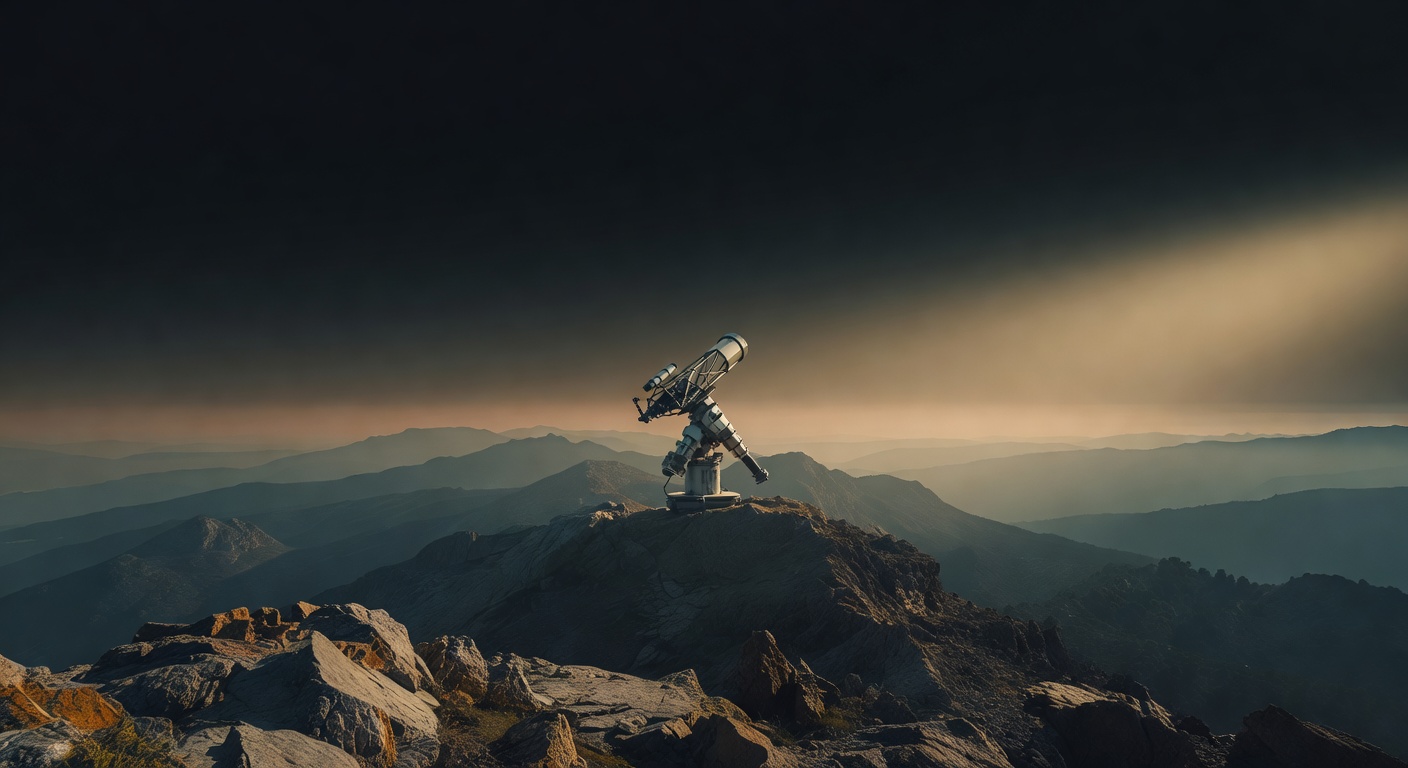
God's Eye on the Mountain
How the Vatican built a telescope on sacred Apache land, named a partner instrument after the Devil, and formally prepared Catholic theology for alien contact - and why every part of that sentence is simultaneously true and misleading.
Traditions analyzed in this research
Grok Imagine / xAI · AI Generated
Why does the Catholic Church own a research telescope in Arizona? Not a symbolic one. A real, peer-reviewed, publishing astrophysics operation. And why has it been doing astronomy since 1582?
The answer is stranger than the conspiracy theories. The Vatican has maintained a continuous scientific program for 440 years. No other religious institution on Earth comes close. Its current observatory directors have formally stated they'd baptize an alien who asked. And the telescope sits on a mountain the San Carlos Apache consider a living sacred being — a site they fought to protect and lost.
The Church spent four centuries insisting it was ready for whatever the universe contains. But what happens when that ambition collides with sacred ground it didn't name — and a question about extraterrestrial life it can't yet answer?
In 1582, Pope Gregory XIII needed to fix Easter. The Julian calendar had drifted ten full days from astronomical reality, and the date of Christianity's central holiday was sliding through the seasons. Solving this required not theology but precision observation of equinoxes and planetary motion. The Church built a tower observatory, hired mathematicians, and produced the Gregorian calendar the world still uses. That project seeded something unexpected: a permanent institutional appetite for astronomy that never went away. By 1891, Pope Leo XIII formally established the Vatican Observatory with a stated purpose that reads almost like a press release. The Church, he wrote, must show it "embraces science" and has nothing to fear from it. The observatory has operated continuously since, relocating from Rome to Castel Gandolfo to the mountains of Arizona as light pollution chased it westward.
Mount Graham was selected for the same reasons other astronomers wanted it. High elevation, dry air, stable atmospheric conditions, dark skies. The University of Arizona was already building there. The Vatican joined as a partner and completed the VATT in 1993. What neither institution fully reckoned with was the mountain's other identity. To the San Carlos Apache, Dzil Nchaa Si An is not a landform with cultural significance. It is a living sacred being. The Apache fought the construction through federal courts, environmental appeals, and direct protest. They lost, largely through legislative exemptions that bypassed normal review.
So the telescope stands. A Catholic research instrument on a mountain one people consider a body and another considers a platform for understanding creation. That collision alone would make the story worth telling. But layered on top of it is something even harder to categorize.
The paper trail is older than most countries. It starts with a calendar problem in 1582 and ends with a telescope on a contested mountain.
The Church That Invented Your Calendar Also Built a Telescope
The calendar on your wall exists because the Vatican hired astronomers. In 1582, Pope Gregory XIII needed to fix a ten-day drift in the old Julian calendar. That required sustained, rigorous sky-watching — and the infrastructure built for it never stopped operating. The modern Vatican Observatory and its Arizona telescope are the latest chapter in a 440-year scientific program.
The papal bull Inter gravissimas (1582) is a primary document commissioning astronomical observations - it predates Newton's Principia by over a century.
But tracking stars was only the beginning. The theology went further.
The World's Largest Christian Institution Has Formally Prepared for Alien Contact
The director of the Vatican Observatory has said, in print, that he'd baptize an extraterrestrial if it asked. This is not a joke or a gaffe. It's a formally published theological position from a credentialed MIT-trained planetary scientist running the Church's official scientific body. The Catholic Church has prepared a doctrinal answer for alien contact before science has confirmed aliens exist.
Funes's 2008 statement appeared in L'Osservatore Romano - the Vatican's official newspaper - making it as close to an official institutional position as anything short of a papal encyclical.
That theological ambition had to land somewhere physical. The location changes everything.
Three Traditions, One Mountain, Zero Agreement
Mount Graham is sacred to the San Carlos Apache. They call it Dzil Nchaa Si An — Big Seated Mountain — a living spiritual entity. The Vatican calls it an ideal platform to study God's creation. Secular astronomers call it an excellent observation site. All three traditions landed on the same coordinates for entirely different reasons. The Apache formally contested the telescope's construction. The Vatican built it anyway.
The San Carlos Apache Tribe's formal legal contestation of the Mount Graham International Observatory is a matter of public record - the conflict was not merely symbolic.
Three findings, three layers of genuine surprise — and not one of them settles cleanly. The same evidence that looks extraordinary from one angle looks like standard institutional behavior from another.
The DebateTwo Cases. You Decide.
The documented record is impressive and real. But every piece of it has an ordinary institutional explanation that doesn't require the word 'convergence.' That tension is the actual debate.
Every claim here rests on primary sources, not inference. The Vatican has published peer-reviewed astronomy for 440 years, formally prepared its theology for alien contact, and built its most advanced telescope on indigenous sacred ground over documented objections. No other religious institution has attempted anything like this convergence of science, theology, and contested geography.
The Church fixed a broken calendar and never stopped managing its post-Galileo reputation. The alien baptism quotes are Scholastic thought experiments dressed up for press coverage, not secret revelations. And Mount Graham's selection followed standard astronomical site surveys — the sacred-site conflict is real, but it's a land-use dispute, not a cosmic signal.
That disagreement didn't start with modern researchers. Communities across centuries and continents have circled this same collision of faith, science, and sacred ground from directions that barely share a vocabulary.
In Their Own WordsHow Different Cultures Tell It
Barnumbirr - the Morning Star, Venus - is the spirit who guides the dead on their journey. When someone dies, their spirit travels to the island of the dead, and Barnumbirr carries messages between the dead and the living. The Morning Star ceremony uses a decorated pole to represent Barnumbirr, and the ceremony is a way of maintaining the connection between the living and those who have gone. The star is not a distant physical object. It is a being with relationships and responsibilities. Its movement through the sky is not a mechanical process but a journey with meaning.
The mountain is not a backdrop or a resource. It is Dzil Nchaa Si An - a being with its own identity, a place where the boundary between the human world and the spirit world is permeable. Ceremonies conducted on the mountain are not symbolic performances but actual communications with powers that sustain the community's wellbeing. The plants that grow there are not merely medicinal but are gifts from the mountain itself. When tribal members describe the observatory's construction as desecration, they are not using the word metaphorically. In their framing, a structure built on the mountain's summit without the mountain's consent - mediated through the community's spiritual authorities - is a violation of a relationship, not merely an intrusion on property.
Strong convergence
Not a truth score. This measures how consistently unconnected cultures describe the same specific narrative elements — nothing more. How it's calculated →
The full picture on God's Eye on the Mountain is free.
6 findings, 7 cultural perspectives, full debate, timeline, sources with credibility ratings — everything, free with an account. No ads, no sponsors.