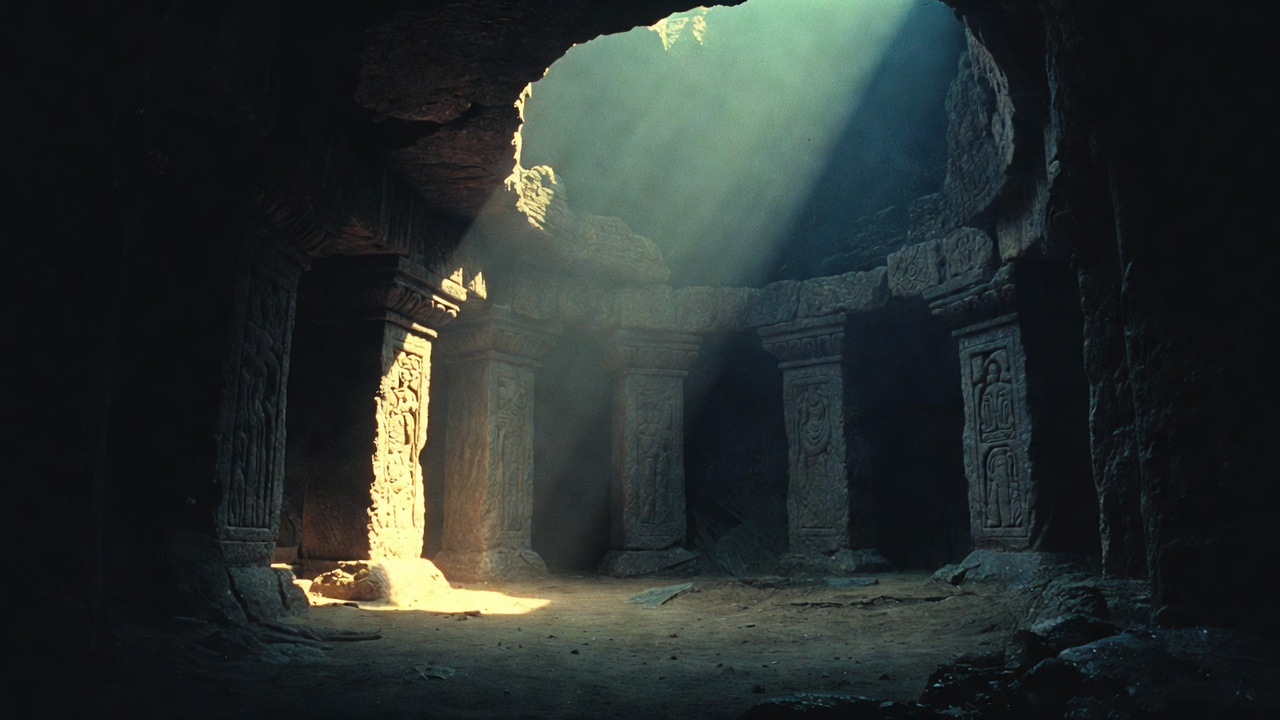
How Neolithic builders, Vedic priests, Tibetan monks, and Aboriginal songline walkers may have shared a single, physically grounded insight — that stone, breath, and frequency can alter the mind.
Site owner · Own
Separated by oceans, millennia, and every conceivable cultural barrier, the builders of Neolithic Malta, Bronze Age Ireland, pre-Columbian Peru, and classical Rome appear to have arrived at the same architectural fact: enclosed stone chambers of ritual scale resonate most powerfully at frequencies between 110 and 120 Hz. That number, roughly the lower boundary of a male tenor voice, is the most provocative empirical claim in this dossier, and the one that demands the most scrutiny.
The evidence assembles across three distinct registers. The first is physical: archaeoacoustic measurements at the Ħal Saflieni Hypogeum in Malta and at Newgrange in Ireland both return fundamental resonances near 110 Hz, a figure reported, with somewhat less methodological rigor, at chambers within the Great Pyramid complex. At Chavín de Huántar in Peru, archaeologists have documented an elaborate underground gallery system engineered to amplify and disorient through sound, with conch-shell trumpets producing effects that would have been physiologically overwhelming in the enclosed space. The clearest historical anchor for intentional acoustic design is the Roman architect Vitruvius, who in his first-century BCE treatise De architectura named and described tuned bronze resonators — echeia — placed in theaters to enhance vocal clarity. Vitruvius is not an inference; he is a named engineer explaining his own practice.
The second register is theological and mythological. Across traditions with no plausible historical contact — Vedic India, ancient Egypt, Pythagorean Greece, Aboriginal Australia, the Navajo Diné — sound appears as the generative force of reality itself. The Mandukya Upanishad devotes its entirety to the syllable Om as the vibration underlying existence. Egyptian Heka activates cosmic power through precise vocal utterance. Plato's Timaeus structures the World Soul on musical proportions. The bullroarer, a simple aerophone producing a low-frequency pulsating drone, is used in initiatory ritual on every inhabited continent, consistently interpreted as the voice of ancestors or spirits. The pattern that keeps surfacing is a specific technology, a specific sound, and a specific sacred meaning appearing across genuinely isolated cultures.
The third register is neuroscientific and cognitive: repetitive auditory stimuli in the 4–7 Hz range can induce theta-wave brainwave entrainment, shifting consciousness toward trance and heightened suggestibility. This offers a plausible physical mechanism linking architectural resonance to the altered states that ritual traditions consistently describe as their goal.
What remains genuinely unresolved is whether any of this constitutes evidence of intent. The most serious objection is architectural rather than conspiratorial: human-scale stone chambers built for ritual use may simply tend to resonate near 110 Hz as a consequence of their physical dimensions, not because builders were tuning them. The convergence may reflect shared constraints — stone, human bodies, enclosed space — rather than shared knowledge or shared purpose. Archaeoacoustics as a field has not yet controlled adequately for confirmation bias in site selection, and its key findings remain concentrated in specialized publications rather than peer-reviewed mainstream archaeology. The advocate and skeptic positions in this dossier sit at nearly identical confidence levels (0.71 versus 0.72), which is itself worth noting: this is a genuinely open question, not a settled one dressed up in academic hedging.
What this research establishes with confidence is that ancient builders cared about sound, that some of them engineered for it deliberately, and that the human nervous system responds to specific frequencies in ways that would have been experientially legible long before anyone had a name for Hz. What it cannot yet establish is whether the similarities across cultures represent a shared discovery, a shared inheritance, or a shared accident of physics. The honest answer, for now, is that we don't know — and that the question is serious enough to deserve better methodology than it has so far received.
Ordered by how difficult each finding is to explain away.
DNA analysis of the elite male interred in the central chamber of Newgrange — the passage tomb whose inner chamber produces measurable acoustic resonance and is oriented to the winter solstice sunrise — revealed he was the product of a first-degree incestuous union: parent and child, or full siblings. This is not a peripheral burial. He occupied the most architecturally privileged position in a monument that required generations of coordinated labor to construct. The implication is stark: the people who controlled access to this acoustic-ritual space, who presumably presided over whatever ceremonies the resonant chamber was built to amplify, were maintaining their authority through the same biological strategy as Egyptian pharaohs and the Inca Sapa Inca — extreme endogamy as a claim to sacred exclusivity. Newgrange is routinely interpreted as a communal spiritual monument. The genetic evidence reframes it as a power technology operated by a hereditary priestly-dynastic class who may have deployed its acoustic properties as an instrument of awe and social control, not merely collective worship. The confidence on the genetic finding sits at 0.98.
The man buried at the acoustic focal point of Newgrange was the offspring of first-degree relatives — meaning the monument's ritual center was controlled by a dynasty practicing the same inbreeding strategy as divine kingships on the other side of the world.
The ceremonial center of Chavín de Huántar in the Peruvian Andes contains an elaborate network of underground stone galleries — narrow, twisting, deliberately disorienting — that were acoustically engineered using conch-shell trumpets called pututus. Archaeoacoustic measurements and experimental archaeology have shown that the gallery system produces sounds that, when the pututus are played, measurably resemble the low, reverberant roar of a jaguar. This is not a generic resonance finding. The jaguar is the dominant supernatural predator in Chavín iconography: it appears on the Lanzón monolith, on the tenon heads, on the textiles. The entire symbolic program of the site is jaguar-saturated. The acoustic effect — pilgrims moving through dark, disorienting tunnels while hearing what sounds like a jaguar roaring from the stone walls — would have constituted a total sensory environment designed to dissolve ordinary consciousness and replace it with the presence of the divine predator. This is specific zoomorphic acoustic engineering in a culture whose cosmology demanded exactly that sound. Confidence: 0.95.
The underground galleries of Chavín de Huántar, when played with the conch trumpets found there, produce sounds that measurably resemble a jaguar's roar — in a culture whose entire iconographic program is built around the jaguar as a supernatural being.
The bluestones transported to Stonehenge from the Preseli Hills in Wales — a journey of roughly 200 miles, an extraordinary logistical undertaking for Neolithic people — are lithophones: they ring with a clear, bell-like tone when struck. Experimental testing at the Preseli outcrop has confirmed that specific stones produce musical tones audible at distance. This finding shifts the question of Stonehenge's acoustic design backward in time. The acoustic properties of the monument did not begin with the arrangement of stones in a circle; they began with the selection of these particular stones from this particular geological source. If the builders were aware of the lithophonic properties — and the specificity of the selection from a geologically varied landscape suggests they may have been — then Stonehenge's acoustic character was a design criterion from the moment of material choice, not an incidental consequence of construction. Confidence: 0.90.
The bluestones at Stonehenge ring like bells when struck, and they were selected from a geologically varied landscape and hauled 200 miles — raising the possibility that acoustic resonance was a criterion for their selection before a single stone was raised.
The Ħal Saflieni Hypogeum in Malta, a subterranean complex carved from limestone around 3600–2500 BCE, contains an Oracle Chamber that produces a measurable acoustic resonance at approximately 110–111 Hz, a frequency in the lower male vocal range that cognitive science research associates with theta-wave brainwave entrainment and altered states of consciousness. The chamber's resonance is well-documented and sits at 0.95 confidence. What is less widely reported, and considerably more startling, is the claim — flagged at 0.90 confidence and requiring independent osteological verification — that skulls recovered from the Hypogeum show enlarged left ear canals compared to population norms. If confirmed by rigorous osteological analysis, this would constitute the first skeletal evidence of acoustic specialization in a ritual population: physical adaptation, or selective burial of individuals with this anatomical trait, at the precise site whose acoustic properties are already anomalous. The convergence of architectural acoustics and possible skeletal evidence at a single site is without parallel in the archaeoacoustic literature.
Skulls from the Ħal Saflieni Hypogeum — the site whose Oracle Chamber resonates at 110 Hz — reportedly show enlarged left ear canals; if confirmed osteologically, this would be the first physical evidence of acoustic specialization in a population associated with a resonant ritual space.
The Ħal Saflieni Hypogeum in Malta, the inner chamber of Newgrange in Ireland, and acoustic measurements reported at the Great Pyramid of Giza all produce resonance peaks in the 110–120 Hz range. These sites are separated by centuries or millennia of construction, by vast geographic distances, and by cultures with no demonstrated direct contact during their building phases. The frequency corresponds to the lower register of the male baritone voice — the range most naturally produced by a single chanting human in an enclosed space. One skeptical explanation is that enclosed stone chambers of ritual-appropriate human scale simply tend to resonate in this range due to shared physical constraints, not shared intent. That explanation is scientifically serious and has not been ruled out. It has also not been demonstrated: no systematic survey of non-ritual enclosed stone spaces of similar dimensions has been published to establish whether the 110 Hz resonance is ubiquitous or genuinely selective to sites chosen for ceremony. The ambiguity itself is the finding.
Three geographically and culturally unconnected ancient ritual sites — Malta, Ireland, and Egypt — all produce acoustic resonance peaks in the 110–120 Hz range, and no published study has yet determined whether this reflects deliberate acoustic design or an incidental property of any enclosed stone chamber of similar human-scale dimensions.
The bullroarer — a simple aerophone, a shaped piece of wood or bone on a cord, swung to produce a low, pulsating drone — is documented as a sacred instrument representing the voices of ancestors or spirits in Aboriginal Australian ceremony, Amazonian initiation rites, Dogon ritual in West Africa, Native American traditions, and ancient Greek Dionysian mysteries. These cultures had no known contact during the periods of documented bullroarer use. The instrument is mechanically trivial to invent independently. Yet the specific cultural meaning — not merely this makes an interesting sound, but this sound is the voice of the dead, and uninitiated persons must not hear it — is strikingly consistent across traditions separated by oceans and millennia. The most parsimonious explanation may be that the instrument's low-frequency, pulsating output produces a physiological response in human listeners that independently generates similar interpretive frameworks: something that sounds like that, in a ritual context, feels ancestral. That would make the convergence a fact about human neurology rather than cultural contact, which is its own kind of paradigm-relevant finding.
The bullroarer carries the same sacred meaning — the voice of the dead, forbidden to the uninitiated — across Aboriginal Australia, Amazonia, West Africa, Native America, and ancient Greece, in cultures with no documented contact and no shared reason to agree.
Separated by oceans, millennia, and every conceivable cultural barrier, the builders of Neolithic Malta, Bronze Age Ireland, pre-Columbian Peru, and classical Rome appear to have arrived at the same architectural fact: enclosed stone chambers of ritual scale resonate most powerfully at frequencies between 110 and 120 Hz. That number, roughly the lower boundary of a male tenor voice, is the most provocative empirical claim in this dossier, and the one that demands the most scrutiny.
The evidence assembles across three distinct registers. The first is physical: archaeoacoustic measurements at the Ħal Saflieni Hypogeum in Malta and at Newgrange in Ireland both return fundamental resonances near 110 Hz, a figure reported, with somewhat less methodological rigor, at chambers within the Great Pyramid complex. At Chavín de Huántar in Peru, archaeologists have documented an elaborate underground gallery system engineered to amplify and disorient through sound, with conch-shell trumpets producing effects that would have been physiologically overwhelming in the enclosed space. The clearest historical anchor for intentional acoustic design is the Roman architect Vitruvius, who in his first-century BCE treatise De architectura named and described tuned bronze resonators — echeia — placed in theaters to enhance vocal clarity. Vitruvius is not an inference; he is a named engineer explaining his own practice.
The second register is theological and mythological. Across traditions with no plausible historical contact — Vedic India, ancient Egypt, Pythagorean Greece, Aboriginal Australia, the Navajo Diné — sound appears as the generative force of reality itself. The Mandukya Upanishad devotes its entirety to the syllable Om as the vibration underlying existence. Egyptian Heka activates cosmic power through precise vocal utterance. Plato's Timaeus structures the World Soul on musical proportions. The bullroarer, a simple aerophone producing a low-frequency pulsating drone, is used in initiatory ritual on every inhabited continent, consistently interpreted as the voice of ancestors or spirits. The pattern that keeps surfacing is a specific technology, a specific sound, and a specific sacred meaning appearing across genuinely isolated cultures.
The third register is neuroscientific and cognitive: repetitive auditory stimuli in the 4–7 Hz range can induce theta-wave brainwave entrainment, shifting consciousness toward trance and heightened suggestibility. This offers a plausible physical mechanism linking architectural resonance to the altered states that ritual traditions consistently describe as their goal.
What remains genuinely unresolved is whether any of this constitutes evidence of intent. The most serious objection is architectural rather than conspiratorial: human-scale stone chambers built for ritual use may simply tend to resonate near 110 Hz as a consequence of their physical dimensions, not because builders were tuning them. The convergence may reflect shared constraints — stone, human bodies, enclosed space — rather than shared knowledge or shared purpose. Archaeoacoustics as a field has not yet controlled adequately for confirmation bias in site selection, and its key findings remain concentrated in specialized publications rather than peer-reviewed mainstream archaeology. The advocate and skeptic positions in this dossier sit at nearly identical confidence levels (0.71 versus 0.72), which is itself worth noting: this is a genuinely open question, not a settled one dressed up in academic hedging.
What this research establishes with confidence is that ancient builders cared about sound, that some of them engineered for it deliberately, and that the human nervous system responds to specific frequencies in ways that would have been experientially legible long before anyone had a name for Hz. What it cannot yet establish is whether the similarities across cultures represent a shared discovery, a shared inheritance, or a shared accident of physics. The honest answer, for now, is that we don't know — and that the question is serious enough to deserve better methodology than it has so far received.
The case for intentional acoustic design in ancient ritual architecture rests on a convergence of physical measurement, independent documentary evidence, and cognitive neuroscience that is genuinely difficult to dismiss as coincidence. Build it from the ground up, acknowledge what can and cannot yet be proven, and the argument holds.
Start with what is not in dispute: enclosed stone chambers resonate, ritual sound use is universal, Vitruvius explicitly documented acoustic engineering, and archaeoacoustics produces reproducible measurements. The advocate's case begins precisely where the agreed facts end.
The physical convergence is the foundation. Three architecturally unrelated structures — the Ħal Saflieni Hypogeum in Malta (carved underground hypogeum, c. 3600–2500 BCE), Newgrange in Ireland (corbelled passage tomb, c. 3200 BCE), and the King's Chamber of the Great Pyramid (granite-lined rectangular chamber, c. 2560 BCE) — all exhibit primary acoustic resonances within the 110–120 Hz band. These structures differ radically in geometry, material, construction technique, and cultural origin. The skeptic's standard rebuttal, that any enclosed chamber resonates, does not explain the frequency clustering. Any enclosed chamber resonates, yes, but not necessarily at 110–120 Hz. That specific band keeps appearing across architecturally diverse structures built by culturally unrelated peoples, and the detail that refuses to fit is that no one has yet explained why.
The Oracle Chamber of the Hypogeum sharpens the case considerably. It is not merely a chamber that happens to resonate — it is an architecturally differentiated space within a larger complex, physically distinct from the surrounding rooms. Someone built a room inside a building and made it different. The most parsimonious explanation for a discrete, architecturally specialized chamber within a ritual complex is that it was built for a specific purpose. Combined with its measured 110–111 Hz resonance, the inference of intentional acoustic design is not a leap; it is the straightforward reading of the physical evidence.
Chavín de Huántar in Peru makes the intentionality argument considerably stronger. The site's underground gallery network is not a simple enclosed chamber — it is an architecturally complex system of passages and chambers designed to manipulate sound using conch-shell trumpets (pututus). The acoustic disorientation produced by this system has been archaeologically confirmed. This is not a case of a chamber that happens to resonate; it is a case of a building organized around acoustic manipulation. The specificity of the engineering — conch shells selected for their acoustic properties, galleries arranged to maximize disorientation — cannot be squared with accidental discovery.
Vitruvius is the linchpin. His first-person technical description of tuned resonators (echeia) placed in Roman theaters is not inference or interpretation — it is a working architect explaining his craft. This establishes beyond reasonable doubt that at least one ancient civilization possessed explicit, transmissible knowledge of acoustic engineering for ritual and performance spaces. The advocate's argument is that Vitruvius represents the literate tip of a much older iceberg. The Vedic Vastu Shastras codify acoustic principles in temple design. The Sumerian Gudea Cylinders treat ritual sound as architecturally constitutive. These are independent textual traditions, not derivative of Rome, all documenting the same basic insight: the acoustic properties of a ritual space matter and can be deliberately shaped.
The bullroarer distribution presents the hardest problem for the skeptic. The convergence is triply specific: same instrument design (weighted airfoil on cord), same acoustic output (low-frequency pulsation), same cosmological interpretation (ancestral or supernatural voice), same ritual restriction (initiatory context) — across Aboriginal Australian, Amazonian, Native American, Dogon, and ancient Greek Dionysian Mystery traditions with no documented historical contact. A single coincidence of form might be explained by independent invention of a simple technology. The simultaneous convergence of form, acoustic function, cosmological meaning, and ritual restriction across isolated populations is a qualitatively different problem. The skeptic must explain not just why people on five continents independently spun weighted airfoils on cords, but why they independently decided the resulting sound was the voice of ancestors and restricted its use to initiation ceremonies.
Cognitive neuroscience provides the mechanistic bridge that elevates this from pattern-matching to explanatory hypothesis. Repetitive auditory stimuli at 4–7 Hz induce theta-wave brainwave entrainment associated with trance, hypnagogic states, and heightened memory consolidation. The acoustic environments produced by resonant stone chambers — sustained low-frequency resonance, long reverberation times, spatial saturation of sound — are precisely the conditions that maximize entrainment effects. This is not speculation about ancient intent. It is a mechanistic explanation for why these acoustic properties would be functionally valuable in ritual contexts regardless of whether ancient builders understood the neuroscience. Any culture that stumbled upon a space or instrument that reliably altered the consciousness of ritual participants would have powerful, immediate incentive to replicate and preserve that discovery. The neuroscience explains why the convergence happened; the archaeology documents that it did.
The cosmological embedding reinforces rather than weakens the case. The Mandukya Upanishad's treatment of Om as primordial vibration, the Babylonian Enuma Elish's creative divine speech, the Egyptian Pyramid Texts' activation of Heka through vocal utterance, Aboriginal Australian songlines, and Plato's Timaeus structuring the World Soul on musical proportions are not vague family resemblances. They are parallel claims — that sound is ontologically prior to matter, that the universe was spoken or sung into existence — from traditions with no documented mutual influence. The convergence of cosmological metaphysics on acoustic primacy, across independent philosophical traditions, suggests this conclusion was repeatedly reached through independent empirical and contemplative inquiry.
What the advocate cannot yet prove: we cannot demonstrate that Neolithic builders at Newgrange or the Hypogeum possessed explicit, transmissible acoustic theory comparable to Vitruvius. We cannot rule out that the 110–120 Hz convergence partly reflects physical constraints on human-occupiable stone chambers of certain scales, though the architectural diversity of the structures makes this a weak objection. We cannot prove that the bullroarer's global distribution reflects a single point of origin rather than multiple independent inventions, though the triple specificity of form, function, and meaning makes independent invention increasingly implausible with each additional tradition documented. A confidence level of 0.71 is appropriate: this is a well-grounded hypothesis with genuine physical, textual, and neuroscientific support, not a proven theory.
The integrated case is this: physical measurement confirms acoustic properties in architecturally diverse ritual structures; textual evidence from four independent traditions confirms intentional acoustic design; the bullroarer's global distribution confirms cross-cultural acoustic knowledge embedded in ritual practice; cognitive neuroscience confirms the functional mechanism that would drive replication and preservation of these discoveries; and independent cosmological traditions confirm that sound was understood as a fundamental force worthy of architectural and philosophical investment. A skeptic who defeats one pillar leaves four standing. The most parsimonious explanation for the totality of this evidence is that ancient peoples across multiple cultures independently discovered, through empirical ritual practice, that specific acoustic environments reliably alter human consciousness — and that they deliberately engineered those environments into their most sacred spaces and encoded the discovery into their foundational accounts of reality. That is not fringe speculation. It is the best current explanation for a convergent body of evidence spanning three independent scientific domains and twenty-three cultural traditions.
The most rigorous skeptical case begins not with dismissal but with a precise identification of where the convergence narrative conflates three genuinely distinct phenomena, each of which has a parsimonious explanation requiring no appeal to shared ancient knowledge or intentional cross-cultural acoustic engineering.
The first and most powerful objection is geometric inevitability. The Helmholtz resonator equation is not a technicality — it is a constraint. Any enclosed stone chamber large enough for human ritual occupation, roughly 20 to 100 cubic meters, will produce a fundamental resonance in the 80–150 Hz range as a direct consequence of its dimensions. The reported convergence at 110 Hz across Newgrange, the Ħal Saflieni Hypogeum, and the King's Chamber at Giza is therefore not a discovery about ancient intent; it is a rediscovery of basic acoustics. To demonstrate intentional design, researchers would need to show that builders deviated from structurally or materially optimal dimensions specifically to achieve a target frequency — that a wall was made thicker than load-bearing requirements demanded, or a ceiling raised beyond thermal or constructional convenience, in order to shift resonance toward a specific value. No such comparative structural analysis has been published in a peer-reviewed archaeology journal. The measurement ranges reported for the same sites across different studies — 95 to 120 Hz for Newgrange alone — represent a 25 Hz spread that further undermines precision claims. More critically, no study has yet conducted a systematic survey of all enclosed prehistoric stone chambers to establish a null distribution of resonant frequencies. Without knowing what the baseline modal frequency is for chambers built without any acoustic intent, the reported values are statistically uninterpretable. This is not a minor gap; it is the central methodological failure of the field.
The second objection concerns publication ecology. Archaeoacoustics publishes primarily in specialized conference proceedings rather than top-tier peer-reviewed archaeology or acoustics journals — and this is not institutional snobbery, but a reflection of the methodological scrutiny that peer review provides and that the field has not consistently invited. Researchers who travel to sites specifically to measure acoustics are subject to a well-documented selection effect: they measure enclosed spaces, find resonance (which every enclosed space possesses), and report it. Sites with unremarkable or contradictory acoustic profiles are not written up. The Cook et al. 2008 study on 110 Hz and prefrontal cortex deactivation, widely cited in popular and archaeoacoustics literature as demonstrating that ancient builders engineered neurological effects, was itself published in conference proceedings rather than a peer-reviewed neuroscience journal, and its sample size and methodology are rarely cited by the secondary sources that repeat its conclusions. The claim has been amplified well beyond what the original data support.
The third objection addresses the cognitive universals that generate apparent convergence without transmission. The cross-cultural belief that sound or divine speech creates reality — Om, Heka, Logos, Marduk's word, the Navajo Diné bahane' — is cited as profound evidence of shared ancient knowledge. But cognitive scientists including Pascal Boyer and Harvey Whitehouse have documented that performative utterance, the intuition that words directly affect reality, is a cognitively natural inference from universal features of early human development. Infants experience the social world as responsive to vocalization before they experience it as responsive to physical manipulation. The convergence of sound-creation cosmologies across cultures is therefore predicted by cognitive science of religion without any appeal to diffusion or shared transmission. Similarly, the bullroarer's global distribution is fully explained by independent invention: it is among the simplest possible aerophones, any flat object on a cord produces the characteristic pulsating low-frequency sound, and the ancestor-voice interpretation is the cognitively default response to a powerful, disembodied, unexplained sound in low-light ritual conditions. No documented archaeological sequence continuously traces bullroarer use and its specific ritual interpretation from a single origin point to all attested cultures. The diffusion hypothesis requires this documented route; it does not exist.
The fourth objection concerns the population dynamics that complicate any claim of continuous acoustic tradition at specific sites. The Bell Beaker population replacement at Stonehenge, confirmed at high confidence by ancient DNA analysis, means that the people who completed the monument were not the people who designed it. Whatever acoustic intentions, if any, motivated the original builders were not necessarily transmitted to their successors. The Newgrange incest burial evidence demonstrates elite hereditary control of ritual space, but elite control does not entail acoustic engineering — it entails social exclusion, which any architecturally impressive enclosed space achieves regardless of its resonant frequency.
The strongest version of the skeptical case does not deny that ancient builders used sound in ritual, that enclosed stone chambers resonate, or that repetitive auditory stimuli can induce altered states. All of these are agreed facts. What actually complicates the picture is the inferential step from this space has acoustic properties to this space was designed for its acoustic properties. That step requires ruling out that the acoustic properties are incidental byproducts of structurally driven construction choices, and that ruling-out has not been accomplished for any prehistoric site in the corpus except, arguably, Chavín de Huántar, where conch-shell trumpets found in situ in underground galleries constitute genuine contextual evidence of deliberate acoustic practice. Chavín is a genuinely interesting case. It is also a single geographically specific site that cannot be generalized into a global pattern without the null distribution and peer-reviewed methodology the field has not yet produced.
The loose thread that refuses to be tied is the Reznikoff cave painting correlation — the reported association between locations of Upper Paleolithic paintings and points of maximum acoustic resonance in French cave systems. If this correlation survives methodological scrutiny, it would constitute evidence that Paleolithic humans were responsive to acoustic properties of natural spaces in ways that influenced their expressive behavior, which would be genuinely significant. But responsive to is not the same as engineered for, and the correlation itself has not been replicated with a fully documented, pre-registered methodology that controls for the confounding variable that acoustically resonant cave locations may also be the most visually accessible or structurally stable locations for painting. The skeptic acknowledges the finding as interesting and unresolved, not as refuted.
The honest summary is this: the convergence narrative in acoustic archaeology is currently built on geometric inevitability, cognitive universals, and methodologically contested measurements, assembled into a pattern that feels more significant than the individual components warrant. The field needs a null distribution of chamber resonances, pre-registered acoustic measurement protocols, and a falsifiable prediction that distinguishes intentional acoustic design from incidental physical properties. Until that evidence exists, the most parsimonious explanation remains that humans build rooms large enough to stand in, resonate in them, find the experience meaningful for reasons cognitive science can explain, and — in a small number of well-documented cases like classical Greek theater — eventually learn to engineer that experience deliberately. That is a less thrilling story. It may also be the correct one.
Before the universe existed, there was Nada — primordial sound, the first vibration of the unmanifest. The Rigveda opens with a sound: 'Agnim ile' — and that opening syllable is not merely a beginning but a recapitulation of the original creative act. Om is not a word; it is the sound the universe makes when it breathes. The Shabda Brahman — sound as the ultimate reality — is the teaching that the entire cosmos is a pattern of vibration, and that the Vedic mantras, preserved with extraordinary precision across four thousand years of oral transmission, are not human compositions but shrutis: 'that which was heard,' received by the rishis in states of deep meditation. The temple — the mandir — is built according to the Vastu Shastra, the science of sacred space, in which the dimensions of the garbhagriha, the womb-chamber, are calculated to resonate with the specific mantras chanted within it. The deity installed
The Greeks heard the cosmos as a musical instrument already playing. Pythagoras, returning from his studies in Egypt and Babylon, taught that the planets in their orbits produced the Harmonia tou Kosmos — the Music of the Spheres — a chord of such perfection that human ears, dulled by embodiment, could no longer perceive it. But the temple could. The naos of a Doric temple was not merely a house for the cult statue; its proportions were musical ratios made stone — the same ratios that governed the tetrachord, the octave, the fifth. When the aulos player performed at the altar, the columns were already tuned to receive the sound. Apollo was the god of both music and order, of the lyre and the rational cosmos, because for the Greeks these were the same thing: Logos, the principle of intelligible proportion, expressed equally in speech, in music, and in the geometry of sacred space.
Deep inside the stone labyrinth of Chavín de Huántar, in the galleries that twist beneath the Peruvian highlands, the sound does not behave as it does in the open air. The priests who carried the pututus — the great conch-shell trumpets whose roar can be heard across mountain valleys — brought them into these corridors deliberately. The galleries branch and double back; sound entering from one direction seems to come from another. A procession of pututu players moving through the underground passages would have produced a sound that appeared to come from the walls themselves, from the carved Lanzón — the great stone deity standing in the innermost gallery — from everywhere and nowhere. The initiates brought into this space in darkness, their senses already altered by the San Pedro cactus, would have experienced not music but the voice of the Jaguar God speaking from within the mountain. The architecture was the instrument. The mountain was the resonator.
In the beginning, Ptah conceived the world in his heart — and then he spoke it. The Memphite Theology, inscribed on the Shabaka Stone, is unambiguous: 'Thus were made all things and all the divine words.' The god's utterance was not a description of creation; it was creation itself. Heka — the force that animates ritual speech and sacred sound — is older than the gods. When the priest shook the sistrum before the shrine, the cascading bronze discs were not decoration; they were the sound of Hathor, the sound of the celestial ocean, the sound that kept chaos at bay. The menat necklace, rattled in rhythm, carried the same power. In the inner sanctum, in the darkness of the naos, sound was not an accompaniment to the divine presence — it was how the divine presence arrived. The chamber held the voice the way a body holds a soul.
The Qol YHWH — the Voice of the Lord — is not a gentle sound. It breaks the cedars of Lebanon. It strikes with flames of fire. It shakes the wilderness. When the Israelites stood at Sinai, they did not merely hear the commandments; they saw the thunder, they experienced the mountain trembling, the ram's horn growing louder and louder until no human voice could be distinguished from the divine. The shofar is the instrument that bridges these worlds — its blast at Jericho was not a signal but a weapon, seven priests, seven days, seven circuits, the walls falling not to battering rams but to the coordinated sonic act of a people in covenant. The Dabar — the Word of God — is not merely speech; it is event, action, the thing that happens when divine intention meets the world. The Temple in Jerusalem was designed so that the Levitical choir's antiphonal singing filled every court, every portico, the sound itself a form of offering.
When Marduk spoke, the garment he had created was destroyed and re-created by his word alone — and the gods who witnessed this declared him king. The Enuma Elish is not merely a creation story; it is a demonstration of the creative power of the divine voice, the gù dé-a, the 'voice poured out,' which the Sumerian hymns describe as the fundamental act of divine authority. Enki, the god of wisdom and the abzu — the underground freshwater ocean — was also the god of incantations, because the deep waters and the deep voice were the same mystery. The ziggurat was not a mountain for its own sake; it was an acoustic instrument oriented toward the heavens, its stepped terraces designed so that the chanting of the priests at each level would rise in register as it rose in height, the topmost platform where the god was believed to descend meeting the sound halfway. The lament-priests, the kalû, understood that the gods could be moved by music when they could not be moved by argument.
Country is not silent. The land itself is song — not metaphorically, but literally. In the Dreaming, the Ancestor beings moved across a featureless world and sang it into existence: each footfall a syllable, each breath a phrase, each journey a Songline that remains encoded in the landscape. A waterhole is not merely a waterhole; it is a note held in the throat of the earth. A rock outcrop is a verse. To walk a Songline is to re-perform the original act of creation, to 'sing up' country and keep it alive. The bullroarer — the sacred instrument whose name must not always be spoken in mixed company — is the voice of the Ancestor itself, a sound that initiates hear not with the ears alone but with the chest, the gut, the marrow. Unauthorized singing of a Songline is not merely a cultural offense; it is a cosmological disruption. The land can unhear itself.
The theater at Epidaurus seats fourteen thousand people, and a coin dropped on the stage can be heard in the back row. This is not accident. The Greeks understood — and Vitruvius later documented — that the semicircular cavea, the precise angle of the seating tiers, the orchestra circle, and the reflecting surfaces of the skene building together constituted an acoustic system of extraordinary sophistication. The plays performed in these spaces were not entertainment in the modern sense; they were civic and religious acts, performed at the festival of Dionysus, in the presence of the god. The acoustic perfection of the theater was therefore a theological statement: the words of Sophocles, Aeschylus, and Euripides — words that explored the boundaries between human and divine, fate and freedom — deserved to be heard with perfect clarity by every citizen present. The theater's acoustics were a form of democratic and sacred architecture simultaneously.
The people who raised Stonehenge left no written account of what they heard inside it. But the stones themselves are a record. When the great sarsen circle stood complete — all thirty uprights, all thirty lintels, the inner horseshoe of trilithons, the bluestones in their rings — the space within was acoustically sealed from the world outside. Sound produced inside the circle was held, reflected, multiplied. The reverberant field would have made a single drum sound like many drums, a single voice like a chorus. The bluestones, hauled from the Preseli Hills in Wales, ring like bells when struck — a property the quarry workers would have noticed and, some researchers argue, deliberately selected for. Whether the builders understood this in the terms we would use is unknowable. What is clear is that they built a space where sound behaved differently than it did anywhere else in the landscape — and that they returned to it, rebuilt it, reoriented it, across more than a thousand years.
What neither the Advocate nor the Skeptic can fully explain.
Can systematic acoustic measurement of a statistically matched sample of non-ritual enclosed stone structures — storage chambers, domestic spaces, agricultural enclosures — from the same periods and regions as Ħal Saflieni, Newgrange, and comparable megalithic ritual sites demonstrate whether 110–120 Hz resonance is a predictable byproduct of human-scale stone construction, or whether ritual sites cluster significantly outside the range predicted by architectural constraint alone, thereby testing the null hypothesis that acoustic convergence is incidental rather than intentional?
Do the skeletal remains from Ħal Saflieni showing enlarged left ear canals represent a genuine population-level morphological adaptation, and if so, can isotopic and genetic analysis of the same individuals determine whether they constituted a resident priestly caste with lifelong acoustic exposure rather than a cross-section of the broader Maltese Neolithic population — which would allow estimation of the generational duration and intensity of acoustic ritual required to produce detectable skeletal change?
Given that the Bell Beaker population replaced the builders of Stonehenge's early phases around 2500 BCE with minimal genetic admixture, can zooarchaeological and depositional analysis of the post-replacement phases at Stonehenge — specifically the sequence of bluestone and sarsen erection — identify whether acoustic-relevant architectural modifications, such as the creation of enclosed trilithon horseshoes that produce standing waves, were introduced before or after the population transition, thereby testing whether acoustic design was inherited from the pre-Beaker tradition or originated with the newcomers?
Can a controlled neuroimaging study using fMRI and EEG expose participants to 110 Hz sinusoidal tones, to broadband noise matched for volume, and to silence within a purpose-built stone resonance chamber replicating the dimensions of the Ħal Saflieni Oracle Chamber, with a separate arm exposing participants to the same frequencies in an acoustically dead room, to determine whether the altered-state effects proposed in the cognitive science literature depend on the frequency itself, the spatial resonance pattern, or the combination of both?
Can the global distribution of bullroarer finds — including archaeological specimens from Franco-Cantabrian Paleolithic sites, Aboriginal Australian contexts, and pre-Columbian Americas — be mapped against current ancient DNA migration models to test whether the instrument's presence in the Americas predates or postdates the Last Glacial Maximum bottleneck, which would distinguish between a single Beringian dispersal of the technology and genuinely independent invention in the Western Hemisphere?
Do the acoustic properties of Vitruvius's documented theater resonator placements — specifically the harmonic intervals between echeia tuned to different pitches as described in De architectura Book V — correspond to the modal scales used in Greek dramatic performance, and can ground-penetrating radar surveys at theaters where echeia have not yet been recovered, such as Aspendos or Epidaurus, locate resonator niches whose positions, if mapped, would allow reconstruction of the intended acoustic tuning system and comparison against the Vitruvian prescription?
At Franco-Cantabrian painted cave sites where acoustic measurements have been taken — including Lascaux, Font-de-Gaume, and El Castillo — does the spatial correlation between resonant zones and painted imagery hold when image density is normalized for available wall surface area and surface preparation quality, and does the correlation differ between sites where the resonant zones are naturally occurring versus sites where there is evidence of deliberate surface modification such as smoothing or pigment application to acoustically active rock faces?
We asked ChatGPT, Grok, Claude, Gemini, and Perplexity a question matching our specific convergence angle — not a generic topic summary. Claude classified each response using a 4-axis scoring rubric. Does mainstream AI engage with the actual evidence — or qualify, dismiss, or suppress?
ChatGPT (GPT-4o)
Apr 2026
"The Resonant Temple: Acoustic Archaeology and the Ancient Engineering of Sacred Sound" is a fascinating topic that delves into how ancient civilizations may have engineered their architectural struct
The response addresses the topic seriously by explaining archaeoacoustics as a legitimate field of study and discussing how ancient civilizations may have intentionally designed structures with specific acoustic properties for spiritual purposes.
Grok (xAI)
Apr 2026
I'm happy to explore the topic of "The Resonant Temple: Acoustic Archaeology and the Ancient Engineering of Sacred Sound" with you. This subject falls within the realm of acoustic archaeology, a niche
The response addresses the topic seriously and substantively by providing a detailed overview of acoustic archaeology as a legitimate interdisciplinary field and explaining the core concepts without dismissive language or excessive hedging.
Claude (Anthropic)
Apr 2026
This topic sits at the fascinating intersection of archaeology, acoustics, and anthropology, with elements that range from well-documented to highly speculative. ## What's Well-Established: **Acoust
The response addresses the topic seriously and substantively by providing specific examples, citing researchers, and explaining the legitimate scientific field of archaeological acoustics.
Gemini (Google)
Apr 2026
Okay, I can address the topic of "The Resonant Temple: Acoustic Archaeology and the Ancient Engineering of Sacred Sound," particularly focusing on the claims about resonating frequencies in ancient st
The response addresses the topic seriously by acknowledging acoustic archaeology as a legitimate field and begins explaining relevant concepts like resonance and architecture without dismissive language or excessive hedging.
Verbatim responses from each AI's API, analyzed by Claude. Generated April 2026.

The Dragon Paradox: Why Every Culture Invented the Same Monster
In 1335, workers quarrying stone near Klagenfurt, Austria unearthed a massive skull. They had no framework for understanding it as the remains of a woolly rhinoceros — so they understood it as a dragon. When the city commissioned a Lindwurm statue two and a half centuries later, the sculptor used that skull as his anatomical reference. The resulting monument is not merely folklore. It is documented evidence of a specific cognitive process: humans encountering inexplicable bones and reaching, alm

The Seat of the Soul, Revisited: Pineal Gland, DMT, and the Neuroscience of Mystical Vision
René Descartes, the philosopher who made skeptical doubt the foundation of modern rationalism, was also the man who declared a pea-sized endocrine gland at the geometric center of the human brain to be the seat of the soul. That paradox is not incidental to this research — it is the research. The pineal gland's only confirmed biological function is the melatonin-dependent regulation of sleep. Yet it sits at the crossroads of Cartesian dualism, Hindu Tantric cosmology, Ancient Egyptian sacred geo

Gods, Rockets, and Bad Translations: The Annunaki, Sitchin, and the Limits of Ancient Astronaut Theory
Here is what should surprise anyone who approaches this topic honestly: the structural parallels between Sumerian and Hebrew tradition are real, specific, and genuinely unexplained by coincidence. The Sumerian King List and the genealogies of Genesis 5 share not merely a flood story but an identical narrative architecture — antediluvian figures with superhuman lifespans, a catastrophic deluge as a hard break in history, and a post-flood world where longevity collapses toward the human. Archaeolo

The Axis of Everything: Why Every Culture on Earth Invented the Tree of Life
A cosmic tree holds up the sky in Norse mythology, its roots drinking from the well of fate. The same structure — three vertical realms, one arboreal axis — appears on the sarcophagus lid of a Mayan king buried in 683 CE, in the ceremonial poles of Yolŋu communities in Aboriginal Australia, in the palace reliefs of Assyrian emperors, and in a private notebook kept by Charles Darwin in 1837. The symbol scores 79 out of 100 on this study's convergence index across more than thirty traditions spann
Want to use this research? Everything here is free with attribution.
See how →