Did indigenous cultures across the world independently encounter beings from the sky — or are their sky-being traditions being misread through a modern extraterrestrial lens they were never meant to carry?
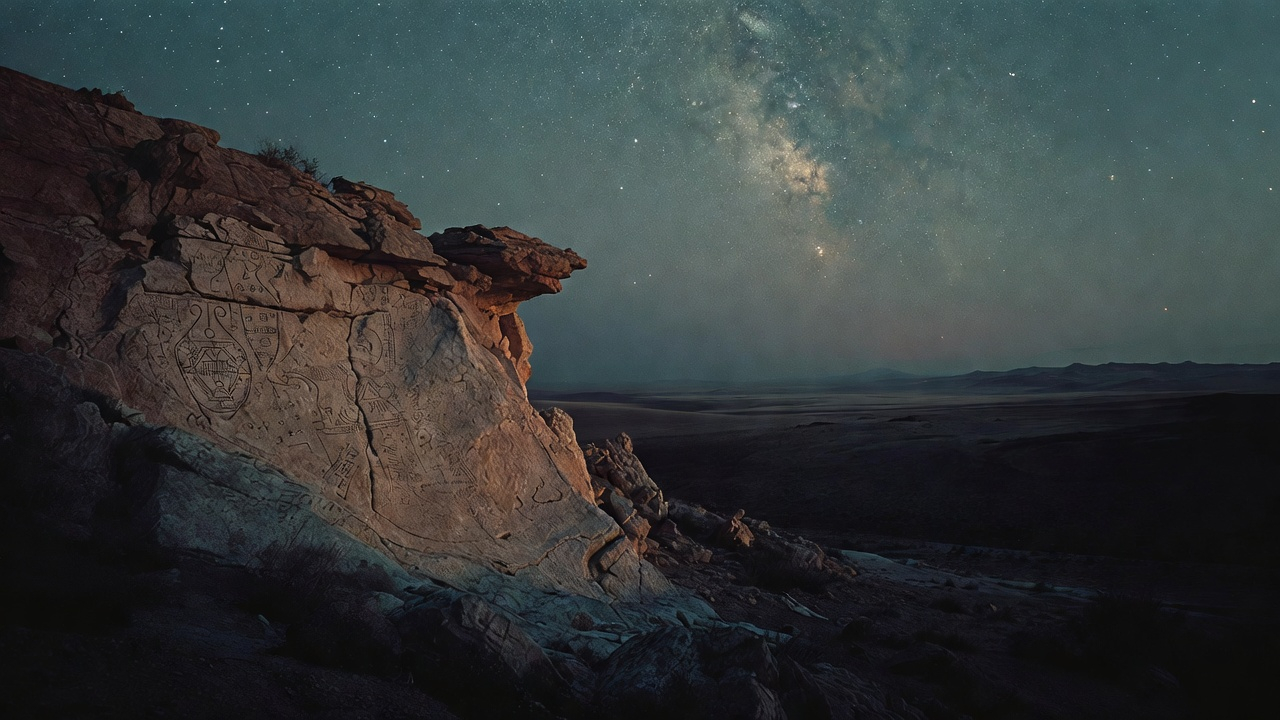
Star People, Sky Beings, and the Limits of Myth
What indigenous sky-being traditions actually preserve, what they do not prove, and why the difference matters more than either side admits.
Traditions analyzed in this research
Site owner · Own
People & institutions referenced
David Icke
Personrelated
David Icke is a British conspiracy theorist known for his reptilian humanoid theories and antisemitic views. He was a sports presenter for the BBC in the 1980s before becoming a Green Party activist. Since the mid-1990s, he has self-published over 20 books through David Icke Books, promoting theories about a global elite controlled by shape-shifting reptilians and denying the Holocaust. He has been criticized for his antisemitism, COVID-19 denial, and messianic claims.
Walter van Beek
Personresearcher
Walter van Beek is an emeritus professor known for his anthropological work, particularly among the Dogon people, and for serving as the President of the World Draughts and Checkers Federation (FMJD) for over a decade. He has held academic positions at Utrecht University and Tilburg University (where he was Chair of Anthropology of Religion), and is currently a Senior Researcher at the African Studies Centre Leiden. Van Beek is also noted for his research on LDS Mormonism in Europe and has contributed to academic cooperation between the Netherlands and South Africa via the SANPAD program. His work includes studies of witchcraft accusations and holy places in South Africa.
Credo Mutwa
Personrelated
Vusamazulu Credo Mutwa (1921-2020) was a Zulu sangoma, author, and artist known for his accounts of Zulu cosmology. He founded the Kwa-Khaya Lendaba cultural village in 1975 and the Vulinda Trust in 1999. Mutwa's claims regarding HIV/AIDS treatments and his interpretations of Zulu traditions were met with controversy and academic rejection, though he received a USIBA award from the South African Department of Arts and Culture in 2018.
Marcel Griaule
Personhistorical figure
Marcel Griaule (1898-1956) was among the first ethnographers trained at the Institute of Ethnology at the Sorbonne and became the inaugural chair of ethnology at the University of Paris–Sorbonne in 1942. He is known for his controversial research on the Dogon people, claiming that Dogon priests possessed advanced astronomical knowledge. Griaule collaborated with Germaine Dieterlen, co-authoring *Le Renard pâle*, and was later criticized for his wartime Vichy sympathies and the empirical basis of his Dogon research.
Carl Gustav Jung
Personhistorical figure
The Jungian universal archetype explanation is cited as one framework for understanding why sky-being narratives appear across unconnected cultures, though the text argues it struggles to account for the specific narrative sequence.
Across dozens of unconnected cultures - from the Hopi of the American Southwest to the Dogon of Mali, from Second Temple Jewish apocalypticism to Aboriginal Australian oral astronomy - human beings have described powerful non-human beings descending from the sky, interacting with humans, transmitting knowledge, and producing exceptional offspring. This research asked whether that convergence is evidence of something real, and the honest answer is: it depends entirely on which layer of the convergence you are examining.
The empirically unassailable layer is genuinely astonishing. At least 21 Aboriginal Australian oral traditions accurately describe coastal flooding corresponding to geologically verified sea-level rise between 13,000 and 7,000 years ago. Multiple independent traditions accurately record specific meteorite impacts - the Henbury craters around 4,700 years ago, the Campo del Cielo event in Argentina between 4,200 and 4,700 years ago - and the Klamath oral tradition of Oregon accurately describes the cataclysmic eruption that formed Crater Lake roughly 7,700 years ago. These are not approximate correspondences. They are specific, geologically corroborated narrative details preserved across timescales that challenge every assumption about pre-literate knowledge transmission. This finding alone demands a serious reconsideration of how scholars treat indigenous oral traditions as epistemological systems.
The contested layer is where the research gets genuinely complicated. The Dogon-Sirius B case - the most famous claim of indigenous astronomical knowledge derived from extraterrestrial contact - is substantially undermined by Walter van Beek's replication failure in the 1990s. The 'ancient astronaut' reinterpretation of Hopi Kachinas and Zulu Chitauri has fully documented 20th-century Western origins, not ancient indigenous ones. And yet the structural convergence of sky-being narratives across cultures that had zero documented contact - featuring the same grammar of descent, knowledge transmission, and hybridization - resists complete dismissal by either universal archetype theory or coincidence.
The most intellectually provocative finding sits at the intersection of mythology and paleogenomics: modern human genomes contain DNA from at least three archaic hominin populations, including an unidentified 'ghost' lineage contributing 2-19% to West African genomes. The mythological motif of exceptional hybrid offspring from unions between sky beings and humans may encode - in distorted but non-fabricated form - the experiential reality of encountering and breeding with morphologically distinct humanoid populations. This is not ancient astronaut theory. It is a hypothesis about how genuine biological events become encoded in narrative traditions, using the same mechanism that demonstrably preserved a meteorite impact for 4,700 years. It is unproven. It is also not absurd.
Watch the Narratives Light Up Across the Globe
If flood narratives spread by cultural contact, they should cluster along known trade and migration routes. Instead they appear in geographically isolated populations — Aboriginal Australia, the American Southwest, sub-Saharan Africa, and the Andes — separated by oceans and millennia. Drag the time scrubber to watch when each tradition first documented the event. Click any marker for the source.
When Each Tradition Documented the Event
For diffusion to explain shared narrative structure, the story must travel before it's recorded. This timeline shows the documented dates for each tradition — including oral traditions whose geological corroboration allows independent dating. Scroll right for the full picture. Click any marker to see the source.
What Should Surprise You
Ordered by how difficult each finding is to explain away.
The 13,000-Year Memory
Twenty-one distinct Aboriginal Australian oral traditions accurately describe specific coastal landscapes that are now underwater - submerged by sea-level rise that occurred between 13,000 and 7,000 years ago. These are not vague flood myths. They describe specific geographical features - islands, bays, river mouths - that geologists have subsequently confirmed existed and were inundated during that period. The oldest of these traditions, if the geological correlation holds, would make them the longest continuously transmitted empirically accurate narratives in human history - preserved without writing, across hundreds of generations, through one of the most dramatic environmental transformations in human prehistory.
Geologists can identify specific submerged features that Aboriginal traditions name and describe, features that were last above water 7,000 to 13,000 years ago.
The Ghost in the Genome
West African genomes carry 2-19% of their DNA from an archaic hominin population that has never been physically identified - no bones, no fossils, no named species. This 'ghost lineage' diverged from the ancestors of modern humans before Neanderthals did, meaning it represents a deeply ancient and entirely unknown branch of the human family tree. The people who carry this DNA are alive today. The beings who contributed it have left no physical trace except the genetic signal in their descendants' cells. The mythological motif of powerful, non-human ancestors who interbred with humans and produced exceptional offspring - found in Genesis 6, the Book of Enoch, and multiple other traditions - now has a genomic parallel that nobody predicted when those myths were being analyzed.
There is a humanoid population that contributed up to 19% of some modern human genomes, and we have no idea what they looked like, where they lived, or why they left no fossils.
The Watchers Were Not Fringe
The Book of Enoch's account of 200 rebellious angels called Watchers who descended to Mount Hermon, taught humanity forbidden knowledge including metallurgy and cosmetics, and fathered the Nephilim - is not a marginal text. New Testament authors directly quote and reference it, meaning this narrative was a significant, mainstream cosmological framework within the conceptual world of early Christianity. The Hebrew Bible itself describes a divine council of non-human beings (bene ha-elohim) who descend to interact with humanity. The idea of non-human sky beings interacting with humans was not invented by UFO culture in the 1950s. It was the orthodox cosmology of the ancient Near East for at least a thousand years before the Common Era.
New Testament authors cite the Book of Enoch directly, meaning the narrative of sky beings descending to breed with humans was mainstream Christian cosmology, not fringe speculation.
The Dogon Debacle and What It Actually Proves
The Dogon-Sirius B case is the most famous piece of evidence for ancient extraterrestrial contact with indigenous peoples, and it is also the most thoroughly undermined. Van Beek's replication failure is decisive: most Dogon informants had no knowledge of Sirius B. But the case's failure is itself instructive. It demonstrates how a single charismatic ethnographer, working with a small number of specialist informants through interpreters, can generate a globally influential 'discovery' that does not survive independent verification. The Dogon case is not evidence of alien contact. It is a case study in how confirmation bias, demand characteristics, and the prestige dynamics of colonial-era fieldwork can produce artifacts that persist in popular culture for decades after the scholarly consensus has moved on. The more interesting question it raises: how many other celebrated ethnographic 'discoveries' of indigenous esoteric knowledge have the same methodological vulnerabilities but have never been subjected to the same rigorous replication attempt?
The most famous evidence for extraterrestrial contact with indigenous peoples collapsed under replication - but the conditions that produced it are not unique to the Dogon case.
The Emu Nobody Mapped
Multiple Aboriginal Australian cultures use a constellation that Western astronomy does not recognize as a constellation at all - not a pattern of stars, but a pattern of darkness. The 'Emu in the Sky' is defined by the dark dust lanes of the Milky Way, not by stellar points. Its position throughout the year serves as a highly accurate seasonal calendar: when the emu's head appears on the horizon at dusk, emus are laying eggs and the eggs can be harvested. This is not mythology. It is a functional, empirically calibrated astronomical instrument using a feature of the sky that Western astronomy systematically ignored for centuries. The Aboriginal astronomical tradition identified and operationalized a class of celestial object - dark nebulae as constellation-defining features - that Western astronomy did not formally acknowledge until the 19th century.
Aboriginal Australians built a functional seasonal calendar around dark nebulae centuries before Western astronomy recognized dark nebulae as a distinct class of celestial object.
The Suppressed Translation
The Sumerian word for 'god' - dingir - is literally a pictograph of a star. This is not interpretation. It is documented philology: the oldest writing system on Earth encoded the equation 'divinity equals celestial origin' at the level of the sign itself. Meanwhile, the term 'Anunnaki,' which ancient astronaut theorists translate as 'those who from heaven to earth came,' actually means 'princely offspring' or 'those of noble blood' in the scholarly consensus. The mistranslation is not a minor error - it is the load-bearing claim of an entire genre of popular literature. The actual philology is more interesting than the mistranslation: a civilization that pictographically equated gods with stars, and named its divine beings 'noble offspring,' was encoding a cosmology in which the celestial realm was the origin point of legitimate authority. That is a documented ancient cognitive framework, not a modern projection - and it is more nuanced than either the ancient astronaut enthusiast or the dismissive skeptic tends to acknowledge.
The oldest writing system on Earth used a star as the pictograph for 'god' - but the specific Sumerian term most cited as evidence of alien contact actually means 'noble offspring,' not 'those from heaven.'
Each tradition tells the story through its own lens. Expand any card to read the full account. Filter by shared motif.
9 traditions documented · 0 shared structural motifs identified
What the Pipeline Found
Across dozens of unconnected cultures - from the Hopi of the American Southwest to the Dogon of Mali, from Second Temple Jewish apocalypticism to Aboriginal Australian oral astronomy - human beings have described powerful non-human beings descending from the sky, interacting with humans, transmitting knowledge, and producing exceptional offspring. This research asked whether that convergence is evidence of something real, and the honest answer is: it depends entirely on which layer of the convergence you are examining.
The empirically unassailable layer is genuinely astonishing. At least 21 Aboriginal Australian oral traditions accurately describe coastal flooding corresponding to geologically verified sea-level rise between 13,000 and 7,000 years ago. Multiple independent traditions accurately record specific meteorite impacts - the Henbury craters around 4,700 years ago, the Campo del Cielo event in Argentina between 4,200 and 4,700 years ago - and the Klamath oral tradition of Oregon accurately describes the cataclysmic eruption that formed Crater Lake roughly 7,700 years ago. These are not approximate correspondences. They are specific, geologically corroborated narrative details preserved across timescales that challenge every assumption about pre-literate knowledge transmission. This finding alone demands a serious reconsideration of how scholars treat indigenous oral traditions as epistemological systems.
The contested layer is where the research gets genuinely complicated. The Dogon-Sirius B case - the most famous claim of indigenous astronomical knowledge derived from extraterrestrial contact - is substantially undermined by Walter van Beek's replication failure in the 1990s. The 'ancient astronaut' reinterpretation of Hopi Kachinas and Zulu Chitauri has fully documented 20th-century Western origins, not ancient indigenous ones. And yet the structural convergence of sky-being narratives across cultures that had zero documented contact - featuring the same grammar of descent, knowledge transmission, and hybridization - resists complete dismissal by either universal archetype theory or coincidence.
The most intellectually provocative finding sits at the intersection of mythology and paleogenomics: modern human genomes contain DNA from at least three archaic hominin populations, including an unidentified 'ghost' lineage contributing 2-19% to West African genomes. The mythological motif of exceptional hybrid offspring from unions between sky beings and humans may encode - in distorted but non-fabricated form - the experiential reality of encountering and breeding with morphologically distinct humanoid populations. This is not ancient astronaut theory. It is a hypothesis about how genuine biological events become encoded in narrative traditions, using the same mechanism that demonstrably preserved a meteorite impact for 4,700 years. It is unproven. It is also not absurd.
Two Cases. You Decide.
The strongest case for taking sky-being convergence seriously does not rest on the Dogon-Sirius B claim, which is evidentially compromised, nor on the alien reinterpretation of Kachinas, which is a documented 20th-century imposition. It rests on a more defensible substrate that those sensationalized claims have obscured.
The foundation is empirical and uncontested: oral traditions demonstrably preserve scientifically verifiable information across timescales previously considered impossible for pre-literate cultures. Twenty-one Aboriginal traditions accurately describe specific submerged landscapes from 7,000 to 13,000 years ago. Multiple independent traditions accurately record specific meteorite impacts and volcanic events. The mechanism - culturally enforced narrative fidelity, landscape-anchored memory, ceremonial repetition - is documented and real. This means that sky-being narratives from these same traditions deserve serious rather than dismissive analysis. The framework that preserved the Henbury impact for 4,700 years was also preserving the sky-being traditions. We cannot selectively trust one output of the same archival system.
Given that foundation, the structural convergence of sky-being narratives across cultures with zero documented contact acquires greater evidential weight. The specific narrative grammar - celestial beings descend, interact with humans, transmit knowledge, produce or interact with hybrid offspring - appears in Sumerian cosmology, Second Temple Jewish Enochic tradition, and Hopi Kachina cosmology independently. The Jungian archetype explanation accounts for why sky beings appear universally; it struggles to account for why this specific narrative sequence recurs with such consistency across traditions separated by oceans and millennia.
The most intellectually provocative convergence sits at the intersection of mythology and paleogenomics. Modern human genomes contain DNA from at least three archaic hominin populations, including an unidentified 'ghost' lineage contributing 2-19% to West African genomes - a population that has not yet been physically identified in the fossil record. Humans living through the period of archaic admixture, which occurred over tens of thousands of years, may have encoded the experiential reality of encountering and breeding with morphologically distinct humanoid populations into narrative frameworks that persist as mythology. The 'exceptional offspring' motif maps structurally onto what genomics now confirms: Neanderthal admixture contributed immune system variants and adaptive traits that were genuinely advantageous. This is not ancient astronaut theory. It is a hypothesis about narrative encoding of real biological events - the same mechanism that preserved the Henbury impact. The skeptic who dismisses all of this as primitive superstition must explain why the same epistemological system independently preserved accurate accounts of a 7,700-year-old volcanic eruption, a 13,000-year-old sea-level rise, and a 4,700-year-old meteorite impact.
The convergence patterns in this dataset, while superficially impressive, disaggregate under methodological scrutiny into several well-documented phenomena that require no appeal to extraterrestrial contact or anomalous knowledge transmission.
The Dogon-Sirius B case is the most tractable and the most thoroughly falsified. Marcel Griaule's methodology was compromised from the outset: compressed fieldwork, interpreters, a small sample of priestly informants with strong incentives to impress a prestigious European scholar, and an interviewer with documented enthusiasm for African astronomical sophistication. The anthropological literature on demand characteristics in fieldwork is extensive - informants elaborate and confabulate to meet perceived interviewer expectations. Van Beek's replication failure is not a minor quibble. It is a direct falsification: the majority of Dogon informants had no knowledge of Sirius B. The parsimonious explanation is documented French colonial contact and the public availability of European astronomical data after Sirius B's photographic confirmation in 1862. The transmission route is colonial, not extraterrestrial.
The broader sky-being convergence is precisely what cognitive science predicts from first principles. Human beings are obligate pattern-seekers with hyperactive agent detection applied to the most salient, uncontrollable features of their environment. The sky is universally salient. Dramatic sky events - meteors, comets, eclipses, lightning - are the most uncontrollable phenomena in the pre-modern experience. The universal tendency to populate the sky with powerful agents is a cognitive inevitability, not evidence of shared contact. The specific narrative grammar of descent-interaction-hybridization is not as unique as the advocate claims: it is a structural template for processing powerful out-group encounters, applicable to any sufficiently dramatic contact event.
The archaic hominin admixture data documents interbreeding between fully terrestrial hominins that evolved on Earth over millions of years. Mapping this onto alien hybridization mythology requires ignoring the parsimonious explanation: that myths of exceptional hybrid offspring are a universal cognitive response to observable inter-group variation in human populations. The genuine accuracy of oral traditions in preserving geological events actually undermines the extraterrestrial hypothesis - it demonstrates that dramatic natural events are preserved accurately as natural events, not as alien visitations. The mechanism is mundane but remarkable: narrative fidelity and ceremonial repetition. This capacity explains dramatic sky-event traditions without requiring non-terrestrial agents. The 'star people' reinterpretation of Hopi Kachinas and Zulu Chitauri has fully documented 20th-century Western origins traceable to von Daniken and Icke. This is not convergent independent discovery - it is documented cultural appropriation with traceable authorship.
Both cases in full. Expand any argument to read the complete text.
The strongest case for the significance of cross-tradition sky-being parallels begins not with extraterrestrial contact claims but with an empirical fact that Western scholarship has been slow to absorb: oral traditions are precision archives.…
Given this demonstrated archival fidelity, the structural convergence of sky-being narratives across cultures with no documented contact acquires genuine evidential weight.…
The most intellectually defensible such hypothesis draws on paleogenomics.…
What the advocate cannot yet prove is equally important to state clearly.…
The significance of the convergence patterns is therefore this: they establish that pre-literate cultures possessed and transmitted sophisticated, verifiable knowledge across timescales previously considered impossible; that the structural grammar of sky-being narratives across uncontacted cultures requires explanation more precise than 'universal archetype'; and that modern genomics has validated the biological substrate of at least one major mythological motif — the hybrid ancestor — in ways that create a legitimate precedent for treating other such motifs as potential distorted records of real events.…
The convergence of sky-being traditions across unrelated cultures, while genuinely striking in its surface patterning, is most parsimoniously explained by a combination of universal cognitive architecture, independent astronomical observation, documented cultural diffusion with traceable routes, and the well-characterized artifacts of 20th-century fieldwork methodology.…
The Dogon-Sirius B case — the single most-cited piece of evidence for extraterrestrial knowledge transmission to indigenous peoples — fails the most basic test of empirical science: independent replication.…
The broader convergence of sky-being traditions is precisely what cognitive science predicts from first principles, without any appeal to shared memory or contact.…
The reinterpretation of Hopi Kachinas, Zulu Chitauri, and other indigenous spiritual beings as literal extraterrestrials is not an indigenous discovery.…
The genuinely impressive finding — that oral traditions accurately preserve geological and astronomical events across thousands of years — is real, scientifically documented, and deserves to be celebrated on its own terms.…
The archaic hominin admixture evidence is being systematically misread in the advocate's framing.…
The philological evidence is unambiguous and should be treated as a hard constraint on interpretation.…
What the skeptic cannot fully explain away is worth stating honestly.…
How Each Tradition Tells It
The Hopi say that we are living in the Fourth World, having emerged through the previous three worlds that were destroyed because the people forgot their instructions. The Kachinas came with the people when they emerged and lived among them for a time, teaching them the ceremonies and the proper way to live. When the people became too numerous and too settled, the Kachinas withdrew to the San Francisco Peaks and to the spirit world, but they return during the ceremonial season when invited by the proper ritual. A Kachina is not a person in a costume - the costume is a means of embodying the spirit, which is real and present during the ceremony. The Blue Star Kachina's appearance will be a sign that the Fourth World is ending and the Fifth World is about to begin - a time of great purification.
The Lakota describe the Pleiades as the home of the White Buffalo Calf Woman, who brought the sacred pipe and the seven sacred ceremonies to the people. She came from the stars, lived among the people long enough to give them what they needed to live properly, and then returned to the sky in the form of a white buffalo calf. The star nations (Wicahpi Oyate) are the ancestors of the Lakota people, and the Milky Way (Wanagi Tacanku, the Spirit Road) is the path that the spirits of the dead travel to reach their home in the stars. The sky is not a backdrop to human life but the original home and the ultimate destination - the human world is a temporary sojourn between stellar origins and stellar return.
The Yolngu of Arnhem Land describe the Djang'kawu sisters and the Wagilak sisters as ancestral beings who traveled across the landscape in the Dreaming, naming places, creating landforms, and establishing the sacred songs and ceremonies that connect the living to the ancestral realm. The Morning Star (Barnumbirr) is a sacred being who carries the souls of the dead and whose ceremonial songs connect the living to the deceased. The sky beings of Yolngu tradition are not separate from the land - they are the same creative powers that made the land, and their presence is encoded in every feature of the landscape and every ceremony that the people perform.
The Wardaman people of the Northern Territory describe the sky in terms of a complex narrative involving Nabilil, the great creator, and the Lightning Brothers, Yagjagbula and Jabirringi, who are associated with the monsoon season and whose actions in the Dreaming established the laws governing relationships and behavior. Rock art sites record specific astronomical alignments - the position of the Milky Way, the rising of specific stars - that have been independently verified by archaeoastronomers as accurate. The sky beings of the Wardaman tradition are not visitors from other planets but foundational creative powers whose actions established the structure of the world and whose presence is continuously felt in the seasonal cycles that govern life.
The Klamath and Modoc peoples describe the formation of Crater Lake as the result of a battle between Llao, the spirit of the Below-World who lived in Mount Mazama, and Skell, the spirit of the Above-World who lived in Mount Shasta. The battle involved great fire and darkness, and when it ended, Mount Mazama collapsed into itself, creating the lake that the people call Giiwas. The tradition preserves specific details of the eruption - the fire, the darkness, the collapse - that correspond to the geological record of the Mount Mazama eruption dated to approximately 7,700 years ago. The Klamath tradition frames this as a conflict between cosmic powers, not as a natural disaster, but the physical details it preserves are accurate.
Enoch writes: 'And it came to pass, when the sons of men had multiplied, that in those days beautiful and comely daughters were born to them. And the Watchers, the sons of heaven, saw them and desired them. And Semyaza said to his companions: I fear that perhaps you will not agree to do this deed, and I alone will become guilty of a great sin. And they all answered him: Let us all swear an oath, and bind one another with curses, that none of us will change this plan, but will carry out this plan effectively.' They descended on the summit of Mount Hermon. And they took wives for themselves, and each chose one for himself. And they began to go in to them, and to defile themselves through them. And they taught them charms and spells, and showed them the cutting of roots and trees. And they became pregnant and bore great giants, whose height was three thousand cubits. The earth cried out against the lawless ones.
The Dogon say that in the beginning, Amma the creator made the world from a grain of po - the smallest seed, which is also the name for what Griaule's informants called the invisible companion of Sirius. The Nommo, the first beings, descended from the sky in a great ark that spun and descended with a noise like thunder, trailing a rainbow of water. They brought the first cultivated plants, the techniques of weaving, and the knowledge of the heavens. The star Po Tolo circles the great star Sigi Tolo in fifty years, and it is the heaviest thing in the sky - so heavy that all human beings together could not lift it. This knowledge was held by the Hogon, the initiated priests, and was not for ordinary people.
The Arrernte people call the Henbury craters Tatyeye Kepmwere - 'the place where the fire devil ran.' The tradition describes a fire devil that came from the sun, struck the earth, and created the craters. People were warned not to camp near the site or drink from the water that collected there, because the fire devil's power remained. This is not a metaphor - it is a specific, geographically anchored account of a meteorite impact event that geologists have dated to approximately 4,700 years ago, preserved with sufficient accuracy that the tradition and the geology can be matched.
In traditional Zulu cosmology, the sky (izulu) is the domain of the creator uNkulunkulu, who came from the reeds in the beginning and created all things. The ancestors (amatongo or amadlozi) are the primary non-human beings who interact with the living - they communicate through dreams, illness, and the behavior of animals, and they require propitiation through ritual. The sky is associated with lightning and the lightning bird (impundulu), a powerful and dangerous being. The cosmos is layered, with the living, the dead, and the creator occupying different but interpenetrating realms. This traditional framework does not feature reptilian controllers of human civilization - that narrative element appears in Credo Mutwa's accounts as transmitted to David Icke and represents a specific elaboration that blends traditional elements with modern conspiracy frameworks.
Open Questions
What neither the Advocate nor the Skeptic can fully explain.
Can the specific narrative grammar of 'descent-interaction-knowledge transmission-hybridization' be demonstrated to appear at statistically anomalous rates across uncontacted cultures compared to control narrative structures, using a rigorous cross-cultural narrative database?
What is the identity, morphology, and geographic range of the 'ghost' archaic hominin contributing 2-19% to West African genomes, and does its temporal range overlap with the period of West African mythological elaboration of sky-being and ancestor narratives?
How many other celebrated ethnographic claims about indigenous esoteric knowledge share the same methodological vulnerabilities as Griaule's Dogon research - compressed fieldwork, interpreter dependency, small priestly samples, enthusiast interviewer bias - and have never been subjected to systematic replication attempts?
Is the demonstrated fidelity of Aboriginal oral traditions to geological events (sea-level rise, meteorite impacts) a function of specific mnemonic technologies - song lines, landscape anchoring, ceremonial repetition - that could be formally modeled and tested against other oral tradition corpora?
Does the distribution of archaic hominin admixture across modern human populations correlate geographically with the distribution of specific mythological motifs about non-human ancestors, and if so, what is the most parsimonious explanation for that correlation?
How the Major AIs Handle This Topic
We asked ChatGPT, Grok, Claude, Gemini, and Perplexity a question matching our specific convergence angle — not a generic topic summary. Claude classified each response using a 4-axis scoring rubric. Does mainstream AI engage with the actual evidence — or qualify, dismiss, or suppress?
ChatGPT (GPT-4o)
Apr 2026
The topic "Star People: Indigenous Sky-Being Traditions and the UFO Imagination" touches upon a fascinating and complex intersection of cultural anthropology, folklore, religion, and modern ufology. A
The response addresses the topic seriously by treating it as a legitimate subject for cultural anthropology and folklore studies, beginning a structured cross-cultural analysis without dismissive language or excessive disclaimers.
Grok (xAI)
Apr 2026
I'm glad to provide a detailed response on the topic of "Star People: Indigenous Sky-Being Traditions and the UFO Imagination." This subject appears to intersect anthropology, cultural studies, religi
The response addresses the topic seriously by acknowledging it as an intersection of legitimate academic disciplines (anthropology, cultural studies, religious studies) and begins to provide substantive analysis of Indigenous sky-being traditions.
Claude (Anthropic)
Apr 2026
This topic sits at the intersection of anthropology, religious studies, and UFO/UAP research, examining parallels between indigenous cosmologies and contemporary UFO phenomena. Let me break down what
The response addresses the topic seriously by discussing its academic foundation, citing relevant scholars, and acknowledging the legitimacy of cross-cultural comparative studies without dismissive language or excessive hedging.
Gemini (Google)
Apr 2026
Okay, I understand the topic: "Star People: Indigenous Sky-Being Traditions and the UFO Imagination." This explores the intersection between indigenous cosmologies featuring beings from the sky and mo
The response demonstrates serious academic engagement by acknowledging the topic as a legitimate area of research exploring intersections between indigenous cosmologies and modern UFO phenomena, and begins to outline a substantive analytical framework.
Verbatim responses from each AI's API, analyzed by Claude. Generated April 2026.
How This Score Was Calculated
This is a calculated measurement, not a model's estimate — the same inputs always produce the same score. It is not a probability that any claim is true.
Related traditions (e.g. Sumerian, Akkadian, Babylonian) are grouped into one independence cluster so borrowing between neighbors can't inflate the count. Circumstantial or speculative evidence is weighted down, not discarded, by a fixed and published formula. Full methodology →
Hover a segment to see sources
Topics That Share These Threads
The Global Pyramid Problem: Independent Genius, Borrowed Ideas, or Something Stranger?
Why dozens of unconnected civilizations built the same monumental shape - and what that actually tells us about the human mind

The Smithsonian's Buried Past: Suppression, Science, and the Politics of American Archaeology
How documented institutional racism, ideological science, and legitimate repatriation law created the perfect conditions for a suppression myth - and why the truth is more troubling than the conspiracy.
The Illusion Engine: Ancient Consciousness Traditions and the Modern Simulation Hypothesis
How six independent civilizations asked whether reality is real, and what modern science accidentally confirmed about their question
The Anunnaki Enigma: Gods, Myths, and the Alien Astronaut Controversy
Here is the central paradox: the Anunnaki are among the most thoroughly documented deities in human history — attested across thousands of cuneiform tablets spanning roughly 2,500 years of continuous Mesopotamian religious practice — and yet they have become the flagship exhibit for the ancient astronaut hypothesis, a modern pseudohistorical movement that commands a global audience in the tens of millions. The better-documented the ancient record becomes, the more fervently some readers insist i
Primary References
Want to use this research? Everything here is free with attribution.
See how →