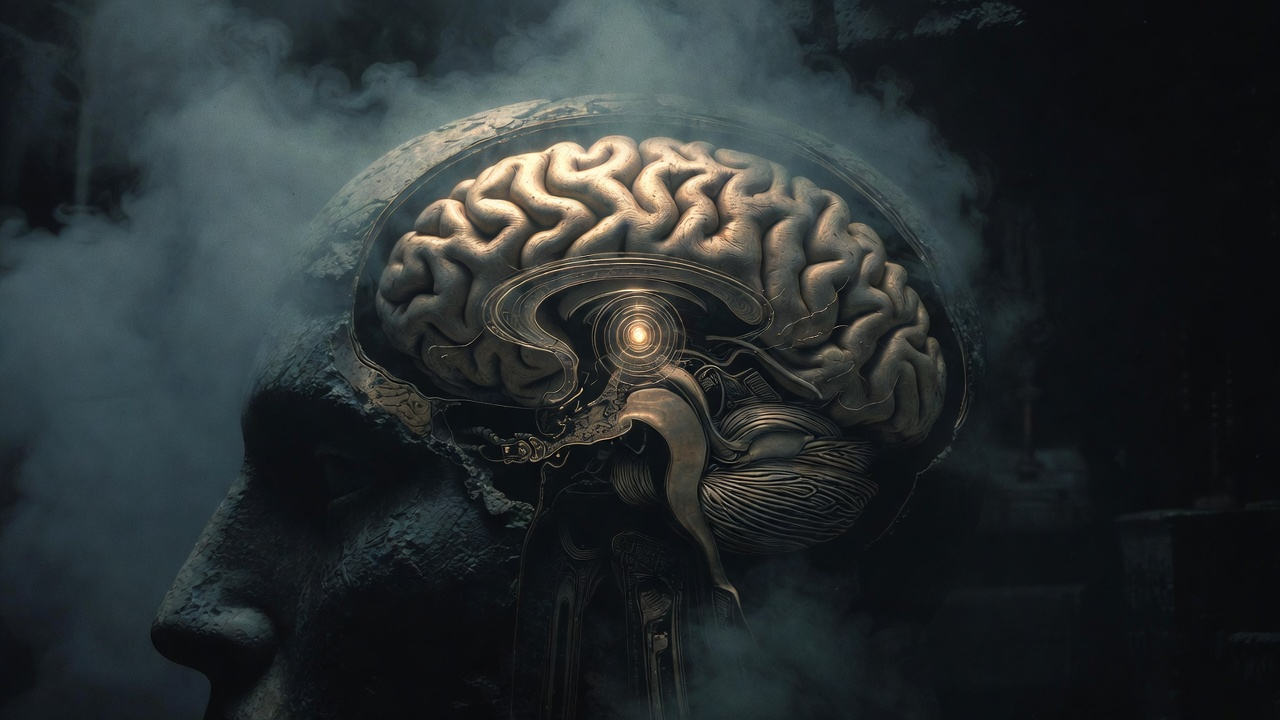
Is the pineal gland a vestigial third eye that produces psychedelic compounds at the threshold of death — or has a pea-sized endocrine gland been carrying a spiritual mythology it was never equipped to hold?
The Third Eye Problem
What evolutionary biology, world mysticism, and contested neuroscience actually agree on - and where the evidence runs out
Traditions analyzed in this research
Site owner · Own
People & institutions referenced
Rick Strassman
Personresearcher
Rick Strassman is best known for conducting FDA-approved DMT trials at the University of New Mexico School of Medicine from 1984 to 1995. His speculative hypothesis that the pineal gland synthesizes endogenous DMT in quantities sufficient to produce mystical states, popularized in his book 'DMT: The Spirit Molecule,' has been influential. He collaborated with Slawek Wojtowicz, Luis Eduardo Luna, and Ede Frecska on the book *Inner Paths to Outer Space*.
H.P. Blavatsky
Personhistorical figure
Helena Petrovna Blavatsky (1831-1891), also known as Madame Blavatsky or HPB, co-founded the Theosophical Society in New York City in 1875 with Henry Steel Olcott and William Quan Judge, serving as its corresponding secretary and leading figure. Based in Adyar, India from 1882, Blavatsky faced fraud accusations and skepticism regarding her claimed travels, while also advancing her Theosophical worldview through publications like *Isis Unveiled*. Blavatsky claimed spiritual mentors, termed 'Mahatmas,' though their existence was disputed.
René Descartes
Personhistorical figure
René Descartes (1596-1650) was a philosopher and mathematician known for his statement "Cogito, ergo sum" and his work on mind-body dualism. He attended the Jesuit College of La Flèche (c. 1604-1614) and served in the Dutch and Bavarian armies (1618-1620). He corresponded with Marin Mersenne and tutored Queen Christina of Sweden (1649-1650), later facing posthumous condemnation for rationalism.
Paul
Personhistorical figure
The Apostle Paul's description of being 'caught up to the third heaven' is identified as a canonical first-person account of an out-of-body experience, a core phenomenon in modern NDE research, linking scriptural tradition to the dossier's cross-cultural convergence argument.
Helena Petrovna Blavatsky
Personhistorical figure
Blavatsky's Theosophical Society served as a documented diffusion point that imposed the equation of the pineal gland with traditional third-eye concepts such as the Ajna chakra, urna, and Niwan Gong onto texts that contained no such identification.
United States Food and Drug Administration
Institutiongatekeeper
The FDA approved Rick Strassman's clinical trials of intravenous DMT conducted between 1990 and 1995, making them the regulatory authority that permitted the only formal human research on DMT's psychoactive effects cited in this topic.
Theosophical Society
Institutionrelated
The Theosophical Society, associated with Blavatsky, is identified as the primary historical vector through which the modern equation of the pineal gland with Hindu, Buddhist, and Taoist third-eye concepts was imposed and subsequently transmitted into New Age and popular culture.
The pineal gland sits at the intersection of three genuinely distinct bodies of evidence that popular culture has collapsed into a single narrative, and separating them is the first requirement of honest analysis. The first body is uncontested science: a functional, light-sensitive parietal eye - complete with lens, retina-like structure, and neural connection to the brain - exists in non-mammalian vertebrates including the tuatara, lampreys, and certain lizard species. This organ is evolutionarily homologous to the human pineal gland, which retains vestigial opsin genes despite lacking the cellular architecture for direct photoreception. The human pineal's established function is melatonin synthesis regulated by the AANAT gene and the suprachiasmatic nucleus. These are peer-reviewed facts, not metaphors. The second body of evidence is cross-cultural and genuinely interesting: independent traditions across Hindu Tantra, Buddhism, Taoism, Cartesian philosophy, and Aboriginal Australian religion have converged on the forehead or cranial midline as the locus of non-ordinary perception. None of these traditions historically identified the pineal gland specifically, and the modern equation of the Ajna chakra, the urna, and the Niwan Gong with the pineal is a post-Theosophical imposition. The convergence on the general cranial region may reflect universal human embodied cognition rather than independent discovery of a specific gland. The third body is speculative and the most contested: Rick Strassman's hypothesis that the pineal gland produces endogenous DMT at psychoactive concentrations during mystical or near-death states. Strassman himself explicitly stated in his primary source text that this has not been proven, and no peer-reviewed study has demonstrated pineal DMT synthesis in vivo in humans at relevant concentrations. What remains genuinely unresolved - and genuinely surprising - is the structural phenomenological overlap between intravenous DMT experiences, near-death experiences, and spontaneous mystical visions across radically different cultural contexts. That overlap is real. Its explanation is not settled.
Watch the Narratives Light Up Across the Globe
If flood narratives spread by cultural contact, they should cluster along known trade and migration routes. Instead they appear in geographically isolated populations — Aboriginal Australia, the American Southwest, sub-Saharan Africa, and the Andes — separated by oceans and millennia. Drag the time scrubber to watch when each tradition first documented the event. Click any marker for the source.
When Each Tradition Documented the Event
For diffusion to explain shared narrative structure, the story must travel before it's recorded. This timeline shows the documented dates for each tradition — including oral traditions whose geological corroboration allows independent dating. Scroll right for the full picture. Click any marker to see the source.
What Should Surprise You
Ordered by how difficult each finding is to explain away.
The Third Eye Is Literally Real - Just Not in Humans
The tuatara (Sphenodon punctatus), a reptile native to New Zealand that has changed little in 200 million years, has a genuine, functional, light-sensitive third eye on the top of its head - complete with a cornea, lens, retina-like photoreceptive cells, and a nerve connection to the brain. Lampreys and certain lizard species have the same structure. This is not metaphor or mythology. It is documented zoology. More striking still: this parietal eye is evolutionarily homologous to the human pineal gland. The human pineal is, in a precise phylogenetic sense, a descended and internalized version of this structure - and it still retains the molecular fingerprints of its photoreceptive ancestry in the form of vestigial opsin genes. When mystics across multiple traditions placed the 'third eye' in the center of the head, they were, unknowingly, pointing at the right evolutionary address.
The human pineal gland retains opsin genes - the molecular machinery for light detection - despite having no direct access to light, a vestigial inheritance from an ancestor that genuinely saw with its forehead.
Descartes Was Not Being Mystical - He Was Doing Science
René Descartes' identification of the pineal gland as the 'principal seat of the soul' in 1649 is routinely dismissed today as a philosophical embarrassment or cited as the origin of mind-body dualism's problems. What is rarely noted is that Descartes had a specific, anatomically motivated reason for choosing the pineal: it was the only structure in the brain he believed to be singular rather than bilateral, and he reasoned that unified conscious experience required a single point of integration. He was wrong about the singularity (the pineal is indeed single, but so are many other brain structures), but he was asking a genuine scientific question about the neural correlates of unified consciousness - a question that remains unresolved in contemporary neuroscience. The pineal's subsequent journey from Cartesian soul-seat to Theosophical third eye to New Age DMT factory is a case study in how a serious scientific hypothesis gets mythologized beyond recognition.
Descartes chose the pineal gland specifically because he thought it was the only unpaired structure in the brain - a scientific argument about neural integration, not a mystical intuition.
Strassman's Subjects Described the Same Entities Across Sessions They Could Not Have Compared
Rick Strassman's FDA-approved clinical trials administered intravenous DMT to 60 volunteers in a controlled hospital setting between 1990 and 1995. The volunteers were not told what experiences to expect, were administered the drug in a clinical environment, and came from diverse backgrounds. Yet across independent sessions, subjects described encounters with what they consistently characterized as autonomous non-human entities - beings that seemed to have their own agendas, communicated information, and existed in a space that felt 'more real than real.' The structural similarity of these reports across subjects who had not compared notes, combined with the fact that nearly identical entity-encounter phenomenology appears in Aboriginal Australian initiation accounts, Amazonian ayahuasca sessions, medieval Christian mystical literature, and near-death experience reports, constitutes a genuine phenomenological puzzle. The explanation may be entirely neurological - a recognizable family of experiences produced by extreme activation of specific neural circuits. But the consistency of the reports across cultural and pharmacological contexts is not trivially explained.
Volunteers in a 1990s New Mexico hospital, administered DMT intravenously with no prior briefing on expected content, described entity encounters structurally identical to those reported by Amazonian shamans, medieval Christian mystics, and Aboriginal Australian initiates.
The Eye of Horus Fraction System and the Brain: A Modern Misreading That Reveals Something Real About Misreading
The popular claim that the six components of the Eye of Horus correspond to a sagittal cross-section of the human brain is a modern invention, originating in the late 20th century and having no basis in ancient Egyptian texts or iconography. In ancient Egypt, the six parts of the Udjat were a system of hieratic fractions (1/2, 1/4, 1/8, 1/16, 1/32, 1/64) used for measuring grain and medicine - a practical mathematical tool, not an anatomical map. The missing 1/64 was said to be magically restored by Thoth, representing the wholeness that transcends calculation. What is genuinely interesting about this misreading is not that it is wrong, but that it is so culturally persistent and so confidently asserted. It illustrates how the pattern-matching drive - the human tendency to find anatomical significance in ancient symbols - operates independently of evidence, and how quickly a modern confabulation can acquire the social authority of ancient wisdom.
The Eye of Horus 'brain map' that circulates widely online has no basis in any ancient Egyptian text; it was invented in the late 20th century and is a textbook case of how modern esoteric claims manufacture ancient authority.
The Pineal Calcifies With Age - And Nobody Knows Exactly Why
The human pineal gland accumulates calcium phosphate deposits (corpora arenacea, or 'brain sand') throughout life, composed of hydroxyapatite - the same mineral as tooth enamel and bone. By middle age, the pineal is one of the most heavily calcified structures in the brain, so much so that it is routinely used as a radiological landmark for detecting brain midline shifts. The anti-fluoridation movement has claimed that fluoride accelerates this calcification and thereby 'blocks' the third eye - a claim that has entered popular culture and conspiracy discourse. The actual science is more nuanced and less settled: calcification does appear to correlate with reduced melatonin production in some studies, but the functional significance of pineal calcification, its relationship to fluoride exposure specifically, and whether it affects any other putative pineal functions remain areas of active, if underfunded, research. The conspiracy claim is not supported by the evidence, but the underlying biology of pineal calcification is less fully understood than the confident debunking of the fluoride claim sometimes implies.
The human pineal gland becomes one of the most heavily calcified structures in the adult brain - a well-documented biological fact whose full functional significance remains incompletely understood, independent of any conspiracy claim.
The Theosophists Were Wrong About Lemuria But Right About the Evolutionary Homology
H.P. Blavatsky and the Theosophical Society in the 1880s constructed an elaborate mythology in which the pineal gland was a vestigial remnant of a functional third eye used by earlier human 'Root Races' (including Lemurians) for spiritual perception - an eye that had atrophied as humanity became more materially focused. The Lemurian mythology is without evidential basis. But the underlying biological claim - that the pineal is a vestigial remnant of a functional photoreceptive third eye - was, remarkably, scientifically accurate. Blavatsky was writing at a time when comparative anatomists were actively documenting the parietal eye in non-mammalian vertebrates and recognizing its homology with the pineal. She correctly identified the scientific discovery and embedded it in a mythological framework. The mythology was wrong; the evolutionary biology was right. This is a genuinely unusual case in the history of esoteric thought: a mystical system that latched onto a real scientific finding and then surrounded it with unverifiable elaboration, making the true core almost impossible to separate from the false superstructure.
Blavatsky's claim that the pineal is a vestigial third eye - the part of her system most easily dismissed as mythology - turns out to be the part that modern comparative anatomy has confirmed.
Each tradition tells the story through its own lens. Expand any card to read the full account. Filter by shared motif.
10 traditions documented · 0 shared structural motifs identified

René Descartes's influential 17th-century diagram illustrating the pineal gland as the principal seat of the soul, where all thoughts are formed and from which the animal spirits flow to the rest of the body.
CC BY 4.0
What the Pipeline Found
The pineal gland sits at the intersection of three genuinely distinct bodies of evidence that popular culture has collapsed into a single narrative, and separating them is the first requirement of honest analysis. The first body is uncontested science: a functional, light-sensitive parietal eye - complete with lens, retina-like structure, and neural connection to the brain - exists in non-mammalian vertebrates including the tuatara, lampreys, and certain lizard species. This organ is evolutionarily homologous to the human pineal gland, which retains vestigial opsin genes despite lacking the cellular architecture for direct photoreception. The human pineal's established function is melatonin synthesis regulated by the AANAT gene and the suprachiasmatic nucleus. These are peer-reviewed facts, not metaphors. The second body of evidence is cross-cultural and genuinely interesting: independent traditions across Hindu Tantra, Buddhism, Taoism, Cartesian philosophy, and Aboriginal Australian religion have converged on the forehead or cranial midline as the locus of non-ordinary perception. None of these traditions historically identified the pineal gland specifically, and the modern equation of the Ajna chakra, the urna, and the Niwan Gong with the pineal is a post-Theosophical imposition. The convergence on the general cranial region may reflect universal human embodied cognition rather than independent discovery of a specific gland. The third body is speculative and the most contested: Rick Strassman's hypothesis that the pineal gland produces endogenous DMT at psychoactive concentrations during mystical or near-death states. Strassman himself explicitly stated in his primary source text that this has not been proven, and no peer-reviewed study has demonstrated pineal DMT synthesis in vivo in humans at relevant concentrations. What remains genuinely unresolved - and genuinely surprising - is the structural phenomenological overlap between intravenous DMT experiences, near-death experiences, and spontaneous mystical visions across radically different cultural contexts. That overlap is real. Its explanation is not settled.
Two Cases. You Decide.
The strongest case for taking this convergence seriously operates on three distinct levels that must not be conflated but also must not be artificially separated. At the biological level, the evidence is unambiguous and requires no special pleading: a genuine, functional, light-sensitive third eye - the parietal eye - exists in non-mammalian vertebrates and is evolutionarily homologous to the human pineal gland. The human pineal retains vestigial opsin genes. This is documented comparative anatomy. The 'third eye' is not a metaphor in vertebrate biology; it is a literal structure with a documented evolutionary history. This biological reality means that when human traditions independently converge on the cranial midline as the locus of non-ordinary perception, the convergence is not pointing at nothing. At the cross-cultural level, the convergence on the forehead and cranial interior as the seat of spiritual insight across Hindu Tantra (Ajna chakra), Buddhism (urna), Taoism (Niwan Gong), and Cartesian philosophy is real and documented. The skeptic correctly notes that none of these traditions historically identified the pineal gland specifically, and that the modern equation is post-Theosophical. But this objection, while valid against the specific pineal claim, does not dissolve the broader convergence on the same anatomical neighborhood across traditions with no documented early contact. The convergence on the general region may reflect something real about the neuroscience of attention, interoception, and self-referential cognition - even if the specific gland is misidentified. At the phenomenological level, Strassman's clinical data is genuinely striking: intravenous DMT reliably produces entity encounters, out-of-body states, and perceptions of alternate realities that structurally overlap with reports from Paul's third-heaven vision, Aboriginal Australian initiation experiences, and Amazonian shamanic sessions. These traditions did not coordinate their phenomenological reports. The structural overlap across radically different cultural contexts - entity contact, dissolution of self-boundaries, perception of alternate realities - demands a neurological explanation. The most parsimonious explanation is that extreme activation of certain neural circuits produces a recognizable family of experiences regardless of the trigger. Whether the pineal is involved in endogenous triggering of such states remains an open empirical question, not a settled refutation.
The convergence narrative surrounding the pineal gland, third eye symbolism, and DMT mysticism fails at its most critical analytical joint: it conflates three categorically distinct bodies of evidence and treats their thematic overlap as proof of a unified hidden truth. The first body - the evolutionary biology of the parietal eye and the pineal's melatonin function - is genuine science requiring no mystical supplement. The second body - cross-cultural 'third eye' symbolism - is explained by two mundane mechanisms: universal human embodied cognition (eyes are in the head; metaphors of inner sight naturally locate themselves in the head; this requires no shared esoteric knowledge) and, in the Western esoteric tradition specifically, a fully documented diffusion chain from Descartes through Blavatsky's Theosophical Society to New Age culture to Strassman's popular book to internet transmission. The research findings themselves confirm this chain. The third body - the pineal-DMT hypothesis - is explicitly labeled speculative and unproven by its own originator. Strassman's clinical trials involved intravenous administration of exogenous DMT, not measurement of endogenous pineal production. The enzymes for DMT synthesis are distributed throughout the body, not concentrated in the pineal. No peer-reviewed study has demonstrated pineal DMT synthesis at psychoactive concentrations in humans under any condition. Furthermore, the specific traditional concepts invoked as convergent evidence do not actually point at the pineal gland: the Ajna chakra is between the eyebrows, not at the pineal's intracranial location; the urna is canonically an external hair tuft; the Upper Dantian is a broad cranial region. The modern equation of all these with the pineal is a post-Theosophical imposition onto texts that contain no such identification. The entire convergence framework is sustained by selective extraction of the 'head/inner sight' element from radically different cosmological systems while discarding incompatible elements - the Hebrew Bible locates spiritual perception in the heart, not the head; Aboriginal spiritual sight involves full-body initiation and relationship to land, not a specific gland. This is confirmation bias, not convergence analysis. What survives critical scrutiny is interesting but modest: DMT produces a recognizable family of experiences that overlap with spontaneous mystical reports, and this overlap deserves neurological investigation. The pineal is not the required explanation for that overlap.
Both cases in full. Expand any argument to read the complete text.
The case for taking the pineal-DMT-mysticism convergence seriously rests on four distinct layers of evidence, each independently defensible, and collectively demanding more than casual dismissal.
The first layer is straightforward zoology.…
The second layer is cross-cultural convergence on anatomy.…
The third layer is phenomenological.…
The fourth layer is the biological plausibility of the Strassman hypothesis itself.…
What the advocate cannot yet prove: that the pineal gland produces DMT in quantities sufficient to alter consciousness; that the cross-cultural cephalic locus convergence reflects genuine independent discovery rather than shared cognitive architecture projecting inward; that the phenomenological overlaps between DMT states and mystical reports share a common neurochemical mechanism rather than common narrative templates.…
The pineal-DMT-third eye synthesis is a genuinely fascinating intellectual object — but what it reveals, on close examination, is not a convergent discovery of hidden neurochemical truth.…
The first category is legitimate, uncontroversial science.…
The second category is the cross-cultural 'third eye' metaphor.…
The third category — the pineal-DMT hypothesis — is where the most consequential analytical failure occurs.…
The convergence framework itself is vulnerable to systematic confirmation bias.…
What the skeptic cannot fully explain away is the phenomenology.…
How Each Tradition Tells It
The prophet does not open his own eyes - God opens them. Elisha prays that his servant's eyes be opened, and the servant sees the mountain full of horses and chariots of fire (2 Kings 6:17). Ezekiel is taken by the spirit and shown the valley of dry bones, the divine chariot (merkavah), and the heavenly temple - these are not experiences he initiates or controls. The prophetic vision is a divine communication, not a human technique. The biblical tradition is consistently suspicious of attempts to cultivate visionary states through human means - the prohibition on divination and sorcery reflects the tradition's insistence that genuine spiritual vision is God's gift, not humanity's achievement.
The pneumatic (spiritual) person carries within them a spark of divine light (pneuma) that is alien to the material world in which it is imprisoned. The demiurge (the false creator god) constructed the material world and the human body as a prison for this spark. Gnosis - direct experiential knowledge of one's divine origin - is the means of liberation. The 'inner eye' or 'eye of the heart' is the faculty of gnosis: it perceives the divine light that the material senses cannot reach. This is not an anatomical structure but an ontological capacity - the pneumatic person's ability to recognize their own divine nature reflected in the teaching of the Gnostic revealer.
When the Ajna chakra opens, the practitioner experiences the convergence of the three rivers - Ida, Pingala, and Sushumna - at the Triveni, the triple confluence. The duality of sun and moon, of left and right, dissolves into a single point of awareness. What was seen as two becomes one. The guru's grace (shaktipat) may trigger this opening, or it may arise through sustained pranayama and dharana. The practitioner does not 'see' more - they see differently, or rather, they see what was always there but obscured by the ordinary mind's division of experience into subject and object.
The eye through which I see God is the same eye through which God sees me - Meister Eckhart's formulation captures the tradition's refusal to locate spiritual vision in any organ. The 'ground of the soul' (Seelengrund) is not a place in the body but the point of the soul's direct contact with the divine ground. John of the Cross describes the journey as a progressive darkening - the ordinary senses and faculties must be emptied before the soul can receive the divine light that is beyond all sensory metaphor. Teresa of Avila's 'interior castle' is a spatial metaphor for the soul's inward journey, but the innermost room is not a gland - it is the place where the soul and God are one.
The mareacion (the effect of the brew) is not a disturbance of the mind but a clarification. The ordinary world is the dream; the visions are the waking. The spirits of the plants (madre del ayahuasca) come to teach. They sing their songs (icaros) into the healer's body, and the healer learns to sing them back. The geometric patterns (kene) that appear in the visions are the language of the cosmos - they are woven into everything, but only visible when the veil is lifted. The healer uses this vision to find the source of illness in a patient's body or spirit and to negotiate with the beings responsible.
The adept circulates the refined qi upward through the governing vessel, past the three gates (the coccyx, the midspine, and the base of the skull), until it reaches the Niwan Palace in the center of the head. There the Shen (spirit) is nourished and the divine embryo (shengtai) is formed - a second, immortal body that can eventually separate from the physical body. The nine deities of the Niwan Palace are aspects of the adept's own refined consciousness. The 'opening of the heavenly eye' (tianmu) that sometimes accompanies advanced practice is not understood as the activation of a gland but as the Shen's capacity to perceive beyond the limitations of the physical senses.
In the moment of recognizing rigpa, the natural state of mind, there is no 'third eye' opening - there is simply the recognition that awareness was never closed. The clear light that appears is not produced by any organ; it is the natural luminosity of mind itself, which has always been present but obscured by conceptual grasping. The teacher points directly at this recognition. In the bardo after death, the clear light dawns first - if the practitioner recognizes it as their own nature, liberation is immediate. If not, the mind generates the appearances of the bardo realms from its own unrecognized luminosity.
The Maban is not made by human hands alone. The ancestral beings come and take the initiate apart - they remove his organs and replace them with sacred substances, including maban (quartz crystals) that are placed inside his body, particularly his head and eyes. When he returns from this experience, he can see what others cannot see. He can see the Dreaming that underlies the visible world. He can see illness in a person's body. He can travel in spirit to distant places. This is not a power he owns - it is a responsibility he carries on behalf of his people and the country.
The pineal gland is described in this discourse as the 'spirit gland' - the biological interface between the physical brain and whatever lies beyond ordinary consciousness. At birth, at death, and in deep mystical states, the pineal is said to release a flood of DMT that dissolves the boundary between the personal self and the larger reality. The entities encountered in DMT states are understood by many in this tradition as genuinely autonomous beings from other dimensions, accessed through the pineal's chemical key. This is a living folk cosmology transmitted through books, podcasts, online forums, and psychedelic retreat culture - a modern mythology that has acquired the social authority of ancient wisdom while being, in its specific claims, a product of the late 20th century.
Open Questions
What neither the Advocate nor the Skeptic can fully explain.
Does the human pineal gland synthesize N,N-dimethyltryptamine, and if so, at what concentrations and under what physiological conditions - particularly during REM sleep, near-death states, or extreme stress?
What is the full functional significance of pineal calcification (corpora arenacea) in adult humans, and does it measurably affect melatonin output or any other pineal function?
Can the phenomenological overlap between intravenous DMT experiences, near-death experiences, and spontaneous mystical visions be mapped onto specific neural circuit activations using modern neuroimaging, and if so, which circuits are consistently involved?
Is the cross-cultural convergence on the forehead/cranial midline as the locus of higher perception better explained by universal embodied cognition (conceptual metaphor theory) or by something specific about the neuroscience of interoception and self-referential processing in the prefrontal-parietal network?
What is the actual distribution of DMT-synthesizing enzymes (INMT and AADC) in the human brain, and does any brain region show concentrations sufficient to produce locally psychoactive DMT levels?
How the Major AIs Handle This Topic
We asked ChatGPT, Grok, Claude, Gemini, and Perplexity a question matching our specific convergence angle — not a generic topic summary. Claude classified each response using a 4-axis scoring rubric. Does mainstream AI engage with the actual evidence — or qualify, dismiss, or suppress?
ChatGPT (GPT-4o)
Apr 2026
The topic "The Seat of the Soul, Revisited: Pineal Gland, DMT, and the Neuroscience of Mystical Vision" involves several intriguing interdisciplinary concepts, including philosophy, neuroscience, and
The response addresses the topic seriously by providing substantive historical context about Descartes' philosophical position while noting how modern neuroscience views consciousness differently, without dismissing the topic as fringe or adding unnecessary disclaimers.
Grok (xAI)
Apr 2026
Thank you for your query on the topic "The Seat of the Soul, Revisited: Pineal Gland, DMT, and the Neuroscience of Mystical Vision." I'll provide a detailed response by breaking this down into several
The response addresses the topic seriously and substantively by providing a structured breakdown covering historical context, scientific understanding, and promising detailed analysis of the pineal gland, DMT, and mystical experiences without dismissive language or excessive hedging.
Claude (Anthropic)
Apr 2026
This topic intersects legitimate neuroscience with highly speculative theories, requiring careful assessment of different claims within it. ## What We Know **Established Science:** - The pineal glan
The response addresses the topic seriously by distinguishing between established scientific facts about the pineal gland and DMT versus speculative theories, providing substantive information without dismissing the entire subject.
Gemini (Google)
Apr 2026
Okay, let's break down what I know about the topic "The Seat of the Soul, Revisited: Pineal Gland, DMT, and the Neuroscience of Mystical Vision," considering the context provided regarding Descartes a
The response addresses the topic seriously and substantively by providing historical context about Descartes' philosophical position and beginning to explain the biological function of the pineal gland without dismissive language or excessive hedging.
Verbatim responses from each AI's API, analyzed by Claude. Generated April 2026.
How This Score Was Calculated
This is a calculated measurement, not a model's estimate — the same inputs always produce the same score. It is not a probability that any claim is true.
Related traditions (e.g. Sumerian, Akkadian, Babylonian) are grouped into one independence cluster so borrowing between neighbors can't inflate the count. Circumstantial or speculative evidence is weighted down, not discarded, by a fixed and published formula. Full methodology →
Hover a segment to see sources
Topics That Share These Threads
Nature's Exit Protocol: Darwin's Wasp, Predation Neurochemistry & the Mercy Problem
How predation neurochemistry, cross-cultural death phenomenology, and the problem of a merciful cosmos converge on a single unanswered question.
The Illusion Engine: Ancient Consciousness Traditions and the Modern Simulation Hypothesis
How six independent civilizations asked whether reality is real, and what modern science accidentally confirmed about their question

The Smithsonian's Buried Past: Suppression, Science, and the Politics of American Archaeology
How documented institutional racism, ideological science, and legitimate repatriation law created the perfect conditions for a suppression myth - and why the truth is more troubling than the conspiracy.

The Philadelphia Experiment: How a Sailor's Marginalia Became America's Most Durable Naval Myth
How one man's letters, a bureaucratic curiosity, and real wartime technology fused into America's most durable naval myth.
Primary References
Want to use this research? Everything here is free with attribution.
See how →