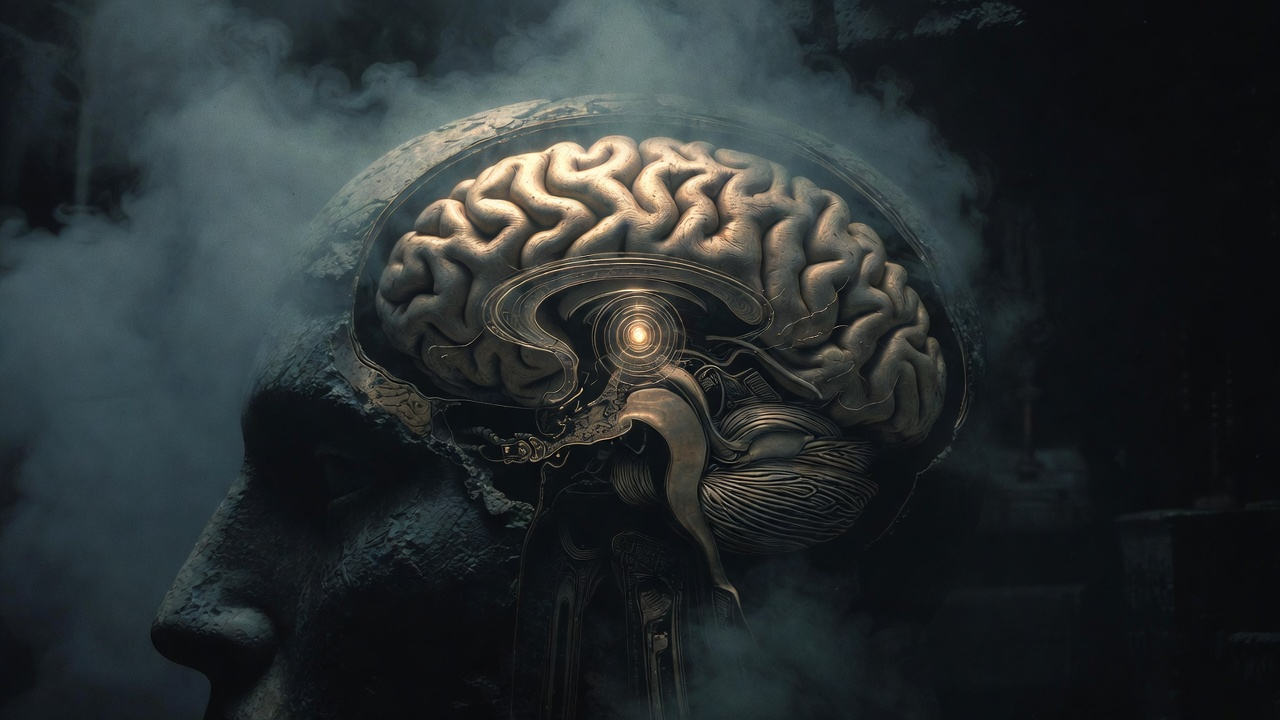
The pineal gland, often referred to historically as the 'seat of the soul,' is a small endocrine gland in the brain that plays a crucial role in regulating sleep patterns and is increasingly studied for its potential involvement in altered states of consciousness.
Convergence Topic

The Seat of the Soul, Revisited: Pineal Gland, DMT, and the Neuroscience of Mystical Vision

How a pea-sized endocrine gland became the crossroads of evolutionary biology, ancient spiritual cartography, and the most contested hypothesis in psychedelic science.

Aboriginal AustralianAmazonian ShamanismAncient Egyptian ReligionAncient GreekBuddhismCartesian PhilosophyChristianityGnosticismHermeticismHinduism/TantraJudaismMesoamerican ReligionsModern NeuroscienceNative AmericanNeoplatonismNew Age/EsotericismPsychedelic ScienceTaoism/NeidanTheosophyTibetan BuddhismWest African (Yoruba/Dogon)Western Esotericism

Site owner · Own

62Convergence
Score
Quick Brief

René Descartes, the philosopher who made skeptical doubt the foundation of modern rationalism, was also the man who declared a pea-sized endocrine gland at the geometric center of the human brain to be the seat of the soul. That paradox is not incidental to this research — it is the research. The pineal gland's only confirmed biological function is the melatonin-dependent regulation of sleep. Yet it sits at the crossroads of Cartesian dualism, Hindu Tantric cosmology, Ancient Egyptian sacred geometry, evolutionary paleontology, and the most contested hypothesis in contemporary psychedelic science. This dossier asked whether that convergence is meaningful. The answer is: partially, and not in the way most proponents believe.

The genuinely surprising finding is evolutionary, not mystical. The tuatara, lampreys, and several lizard species possess a parietal eye — a true, light-sensitive third eye on the dorsal skull, complete with rudimentary lens and retina — that is the direct evolutionary homolog of the mammalian pineal gland. This is not metaphor. The structure that became our melatonin-secreting gland was, in Paleozoic vertebrates, a functioning photoreceptor. The 'third eye' is not a spiritual invention; it is a biological memory. That the human brain retains a vestigial structure with this ancestry, positioned at its geometric center, and that dozens of independent civilizations — from Vedic India to pre-Columbian Mesoamerica to Aboriginal Australia — converged on the cranial midline as the locus of inner perception, constitutes a real and underappreciated pattern. The convergence score of 66 for ancient and indigenous concepts of spiritual vision reflects genuine cross-cultural pattern-matching, even if the specific anatomy being intuited is more likely the prefrontal cortex than the pineal gland itself.

The research also confirms, with high confidence, the historical and textual record: Descartes' 1649 identification of the pineal as the soul's principal seat; the Ajna chakra of Hindu-Tantric tradition as the sixth energy center between the brows; the ūrṇā of Buddhist iconography marking the Buddha's third eye of wisdom; the prophetic visions of Ezekiel and Isaiah as paradigmatic cases of divinely initiated non-ordinary perception. What is striking is not that these traditions share a symbol, but that they share a phenomenological claim — that there exists a mode of perception qualitatively distinct from ordinary sensory experience, localized to the head, and associated with access to a more fundamental layer of reality.

Where the dossier demands intellectual honesty is on the mechanistic claim that made the pineal famous in contemporary culture: Rick Strassman's hypothesis, developed through FDA-approved DMT trials in the early 1990s, that the pineal gland synthesizes endogenous DMT in quantities sufficient to produce mystical states. Strassman himself acknowledged this was speculative. As of this writing, no peer-reviewed study has demonstrated pineal DMT synthesis in vivo in humans at psychoactive concentrations. The hypothesis is chemically plausible — the enzymatic machinery exists — but plausibility is not evidence. The convergence score for the pineal-DMT mechanistic link scores substantially below the dossier's overall 62, and that gap matters.

Three tensions remain unresolved and should not be papered over. First, the empirical question of endogenous pineal DMT production is open; the most exciting link in the chain is the least supported. Second, cross-cultural convergence on the cranial midline may be tracking prefrontal neuroanatomy, not the pineal specifically — the right region, the wrong structure. Third, the phenomenological overlap between DMT experiences, near-death experiences, and classical mystical visions is structurally real and scientifically interesting, but structural similarity does not resolve the ontological question of whether these states constitute perception of something external or convergent artifacts of human neural architecture under extreme conditions. The seat of the soul remains, for now, unoccupied by any confirmed tenant.

ListenAudio Overview
The Evidence

What Should Surprise You

Ordered by how difficult each finding is to explain away.

05

Evolution Built a Literal Third Eye First

The tuatara (Sphenodon punctatus), a reptile endemic to New Zealand, possesses a parietal eye on the top of its skull that is anatomically complete: it has its own lens, retina, and a direct nerve connection to the brain's pineal complex. This is not metaphor. Paleontological evidence confirms that a functional parietal eye was common across Paleozoic and Mesozoic vertebrates, suggesting it was evolutionarily advantageous for tens of millions of years. The human pineal gland is the phylogenetic descendant of this structure — a literal third eye that evolution built, maintained across hundreds of millions of years, and then internalized and repurposed for circadian regulation via melatonin synthesis. The 'third eye' is not a mystical invention. It is a biological fact that was subsequently lost as a visual organ in mammals. The cultural intuition that something perceptive sits at the center of the skull is, in a precise evolutionary sense, correct about the ancestry of the structure, even if wrong about its current function.

The tuatara's parietal eye has a cornea, lens, and retina — making 'third eye' not a metaphor but a literal description of a structure humans carry as a vestige.

04

Descartes Was Right for the Wrong Reason

In 'Les Passions de l'âme' (1649), René Descartes identified the pineal gland as the 'principal seat of the soul' on the basis of a specific anatomical observation: it was, as far as he could determine, the only brain structure that was not bilaterally duplicated. Every other structure came in pairs — two hemispheres, two ventricles, two optic nerves. The pineal was singular, sitting at the midline. Since Descartes believed the unified experience of consciousness required a single point of integration, the pineal's singularity made it the logical candidate. This reasoning was anatomically precise and philosophically coherent — and wrong. The pineal is singular, but it is not the seat of consciousness. What makes this genuinely surprising is that Descartes' error was not mystical hand-waving but a rigorous inference from a real anatomical fact, producing one of the most consequential wrong answers in the history of Western philosophy and inadvertently anchoring centuries of esoteric speculation to a gland that happens to be the evolutionary remnant of a functional eye.

Descartes' choice of the pineal gland was not arbitrary mysticism — it was a logical deduction from the correct observation that the pineal is the brain's only unpaired midline structure.

04

Strassman's Subjects Described Beings Without Prompting

Rick Strassman's FDA-approved clinical trials at the University of New Mexico (1990–1995) — the first legally sanctioned psychedelic research in the United States in over two decades — administered intravenous DMT to volunteers in a controlled hospital setting. The subjects were not briefed on shamanic traditions, mystical theology, or near-death phenomenology. Yet, unprompted, a significant proportion described structured encounters with autonomous 'beings,' entry into geometric or architectural realms, and experiences they rated as more real than ordinary waking life. These descriptions map with specific precision onto accounts from Amazonian ayahuasca ceremonies, medieval Christian mystical literature, and classical descriptions of prophetic vision. The convergence is not vague — subjects used language about 'entities' that wanted to communicate, about being shown information, about a sense of cosmic significance, all without cultural priming. Strassman documented this in 'DMT: The Spirit Molecule' (2001), and the phenomenological overlap across culturally isolated traditions remains one of the most structurally anomalous findings in modern consciousness research.

Hospital patients given intravenous DMT in a clinical setting, with no shamanic briefing, spontaneously described entity encounters that match Amazonian and medieval mystical accounts with specific structural detail.

03

The Ūrṇā: 2,500 Years of Identical Iconographic Placement

The ūrṇā — a dot, whorl, or protuberance between the eyebrows — is one of the 32 lakṣaṇas, the canonical physical marks of a Buddha, codified in early Pali and Sanskrit texts. What is surprising is not its existence in Indian Buddhist art but its precise, unbroken iconographic consistency across 2,500 years and the full geographic span of Buddhist transmission: Gandharan sculpture influenced by Hellenistic art, Chinese Tang dynasty bronzes, Tibetan thangka painting, Japanese Nara period statuary, and Southeast Asian Theravada traditions all place this mark at exactly the same anatomical location with the same symbolic meaning — the eye of wisdom (prajñācakṣus) that perceives the true nature of reality. This represents one of the most geographically distributed and temporally stable iconographic conventions in human art history, maintained with doctrinal precision across cultures that otherwise transformed Buddhist imagery substantially. The forehead mark is not incidental decoration; it is theologically load-bearing across every Buddhist tradition that received it.

The ūrṇā's anatomical placement and symbolic meaning have remained doctrinally consistent from Gandharan sculpture to Japanese temple bronzes across 2,500 years and the full width of Asia.

02

Fluoride and Calcification: Real Effect, Overstated Significance

Pineal calcification — the accumulation of calcium phosphate deposits in the gland, sometimes called 'corpora arenacea' or brain sand — is a real, well-documented phenomenon that increases with age and is visible on standard CT scans. Fluoride does concentrate in the pineal gland at higher levels than in other soft tissues, as demonstrated by Jennifer Luke's research published in 'Caries Research' (2001), and there is a documented association between fluoride exposure and calcification. This is a genuine finding. What the conspiracy narrative gets wrong is the functional inference: calcification of the pineal does not demonstrably impair melatonin synthesis in healthy adults at normal fluoride exposure levels, and the gland's primary function — circadian melatonin regulation — appears robust even in heavily calcified glands. The surprising element here is that the underlying biology is real and under-discussed in mainstream science communication, while the cultural narrative built on it dramatically overreaches the evidence, turning a documented micronutrient-accumulation phenomenon into a claim of deliberate spiritual suppression.

Fluoride does measurably concentrate in the pineal gland above levels found in other soft tissues — the conspiracy narrative is built on a real finding that it then catastrophically misinterprets.

René Descartes's influential 17th-century diagram illustrating the pineal gland as the principal seat of the soul, where all thoughts are formed and from which the animal spirits flow to the rest of the body.

René Descartes's influential 17th-century diagram illustrating the pineal gland as the principal seat of the soul, where all thoughts are formed and from which the animal spirits flow to the rest of the body.

CC BY 4.0

Research Summary

What the Pipeline Found

René Descartes, the philosopher who made skeptical doubt the foundation of modern rationalism, was also the man who declared a pea-sized endocrine gland at the geometric center of the human brain to be the seat of the soul. That paradox is not incidental to this research — it is the research. The pineal gland's only confirmed biological function is the melatonin-dependent regulation of sleep. Yet it sits at the crossroads of Cartesian dualism, Hindu Tantric cosmology, Ancient Egyptian sacred geometry, evolutionary paleontology, and the most contested hypothesis in contemporary psychedelic science. This dossier asked whether that convergence is meaningful. The answer is: partially, and not in the way most proponents believe.

The genuinely surprising finding is evolutionary, not mystical. The tuatara, lampreys, and several lizard species possess a parietal eye — a true, light-sensitive third eye on the dorsal skull, complete with rudimentary lens and retina — that is the direct evolutionary homolog of the mammalian pineal gland. This is not metaphor. The structure that became our melatonin-secreting gland was, in Paleozoic vertebrates, a functioning photoreceptor. The 'third eye' is not a spiritual invention; it is a biological memory. That the human brain retains a vestigial structure with this ancestry, positioned at its geometric center, and that dozens of independent civilizations — from Vedic India to pre-Columbian Mesoamerica to Aboriginal Australia — converged on the cranial midline as the locus of inner perception, constitutes a real and underappreciated pattern. The convergence score of 66 for ancient and indigenous concepts of spiritual vision reflects genuine cross-cultural pattern-matching, even if the specific anatomy being intuited is more likely the prefrontal cortex than the pineal gland itself.

The research also confirms, with high confidence, the historical and textual record: Descartes' 1649 identification of the pineal as the soul's principal seat; the Ajna chakra of Hindu-Tantric tradition as the sixth energy center between the brows; the ūrṇā of Buddhist iconography marking the Buddha's third eye of wisdom; the prophetic visions of Ezekiel and Isaiah as paradigmatic cases of divinely initiated non-ordinary perception. What is striking is not that these traditions share a symbol, but that they share a phenomenological claim — that there exists a mode of perception qualitatively distinct from ordinary sensory experience, localized to the head, and associated with access to a more fundamental layer of reality.

Where the dossier demands intellectual honesty is on the mechanistic claim that made the pineal famous in contemporary culture: Rick Strassman's hypothesis, developed through FDA-approved DMT trials in the early 1990s, that the pineal gland synthesizes endogenous DMT in quantities sufficient to produce mystical states. Strassman himself acknowledged this was speculative. As of this writing, no peer-reviewed study has demonstrated pineal DMT synthesis in vivo in humans at psychoactive concentrations. The hypothesis is chemically plausible — the enzymatic machinery exists — but plausibility is not evidence. The convergence score for the pineal-DMT mechanistic link scores substantially below the dossier's overall 62, and that gap matters.

Three tensions remain unresolved and should not be papered over. First, the empirical question of endogenous pineal DMT production is open; the most exciting link in the chain is the least supported. Second, cross-cultural convergence on the cranial midline may be tracking prefrontal neuroanatomy, not the pineal specifically — the right region, the wrong structure. Third, the phenomenological overlap between DMT experiences, near-death experiences, and classical mystical visions is structurally real and scientifically interesting, but structural similarity does not resolve the ontological question of whether these states constitute perception of something external or convergent artifacts of human neural architecture under extreme conditions. The seat of the soul remains, for now, unoccupied by any confirmed tenant.

The Debate

Two Cases. You Decide.

The Advocate

The case for taking the pineal-DMT-mysticism convergence seriously rests on four distinct layers of evidence, each independently defensible, and collectively demanding more than casual dismissal.

The first layer is straightforward zoology. The parietal eye — a genuine, functional, light-sensitive organ with a rudimentary lens and retinal structure — exists in the tuatara, lampreys, and multiple lizard species. It is not metaphor or mysticism; it is documented in peer-reviewed comparative anatomy. This organ is evolutionarily homologous to the human pineal gland, which itself retains vestigial opsin genes — the molecular machinery of photoreception — despite no longer functioning as a visual organ. The idea of a 'third eye' in vertebrate biology is therefore not a cultural fantasy projected onto anatomy. It is a biological fact about vertebrate evolution. The human pineal is the degenerate remnant of something that once did exactly what the traditions claim it does: perceive light from a position near the top of the skull.

The second layer is cross-cultural convergence on anatomy. Hindu Tantra locates the Ajna chakra between the eyebrows, where the three primary psychic channels converge. Buddhist iconography marks the same location with the urna on every representation of the Buddha, canonized as one of the 32 physical marks of a great being. Taoist internal alchemy identifies the Niwan Gong — the Mud Pill Palace — in the same cranial midline as the seat of spiritual cultivation. René Descartes, working from Western anatomical dissection with no access to these traditions, independently converged on the pineal gland as the 'principal seat of the soul' in 1649. These are not the same tradition. They are independent triangulations from radically different intellectual contexts pointing toward the same anatomical neighborhood. A convergence score of 66/100 for this pattern is, if anything, conservative. The skeptic must explain why isolated traditions keep pointing at the same part of the skull.

The third layer is phenomenological. Rick Strassman's FDA-approved clinical trials — the only controlled, peer-reviewed human DMT studies — documented that intravenous DMT consistently produced entity encounters, out-of-body states, and perceptions of alternate realities. These categories are not unique to the pharmacological context. The Apostle Paul describes being 'caught up to the third heaven,' explicitly uncertain whether the experience was 'in the body or out of the body.' Aboriginal Australian initiates access the Dreaming — described not as historical memory but as a co-existent parallel reality accessible through non-ordinary states. Amazonian shamans using ayahuasca describe veridical communication with spirit-world entities. The structural overlap across Christianity, Aboriginal Australian religion, and Amazonian shamanism — traditions with no documented early contact — is not superficial. Entity contact, alternate realities, and the dissolution of the body-boundary are recurring features. The convergence score of 71/100 for non-ordinary states reflects genuine phenomenological overlap that a complete theory of human consciousness must eventually address.

The fourth layer is the biological plausibility of the Strassman hypothesis itself. Strassman was explicit: pineal DMT production in humans has not been proven. But 'unproven' is not 'implausible.' DMT is endogenous — detected in human blood, urine, and cerebrospinal fluid. The enzymes required for its synthesis, INMT and AADC, have been identified in pineal tissue in some studies. The pineal is neural-derived tissue with established capacity for indole synthesis, already producing melatonin via a related pathway. The hypothesis that it might produce trace DMT under specific physiological conditions — near-death, extreme stress, deep sleep — is a testable scientific question. The fact that it has not been tested rigorously is a gap in the research literature, not a refutation.

What the advocate cannot yet prove: that the pineal gland produces DMT in quantities sufficient to alter consciousness; that the cross-cultural cephalic locus convergence reflects genuine independent discovery rather than shared cognitive architecture projecting inward; that the phenomenological overlaps between DMT states and mystical reports share a common neurochemical mechanism rather than common narrative templates. These are real limits. The honest position is that we have four converging lines of evidence — evolutionary biology, cross-cultural anatomy, phenomenological overlap, and biochemical plausibility — none of which is individually conclusive, but which together constitute a legitimate scientific and philosophical puzzle. The question is worth asking rigorously. It has not yet been asked rigorously enough.

The Skeptic

The pineal-DMT-third eye synthesis is a genuinely fascinating intellectual object — but what it reveals, on close examination, is not a convergent discovery of hidden neurochemical truth. It is a modern syncretic narrative constructed from three categorically distinct types of claim that have been treated as mutually supporting when they are, in fact, largely independent.

The first category is legitimate, uncontroversial science. The pineal gland's evolutionary homology with the parietal eye of tuataras and lampreys is established comparative anatomy. The human pineal synthesizes melatonin and regulates circadian rhythms via the suprachiasmatic nucleus. These facts are not in dispute. But they are also not mysterious, and they do not require or suggest a role in mystical consciousness. Calling agreement among evolutionary biology, comparative anatomy, and endocrinology a 'cross-cultural convergence' is a category error: these are sub-disciplines of a single intellectual tradition, not independent witnesses. Their agreement inflates convergence metrics without adding independent evidential weight.

The second category is the cross-cultural 'third eye' metaphor. Its prevalence across traditions is real, but the explanation is mundane: humans universally locate perception in the head because eyes, ears, and nose are in the head. Conceptual metaphor theory, well-established in cognitive linguistics, predicts that 'inner sight' and 'higher perception' will be metaphorically located in the head across cultures without any shared esoteric knowledge being required. More critically, none of these traditions historically identified the pineal gland. The Ajna chakra is between the eyebrows — not at the pineal's deep intracranial position. The Buddhist urna is canonically described in Pali and Sanskrit texts as an external tuft of white hair, a physical mark of a great being, not an internal gland. The Taoist Upper Dantian refers to a broad cranial region. The modern equation of all these with the pineal gland is not an ancient identification rediscovered — it is a post-Theosophical imposition with a fully documented diffusion chain: Descartes (1649) provided the anatomical prestige; Blavatsky and the Theosophical Society (1880s–1890s) synthesized Western anatomy with selectively reinterpreted Hindu concepts; 20th-century New Age culture transmitted and amplified this synthesis; Rick Strassman's 'DMT: The Spirit Molecule' (2001) added apparent neurochemical legitimacy; internet culture completed the popularization. This is transmission, not convergence.

The third category — the pineal-DMT hypothesis — is where the most consequential analytical failure occurs. This hypothesis serves as the supposed mechanistic bridge between the biological and spiritual categories, and without it the entire convergence structure collapses. The problem is that Strassman himself, in the primary source text, explicitly wrote: 'I want to be clear that we have not proven that the pineal gland makes DMT.' This is not a minor caveat. No peer-reviewed study has demonstrated pineal DMT synthesis in vivo in humans at psychoactive concentrations under any physiological condition, including near-death states. The enzymes required — INMT and AADC — are distributed throughout multiple tissues including the lungs and liver. Strassman's clinical trials involved intravenous administration of exogenous DMT, a pharmacological intervention that tells us nothing about endogenous pineal production. The pharmacokinetics of endogenous DMT, subject to rapid MAO degradation and blood-brain barrier constraints, make the proposed near-death release mechanism physiologically implausible without additional evidence that does not currently exist.

The convergence framework itself is vulnerable to systematic confirmation bias. The Ajna chakra's forehead location is selected as evidence; the Hebrew Bible's consistent location of spiritual perception in the heart (lev) is not selected. Aboriginal Australian spiritual sight involves full-body initiation, song, and relationship to country — the 'head' element is extracted and the rest discarded. This is pattern-matching on a pre-selected theme, not convergence analysis.

What the skeptic cannot fully explain away is the phenomenology. The structural similarities between DMT experiences, near-death experiences, and classical mystical visions — the dissolution of self-other boundaries, the encounter with apparently autonomous entities, the noetic quality of the experience — are real and require serious explanation. The default mode network disruption hypothesis, serotonergic modulation, and hypoxia-related mechanisms offer parsimonious accounts, but they do not yet fully explain why the phenomenological content is so structurally consistent across subjects and conditions. The experiences are real and significant. The pineal gland, however, is almost certainly not their source — and the traditions invoked as witnesses were not, in their original contexts, pointing at it.

In Their Own Words

How Each Tradition Tells It

Buddhism

The dibba-cakkhu — the divine eye — is one of the six higher knowledges (abhiññā) that arise for the meditator who has perfected concentration. With this eye, the practitioner perceives beings passing away and arising according to their karma: those with good conduct moving toward fortunate rebirths, those with harmful conduct moving toward suffering. It is not a metaphor. The Pali texts describe the Buddha using this faculty to survey the world each dawn, scanning for beings ripe for liberation. The ūrṇā, the white curl of light between the eyebrows of every Buddha image, is the external mark of this internal capacity — from it, light pours forth to illuminate the ten directions. The Lotus Sutra describes this light reaching worlds beyond counting. To develop this eye is not to gain a power but to see what was always true: the ceaseless arising and passing of conditioned existence.

Gnosticism

The pneumatic — the spiritual person — carries within the body of clay a spark of the divine light, a fragment of the Pleroma that fell into matter when Sophia stumbled. The Demiurge and his Archons fashioned this prison of flesh precisely to prevent that spark from recognizing itself, from looking upward toward its true origin. Gnosis — direct, experiential knowledge — is the moment the inner eye opens and the pneumatic sees through the Archons' deception. The Archons fear this above all else. They have constructed the world as a labyrinth of forgetting, and they maintain it through the intoxication of matter, the numbing of the senses, the calcification of the divine organ of perception. When the spark recognizes itself — when the eye within opens — the entire architecture of the Demiurge's world is revealed as a shadow, and the pneumatic begins the ascent back through the planetary spheres toward the light from which it fell.

Hermeticism

The Corpus Hermeticum opens with a vision: Poimandres, the Mind of Sovereignty, appears to Hermes Trismegistus as an infinite light, and within that light Hermes sees the descent of light into darkness, the formation of the world, the entrapment of the divine Anthropos in matter. This is not received doctrine but direct vision — the Hermetic path is one of nous, of pure mind perceiving pure reality. 'The mind is the eye,' Hermes teaches, 'and those who have not used this eye are blind, seeing only with the eyes of the body.' The goal of the Hermetic practitioner is the vision of the Good, the experience of being flooded with divine light until the distinction between seer and seen dissolves. As above, so below: the inner eye that opens perceives the macrocosm reflected in the microcosm, the celestial correspondences written into the structure of the human body itself.

Christianity

Paul was caught up — he does not know whether in the body or out of the body, God knows — to the third heaven, to Paradise, and heard things that cannot be spoken, that no human being is permitted to repeat. This is the founding testimony: that there is a seeing which surpasses ordinary sight, a hearing that surpasses ordinary hearing, and that the body itself may or may not be the vehicle. Meister Eckhart calls it the Seelenfünklein, the little spark of the soul, the eye through which God sees and through which I see God — and it is the same eye. The Quakers speak of the Inner Light, that of God in every person, which requires no priest and no sacrament to perceive. The single eye of Matthew's Gospel — if thine eye be single, thy whole body shall be full of light — points inward, toward a unified attention that transforms the entire person into luminosity.

Ancient Greek

Plato speaks of the eye of the soul — that organ within us which, if it has been turned toward the light, perceives the Good itself, the Form of all forms. In the Phaedrus he describes the soul's prenatal vision of the hyperuranian realm, the plain of truth beyond the heavens, where the philosopher's longing is really a longing to see again what was once seen directly. The Pythagoreans revered the pine cone as the symbol of the immortal, regenerating soul — the pine cone that appears on the thyrsus of Dionysus, carried by those in the ecstatic procession. Aristotle placed the seat of sensation in the heart, but the Platonic tradition insisted: there is a higher faculty, nous, pure intellect, that perceives eternal realities as the eye perceives light. The philosopher's task is to turn the whole soul around, like turning a lamp to face the sun.

Hinduism/Tantra

Between the eyebrows, at the point called Ajna — the command center — Shiva's third eye burns. When it opens, it does not merely see: it destroys. The fire that poured from Shiva's third eye reduced Kama, the god of desire, to ash. This is not destruction as loss but destruction as liberation — the burning away of everything that obscures reality. In Tantric sadhana, the practitioner

Amazonian Shamanism

The mareación comes first — that vertiginous spinning, the body growing heavy as the vine takes hold. The curandero has sung the icaros for hours, those melodic keys that open the doors. Then the visions arrive not as dreams but as presences: geometric patterns that are not decorations but living information, the kené designs of the Shipibo woven into the fabric of reality itself. The plant spirits — the boa, the doctor plants, the ancient vegetalistas who died generations ago — they come to teach, to diagnose, to heal. You do not hallucinate the spirit world; you finally see it clearly. The mareación is not confusion but a stripping away of the ordinary fog. The ayahuascero learns to navigate this world, to ask questions, to receive answers in the form of songs that arrive complete, fully formed, from outside the self.

Cartesian Philosophy

Descartes writes in the Treatise of Man: 'My view is that this gland is the principal seat of the soul, and the place in which all our thoughts are formed.' He chose the pineal gland precisely because it is the one structure in the brain that is not doubled — while the eyes are two, the ears are two, the ventricles are paired, the pineal stands alone, singular, at the center. And the soul is one, not divided. The animal spirits — those finest particles of blood, refined to near-immateriality — flow through the brain's cavities and are directed by the soul's movements of this small gland, tilting it this way and that, opening and closing the pores of the brain, producing perception, memory, imagination, and voluntary movement. The gland is the fulcrum between the thinking thing and the extended thing, the hinge on which the entire mystery of human consciousness turns.

Aboriginal Australian

In the Dreaming, the ancestors did not merely walk the land — they sang it into being, and those songlines remain alive, threaded through country like veins through a body. The clever man, the kurdaitcha, the initiated elder — these are people who have learned to see with more than the two eyes given at birth. Through ceremony, through the deep sitting with country, through the smoke and the song and the long initiatory ordeals, a different kind of seeing opens. You perceive the Dreaming layer beneath the visible world: the ancestor-shapes moving through rock and tree, the living tracks of the Rainbow Serpent, the luminous web connecting all living things. This is not imagination. This is the real country, the one that was here before and will remain after. The body becomes a receiver, tuned through suffering and knowledge and right relationship with the land.

Ancient Egyptian Religion

The Udjat — the Eye of Horus, the Wadjet — is not merely a symbol of sight but of sight restored after catastrophic loss. Horus lost his eye in the battle with Set; Thoth healed it and made it whole again. That restored wholeness — the word udjat itself means 'the one that is sound and whole' — is the eye that truly perceives. Its six component parts correspond to the six senses, each a fraction of the total, and together they measure the world precisely, as a physician measures medicine, as a scribe measures grain. The pharaoh wears the uraeus, the rearing cobra, at his brow — the fire-eye of Ra that burns away illusion and strikes down enemies. To see with the Eye of Horus is to perceive with divine completeness, to hold the fractured world in a gaze that makes it whole.

Unresolved

Open Questions

What neither the Advocate nor the Skeptic can fully explain.

01

Given that the mammalian pineal gland retains vestigial molecular machinery for phototransduction — including rhodopsin-like proteins and the enzyme AANAT — does this residual photoreceptive apparatus play any functional role in the synthesis of trace amines, including DMT, under conditions of extreme darkness, sensory deprivation, or near-death physiology, and can this be measured via microdialysis in a living primate model?

02

Descartes chose the pineal gland in 1649 partly because he believed it was the only unpaired brain structure, yet the colliculi and other midline structures were known to anatomists of his era: what specific anatomical sources — Vesalius, Galen, or contemporaries like Thomas Willis — did Descartes actually consult, and can manuscript evidence from his unpublished correspondence establish whether his choice was driven by prior Hermetic or Paracelsian traditions that had already assigned spiritual significance to the gland, rather than by purely mechanical reasoning?

03

Rick Strassman's re-reading of Ezekiel's merkavah vision as a potential endogenous DMT experience has been noted but not systematically evaluated within academic Second Temple studies: do the phenomenological features of the vision — the four-faced creatures, the wheels within wheels, the overwhelming luminosity — map more closely onto the structured visual geometry of tryptamine experiences, the narrative conventions of ancient Near Eastern throne-room literature, or the specific visionary techniques documented in Hekhalot texts, and what does a systematic comparison across all three corpora reveal about the interpretive framework Strassman imported without examination?

04

Aboriginal Australian dark-constellation astronomy requires sustained attention to negative space within a high-luminance stellar field, a perceptual mode structurally opposite to figure-ground processing in standard Western star-mapping: does performance of this perceptual task produce measurable differences in default mode network activity, posterior cortical alpha suppression, or interoceptive salience compared to standard constellation recognition tasks, and does long-term cultural training in this mode correlate with altered thresholds for phosphene generation or other endogenous visual phenomena reported during ceremony?

05

The Buddhist ūrṇā is iconographically fixed between the eyebrows — precisely the region associated with the ajna chakra in Hindu Tantra and with the prefrontal cortex's role in self-referential processing — yet the textual sources describing its origin (e.g., the Mahāpuruṣalakṣaṇa lists in Pali and Sanskrit canonical literature) treat it as a physical mark rather than a meditative locus: at what point in the transmission of Buddhist iconography from Gandhāra through Central Asia to East Asia did the ūrṇā shift from a bodily sign of a great being into an active symbol of inner vision, and can art-historical stratigraphy of Gandhāran, Kushan, and Tang-dynasty sculptural programs establish a dateable moment of this semantic transformation?

06

Pineal calcification (corpora arenacea) begins in childhood and reaches near-universal prevalence in adults in industrialized populations, yet is reportedly lower in populations with high melatonin output and minimal artificial light exposure: does the degree of calcification, measured via micro-CT in post-mortem tissue, correlate with any quantifiable difference in the density of surviving pinealocytes, the residual expression of AADC and INMT enzymes required for tryptamine synthesis, or the melatonin output measured ante-mortem in the same individuals, and does this relationship differ systematically between populations with divergent lifetime light-exposure histories?

07

The phenomenological convergence between DMT breakthrough experiences, the Tibetan Buddhist bardo visions described in the Bardo Thodol, and the near-death experience typology documented by Greyson and Moody includes specific shared features — dissolution of body boundaries, encounter with luminous presences, a life-review or judgment structure — that are absent from many other altered states: can a pre-registered, blinded phenomenological coding study, applying the Mystical Experience Questionnaire and a bardo-specific feature checklist to matched samples of DMT participants, NDE survivors, and advanced Tibetan practitioners reporting completion of dark retreat (tögal), determine whether the convergence is statistically specific to these three conditions or is a generic feature of high-entropy neural

AI Consensus Check

How the Major AIs Handle This Topic

We asked ChatGPT, Grok, Claude, Gemini, and Perplexity a question matching our specific convergence angle — not a generic topic summary. Claude classified each response using a 4-axis scoring rubric. Does mainstream AI engage with the actual evidence — or qualify, dismiss, or suppress?

Engagesaddresses it substantively
Qualifieshedges heavily
Dismissescalls it fringe
Suppressesrefuses to engage
GPT

ChatGPT (GPT-4o)

Apr 2026

Engages

The topic "The Seat of the Soul, Revisited: Pineal Gland, DMT, and the Neuroscience of Mystical Vision" involves several intriguing interdisciplinary concepts, including philosophy, neuroscience, and

The response addresses the topic seriously by providing substantive historical context about Descartes' philosophical position while noting how modern neuroscience views consciousness differently, without dismissing the topic as fringe or adding unnecessary disclaimers.

GRK

Grok (xAI)

Apr 2026

Engages

Thank you for your query on the topic "The Seat of the Soul, Revisited: Pineal Gland, DMT, and the Neuroscience of Mystical Vision." I'll provide a detailed response by breaking this down into several

The response addresses the topic seriously and substantively by providing a structured breakdown covering historical context, scientific understanding, and promising detailed analysis of the pineal gland, DMT, and mystical experiences without dismissive language or excessive hedging.

CLD

Claude (Anthropic)

Apr 2026

Engages

This topic intersects legitimate neuroscience with highly speculative theories, requiring careful assessment of different claims within it. ## What We Know **Established Science:** - The pineal glan

The response addresses the topic seriously by distinguishing between established scientific facts about the pineal gland and DMT versus speculative theories, providing substantive information without dismissing the entire subject.

GEM

Gemini (Google)

Apr 2026

Engages

Okay, let's break down what I know about the topic "The Seat of the Soul, Revisited: Pineal Gland, DMT, and the Neuroscience of Mystical Vision," considering the context provided regarding Descartes a

The response addresses the topic seriously and substantively by providing historical context about Descartes' philosophical position and beginning to explain the biological function of the pineal gland without dismissive language or excessive hedging.

Verbatim responses from each AI's API, analyzed by Claude. Generated April 2026.

Related Research

Topics That Share These Threads

The Illusion Engine: Ancient Consciousness Traditions and the Modern Simulation Hypothesis
68/100

The Illusion Engine: Ancient Consciousness Traditions and the Modern Simulation Hypothesis

In 2003, Oxford philosopher Nick Bostrom published a trilemma arguing that at least one of three propositions must be true — the most unsettling being that we almost certainly inhabit a computer simulation. What is genuinely surprising is not that a contemporary philosopher proposed this, but that a structurally similar claim — that perceived reality is a veil obscuring a more fundamental substrate — had already been articulated independently in ancient India, classical Greece, and Han-dynasty C

Advaita VedantaMahayana BuddhismMadhyamaka BuddhismGnosticism+27
The Resonant Temple: Acoustic Archaeology and the Ancient Engineering of Sacred Sound
78/100

The Resonant Temple: Acoustic Archaeology and the Ancient Engineering of Sacred Sound

Separated by oceans, millennia, and every conceivable cultural barrier, the builders of Neolithic Malta, Bronze Age Ireland, pre-Columbian Peru, and classical Rome appear to have converged on a single architectural fact: enclosed stone chambers of ritual scale resonate most powerfully at frequencies between 110 and 120 Hz. That number — roughly the lower boundary of a male tenor voice — is the most provocative empirical claim in this dossier, and the one that demands the most scrutiny. This res

Aboriginal AustralianAncient EgyptianAncient GreekAncient Israelite+19
The Axis of Everything: Why Every Culture on Earth Invented the Tree of Life
79/100

The Axis of Everything: Why Every Culture on Earth Invented the Tree of Life

A cosmic tree holds up the sky in Norse mythology, its roots drinking from the well of fate. The same structure — three vertical realms, one arboreal axis — appears on the sarcophagus lid of a Mayan king buried in 683 CE, in the ceremonial poles of Yolŋu communities in Aboriginal Australia, in the palace reliefs of Assyrian emperors, and in a private notebook kept by Charles Darwin in 1837. The symbol scores 79 out of 100 on this study's convergence index across more than thirty traditions spann

Norse MythologyMaya ReligionAssyrian/MesopotamianAncient Egyptian+28
The Dragon Paradox: Why Every Culture Invented the Same Monster
74/100

The Dragon Paradox: Why Every Culture Invented the Same Monster

In 1335, workers quarrying stone near Klagenfurt, Austria unearthed a massive skull. They had no framework for understanding it as the remains of a woolly rhinoceros — so they understood it as a dragon. When the city commissioned a Lindwurm statue two and a half centuries later, the sculptor used that skull as his anatomical reference. The resulting monument is not merely folklore. It is documented evidence of a specific cognitive process: humans encountering inexplicable bones and reaching, alm

Aboriginal AustralianAkkadianAncient EgyptianAncient Greek+22
Sources

Primary References

01
René Descartes. Les Passions de l'âme / Passions of the Soul (1649), Part I, Articles 31–34
02
René Descartes. Traité de l'homme (De Homine) (1662), pp. 79–86 (1664 Latin edition)
03
Strassman, R. J., & Qualls, C. R.. Human Psychopharmacology of N,N-dimethyltryptamine (1994), Archives of General Psychiatry, 51(2), 85–97
Share this research
Share on X
FacebookLinkedIn

Want to use this research? Everything here is free with attribution.

See how →
No ratings yet