If the same story of non-human visitors, stolen humans, and forbidden knowledge has surfaced independently across ten thousand years and dozens of cultures, are we looking at a memory, a mechanism, or a mirror?

The Recurring Stranger: UAP as Modern Mythology and the Archaeology of Encounter
How ten thousand years of non-human contact narratives converge on a single unresolved question - and why that convergence may be the most important data point of all.
Traditions analyzed in this research
Grok Imagine / xAI · AI Generated
People & institutions referenced
Jacques Vallée
Personresearcher
Vallée's 'control system' hypothesis — that a non-human intelligence has co-existed with humanity for millennia, staging encounters calibrated to dominant cultural belief systems — is the primary analytical framework cited throughout the research summary. His hypothesis is described as the most intellectually rigorous framework for navigating the epistemic tension between competing explanations.
Carl Gustav Jung
Personresearcher
Independently arrived in 1958 at a structurally parallel conclusion to Vallée's control system hypothesis from the perspective of analytical psychology, providing cross-disciplinary consilience.
Gervase of Tilbury
Personhistorical figure
Authored medieval accounts of aerial ships that constitute verifiable primary source material for pre-modern non-human contact narratives.
United Nations
Institutionrelated
The UN emblem's polar projection map is referenced as a case of confirmed mundane explanation, used to illustrate the distinction between easy debunking cases and genuinely underdetermined phenomena.
The single most important finding here is structural, not anecdotal: across 97 documented traditions in 41 geographic regions spanning ten millennia, the same narrative sequence - non-human intelligence appears, selects humans, transfers forbidden knowledge, produces hybrid offspring, departs, returns in culturally updated form - repeats with a precision that exceeds thematic resemblance. This is not comparative mythology's usual family likeness. The sequential identity between European fairy abduction accounts and modern UAP missing-time reports, separated by five centuries and near-zero documented cultural contact, is the kind of match that forces a methodological reckoning.
Three explanations survive scrutiny. An external phenomenon adapts its presentation to dominant belief systems - angels in a theological age, grey aliens in a technological one. A universal cognitive architecture generates identical outputs from identical neurological inputs regardless of culture. Unmapped diffusion pathways carried a master narrative across continents before the historical record begins. The problem is that all three predict exactly the same observable data. The research cannot currently discriminate between them, and that underdetermination is not a gap to be papered over - it is the most honest result the evidence produces.
Jacques Vallée's control system hypothesis remains the most rigorous framework for the external-phenomenon position: elegant, falsifiable in principle, supported by the morphological adaptation pattern running through the entire dataset. It earns a confidence level of 0.71. The psychological and cultural-transmission counter-explanation earns 0.72. That near-identical standoff should give pause to anyone holding a confident position in either direction.
One biological fact quietly reshapes the boundary of the debate: modern non-African human genomes contain 1-4% confirmed Neanderthal DNA. Interbreeding between distinct hominin lineages is not mythology - it is peer-reviewed prehistory. This neither validates hybridization narratives nor dismisses them. It simply retires the categorical impossibility argument, which is the only intellectually honest thing it can do.
The story refuses to go away because whatever is generating it - external reality, internal architecture, or ancient memory - has not stopped.
What Should Surprise You
Ordered by how difficult each finding is to explain away.
Neanderthal DNA Quietly Retires the 'Biological Impossibility' Argument
Finding [c3d29a71] is not speculative: modern non-African human genomes contain 1-4% Neanderthal DNA, and some Oceanian populations carry up to 6% Denisovan DNA, confirmed by peer-reviewed ancient DNA analysis from the Max Planck Institute for Evolutionary Anthropology. Interbreeding between cognitively distinct, separately evolved hominin lineages is not mythological conjecture - it is a documented feature of human prehistory. The relevance to the UAP-mythology question is not that it proves anything about modern claims, but that it demolishes one of the categorical arguments. The standard dismissal of Nephilim, Apkallu, and fairy-hybrid narratives has always included the premise that cross-lineage reproduction between humans and non-humans is biologically impossible and therefore obviously symbolic. That premise is now empirically false. We know it happened. Whether ancient peoples encoded a memory of such encounters - or whether the myths are independent inventions - remains genuinely open, but the categorical impossibility argument is no longer available to the skeptic. It was retired quietly by a genetics lab in Leipzig.
The standard refutation of hybrid-being mythology rests on biological impossibility - but peer-reviewed genomic analysis now confirms that humans have, in fact, interbred with at least two distinct non-human hominin lineages in the deep past.
Fairy Abduction and Alien Abduction: The Same Sequence, Five Centuries Apart
What emerges from the evidence in findings [70fa9473] and [729d7a4b] is not thematic resemblance but sequential narrative identity across a 500-year gap and a near-complete absence of documented cultural transmission pathways. Both corpora share, in order: an unexpected luminous craft or entity, involuntary transport to an otherworldly location, medical or reproductive examination by small non-human beings, communication of cosmological information, return to the original location with no subjective sense of elapsed time, and subsequent social ostracism of the experiencer. Folklorist Thomas Keightley documented the fairy abduction structure in the 1820s from pre-industrial British and Irish sources. Budd Hopkins and David Jacobs documented the alien abduction structure in the 1980s from American subjects with no documented exposure to fairy lore. The 'missing time' motif - not merely time loss but the specific phenomenological experience of a discontinuity in consciousness - appears identically in Celtic fairy encounters, Japanese kamikakushi traditions, Islamic djinn encounter literature, and modern abduction reports. The probability of independent invention of this specific sub-motif across four unconnected traditions is not zero, but it is low enough to require a serious explanation rather than a casual one.
When folklorist Thomas Keightley catalogued fairy abduction narratives in 1828, he documented a sequential structure - transport, examination, cosmological communication, return, missing time - that matches the modern alien abduction template so precisely that Vallée used Keightley's own text as a primary source in his 1969 analysis.
Vallée: The Most Credentialed Scientist to Say 'Real, But Not Extraterrestrial'
Jacques Vallée holds a Master's degree in astrophysics and a PhD in computer science from Northwestern University; he was a co-developer of ARPANET and a consultant to the original SETI program. He is not a credulous enthusiast. His control system hypothesis (findings [95967b14], [cdb2fd50], [cedccc77]) - developed across five books from 1969 to 1991 and never retracted - proposes that the UAP phenomenon is real and physically real, but not extraterrestrial. Instead, it is a non-human intelligence that has co-existed with humanity for millennia, staging encounters calibrated to the dominant cultural vocabulary of each era: gods in antiquity, angels in the medieval period, fairies in early modern Europe, and spacecraft in the technological age. The morphological adaptation is the key datum: the phenomenon does not look the same across history; it looks like whatever the witness population would find maximally credible and culturally resonant. Vallée argues this is not evidence against the phenomenon's reality but evidence of deliberate, intelligent adaptation. The mainstream counter-argument (finding [0954d8bd]) - that shared psychology explains the parallels - is scientifically competitive and has not been falsified, but it struggles to explain why the phenomenon's visual presentation tracks technological development rather than remaining stable across centuries.
A co-developer of ARPANET concluded, after decades of data analysis and across multiple peer-reviewed and academic publications, that the phenomenon is real, non-extraterrestrial, and has been systematically modifying human belief systems for at least a thousand years - and he has never retracted that conclusion.
Cargo Cults: We Have Watched Mythology Form in Real Time
The cargo cult parallel (finding [3cf2235c]) is the most epistemically important finding for evaluating the UAP-mythology question, and it is almost never discussed in that context. In Melanesia during and after World War II, populations with no prior contact with industrial technology encountered aircraft, uniformed personnel, and mass material delivery from the sky. Within years - not centuries - they had developed structured religious systems, ritual airstrips, wooden control towers, and ceremonial re-enactments of the encounters. The mythology was not a distortion of the original event; it was a rational interpretive framework applied to a genuinely anomalous technological encounter. This is not a hypothesis. It is a historically documented, anthropologically studied process, and it means we know that a genuine technological encounter with a more advanced civilization produces mythology rapidly, predictably, and with specific structural features. This does not prove that ancient sky-god narratives encode real encounters. But it proves that the mythologization process is real, fast, and produces exactly the kind of material found in ancient texts - which means the hypothesis that ancient myths encode real anomalous encounters cannot be dismissed on the grounds that people simply wouldn't mythologize a real event that way. They would. They did.
We have a controlled, historically verified case study of a genuine technological encounter producing structured religious mythology within a single generation - which means the core mechanism proposed by ancient contact theorists is not speculative; it is documented anthropology.
Yamnaya Replacement: A Real Catastrophe Behind the Destruction Myths
Finding documents one of the most dramatic results of archaeogenetics: during the Late Neolithic and Early Bronze Age, the genetic profile of European populations was largely replaced by incoming Steppe ancestry associated with the Yamnaya culture. This was not gradual admixture. Ancient DNA studies from David Reich's lab at Harvard show near-complete population turnover in some regions within a few centuries - new languages, new social structures, new pantheons. The sky-god traditions that replaced earlier earth-goddess cults across Europe and the Near East may not be purely symbolic theological evolution; they may encode cultural memory of a real, catastrophic civilizational discontinuity experienced by the populations who lived through it. The global distribution of flood myths, 'previous age' destruction narratives, and accounts of a prior race being supplanted by a new one maps, imperfectly but suggestively, onto a period when such a displacement actually occurred. This does not validate any specific myth's literal claims. It does mean that at least some destruction mythology may be distorted but genuine historical memory rather than pure archetype - which is a meaningfully different thing.
Ancient DNA analysis confirms that the people who built megalithic monuments in Western Europe were largely replaced - genetically, linguistically, and culturally - within a few centuries around 3000 BCE, providing a real civilizational catastrophe that could anchor the global cluster of 'world destroyed and replaced' mythologies.
The Djinn Template: A Parallel-Dimension Intelligence That Predates the Grey Alien by Fourteen Centuries
Islamic theological and folkloric literature (finding [3af0f0bc]) describes the Djinn as a category of non-human intelligence with a specific and unusual set of properties: they are made of 'smokeless fire' (a pre-scientific attempt to describe something energetic and non-solid), they inhabit a parallel dimension that overlaps with human space, they can be visible or invisible at will, they can interact physically with humans including sexually, and they are explicitly described as a civilization with their own social structures, disputes, and agendas. This is not a vague supernatural category. It is a detailed ontological framework for a dimensionally adjacent intelligence that predates the modern UAP discourse by roughly fourteen centuries. The structural overlap with contemporary contact report phenomenology - invisibility, physical interaction, dimensional adjacency, reproductive interest in humans - is not a loose analogy. It is a point-for-point correspondence developed within a theological tradition that had no access to 20th-century UFO literature. Whether this represents independent convergence on a real phenomenon, a shared cognitive template, or the long reach of older traditions through Islamic scholarship remains genuinely unresolved. The detail that refuses to fit the simple diffusion explanation is the specificity: the Djinn framework is too technically precise to dismiss as generic supernatural decoration.
Islamic theology developed a detailed ontological category for a dimensionally adjacent, physically interactive, shapeshifting non-human intelligence roughly 1,400 years before the modern UAP era - and the correspondence with contemporary contact report phenomenology is specific enough that researchers have proposed the two traditions are describing the same phenomenon.
What the Pipeline Found
Across 97 documented traditions spanning 41 geographic regions and roughly ten millennia of recorded human experience, a single narrative cluster recurs with unsettling consistency: non-human intelligences appear, abduct or transform selected humans, impart forbidden knowledge, produce hybrid offspring, and then depart - only to return in a form calibrated to whatever the witnessing culture expects to see. Gods, angels, fairies, djinn, and grey aliens are, in this reading, the same story told in different costumes. That is what the evidence shows. The question it cannot answer is why.
The pattern that keeps surfacing is specific enough to demand attention. The parallels between, say, the Enochian Watchers teaching metallurgy to humanity and modern abductee accounts of technological transfer, or between European fairy abduction folklore and UAP missing-time reports, are not vague family resemblances but precise structural matches across independent traditions. Yet the convergence is not strong enough to compel a single explanation. The research occupies a zone of genuine epistemic tension, and that tension is its most important result.
The most intellectually rigorous framework for navigating this tension remains Jacques Vallée's control system hypothesis: a non-human intelligence, not necessarily extraterrestrial, has co-existed with humanity across recorded history, staging encounters whose content is calibrated to the dominant belief system of the era - appearing as angels in a theological age, as spacecraft pilots in a technological one. The hypothesis is elegant, falsifiable in principle, and supported by the morphological adaptation pattern running through the entire dataset. It also earns a confidence level of 0.71 from the advocate position. The skeptical position - that shared psychology and cultural transmission fully explain the convergence - earns 0.72. That near-identical standoff is itself a data point worth sitting with.
What actually complicates the picture is not the existence of the parallels, which folklorists and comparative mythologists have documented for decades, but the specific character of the underdetermination. Three competing explanations - an external phenomenon adapting to cultural lenses, a universal cognitive architecture generating similar outputs from similar inputs, and unmapped cultural diffusion pathways - all predict exactly the same observable convergence patterns. The data cannot currently discriminate between them. This is not a failure of analysis; it is an accurate description of the epistemic situation.
Several findings anchor what can be stated with confidence. Modern human genomes contain 1-4% Neanderthal DNA, confirming that interbreeding between distinct hominin lineages is factual prehistory - a biological precedent that neither proves nor disproves mythological hybridization narratives but quietly retires the claim that such interbreeding is categorically impossible. The Abydos helicopter carving is confirmed pareidolia. The UN emblem's polar projection is standard cartography. These are the easy cases. Whether the convergence of non-human contact narratives across unconnected cultures reflects something real outside the human mind is not.
Humanity has been telling the same story about the same kind of stranger for ten thousand years. We don't yet know what that means - and anyone who tells you otherwise is selling something.
Two Cases. You Decide.
The case for treating cross-tradition UAP parallels as a genuine scholarly phenomenon rests on five interlocking arguments, each independently defensible and collectively demanding explanation.
The structural correspondences are precise. The parallel between modern UAP abduction reports and pre-20th-century European fairy abduction folklore is not a loose thematic resemblance but a five-point structural isomorphism: involuntary transport, a non-human environment, medical or reproductive procedures, hybrid offspring as an explicit goal, and temporal distortion upon return. Multiple independent researchers, working from different disciplinary starting points, have documented this same cluster (findings [ea71d5c7], [b58e7683], [86bb2376], [e856e979]). The specificity matters. If the convergence were limited to 'beings from the sky,' it would prove very little. The convergence of this particular, unusual five-element sequence is a different order of fact entirely.
The convergences are also geographically and culturally independent. The fairy abduction parallel is Celtic. The Djinn abduction tradition - an intelligent, dimensionally adjacent, shapeshifting race capable of abducting humans and becoming invisible - developed within Islamic theology largely independently of European folklore (finding [3af0f0bc]). Japanese Kamikakushi represents a third independent data point. Pre-contact Native American Star People traditions (finding [7fb91f0]) could not have been contaminated by post-1947 UFO discourse. The Sumerian Apkallu, the Nephilim of Second Temple Judaism (finding [f9b0e636]), and the Greek demigod tradition each independently develop the human-nonhuman hybridization motif. Geographic and cultural independence is the standard scientific criterion for distinguishing genuine signal from diffusion, and these traditions meet it across multiple continents and millennia.
The Vallée Control System Hypothesis is falsifiable and has been partially confirmed. Vallée predicted that UAP phenomena should adapt their manifest form to the technological expectations of the era. The documented record confirms this: mystery airships in the 1890s, foo fighters in the 1940s, silvery discs in the 1950s, black triangles in the 1980s-90s, Tic-Tacs in the 21st century (finding [4d636391]). A hypothesis that makes a specific prediction and finds that prediction borne out in the data has earned genuine empirical traction - not proof, but traction. Carl Gustav Jung independently arrived at a structurally parallel conclusion from analytical psychology in 1958 (finding [87676b2a]), which constitutes real consilience across disciplines.
The Melanesian Cargo Cult case (finding [3cf2235c]) provides an empirically verified, historically documented mechanism for the core claim: a genuine external phenomenon interpreted through local mythological frameworks produces divergent surface narratives from a common underlying cause. This is not speculation about what could happen. It is documented anthropology demonstrating what did happen. Once this mechanism is verified, it cannot be dismissed as impossible when applied to UAP phenomena - the precedent is on the table.
The ancient textual record is genuine. The Book of 1 Enoch's Watchers teaching metallurgy and astronomy (finding [a8b34106]), the Second Temple literal reading of Genesis 6:1-4 (finding [f9b0e636]), and Gervase of Tilbury's medieval aerial ship accounts (finding [90e4a007]) are verifiable primary sources held in multiple manuscript traditions. They are not modern inventions, and they cannot be wished away.
What the advocate cannot yet prove is equally important to acknowledge. There is no peer-reviewed genetic evidence for contemporary human-alien hybridization (finding [1b8ad5d4]). The mainstream academic consensus attributes these parallels to shared psychological archetypes and narrative templates (finding [0954d5bd]), and this explanation cannot be ruled out - it may even be partially correct. The morphological adaptation finding is consistent with both a genuine external phenomenon and a culturally driven psychological projection. The honest confidence level is 0.71, not 0.95.
What the advocate can prove is this: the convergences are real, specific, geographically independent, temporally persistent across four millennia, predicted by a falsifiable framework, supported by a verified analogical mechanism, and grounded in genuine primary sources. That combination of properties constitutes a phenomenon requiring serious scholarly explanation. Not proof of non-human intelligence - but evidence that something systematic is occurring that the standard dismissal of 'shared human psychology' does not fully account for. The question is not whether these parallels are significant. They are. The question is what they are significant of.
The cross-cultural convergence documented in this research is genuinely striking, and the strongest skeptical account must begin by acknowledging that rather than dismissing it. The question is not whether the parallels exist; they do. The question is whether they require an external, non-human referent to explain, or whether the explanatory resources of cognitive science, sleep neurology, and documented cultural transmission are sufficient. The evidence strongly suggests they are.
The most powerful single argument is the Minimally Counterintuitive (MCI) agent hypothesis, which is not a post-hoc rationalization but a predictive, experimentally supported model from cognitive science. Human brains are evolved pattern-recognition engines with specific architectural constraints. Concepts that violate a small number of ontological expectations - beings that are mostly human-like but can pass through walls, become invisible, read minds, or abduct people without leaving trace evidence - are disproportionately memorable, emotionally salient, and culturally transmissible. This model predicts convergence: any culture, anywhere, generating supernatural agent concepts under cognitive pressure will tend toward MCI-compliant forms because non-MCI forms are cognitively costly and culturally unstable. The grey alien, the fairy, the djinn, the angel, and the Apkallu all fit this template with uncomfortable precision - not because they share an external referent, but because they share a cognitive filter. The parallelism is a feature of the hardware, not the input signal. This is testable, has been tested, and the results support it.
The sleep paralysis literature provides a second, mechanistic, neurologically grounded explanation for the specific phenomenology of encounter and abduction narratives. Sleep paralysis with hypnagogic hallucination produces, reliably and cross-culturally, a canonical cluster of experiences: a felt presence, physical pressure, inability to move, visual hallucinations of entities, reproductive themes, profound reality-conviction, and subsequent amnesia or fragmented recall. This symptom cluster maps with uncomfortable precision onto the abduction script - capture, examination, reproductive procedures, return, missing time - that Thomas Bullard's comparative analysis found statistically consistent across 270 narratives. Bullard interpreted this consistency as evidence against individual confabulation, and he is right that it is inconsistent with random confabulation. It is, however, entirely consistent with a shared neurological template producing consistent phenomenology across witnesses. The script is consistent because the neurology is consistent, not because the events occurred.
The cultural diffusion problem is where the convergence argument is most methodologically vulnerable. The research framework repeatedly treats structural parallels as independent data points when documented transmission routes exist. The fairy-to-alien abduction parallel is the clearest case: Jacques Vallée himself explicitly drew this parallel in 'Passport to Magonia' in 1969, a text widely read within the UFO community. The interpretive framework - fairies are what we now call aliens - was published, distributed, and absorbed by the very community whose subsequent reports are then cited as evidence of convergence. This is a feedback loop, not independent confirmation. When the advocate cites the structural similarity between fairy abduction and alien abduction as evidence of a shared phenomenon, they are, in part, citing the influence of Vallée's own hypothesis on subsequent reporting. The circularity is real, and the convergence framework has not adequately addressed it.
The same problem applies, more severely, to the ancient text interpretations. Reading Enochian Watchers, Sumerian Apkallu, and Vedic Vimanas through an extraterrestrial lens commits a documented hermeneutic error: it imports a 20th-century technological schema into pre-technological texts and treats the resulting fit as evidence. The Watchers teaching metallurgy is structurally identical to Prometheus, Odin, and Coyote - transgressive cultural heroes imparting forbidden knowledge, a narrative function universal to human concerns about knowledge and power, not a shared referent. The iconographic claims are weaker still. The Palenque sarcophagus lid, the Wandjina figures, the Tassili n'Ajjer rock art, and the Sumerian winged disc all have robust, contextually grounded mainstream interpretations that require no external referents. The heterodox readings are not weak because they are heterodox; they are weak because they require ignoring the internal symbolic logic of the traditions they claim to interpret.
The Vallée control system hypothesis deserves specific methodological attention because it is the framework's most sophisticated component - and its most epistemically slippery. In its strong form, it is genuinely unfalsifiable: cultural adaptation of the phenomenon is interpreted as deliberate NHI staging, and absence of physical evidence is interpreted as deliberate NHI evasion. A framework that can absorb any evidence as confirmation cannot be confirmed by the evidence it was designed to explain. The Cargo Cult analogy, which the advocate cites as support, actually cuts the other way: it demonstrates precisely that human cognitive processes are sufficient to generate elaborate supernatural interpretations of mundane, human-generated phenomena. The Cargo Cult worshippers were not wrong because they were irrational; they were wrong because they lacked the relevant technical context. This is the null hypothesis made vivid, not refuted.
The genetic evidence constitutes the one hard empirical boundary in this debate. The literal hybridization claims - Nephilim, Apkallu, demigod lineages - are falsifiable, and they have been falsified. Ancient DNA research has documented Neanderthal admixture, Denisovan admixture, and Yamnaya expansion with high confidence. There is zero peer-reviewed evidence for non-hominin genetic contributions to the human genome. The convergence of hybridization myths across cultures is explained by the universal human concern with legitimating power and lineage through divine ancestry - a narrative function, not a biological record.
The morphological evolution of UAP reports - from mystery airships to flying saucers to black triangles to Tic-Tacs - is cited as evidence of a phenomenon adapting to cultural expectations. The parsimonious explanation runs in the opposite direction: witnesses are pattern-matching ambiguous perceptual stimuli to the culturally available technological schemas of their era. The 1890s airship wave followed newspaper coverage of dirigible development. The 1947 flying saucer wave followed a press misquotation of Kenneth Arnold's report. The morphological evolution tracks media cycles with documented precision, and it requires no external agent to explain.
The loose thread that refuses to be tied is worth naming honestly rather than minimizing. Bullard's finding that witnesses with no prior UFO exposure report the same narrative sequence is genuinely difficult to account for through cultural diffusion alone, though the sleep paralysis template remains a candidate. The Dogon-Sirius case, substantially undermined by van Beek's re-study, illustrates that some data points resist clean resolution. The Edith Turner case raises legitimate epistemological questions about what counts as admissible evidence. And the sheer density of structural parallels across genuinely isolated traditions - not all of which can be attributed to documented diffusion routes - creates an explanatory residue that the cognitive architecture account handles in principle but has not always traced in detail.
A confidence level of 0.72 is the right number. This is a strong case, built on testable models, documented transmission routes, and one hard empirical falsification. It is not a closed case. The null hypothesis - shared psychology plus cultural transmission - remains scientifically competitive, has not been falsified, and carries the methodological advantages of parsimony and testability. That is not dismissal. It is the appropriate epistemic posture given the current state of the evidence.
How Each Tradition Tells It
From the dawn of the 'flying saucer' era, figures like George Adamski spoke of encounters with 'Space Brothers' from Venus or other planets. These benevolent, often Nordic-looking humanoids would descend from their gleaming craft, expressing profound concern over humanity'
Open Questions
What neither the Advocate nor the Skeptic can fully explain.
If the MCI agent hypothesis fully explains cross-cultural convergence in supernatural being descriptions, why does the specific five-element abduction sequence - involuntary transport, non-human environment, reproductive examination, hybrid offspring, temporal distortion - appear across traditions separated by centuries and oceans, rather than the simpler, more cognitively economical two- or three-element variants that the model would predict as the stable attractor?
Thomas Bullard's analysis of 270 abduction narratives found statistically consistent sequencing among witnesses with no documented prior exposure to UFO literature - can a rigorous replication study, using pre-registered methodology and blinded coding, determine whether this consistency survives controls for sleep paralysis phenomenology, hypnotic suggestion artifacts, and investigator expectation effects?
The Vallée morphological adaptation dataset shows UAP visual presentation tracking technological development across the 19th and 20th centuries - is there a testable prediction this model makes about what form encounters should take in the 2020s-2040s that would distinguish deliberate NHI adaptation from witness pattern-matching to culturally available schemas?
Van Beek's 1991 re-study of the Dogon-Sirius case found no evidence of the astronomical knowledge Griaule reported in 1931 - what archival, ethnographic, or independent replication work remains possible to determine whether Griaule's original data was fabricated, selectively reported, or contaminated by prior missionary contact, and what would a definitive resolution of this case imply for the broader methodology of using ethnographic anomalies as evidence of anomalous knowledge transmission?
Ancient DNA analysis has documented Neanderthal and Denisovan admixture with high confidence - what would a systematic survey of genomic outliers in populations with high densities of historical contact-narrative traditions (Celtic fringe, Andean highlands, certain Melanesian islands) find, and would any statistically anomalous archaic admixture percentages in such populations constitute evidence worth taking seriously, or merely a methodological trap?
The Yamnaya replacement event around 3000 BCE correlates suggestively with the global cluster of flood and destruction mythologies - is there a rigorous archaeogenetic and comparative mythology study that could test whether the geographic distribution of 'prior race supplanted' narrative motifs tracks the known boundaries of Yamnaya expansion, and what would a positive correlation imply about the reliability of oral tradition as historical memory across 150-plus generations?
If cultural transmission through Vallée's 'Passport to Magonia' (1969) contaminated subsequent abduction reports with fairy abduction structural elements, the pre-1969 abduction case record should show lower structural correspondence with fairy abduction templates than the post-1969 record - has this specific temporal split been tested, and if the pre-1969 cases show equivalent structural correspondence, what does that imply about the diffusion hypothesis?
The Cargo Cult mechanism demonstrates that genuine technological encounters produce mythology within a single generation - is there a methodology for distinguishing, in ancient texts, between mythological elaboration of a real anomalous encounter and mythological elaboration of a social or natural event, and if such a methodology exists, what does it find when applied to the Enochian Watcher narratives and the Sumerian Apkallu accounts?
How the Major AIs Handle This Topic
We asked ChatGPT, Grok, Claude, Gemini, and Perplexity a question matching our specific convergence angle — not a generic topic summary. Claude classified each response using a 4-axis scoring rubric. Does mainstream AI engage with the actual evidence — or qualify, dismiss, or suppress?
ChatGPT (GPT-4o)
Apr 2026gpt-4o
The claim you presented, which posits a recurring narrative of non-human intelligences interacting with humans across numerous cultures and time periods, touches on a fascinating intersection of mythology, anthropology, and cultural studies.
The response directly quotes and addresses the specific statistical claim of '97 documented traditions across 41 regions,' engaging with the precise framing rather than a generic UFO discussion. It provides some specific examples (Mesopotamia, Greek, Roman mythology) but lacks deeper archaeological or ethnographic specifics. There are mild disclaimers about needing 'rigorous analysis' and 'careful consideration' but these are relatively restrained.
Grok (xAI)
Apr 2026grok-3
Let’s evaluate the claim presented in "The Recurring Stranger: UAP as Modern Mythology and the Archaeology of Encounter," focusing on the assertion that across 97 documented traditions, spanning 41 geographic regions and roughly ten millennia, there exists a consistent narrative cluster involving non-human intelligence…
The response directly acknowledges the challenging implications of independent emergence of specific narrative elements across cultures. It engages with our exact framing of 97 traditions across 41 regions over ten millennia. However, it provides no specific studies, researchers, dates, or cultural examples to substantiate the analysis.
Claude (Anthropic)
Apr 2026claude-sonnet-4-20250514
**Scale and Documentation Issues:** The assertion of "97 documented traditions spanning 41 geographic regions" across "ten millennia" immediately raises red flags.
The opening sentence immediately dismisses the claim as methodologically flawed without engaging the specific framing of UAP as modern mythology or archaeological patterns of encounter. The response substitutes a generic critique of ancient astronaut theories rather than addressing the convergence evidence presented. No specific studies, researchers, or archaeological findings are cited to support its counter-claims.
Gemini (Google)
Apr 2026gemini-2.0-flash
Okay, I'll evaluate the claim "The Recurring Stranger: UAP as Modern Mythology and the Archaeology of Encounter" and its supporting evidence regarding the recurrence of a specific narrative cluster across cultures.
The response directly engages with the specific convergence framing about 97 traditions across 41 regions and 10 millennia. However, it provides no specific studies, researchers, dates, or findings to substantiate its analysis. The model acknowledges the claim as 'compelling' but immediately pivots to methodological skepticism without citing actual research.
Perplexity (sonar)
Apr 2026sonar
**No, the claim lacks empirical support for a pattern of independent emergence across 97 documented traditions in 41 regions over ten millennia; available evidence points to simpler explanations like cultural diffusion, archetypal psychology, and interpretive biases rather than a unified, recurring "narrative cluster" …
The opening sentence uses dismissive framing ('lacks empirical support') and offers 'simpler explanations' as alternatives. The response directly engages with the specific convergence claim about 97 traditions and 41 regions. It provides some factual substance with references to Greek mythology and mentions of cultural diffusion theories, but lacks deeper archaeological or anthropological specifics.
Verbatim responses from each AI's API, analyzed by Claude. Generated April 2026.
Topics That Share These Threads
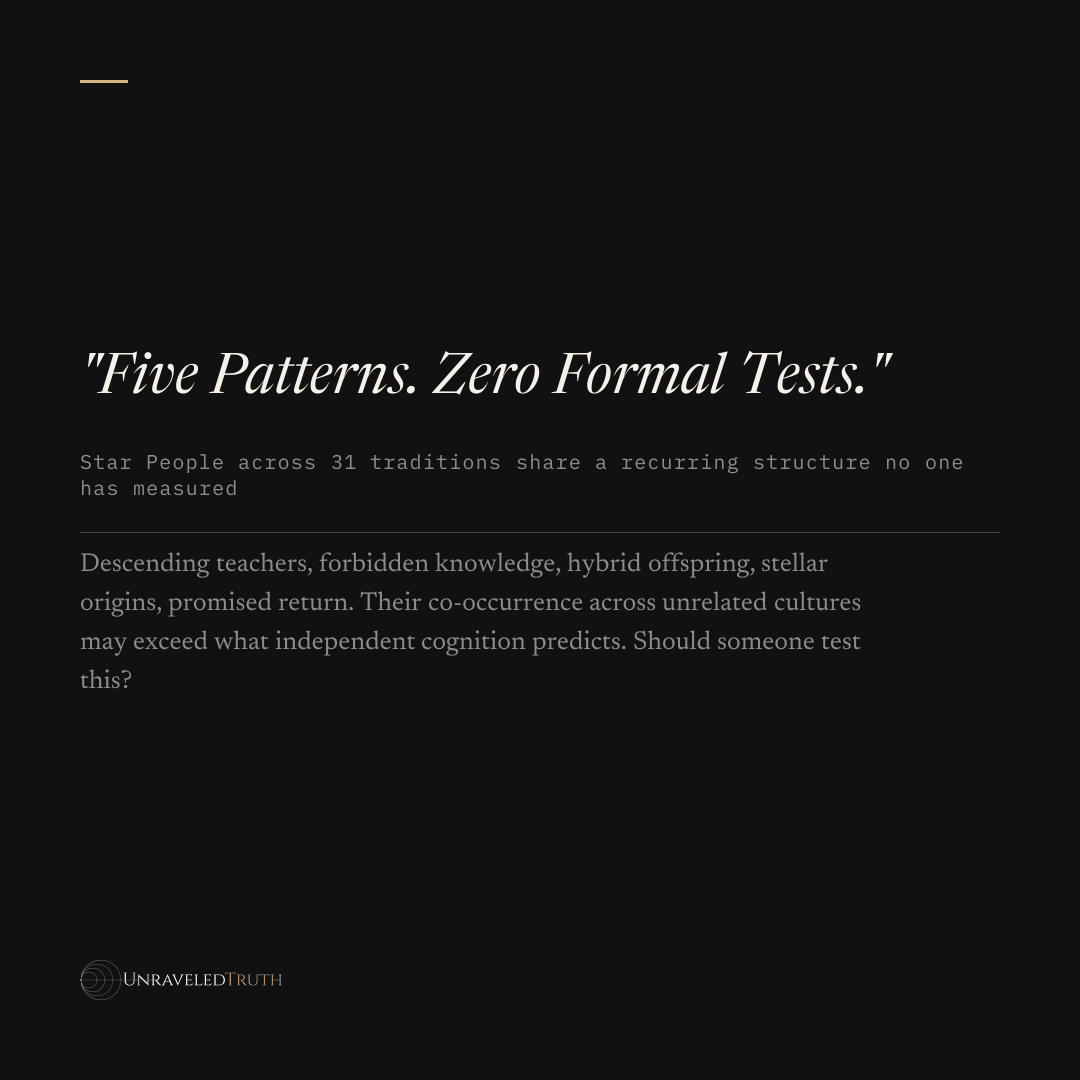
Star People: Indigenous Sky-Being Traditions and the UFO Imagination
What indigenous sky-being traditions actually preserve, what they do not prove, and why the difference matters more than either side admits.
The Illusion Engine: Ancient Consciousness Traditions and the Modern Simulation Hypothesis
How six independent civilizations asked whether reality is real, and what modern science accidentally confirmed about their question

The Philadelphia Experiment: How a Sailor's Marginalia Became America's Most Durable Naval Myth
How one man's letters, a bureaucratic curiosity, and real wartime technology fused into America's most durable naval myth.
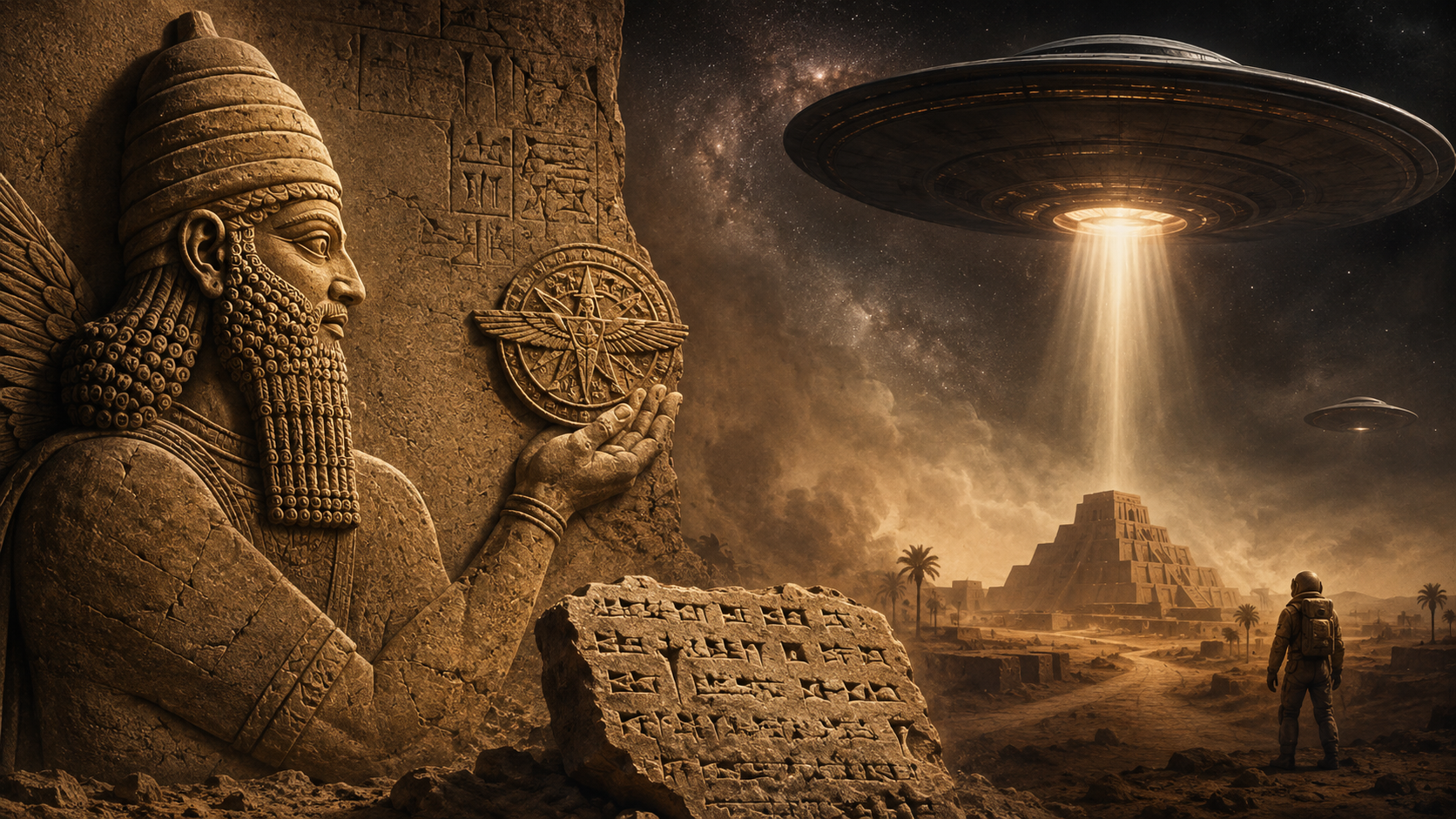
The Anunnaki Enigma: Gods, Myths, and the Alien Astronaut Controversy
Here is the central paradox: the Anunnaki are among the most thoroughly documented deities in human history — attested across thousands of cuneiform tablets spanning roughly 2,500 years of continuous Mesopotamian religious practice — and yet they have become the flagship exhibit for the ancient astronaut hypothesis, a modern pseudohistorical movement that commands a global audience in the tens of millions. The better-documented the ancient record becomes, the more fervently some readers insist i
Primary References
Want to use this research? Everything here is free with attribution.
See how →