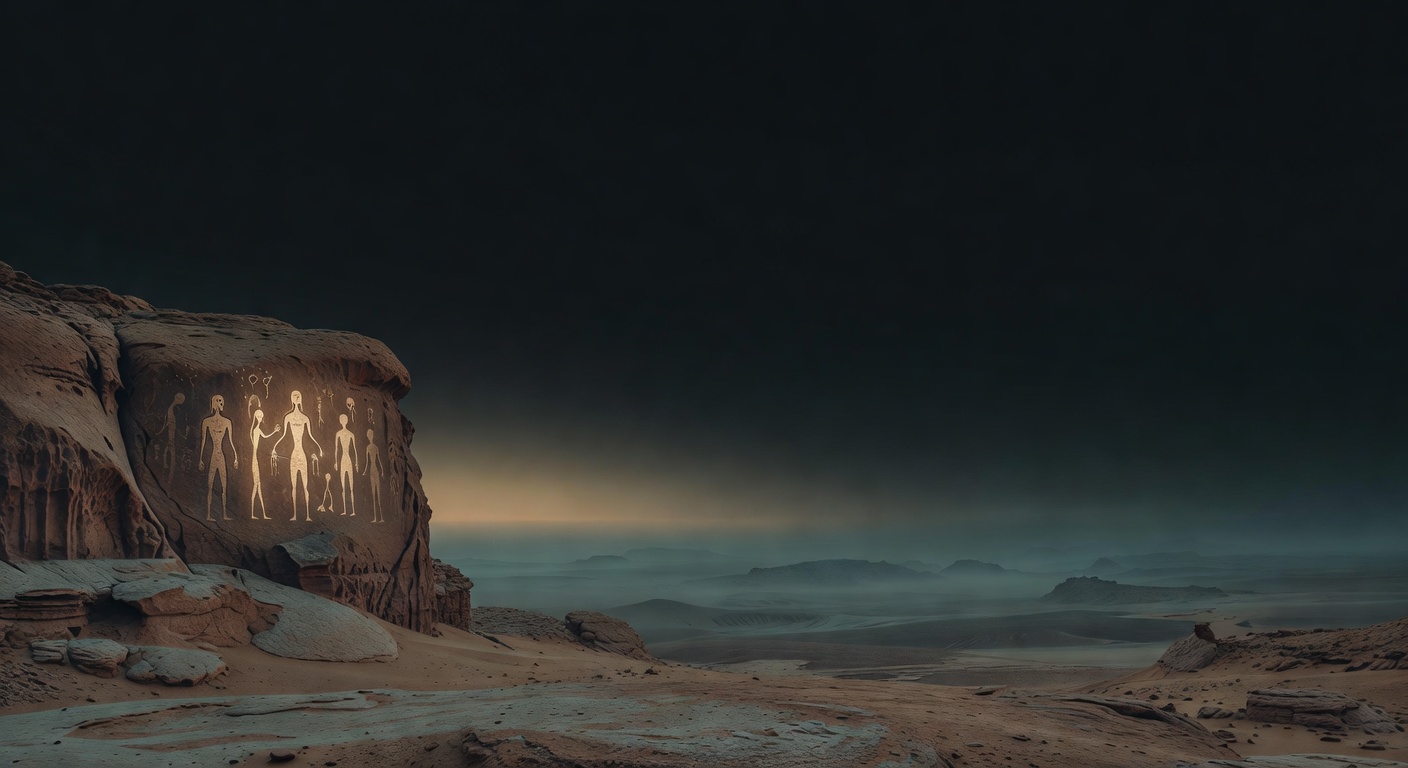
The Recurring Stranger: UAP as Modern Mythology and the Archaeology of Encounter
How ten thousand years of non-human contact narratives converge on a single unresolved question - and why that convergence may be the most important data point of all.
Traditions analyzed in this research
Grok Imagine / xAI · AI Generated
Every culture on Earth tells a story about strange beings who arrive, take people, share forbidden knowledge, and leave. We've been telling it for ten thousand years. Why does the same story keep showing up in places that had no contact with each other?
The answer is genuinely unsettling. Across 97 traditions in 41 regions, the narrative isn't just similar. It follows the same sequence. Involuntary transport. Medical procedures. Hybrid offspring. Missing time. Celtic fairy abductions and modern alien encounters share this exact script. Five centuries apart. No documented link between them. Three competing explanations all predict this pattern equally well. The data cannot tell them apart.
Something is generating this story. It could be an intelligence adapting its costume to each era. It could be the architecture of the human brain itself. But why does the stranger's appearance track our technology instead of staying the same?
Comparative mythology has been cataloging these parallels since at least the nineteenth century. James Frazer's Golden Bough, Joseph Campbell's monomyth, Mircea Eliade's work on shamanic initiation all circled the same observation: human cultures keep producing suspiciously similar stories about contact with the Other. But the modern version of the question crystallized in 1969, when astronomer and computer scientist Jacques Vallée published Passport to Magonia. Vallée did something nobody had tried systematically before. He laid medieval fairy abduction accounts next to contemporary UFO close encounters and showed the structural overlap was not metaphorical. It was procedural. Same sequence of events. Same reported physical effects. Same narrative logic. Different costumes.
That book launched a still unresolved argument. Folklorists saw confirmation that the human brain generates a limited repertoire of contact fantasies. Vallée saw evidence of something external and adaptive, an intelligence that updates its wardrobe across centuries. Skeptics saw cultural diffusion doing the heavy lifting. All three camps could point to the same data and claim vindication. Sixty years later, with far more traditions cataloged and cross-referenced, the standoff has only sharpened.
What makes the current picture different from Vallée's era is scale. Researchers now have access to 97 documented traditions across 41 regions, many from cultures with no plausible transmission pathway between them. The dataset is large enough to test each explanation seriously and honest enough to show where all three hit a wall.
The pattern isn't hiding. Three specific findings anchor it to things we can actually verify.
Neanderthal DNA Quietly Retires the 'Biological Impossibility' Argument
We now know that different human-like species interbred in prehistory. Modern non-African genomes carry 1–4% Neanderthal DNA. That's confirmed science from one of the world's top genetics labs. It doesn't prove ancient hybrid myths are literal history. But it permanently removes the argument that cross-species reproduction is biologically impossible.
The standard refutation of hybrid-being mythology rests on biological impossibility - but peer-reviewed genomic analysis now confirms that humans have, in fact, interbred with at least two distinct non-human hominin lineages in the deep past.
Biology retired one objection. But the narrative evidence goes further.
Fairy Abduction and Alien Abduction: The Same Sequence, Five Centuries Apart
Celtic fairy abductions and modern alien abduction reports follow the same step-by-step script. Luminous craft. Involuntary transport. Small non-human beings. Reproductive procedures. Return with no sense of time passing. This isn't a loose thematic overlap. It's the same sequence appearing five centuries apart in traditions with almost no documented connection to each other.
When folklorist Thomas Keightley catalogued fairy abduction narratives in 1828, he documented a sequential structure - transport, examination, cosmological communication, return, missing time - that matches the modern alien abduction template so precisely that Vallée used Keightley's own text as a primary source in his 1969 analysis.
That pattern needed a framework. One scientist built it.
Vallée: The Most Credentialed Scientist to Say 'Real, But Not Extraterrestrial'
Jacques Vallée isn't a fringe figure. He co-developed ARPANET and consulted for SETI. His hypothesis says the phenomenon is real but not extraterrestrial. A non-human intelligence adapts its appearance to each era's expectations. The key evidence: reported craft shapes track technological development decade by decade. Mystery airships in the 1890s. Flying saucers in the 1950s. Black triangles in the 1980s. Tic-Tacs today.
A co-developer of ARPANET concluded, after decades of data analysis and across multiple peer-reviewed and academic publications, that the phenomenon is real, non-extraterrestrial, and has been systematically modifying human belief systems for at least a thousand years - and he has never retracted that conclusion.
None of these findings settle the question. They sharpen it into a choice between explanations that the current evidence cannot make for us.
The DebateTwo Cases. You Decide.
The case for a real external phenomenon is serious and well-sourced. The case that human brains generate this pattern on their own is equally serious and better tested. That stalemate is the actual finding.
The parallels aren't vague resemblances. They are five-point structural matches across continents and millennia. Geographic independence is the scientific standard for real signal versus coincidence. These traditions meet that standard repeatedly. A verified precedent already exists: Melanesian Cargo Cults show exactly how a real external event gets reinterpreted through local myth.
Human brains are pattern-recognition engines with specific, testable constraints. Concepts that are mostly familiar but slightly impossible—beings that look human but walk through walls—survive in cultural memory because they're cognitively sticky. Sleep paralysis reliably produces the entire abduction script: felt presence, paralysis, entity hallucination, reproductive themes, missing time. The sequence is consistent because the neurology is consistent, not because the events occurred.
That impasse isn't new. Different communities across history have stood in the same place, looking at the same strangeness through completely different lenses.
In Their Own WordsHow Different Cultures Tell It
From the dawn of the 'flying saucer' era, figures like George Adamski spoke of encounters with 'Space Brothers' from Venus or other planets. These benevolent, often Nordic-looking humanoids would descend from their gleaming craft, expressing profound concern over humanity'
The full picture on The Recurring Stranger: UAP as Modern Mythology and the Archaeology of Encounter is free.
6 findings, 1 cultural perspective, full debate, timeline, sources with credibility ratings — everything, free with an account. No ads, no sponsors.
People & institutions referenced
Jacques Vallée
Personresearcher
Vallée's 'control system' hypothesis — that a non-human intelligence has co-existed with humanity for millennia, staging encounters calibrated to dominant cultural belief systems — is the primary analytical framework cited throughout the research summary. His hypothesis is described as the most intellectually rigorous framework for navigating the epistemic tension between competing explanations.
Carl Gustav Jung
Personresearcher
Independently arrived in 1958 at a structurally parallel conclusion to Vallée's control system hypothesis from the perspective of analytical psychology, providing cross-disciplinary consilience.
Gervase of Tilbury
Personhistorical figure
Authored medieval accounts of aerial ships that constitute verifiable primary source material for pre-modern non-human contact narratives.
United Nations
Institutionrelated
The UN emblem's polar projection map is referenced as a case of confirmed mundane explanation, used to illustrate the distinction between easy debunking cases and genuinely underdetermined phenomena.