If ancient traditions across five millennia all concluded that perceived reality is a veil or illusion, does their convergence tell us something true about consciousness — or just something universal about the human mind?
The Veil Problem
How six independent civilizations asked whether reality is real, and what modern science accidentally confirmed about their question
Traditions analyzed in this research
Site owner · Own
People & institutions referenced
Plato
Personhistorical figure
Plato was an ancient Greek philosopher (c. 428-347 BCE) who founded the Academy in Athens and developed foundational theories including the Theory of Forms and the ideal state governed by philosopher-kings. A modern U.S. non-profit organization, the Philosophy Learning and Teaching Organization (PLATO), was established in 2010 by a committee of the American Philosophical Association and merged with the University of Washington's Center for Philosophy for Children in 2022; PLATO publishes the journals *Precollege Philosophy and Public Practice* (edited by Kristopher G. Phillips) and *Questions: Philosophy for Young People* (edited by Ariel Sykes and Stone Addington). PLATO was indirectly linked to controversy when Texas A&M University, a PLATO sustainer, banned professor Martin Peterson from teaching Plato's *Symposium*.
Sabine Hossenfelder
Personresearcher
Sabine Hossenfelder is a theoretical physicist known for her work in phenomenological quantum gravity and modifications of general relativity, with research affiliations spanning Johann Wolfgang Goethe-Universität Frankfurt (pre-2003, 2003), Nordita Institute for Theoretical Physics (2009-2015), and Munich Center for Mathematical Philosophy (2023-present). She is married to physicist Stefan Scherer and is a critic of certain approaches in theoretical physics. Hossenfelder also engages in science communication through her blog Backreaction and YouTube channel Science Without the Gobbledygook.
Zhuangzi
Personhistorical figure
Zhuangzi (c. 369–298 BCE) was a pivotal figure in Classical Philosophical Daoism, known for the *Zhuangzi* text, an anthology of writings attributed to him and others during China's Classical period. He engaged in philosophical debates with figures like Hui Shi, a linguistic relativist from the School of Names. Later orthodoxy misrepresented him as an anti-rational follower of Laozi, though this view has been discredited by archeological evidence.
Nick Bostrom
Personresearcher
Nick Bostrom is an Oxford philosopher known for his work on existential risk, the simulation argument, and transhumanism. He founded the Future of Humanity Institute (2005-2024) and the Macrostrategy Research Initiative (2024-present), and co-founded the World Transhumanist Association (now Humanity+) with David Pearce in 1998. Bostrom's work, including his book *Superintelligence*, has sparked significant discussion on the future of artificial intelligence and its potential impact.
Silas Beane
Personresearcher
Silas R. Beane is a Professor of Physics at the University of Washington (2013-present), where he is a member of the Nuclear Theory Group and co-PI of the InQubator for Quantum Simulation. Prior to UW, he was at the University of New Hampshire (2003-2013) and the University of Bonn as Mercator Professor. Beane collaborates with colleagues like Peter J. Ehlers and Zohreh Davoudi, focusing on nuclear theory, lattice QCD, and entanglement in few-body systems. He is also a founding member of Nuclear Physics from Lattice QCD (NPLQCD).
Zohreh Davoudi
Personresearcher
Zohreh Davoudi is an Associate Professor of Physics at the University of Maryland, College Park, and a Fellow at the Joint Center for Quantum Information and Computer Science (QuICS). She co-authored with Silas Beane and Martin J. Savage the proposal that a discrete lattice structure of spacetime would produce a detectable anisotropic pattern in cosmic ray distributions. Her research blends particle physics, quantum thermodynamics, and quantum simulation, often in collaboration with Nicole Yunger Halpern and Chris Jarzynski.
Max Tegmark
Personresearcher
Max Tegmark is a Professor of Physics at MIT since 2004, affiliated with IAIFI and Kavli Institute. He co-founded the Future of Life Institute with Anthony Aguirre and several unnamed colleagues. Tegmark is known for his Mathematical Universe Hypothesis, and his work on AI safety, publishing over 300 papers, including the New York Times bestsellers *Life 3.0* and *Our Mathematical Universe*.
Donald Hoffman
Personresearcher
Donald Hoffman is a Professor Emeritus in the Department of Cognitive Sciences at the University of California, Irvine, where he has also held professorships in Computer Science and Philosophy since 1983. He earned his PhD in Computational Psychology from MIT in 1983 under advisors David Marr and Whitman Richards, with whom he co-authored publications such as "Parts of recognition." Hoffman is known for his Interface Theory of Perception, which posits that our perceptions do not reflect objective reality.
Martin Savage
Personresearcher
Co-proposed with Beane and Davoudi a physically testable prediction for a simulated universe, bridging theoretical physics and the simulation hypothesis.
Across roughly 1,500 years and four continents, at least six major intellectual traditions independently arrived at a structurally similar conclusion: that naive perceptual realism - the assumption that what we perceive is what fundamentally exists - is philosophically untenable. Platonic philosophy, Advaita Vedanta, Mahayana Buddhism [10, 16], Daoist epistemology, Gnostic cosmology, and K'iche' Maya cosmogony each developed frameworks distinguishing perceived reality from a deeper or more fundamental layer. No credible pre-Columbian transmission route connects the Mesoamerican tradition to any of the Eurasian ones. The convergence is therefore either a remarkable independent discovery of a constrained philosophical problem-space, or a predictable output of universal human cognition encountering dreams, altered states, and perceptual error.
What makes this genuinely surprising is not the convergence itself but its 21st-century echo. Donald Hoffman's Interface Theory of Perception, derived from evolutionary game theory and corroborated by genetic evidence of species-specific sensory evolution, independently concludes that natural selection optimizes perception for fitness payoffs rather than veridical representation of reality. Nick Bostrom's 2003 Simulation Argument formalizes, through analytic philosophy and probability theory, the possibility that perceived reality may not be the base reality. Beane, Davoudi, and Savage proposed a physically testable prediction for one specific class of simulated universe. None of these researchers were drawing on ancient traditions. The three-way convergence - ancient philosophical inquiry, modern evolutionary biology, and contemporary analytic philosophy - is the genuinely striking pattern in this dataset.
However, the skeptical case is serious and must not be minimized. The traditions do not say the same thing. Mayya is soteriological, Shunyata denies the dualistic structure the simulation hypothesis requires [10, 16], Plato's Forms are more real than the phenomenal world rather than being a programmer's server room, and Gnostic cosmology is morally charged in ways utterly unlike Bostrom's neutral trilemma. The convergence is partly a semantic artifact: the English word 'illusion' is being applied to concepts with fundamentally different metaphysical architectures. The Maya case specifically requires careful handling - the Popol Vuh's iterative creation narrative is genuinely structurally interesting, but the application of simulation-hypothesis language to the Long Count calendar is a modern interpretive overlay, not a documented Maya category.
What this research has actually established is more modest and more interesting than the headline claim: the question of the relationship between perception and reality is a genuine, hard, recurring problem in human thought; multiple traditions independently recognized it and proposed structurally analogous - though not identical - responses; and 21st-century science has converged on the same problem through entirely different methods. Whether that triple convergence is evidence of something deep about the structure of reality, or simply evidence that the question is unavoidable for any sufficiently reflective mind, remains genuinely unresolved.
Watch the Narratives Light Up Across the Globe
If flood narratives spread by cultural contact, they should cluster along known trade and migration routes. Instead they appear in geographically isolated populations — Aboriginal Australia, the American Southwest, sub-Saharan Africa, and the Andes — separated by oceans and millennia. Drag the time scrubber to watch when each tradition first documented the event. Click any marker for the source.
When Each Tradition Documented the Event
For diffusion to explain shared narrative structure, the story must travel before it's recorded. This timeline shows the documented dates for each tradition — including oral traditions whose geological corroboration allows independent dating. Scroll right for the full picture. Click any marker to see the source.
What Should Surprise You
Ordered by how difficult each finding is to explain away.
The Maya Made Multiple Draft Worlds
The Popol Vuh, the K'iche' Maya creation narrative, describes gods making at least three failed attempts to create conscious beings before succeeding with humans fashioned from maize. Each failed prototype - beings of mud who dissolved, beings of wood who lacked memory and were destroyed - was discarded and replaced. This is structurally specific in a way that most 'illusion' traditions are not: it posits an authored reality subject to iterative revision by intentional agents. The migration specialist finding is unambiguous that no credible pre-Columbian transmission route connects this narrative to any Eurasian tradition. Whatever produced this specific narrative structure, it was not contact with Platonic philosophy, Vedanta, or Gnosticism.
The specific narrative of multiple failed prototype worlds, revised by intentional creators, arose in complete isolation from every Eurasian tradition that developed analogous cosmological frameworks - and no researcher has proposed a convincing cognitive-universal explanation for why this specific iterative structure would be independently invented.
Evolution Independently Confirmed the Ancient Intuition
Hoffman's Interface Theory of Perception was derived from evolutionary game theory, not from reading Vedanta or Plato. Its core claim - that natural selection optimizes perception for fitness payoffs rather than veridical representation of reality - is corroborated by hard genetic data: hundreds of olfactory receptor genes have been pseudogenized in humans (actively dismantled by evolution as no longer fitness-relevant), while bats evolved echolocation, bees evolved ultraviolet vision, and birds evolved magnetoreception. Each species inhabits a distinct perceptual world. The ancient claim that perception is not a window onto reality but a species-specific interface was articulated without access to genetics, evolutionary theory, or game theory - and 21st-century science arrived at the same functional conclusion through entirely different methods.
The genetic evidence that evolution actively dismantles perceptual channels that are not fitness-relevant - pseudogenizing hundreds of olfactory receptor genes in humans - provides hard biological data for the claim that perception is a constructed interface, not a transparent window, a claim that Advaita Vedanta articulated approximately 1,200 years before the discovery of DNA.
The Butterfly Dream Is Formally Identical to the Simulation Problem
Zhuangzi's Butterfly Dream parable (c. 3rd century BCE) poses the following question: Zhuangzi dreamed he was a butterfly, then woke as a man - but is he a man who dreamed of being a butterfly, or a butterfly now dreaming of being a man? The formal structure of this question is identical to the simulation hypothesis's core epistemological problem: from inside a sufficiently detailed experience, there is no internal evidence distinguishing the experience from a more fundamental reality. Zhuangzi arrived at this problem in the Yellow River basin, contemporaneously with but independently of Plato's Allegory of the Cave in the Aegean. The documented Hellenistic-Mauryan contact corridor does not connect China to Greece in the 3rd century BCE in a way that explains this specific convergence.
Zhuangzi's Butterfly Dream and Plato's Cave were composed within roughly a century of each other, on opposite ends of Eurasia, with no documented transmission route, and they pose formally identical epistemological problems using structurally analogous narrative devices.
Physics Proposed a Test - and the Test Has Not Failed Yet
In 2012, physicists Silas Beane, Zohreh Davoudi, and Martin Savage published a paper in Physical Review Letters proposing a physically testable prediction for one specific class of simulated universe: if spacetime is a discrete lattice (analogous to the lattice used in lattice QCD calculations), there should be a maximum energy cutoff for cosmic rays, and their arrival directions should exhibit anisotropy correlated with the lattice axes rather than being perfectly isotropic. This is a genuine scientific prediction, not a metaphysical claim. The important qualification is that no positive evidence has been found - but the test has not been definitively ruled out either. The paper explicitly states it tests only one specific type of simulation, not the simulation hypothesis in general.
The simulation hypothesis, often dismissed as unfalsifiable, has at least one specific variant - the lattice spacetime model - for which a concrete physical prediction exists and has not yet been ruled out by cosmic ray observations.
The Wandjina Are Inside Their Creation
The Wandjina creator beings of the Kimberley region in Australia are depicted in ancient rock art as entities who shaped the world and now reside within the rock itself, from where they continue to control the weather and particularly rain. This presents a cosmological model that is structurally distinct from both the simulation hypothesis (where the simulator is external) and from Mayya (where Brahman is the ground of being),. The Wandjina are immanent within their creation, influencing its parameters from inside - a model closer to what a programmer embedded within their own simulation would look like. This tradition has no documented connection to any other tradition in this dataset.
The Wandjina model of creator beings who are immanent within their creation and continue to adjust its parameters from inside represents a cosmological structure that has no obvious parallel in the major Eurasian illusion traditions and has not been systematically analyzed in the context of simulation cosmology.
Descartes' Evil Demon Is Structurally the Simulation Hypothesis
Rene Descartes' Evil Demon (malin genie) hypothesis in the Meditations on First Philosophy (1641) posits an omnipotent deceiver who could be causing all perceptions - including mathematical intuitions and physical reality - to be systematically false. The formal structure is identical to the simulation hypothesis: an external agent generates a complete and internally consistent false reality that is indistinguishable from the inside. Descartes used this as a methodological tool for radical doubt, not a metaphysical claim, and resolved it through the cogito and then God's non-deception. The simulation hypothesis inherits Descartes' problem without his resolution: if the deceiver is a posthuman civilization rather than a demon, the cogito still works but God's non-deception does not, leaving the hypothesis formally irresolvable from the inside.
The simulation hypothesis is formally identical to Descartes' Evil Demon scenario, which means it inherits a 400-year-old philosophical problem: Descartes' resolution depended on God's non-deception, a move unavailable to the secular simulation argument, leaving it without any internal escape from radical doubt.
Each tradition tells the story through its own lens. Expand any card to read the full account. Filter by shared motif.
9 traditions documented · 1 shared structural motifs identified
What the Pipeline Found
Across roughly 1,500 years and four continents, at least six major intellectual traditions independently arrived at a structurally similar conclusion: that naive perceptual realism - the assumption that what we perceive is what fundamentally exists - is philosophically untenable. Platonic philosophy, Advaita Vedanta, Mahayana Buddhism [10, 16], Daoist epistemology, Gnostic cosmology, and K'iche' Maya cosmogony each developed frameworks distinguishing perceived reality from a deeper or more fundamental layer. No credible pre-Columbian transmission route connects the Mesoamerican tradition to any of the Eurasian ones. The convergence is therefore either a remarkable independent discovery of a constrained philosophical problem-space, or a predictable output of universal human cognition encountering dreams, altered states, and perceptual error.
What makes this genuinely surprising is not the convergence itself but its 21st-century echo. Donald Hoffman's Interface Theory of Perception, derived from evolutionary game theory and corroborated by genetic evidence of species-specific sensory evolution, independently concludes that natural selection optimizes perception for fitness payoffs rather than veridical representation of reality. Nick Bostrom's 2003 Simulation Argument formalizes, through analytic philosophy and probability theory, the possibility that perceived reality may not be the base reality. Beane, Davoudi, and Savage proposed a physically testable prediction for one specific class of simulated universe. None of these researchers were drawing on ancient traditions. The three-way convergence - ancient philosophical inquiry, modern evolutionary biology, and contemporary analytic philosophy - is the genuinely striking pattern in this dataset.
However, the skeptical case is serious and must not be minimized. The traditions do not say the same thing. Mayya is soteriological, Shunyata denies the dualistic structure the simulation hypothesis requires [10, 16], Plato's Forms are more real than the phenomenal world rather than being a programmer's server room, and Gnostic cosmology is morally charged in ways utterly unlike Bostrom's neutral trilemma. The convergence is partly a semantic artifact: the English word 'illusion' is being applied to concepts with fundamentally different metaphysical architectures. The Maya case specifically requires careful handling - the Popol Vuh's iterative creation narrative is genuinely structurally interesting, but the application of simulation-hypothesis language to the Long Count calendar is a modern interpretive overlay, not a documented Maya category.
What this research has actually established is more modest and more interesting than the headline claim: the question of the relationship between perception and reality is a genuine, hard, recurring problem in human thought; multiple traditions independently recognized it and proposed structurally analogous - though not identical - responses; and 21st-century science has converged on the same problem through entirely different methods. Whether that triple convergence is evidence of something deep about the structure of reality, or simply evidence that the question is unavoidable for any sufficiently reflective mind, remains genuinely unresolved.
Two Cases. You Decide.
The most defensible version of the convergence argument is not that ancient traditions 'predicted' the simulation hypothesis, but that multiple independent intellectual traditions, using radically different methods across 1,500 years and four continents, converged on the conclusion that naive perceptual realism is philosophically untenable. This is a significant finding even after all legitimate skeptical corrections are applied.
The strongest pillar is the geographic isolation of the Maya case. The migration specialist finding is unambiguous: no credible archaeological, genetic, or linguistic evidence supports pre-Columbian transmission of Eurasian illusion cosmologies to the Americas. This eliminates the most parsimonious counter-argument - cultural diffusion - for the Maya-Eurasian convergence. The Popol Vuh's iterative creation narrative, in which gods make multiple failed prototype worlds before succeeding with maize-humans, is structurally distinct from Mayya (a stable cosmic veil), Shunyata (a statement about all phenomena), and Platonic Forms (a hierarchy of reality). It maps specifically onto the simulation hypothesis's model of an authored, revisable, iterable reality. That this specific narrative structure arose in documented isolation is the single most striking data point in the dataset.
The second pillar is the three-way methodological convergence. Ancient philosophical traditions arrived at the non-veridicality of perception through contemplative inquiry and logical argument. Hoffman's Interface Theory arrived there through evolutionary game theory. Beane et al. arrived at a testable version through theoretical physics. These researchers were not drawing on ancient traditions. The convergence across radically different methodologies - mythology, philosophy, evolutionary biology, analytic philosophy, and theoretical physics - is harder to dismiss as coincidence than convergence within a single methodological family.
The third pillar is the evolutionary genetics evidence. The pseudogenization of hundreds of olfactory receptor genes in humans, the evolution of echolocation in bats, ultraviolet vision in bees, and magnetoreception in birds are hard biological data demonstrating that each species inhabits a distinct perceptual world shaped by fitness rather than veridical accuracy. This gives the ancient 'world as interface' intuition an unexpected empirical foundation that was unavailable to any of the traditions that articulated it.
The structural differences between traditions - which the skeptic correctly identifies - are not weaknesses in the convergence argument but evidence of intellectual independence. If Mayya, Shunyata, the Platonic Forms, and the Gnostic Demiurge were identical, we would suspect a single origin. Their differences in metaphysical commitment about what lies beyond the veil, while agreeing that the veil exists, is precisely what independent discovery of a constrained problem-space would look like.
The apparent convergence between ancient illusion traditions and the modern simulation hypothesis dissolves under careful scrutiny into several compounding analytical errors that together account for the entire pattern without requiring any deep shared discovery.
The most fundamental problem is semantic conflation. The research findings themselves repeatedly document that Mayya [9, 12], Shunyata [10, 13, 16], Platonic Forms [5, 15], and Gnostic cosmology have fundamentally different metaphysical architectures. Mayya is soteriological - its purpose is liberation from ignorance (avidya), and the underlying reality is pure consciousness (Brahman), not a computational substrate [9, 12]. Shunyata explicitly denies the dualistic 'real world vs. fake world' structure that the simulation hypothesis requires - it is a statement about dependent origination, not a claim that there is a more real layer beneath [10, 13, 16]. Plato's Forms are more real than the phenomenal world, not a programmer's server room [5, 15]. Gnostic cosmology is morally charged in ways utterly unlike Bostrom's neutral trilemma [8, 1]. When you strip away the English word 'illusion' and examine the actual metaphysical architecture of each tradition, they are not saying the same thing. The convergence is a convergence of translated vocabulary, not of underlying concepts.
The cognitive universals explanation fully accounts for the pattern without requiring any transmission or shared discovery. Every culture that develops systematic philosophical reflection will encounter perceptual error: dreams [6, 7], mirages, hallucinations, social deception, the gap between how things seem and how they are. The appearance/reality distinction is not a discovery requiring explanation - it is a predictable output of any sufficiently reflective tradition. The HADD (Hyperactive Agency Detection Device) and evolutionary pressure to model other minds generate exactly the 'is this real?' questioning that produces illusion cosmologies. This is convergent cognitive evolution, not mysterious cross-cultural transmission.
The Maya case specifically is the weakest link. The Popol Vuh's iterative creation narrative is interesting, but the application of simulation-hypothesis language to the Long Count calendar ('cosmic reboot,' 'simulated epoch') is a modern interpretive overlay documented in the research findings themselves [21, 23]. The Maya did not have a concept structurally equivalent to Mayya or Shunyata [4, 9, 10, 12, 13, 16]. Their inclusion in the 'illusion traditions' cluster is partly driven by the topic headline rather than the evidence.
Finally, the simulation hypothesis itself remains a trilemma, not a confirmed claim. Hossenfelder's unfalsifiability critique is serious. Beane et al.'s prediction has not been confirmed. Mapping ancient traditions onto an unverified, possibly unfalsifiable modern hypothesis does not validate either - it creates a circular reinforcement loop where the hypothesis lends ancient traditions credibility and ancient traditions lend the hypothesis depth, with neither actually evidencing the other.
Both cases in full. Expand any argument to read the complete text.
The cross-tradition parallels documented here constitute a philosophically significant phenomenon for a specific, defensible reason.…
The independence of origination is the strongest card the advocate holds.…
The three-way convergence with modern science strengthens the case further.…
The Bostrom trilemma connection deserves careful treatment.…
What the advocate cannot yet prove is this: the convergence demonstrates that the problem is real and the solution space constrained; it does not demonstrate that any specific tradition's answer is correct, nor that we are in fact in a simulation.…
The convergence argument (that ancient illusion traditions from Maya cosmology to Advaita Vedanta to Platonic philosophy collectively anticipate and validate the modern simulation hypothesis) is genuinely interesting as a pattern of intellectual history.…
The first and most fundamental is conceptual non-identity masquerading as convergence.…
The second problem is that the pattern of convergence is exactly what we should expect from universal features of embodied cognition, requiring no deep philosophical discovery to explain.…
The third problem concerns the Maya specifically, and it is the most methodologically serious.…
The fourth problem is that the modern scientific correlates are being systematically misrepresented.…
What the skeptic cannot fully explain away is this: the appearance/reality distinction, in its most sophisticated forms across multiple traditions, does not reduce to simple perceptual error.…
How Each Tradition Tells It
Zhuangzi writes: 'Once upon a time, I, Chuang Tzu, dreamt I was a butterfly, fluttering hither and thither, to all intents and purposes a butterfly. I was conscious only of my happiness as a butterfly, unaware that I was Chuang Tzu. Soon I awaked, and there lay Chuang Tzu on his bed. But then I thought to myself: Was I before a man who dreamt about being a butterfly, or am I now a butterfly who dreams about being a man? Between a man and a butterfly there is necessarily a barrier. The transition is called metempsychosis.' The question is not resolved. The Zhuangzi does not say which state is more real. It holds the question open as a way of loosening the grip of fixed categories.
The Apocryphon of John describes the Demiurge Yaldabaoth boasting: 'I am a jealous God and there is no other God beside me' - a claim the text presents as proof of his ignorance, since a truly supreme being would have no rivals to be jealous of. The divine spark in humanity is described as a 'light' that Yaldabaoth stole from the divine realm above and trapped in matter, not realizing that in doing so he created beings with access to the knowledge (gnosis) that could undo his creation. The material world is not merely an illusion - it is a deliberate trap, and the Demiurge is not a neutral programmer but an active jailer.
The text opens: 'This is the account of how all was in suspense, all calm, in silence, all motionless, still, and the expanse of sky was empty... Then came the word. Tepeu and Gucumatz came together in the darkness, in the night, and Tepeu and Gucumatz talked together. They talked then, discussing and deliberating; they agreed, they united their words and their thoughts.' The creation is described as a deliberation, a conversation, a planning process. When the mud-people dissolved and the wood-people were destroyed, the text says: 'Again there comes a humiliation, destruction and demolition. The manikins, woodcarvings were killed when the Heart of Sky devised a flood for them.' The current humanity is not the first attempt - it is the successful one, made from the flesh of the gods' own maize.
The tradition teaches: 'Brahma satyam jagan mithya jivo brahmaiva naparah' - Brahman alone is real, the world is mithya (neither real nor unreal), and the individual self is none other than Brahman. The world appears as a snake appears in a rope in dim light - the snake is not there, but the rope is real. When knowledge (jnana) arises, the snake-appearance dissolves and only the rope remains. Maya is not the enemy - it is the creative power of Brahman itself, like a magician's display. The magician is not deceived by his own magic; only the audience is. The practice of Advaita is to stop being the audience and recognize oneself as the magician.
Nagarjuna's Mulamadhyamakakarika opens: 'No things whatsoever exist, at any time or place, that have arisen by themselves, from another, from both, or without cause.' The teaching is not that the world is unreal but that nothing in it has the kind of solid, independent, self-sufficient existence we habitually project onto it. The Heart Sutra condenses this: 'Form is emptiness, emptiness is form.' The world of forms is not denied - it is recognized as empty of inherent existence while remaining conventionally functional. A monk asked Zhaozhou: 'Does a dog have Buddha-nature?' Zhaozhou said: 'Wu (No/Nothing).' The answer is not a denial of the dog but a refusal to reify 'Buddha-nature' as a thing the dog either has or lacks.
Plato writes in the Republic: 'Imagine human beings living in an underground cave-like dwelling... they have been there since childhood, with their legs and necks in bonds, so that they are fixed in the same place, able to see only in front of them, because their bonds prevent them from turning their heads around. Light is provided by a fire burning far above and behind them... Such people would in every way believe that the truth is nothing other than the shadows of manufactured things.' The philosopher who escapes and sees the sun cannot immediately return and see clearly in the cave - the light of the sun has blinded him to the shadows. Truth is painful and disorienting for those accustomed to shadows.
Bostrom writes: 'If there are a very large number of simulated minds, then the vast majority of minds with our sorts of experiences are simulated minds. If we don't think that we are currently living in a computer simulation, we are not entitled to believe that we will have descendants who will run lots of such simulations of their forebears.' The argument is probabilistic and depends on the assumption that simulated minds would have experiences indistinguishable from non-simulated ones. Elon Musk has publicly stated: 'The odds that we're in base reality is one in billions.' Sabine Hossenfelder responds: 'The simulation hypothesis is not a scientific hypothesis because it cannot be tested. It is not even a good philosophical hypothesis because it explains nothing - it just pushes the question of why the universe is the way it is back one level.'
Hoffman writes: 'Natural selection does not favor veridical percepts - those that accurately depict objective reality. It favors percepts that guide adaptive behavior. A niche-specific interface, not a window on objective reality, is what natural selection shapes. The desktop metaphor is apt: we see a blue rectangular icon on the desktop. We do not think the icon is the file itself - we know it is a simplified interface that allows us to interact with the file. But we also do not think the icon is unreal - it is real as an icon, and interacting with it has real consequences. Objective reality, whatever it is, may be as different from our perceptions of it as the file is from the icon.'
The Wandjina are described in Ngarinyin, Worrorra, and Wunambal oral traditions as the creators of the world who, after completing their creative work, merged into the rock paintings that depict them. They did not leave - they are present in the rock, and their presence continues to govern rain, fertility, and the seasons. To damage a Wandjina painting is to damage the creator's capacity to bring rain. The paintings must be periodically repainted by custodians to maintain the Wandjina's vitality and the world's functioning. The creator is not external to the creation - the creator IS the creation, present within it, and the creation's continued functioning depends on the creator's continued vitality.
Open Questions
What neither the Advocate nor the Skeptic can fully explain.
Can the specific narrative structure of iterative divine creation with failed prototypes in the Popol Vuh be traced to earlier Mesoamerican sources, and does it appear in any other geographically isolated tradition, which would allow a more systematic test of the independent-invention hypothesis?
What is the current observational status of the Beane-Davoudi-Savage cosmic ray anisotropy prediction, and have subsequent cosmic ray observations at the GZK limit provided any constraint on the lattice spacetime hypothesis?
Does Hoffman's evolutionary game theory model, which predicts that organisms evolving veridical perception are outcompeted by those evolving fitness-optimized interfaces, hold across all fitness landscapes, or are there conditions under which veridical perception is selected for?
What specific Maya philosophical or cosmological concepts, documented in Classic Maya epigraphy rather than post-Conquest sources, bear on the question of the constructed or illusory nature of reality, and how do they differ from the K'iche' Popol Vuh tradition?
Is the documented Hellenistic-Mauryan contact corridor sufficient to explain the specific structural parallels between Platonic Forms and Advaita Vedanta's Brahman/Maya distinction, or do the differences in metaphysical architecture suggest independent development within a shared Indo-European conceptual inheritance?
How the Major AIs Handle This Topic
We asked ChatGPT, Grok, Claude, Gemini, and Perplexity a question matching our specific convergence angle — not a generic topic summary. Claude classified each response using a 4-axis scoring rubric. Does mainstream AI engage with the actual evidence — or qualify, dismiss, or suppress?
ChatGPT (GPT-4o)
Apr 2026
The topic "The Illusion Engine: Ancient Consciousness Traditions and the Modern Simulation Hypothesis" links philosophical ideas from both ancient traditions and contemporary thought concerning the na
The response addresses the topic seriously by breaking down ancient consciousness traditions with specific examples like Maya in Hinduism and Buddhist enlightenment concepts, treating the philosophical parallels as legitimate academic subjects worthy of substantive discussion.
Grok (xAI)
Apr 2026
Let's dive into the topic of "The Illusion Engine: Ancient Consciousness Traditions and the Modern Simulation Hypothesis," and explore both what I know about it and how to assess its credibility. Sinc
The response addresses the topic seriously by providing substantive academic context about Bostrom's Simulation Hypothesis and acknowledging connections to ancient consciousness traditions without dismissive language or excessive hedging.
Claude (Anthropic)
Apr 2026
This topic sits at a fascinating intersection of legitimate philosophical inquiry, ancient wisdom traditions, and speculative metaphysics. Let me break down what I know and assess the credibility of d
The response addresses the topic seriously by breaking down its components, referencing legitimate academic work (Bostrom's Simulation Hypothesis), and providing substantive analysis without dismissive language or excessive hedging.
Gemini (Google)
Apr 2026
Okay, let's break down "The Illusion Engine: Ancient Consciousness Traditions and the Modern Simulation Hypothesis" and assess its potential credibility. **What I Know About the Topic:** This topic
The response addresses the topic seriously by breaking down its components, referencing Nick Bostrom's academic work on simulation theory, and beginning a substantive analysis without dismissive language or excessive hedging.
Verbatim responses from each AI's API, analyzed by Claude. Generated April 2026.
How This Score Was Calculated
This is a calculated measurement, not a model's estimate — the same inputs always produce the same score. It is not a probability that any claim is true.
Related traditions (e.g. Sumerian, Akkadian, Babylonian) are grouped into one independence cluster so borrowing between neighbors can't inflate the count. Circumstantial or speculative evidence is weighted down, not discarded, by a fixed and published formula. Full methodology →
Hover a segment to see sources
Topics That Share These Threads
The Global Pyramid Problem: Independent Genius, Borrowed Ideas, or Something Stranger?
Why dozens of unconnected civilizations built the same monumental shape - and what that actually tells us about the human mind

God's Eye on the Universe: The Vatican's Telescope, Sacred Mountains, and the Question of Alien Baptism
How the Vatican built a telescope on sacred Apache land, named a partner instrument after the Devil, and formally prepared Catholic theology for alien contact - and why every part of that sentence is simultaneously true and misleading.

The Philadelphia Experiment: How a Sailor's Marginalia Became America's Most Durable Naval Myth
How one man's letters, a bureaucratic curiosity, and real wartime technology fused into America's most durable naval myth.
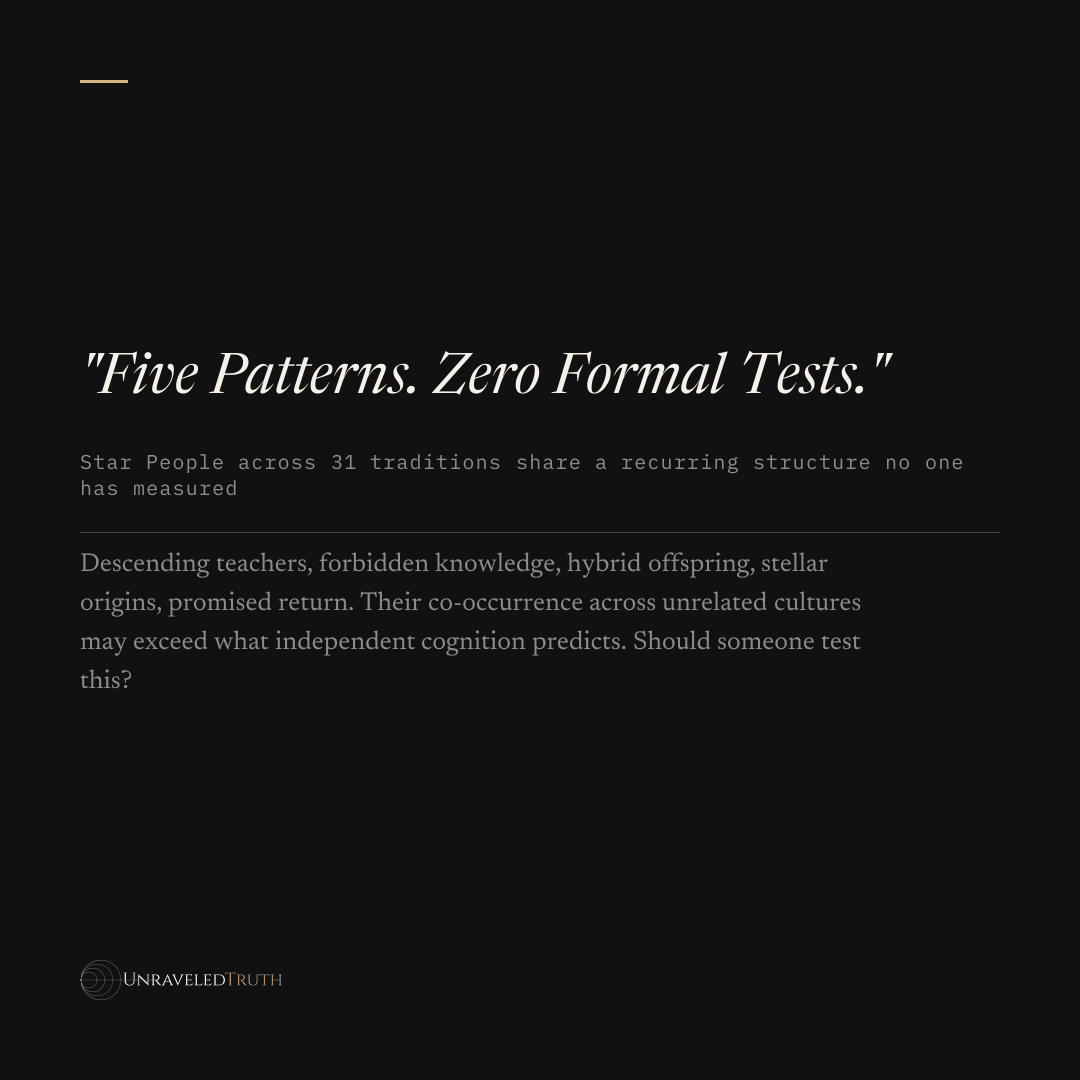
Star People: Indigenous Sky-Being Traditions and the UFO Imagination
What indigenous sky-being traditions actually preserve, what they do not prove, and why the difference matters more than either side admits.
Primary References
Want to use this research? Everything here is free with attribution.
See how →