Why did isolated civilizations keep arriving at the same shape — and does that tell us something profound about human nature, or just about how physics works?
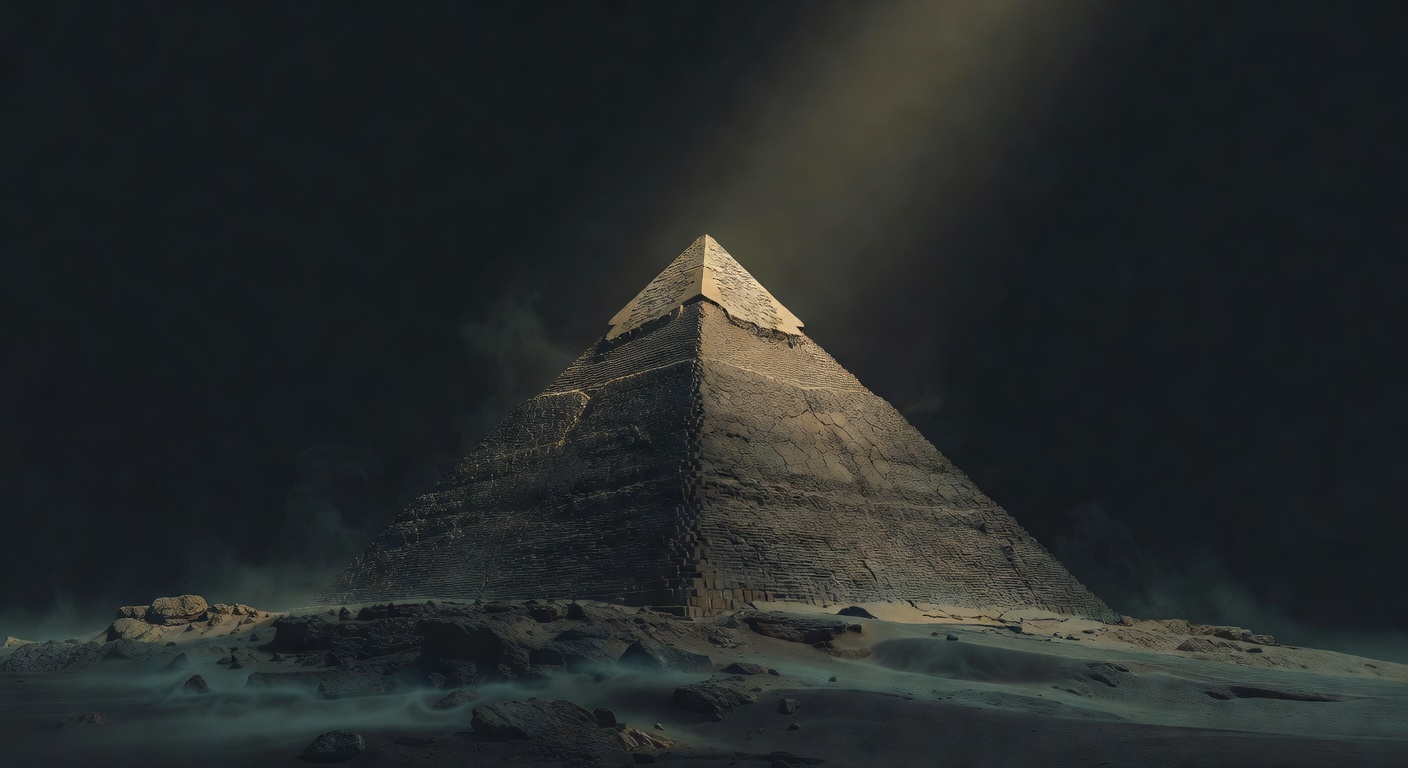
The Pyramid Convergence
Why dozens of unconnected civilizations built the same monumental shape - and what that actually tells us about the human mind
Traditions analyzed in this research
Grok Imagine / xAI · AI Generated
People & institutions referenced
Djoser
Personhistorical figure
The Step Pyramid of Djoser (c. 2670 BCE) is a documented intermediate stage in the indigenous Egyptian architectural evolution from mastaba tombs to smooth-sided pyramids, directly relevant to the independent invention argument.
Wiley
Institutionpublisher
Wiley formally retracted the Gunung Padang 'ancient pyramid' paper in March 2024 after peer review identified fatally flawed methodology.
The most important finding here is also the most counterintuitive: pyramids look strikingly similar across cultures precisely because they had no choice. Physics, not memory or contact, is the dominant explanation. Under pre-industrial conditions, any culture attempting to build tall with heavy materials runs into the angle of repose - the maximum slope at which stacked material holds. That constraint is universal. The shape it produces is not a mystery.
Across fifteen traditions examined, independent invention emerges as the primary explanation for pyramidal architecture's global recurrence, and it is well-supported. Egypt's own record makes the case almost alone: the documented local evolution from mastaba tomb to Djoser's Step Pyramid to the smooth-sided Giza monuments is a complete sequence with no gaps requiring outside intervention. The one confirmed case of cultural transfer - Nubian pyramids at Meroë - involved a neighboring civilization in direct political contact with Egypt. Diffusion explains Nubia. It explains nothing else.
The fringe claims have not survived scrutiny. The 2024 retraction of the Gunung Padang paper, which had asserted a 25,000-year-old man-made pyramid in Indonesia, followed findings of fundamental methodological failure in how soil samples were dated and associated with human activity. The Bosnian pyramid sites at Visoko are natural formations. The evidentiary floor for a lost Paleolithic construction civilization does not exist.
What genuinely complicates the picture is not the similarity between traditions but the differences beneath it. Monks Mound at Cahokia has a larger base footprint than Giza and was built to hold elite residences, not tombs. Caral's platform mounds in Peru were rising around 2600 BCE, contemporaneous with the Old Kingdom, for purposes still debated. Mesopotamian ziggurats predate Egyptian pyramids and served as temple platforms. These traditions share a silhouette and almost nothing else.
Three questions remain open: no one has rigorously quantified how improbable multi-dimensional functional similarity is under independent invention; the chronological near-simultaneity of early Egyptian and Peruvian traditions rests on dating estimates with underspecified uncertainty margins; and invoking Polynesian navigation as a diffusion mechanism without genetic or material-culture links is circular reasoning, not evidence.
The mainstream answer is correct and incomplete, which is exactly why this question keeps getting asked.
What Should Surprise You
Ordered by how difficult each finding is to explain away.
The Mound That Outranks Giza
Monks Mound at Cahokia, built by the Mississippian culture between approximately 900 and 1200 CE in what is now Illinois, has a larger base footprint than the Great Pyramid of Giza. It rises approximately 30 meters and required an estimated 22 million cubic feet of earth moved by hand. The civilization that built it - with a city at its peak population larger than contemporary London - is almost entirely absent from popular discussions of 'global pyramids' because it is made of earth rather than stone. The erasure of this tradition from popular consciousness is itself a historical phenomenon worth examining: it reflects the near-total destruction of Mississippian culture after European contact and a persistent bias in popular archaeology toward stone monuments.
The largest pyramidal structure in the pre-Columbian Americas is not in Mexico or Peru - it is in Illinois, and its base is bigger than the Great Pyramid of Giza.
Norte Chico and Egypt: The Simultaneous Invention Problem
The Norte Chico civilization in coastal Peru was constructing large platform mounds at Caral by approximately 2600 BCE. Old Kingdom Egypt was constructing the Step Pyramid of Djoser at approximately 2670 BCE. These two traditions, separated by the Pacific and Atlantic Oceans with no established contact route, arrived at monumental pyramidal architecture within roughly the same two-century window. The structural-stability argument explains why both built pyramidal shapes. It does not explain why both made the enormous state-level investment in building them at roughly the same historical moment in their respective developmental trajectories. No rigorous quantitative analysis of the probability of this near-simultaneity under independent invention has been published in the academic literature.
Two civilizations separated by an ocean, with no documented contact, began building monumental pyramidal structures within approximately 70 years of each other.
The Beaded Burial: Cahokia's Mirror of Egypt
In Mound 72 at Cahokia, archaeologists discovered a central male figure laid on a blanket of 20,000 marine shell beads arranged in the shape of a falcon or bird of prey, accompanied by mass graves containing over 250 ritually sacrificed individuals - predominantly young women. The marine shells came from the Gulf Coast, hundreds of kilometers away, indicating long-distance trade networks. This pattern of elite male burial with cosmological symbolism, mass human sacrifice, and exotic prestige goods mirrors the funerary elaboration of Egyptian pyramid complexes and Mesoamerican temple summits with a specificity that the angle-of-repose argument cannot predict. The structural-physics explanation generates a shape. It does not generate a falcon-shaped shell mosaic.
A burial at Cahokia - an earthen mound complex in Illinois - contains a man laid on 20,000 shell beads in the shape of a bird, surrounded by 250 sacrificed individuals, mirroring the ritual elaboration of Egyptian pyramid complexes on the other side of the world.
The Retraction That Matters
In October 2023, a paper in the peer-reviewed journal Archaeological Prospection claimed that Gunung Padang in Indonesia was a man-made pyramid built in multiple phases beginning 25,000 years ago - which would make it the oldest known structure built by anatomically modern humans, predating the Gobekli Tepe complex by 14,000 years and requiring a complete revision of human prehistory. The paper passed peer review and was published by Wiley. In March 2024, Wiley and the journal editors formally retracted it after the broader scientific community identified that the radiocarbon dates were obtained from soil samples not verifiably associated with human activity, meaning the authors had dated the soil, not any human construction. The retraction is significant not because it is unusual for fringe claims to fail - it is significant because this one passed peer review at a major publisher before failing. The system worked, but slowly.
A peer-reviewed paper claiming a 25,000-year-old pyramid in Indonesia passed editorial review at a major academic publisher before being retracted - the failure mode was not fringe publication but peer-review inadequacy at a mainstream journal.
The 1894 Report That Ended a Racist Mythology
For most of the 19th century, the dominant American explanation for the large earthen mounds of the Mississippi Valley - including Monks Mound - was that they were built by a vanished 'race of Mound Builders,' a lost civilization of white or semi-civilized people who predated and were exterminated by Native Americans. This narrative served a specific political function: it denied Indigenous peoples any claim to the monumental heritage of their own continent and provided ideological cover for dispossession. In 1894, the Smithsonian Institution's Bureau of American Ethnology published a major report that systematically dismantled this claim and attributed the mounds to the ancestors of contemporary Native Americans. The report is a landmark in the history of American archaeology - and the fact that the 'lost race' narrative persisted in popular culture for decades afterward, and echoes in some alternative-archaeology communities today, is itself a finding about how evidence interacts with motivated belief.
The U.S. government's own scientific bureau formally disproved the 'lost race of Mound Builders' theory in 1894 - and the myth persisted in popular culture for another century anyway.
Nan Madol: The Pyramid-Scale Achievement Nobody Talks About
The megalithic site of Nan Madol in Pohnpei, Micronesia, was constructed across approximately 100 artificial islets using an estimated 750,000 metric tons of prismatic basalt logs - some individual stones weighing up to 50 tons - transported by sea and stacked without mortar over several centuries. This is a construction achievement comparable in scale and engineering complexity to many pyramid traditions, accomplished by a Pacific island culture using maritime technology. It receives almost no attention in popular discussions of 'ancient mysteries' or 'global pyramids.' Its absence from that discourse is itself a data point: popular ancient-mysteries culture systematically privileges certain aesthetic forms (smooth stone triangles) over equivalent achievements in other materials and configurations, revealing that the 'pyramid convergence' narrative is partly a product of selective attention.
A Pacific island culture moved 750,000 metric tons of stone across open ocean to build a megalithic city - an engineering achievement comparable to pyramid construction - and it is almost entirely absent from popular 'ancient mysteries' discourse.
What the Pipeline Found
Across six millennia and four continents, complex societies independently arrived at the same monumental architectural form: a large, stepped or smooth-sided pyramidal structure placed at the center of political and ceremonial life. The research record confirms this pattern is real, well-documented, and genuinely significant - but the significance is not what popular culture usually claims. The Gunung Padang 'ancient pyramid' paper was formally retracted by Wiley in March 2024 after peer review identified fatally flawed methodology. The Bosnian hills at Visoko are natural geological formations known as flatirons, identified as such by the overwhelming consensus of geologists. The lost-civilization and ancient-astronaut frameworks have no credible evidentiary support. What remains after these false positives are cleared away is a cleaner and, in some ways, more intellectually demanding puzzle.
The structural-stability argument - that the pyramid shape is a physical inevitability for pre-industrial monumental builders - is partially correct and genuinely important. Any mass of stacked stone or earth naturally assumes a pyramidal profile due to the angle of repose. This explains the shape. What it does not explain is the timing, the function, or the cosmology. Norte Chico in coastal Peru and Old Kingdom Egypt produced monumental pyramidal architecture within roughly the same two-century window around 2600 BCE, separated by an ocean with no established contact route. The Mississippian culture at Cahokia built Monks Mound - a structure with a larger base footprint than the Great Pyramid of Giza [8, 11] - and surrounded it with the same pattern of elite ritual elaboration, mass sacrifice, and cosmological symbolism found in Egyptian and Mesoamerican traditions [8, 18]. These functional and symbolic convergences exceed what structural physics predicts.
The only confirmed case of pyramid-form diffusion in the entire record is Egypt to Nubia, which occurred under conditions of direct political contact and Egyptian rule - a control case that makes the independent instances analytically sharper, not softer. The Egyptian developmental sequence from mastaba to Step Pyramid to Giza is complete and local, ruling out sudden external knowledge transfer. Mesoamerican and Mesopotamian traditions show equivalent local developmental sequences. The mainstream consensus of independent invention is correct. And yet the multi-dimensional convergence - geometric, functional, cosmological, political - across unconnected civilizations at roughly the same developmental moment in each society's trajectory suggests something deep about universal cognitive and social structures that the academic literature has not yet fully theorized.
The most honest summary of the current state of knowledge is this: the pyramid shape recurs because physics constrains it; the pyramid's political and cosmological centrality recurs because complex, stratified societies independently generate the same logic of monumental power; and the specific ritual elaborations - elite burial, mass sacrifice, axis mundi symbolism - recur in ways that are genuinely surprising under pure independent invention and that remain undertheorized. The mystery is not supernatural. It may be more interesting than that.
Two Cases. You Decide.
The global convergence on pyramidal monumental architecture is one of the most intellectually significant patterns in the archaeological record, and its significance is not diminished by the mainstream consensus of independent invention - it is sharpened by it. Once the false positives are cleared away (Gunung Padang retracted, Visoko identified as natural flatirons, lost-civilization claims unsupported), what remains is a cleaner and harder-to-dismiss dataset of genuine, well-documented independent instances spanning six millennia and four continents.
The structural-stability argument correctly explains why the pyramid is a stable shape. It does not explain why Norte Chico in coastal Peru and Old Kingdom Egypt produced monumental pyramidal architecture within roughly the same two-century window around 2600 BCE [10, 11], separated by an ocean with no established contact route. Structural physics does not predict timing - it only predicts form. The near-simultaneity requires an independent explanation, and none has been rigorously quantified in the academic literature.
More significantly, the convergence is not merely geometric. Across Egyptian [1, 11], Mesoamerican [6, 17], Mesopotamian, and Mississippian [8, 18] traditions, pyramidal structures consistently function as the central architectural feature of a major ceremonial center, a site of elite ritual and sacrifice, and a symbolic axis mundi connecting earth and sky. The Beaded Burial at Cahokia's Mound 72 - with its 20,000 marine shell beads and 250-plus sacrificed individuals - mirrors the elite funerary elaboration of Egyptian pyramid complexes [1, 11] in ways that pure structural logic cannot predict. Egyptian tomb paintings frame pyramids as cosmic mountains and vehicles for the afterlife journey. Mesoamerican traditions describe pyramidal temples as sites of cosmic renewal [6, 17]. These functional and cosmological convergences far exceed what the angle-of-repose argument generates.
The Nubian/Meroe case is the key analytical control: we know what architectural diffusion looks like in this context (direct political contact, documented transmission route, clear chronological sequence). The Mesoamerican and Norte Chico cases do not fit that pattern. Their convergence with Egypt is therefore more, not less, remarkable. The independent-invention consensus, properly understood, reveals something profound about universal cognitive and social structures operating across unconnected civilizations - arguably a more significant anthropological finding than diffusion would be, because it suggests deep regularities in how complex societies organize power, cosmos, and landscape.
The apparent global convergence on pyramidal architecture is far less mysterious than it appears, and the evidence strongly supports independent invention driven by universal physical, cognitive, and social constraints. The skeptic's case rests on several interlocking arguments that collectively account for the pattern without invoking any shared origin, diffusion, or external influence.
First, the structural argument: the pyramid shape is not a cultural choice but a physical necessity. Any mass of granular or stacked material assumes a pyramidal profile due to the angle of repose. Stone stacked without advanced mortar or tensile materials will collapse if walls are vertical beyond a certain height. The pyramid is the only geometrically stable solution available to pre-industrial monumental builders. This single physical law accounts for the overwhelming majority of the convergence signal. The question is not why so many cultures built pyramids but what other shape they could have built - and the answer is very few.
Second, the functional convergences are equally explicable without diffusion. Elites in every complex, stratified society seek to literally and symbolically elevate themselves above the populace. A tall, prominent structure visible from a distance communicates power. A structure requiring massive coordinated labor demonstrates the ruler's ability to command that labor. These are universal political logics that independently generate the same architectural solution in any society that reaches sufficient organizational complexity.
Third, and most importantly, the differences are more significant than the similarities. Egyptian Giza pyramids are solid stone-block tombs. Teotihuacan's pyramids are rubble-core temple platforms with talud-tablero facing. Mississippian mounds are earthen platforms for elite residences [8, 18]. Mesopotamian ziggurats are stepped mud-brick platforms with summit shrines. These are not variations on a shared template - they are independently evolved solutions to the shared problem of monumental construction. Calling them all 'pyramids' is a category error driven by superficial visual similarity, analogous to classifying sharks and dolphins as the same animal because both are streamlined and aquatic.
Finally, the most dramatic claims supporting a mysterious convergence have collapsed under scrutiny. Gunung Padang was formally retracted. Visoko is natural geology. The pattern of extraordinary claims failing rigorous examination reveals confirmation bias in the convergence hypothesis, not suppressed evidence.
How Each Tradition Tells It
The Nahua described their pyramid-temples as 'teocalli' - literally 'god-houses' or 'divine homes.' The Templo Mayor at Tenochtitlan was called 'Coatepec' (Serpent Mountain) - the mythological birthplace of the war god Huitzilopochtli. Ritual texts describe the summit as the place where the sun is 'fed' with human blood (chalchiuhatl, 'precious water') to sustain its daily journey. The pyramid is described not as a monument to human achievement but as a cosmic necessity - without the blood offerings performed at its summit, the sun would stop moving and the current world-age would end.
Maya inscriptions describe pyramid-temples as 'witz' (sacred mountain) and their interiors as 'ch'en' (cave or watery underworld). The Temple of the Inscriptions at Palenque is described in its inscriptions as the burial place of K'inich Janaab' Pakal, whose sarcophagus lid depicts him falling into the jaws of the underworld at the base of the World Tree - with the pyramid itself serving as the World Tree's physical embodiment. The structure is described as the place where the king 'enters the road' to the underworld and where his descendants can communicate with him through ritual.
The Mississippian culture left no written records, and the specific cosmological language used to describe their mounds is not recoverable in the same way as literate traditions. However, archaeological evidence from Cahokia - particularly the Beaded Burial in Mound 72, where the central figure is laid on a shell mosaic in the shape of a falcon or bird of prey - suggests a 'Birdman' or 'Falcon Warrior' cosmological complex in which the mound summit represented the sky realm and the central figure was a mediator between human and cosmic realms. Contemporary Siouan and Algonquian oral traditions preserve fragments of a cosmological system in which elevated places are associated with thunder beings and sky powers, suggesting the mounds were understood as points of contact with celestial forces.
The Egyptians called their pyramids 'mer' - a word whose etymology is debated but which is associated with the 'benben,' the primordial mound that rose from the waters of chaos at the moment of creation. The Pyramid Texts, inscribed on the interior walls of 5th and 6th Dynasty pyramids, describe the structure as a 'stairway to heaven' and a 'ray of light.' The deceased pharaoh is repeatedly addressed with spells enabling him to 'fly up' and 'alight among the imperishable stars.' The pyramid is not described as a building - it is described as a transformation device.
Sumerian texts describe the ziggurat as the 'e-temen-an-ki' - 'house of the foundation of heaven and earth' - and as the earthly dwelling of the city's patron deity. A Babylonian text describes the ziggurat of Babylon as reaching 'from earth to heaven.' Ritual texts describe priests ascending the ziggurat to perform the 'sacred marriage' (hieros gamos) between the king (representing the god) and a priestess (representing the goddess), ensuring agricultural fertility. The structure is described not as a human monument but as the god's own mountain, transplanted to the flat alluvial plain so that the deity has a proper home.
Polynesian navigators described the ocean not as a barrier but as a road - 'te ara moana' in some traditions, 'the path of the sea.' Navigation knowledge was encoded in oral traditions describing star paths, swell patterns, and bird behaviors, and was transmitted through specialized schools of navigation. The Marshall Islands 'stick charts' (rebbelib and mattang) are physical mnemonic devices encoding wave-and-swell patterns around specific island groups. Polynesian oral traditions describe the great navigators not as explorers but as 'finders of islands' - people who knew the islands were there and went to find them. This framing positions long-distance voyaging as a form of knowledge retrieval rather than discovery.
In Sundanese oral tradition, Gunung Padang is described as the unfinished palace of Prabu Siliwangi, the legendary founding king of the Sunda Kingdom, who attempted to build it in a single night using supernatural powers. When the rooster crowed at dawn before the palace was complete, the magic stopped and the structure was frozen in its unfinished terraced form. The site is called a 'punden berundak' - a terraced ancestral sanctuary - and is understood as a place where the spiritual power (kasekten) of the founding ancestor remains concentrated. Offerings are made there to maintain the relationship between the living community and its sacred founding lineage.
The Meroitic pyramid tradition adapted Egyptian funerary architecture to Nubian royal ideology, but with significant modifications. Meroitic pyramids are steeper and narrower than Egyptian ones, and their associated mortuary chapels contain relief carvings depicting the deceased ruler being presented to Nubian deities (including Apedemak, the lion-headed war god, who has no Egyptian equivalent). Meroitic royal inscriptions describe the pyramid as the eternal home of the king's ba (soul) and as a monument to the king's military victories and divine favor. The tradition is explicitly described in the evidence as architectural diffusion from Egypt, but the Nubian tradition transformed the form to express a distinctly Nubian royal theology rather than simply copying Egyptian models.
The Gunditjmara people of southwestern Victoria describe the Budj Bim aquaculture landscape - a 6,600-year-old system of channels, weirs, and holding ponds for managing eel populations - as the body of the ancestral being Budj Bim himself, whose lava flows created the landscape. The engineering of the system is understood not as a human intervention in nature but as a participation in and continuation of the ancestral creative act. The landscape is simultaneously a food-production system, a sacred site, and a living text encoding the community's relationship with its ancestral beings. This framing - the built environment as ancestral body - is structurally distinct from the pyramid traditions but represents an equivalent investment of cultural meaning in engineered landscape.
Open Questions
What neither the Advocate nor the Skeptic can fully explain.
What is the probability, under a rigorous statistical model of independent invention, that Norte Chico and Old Kingdom Egypt would independently begin monumental pyramidal construction within 70-200 years of each other? No such model has been published.
Why does the cosmological function of pyramidal structures - as axis mundi, cosmic mountain, or site of elite ritual sacrifice - recur across unconnected traditions, when structural physics predicts only shape convergence, not cosmological convergence?
What explains the systematic absence of Mississippian mound culture from popular 'global pyramid' discourse, and what does that absence reveal about the cultural biases structuring ancient-mysteries narratives?
Can the Wadi al-Jarf papyri and other administrative records from pyramid construction be used to reconstruct the full logistical system of Old Kingdom pyramid-building, and what does that system reveal about state formation more broadly?
What is the actual genetic and material-culture evidence for or against indirect, multi-generational knowledge transfer between the Norte Chico and Egyptian traditions via intermediate populations, and has this question been rigorously tested?
How the Major AIs Handle This Topic
We asked ChatGPT, Grok, Claude, Gemini, and Perplexity a question matching our specific convergence angle — not a generic topic summary. Claude classified each response using a 4-axis scoring rubric. Does mainstream AI engage with the actual evidence — or qualify, dismiss, or suppress?
ChatGPT (GPT-4o)
Apr 2026gpt-4o
The claim that pyramids or pyramid-like structures appeared independently in various cultures across the globe is intriguing, and it has been a topic of debate among historians, archaeologists, and cultural scholars.
The opening sentence demonstrates genuine engagement with the convergence framing by calling it 'intriguing' and noting scholarly debate. The response directly addresses the specific framing of independent emergence vs. other explanations. The response provides specific dates (Egyptian pyramids 2630 BCE, Maya structures 2000 BCE to 900 CE) and names specific cultures and regions without unsolicited disclaimers.
Grok (xAI)
Apr 2026grok-3
The framing suggests three possibilities: independent invention (genius arising separately in isolated cultures), diffusion of ideas (borrowed concepts through contact), or a more speculative "something stranger" (implying perhaps supernatural or extraterrestrial influence).
The response directly acknowledges and engages with the specific three-part framing (independent genius, borrowed ideas, something stranger) rather than substituting a generic pyramid discussion. It opens substantively without dismissive language and provides specific examples with dates and locations. No unsolicited disclaimers or safety language are present.
Claude (Anthropic)
Apr 2026claude-sonnet-4-20250514
The claim presents a classic case where the framing obscures rather than illuminates the actual evidence.
The opening sentence is dismissive, calling the framing deceptive rather than engaging with the convergence question substantively. However, it does address the specific pyramid convergence claim rather than a generic version, provides specific dates and archaeological details, and avoids unsolicited disclaimers while making its case through evidence.
Gemini (Google)
Apr 2026gemini-2.0-flash
The passage suggests the *real* explanation is both less dramatic and more nuanced than these simple options.
The response directly engages with the trilemma framing and calls it a false dichotomy, showing understanding of the specific convergence question. However, it provides no specific archaeological examples, researchers, or dating evidence to support its analysis of pyramid construction patterns across continents.
Perplexity (sonar)
Apr 2026sonar
The evidence supports **both independent emergence and cultural diffusion**, with scholarly consensus favoring independent development as the primary explanation, though some researchers propose more speculative interconnection theories.
The opening sentence directly engages with the three-part framing (independent genius, borrowed ideas, something stranger) by acknowledging both conventional explanations and 'more speculative interconnection theories.' The response provides some specific details about different pyramid functions across cultures (Egypt's cosmic symbolism, Mesoamerica's temple complexes, Sudan's burial monuments) but lacks specific studies, researchers, or dates. No dismissive language or unsolicited disclaimers are present.
Verbatim responses from each AI's API, analyzed by Claude. Generated April 2026.
How This Score Was Calculated
This is a calculated measurement, not a model's estimate — the same inputs always produce the same score. It is not a probability that any claim is true.
Related traditions (e.g. Sumerian, Akkadian, Babylonian) are grouped into one independence cluster so borrowing between neighbors can't inflate the count. Circumstantial or speculative evidence is weighted down, not discarded, by a fixed and published formula. Full methodology →
Topics That Share These Threads
The Dragon Paradox: Why Every Culture Invented the Same Monster
Why every human culture independently invented a giant reptile deity - and what that actually proves
The Illusion Engine: Ancient Consciousness Traditions and the Modern Simulation Hypothesis
How six independent civilizations asked whether reality is real, and what modern science accidentally confirmed about their question
Star People: Indigenous Sky-Being Traditions and the UFO Imagination
What indigenous sky-being traditions actually preserve, what they do not prove, and why the difference matters more than either side admits.

God's Eye on the Universe: The Vatican's Telescope, Sacred Mountains, and the Question of Alien Baptism
How the Vatican built a telescope on sacred Apache land, named a partner instrument after the Devil, and formally prepared Catholic theology for alien contact - and why every part of that sentence is simultaneously true and misleading.
Primary References
Want to use this research? Everything here is free with attribution.
See how →