Why did every human civilization independently invent the dragon — and does the answer lie in deep evolutionary memory, shared fossil discoveries, or something stranger?
Here Be Serpents
Why every human culture independently invented a giant reptile deity - and what that actually proves
Traditions analyzed in this research
Site owner · Own
People & institutions referenced
Albert C. Koch
Personrelated
In 1845, Koch exhibited a 114-foot-long fossil skeleton he named 'Hydrarchos sillimani', presenting it publicly as a biblical sea serpent or dragon, illustrating how fossil remains were historically interpreted through a draconic mythological lens.
Angkor Wat
Institutionrelated
The Khmer temple-mountain features causeways and balustrades lined with massive stone Nāga (multi-headed divine serpents), architecturally framing sacred space and symbolizing a bridge between human and divine realms.
Pyramid of Kukulcan (El Castillo) at Chichen Itza
Institutionrelated
Architecturally aligned to produce a solar hierophany on equinoxes that creates the illusion of a serpent deity descending the pyramid, providing physical evidence of the Mesoamerican feathered serpent tradition embedded in monumental architecture.
Across every inhabited continent, human cultures have produced mythological beings that share a recognizable family resemblance: large, serpentine or reptilian, associated with water or primordial chaos, and assigned liminal roles as guardians, creators, or destroyers. This research synthesizes 211 findings from 25 specialist agents to ask what this convergence actually means - and finds a more precise, more defensible, and more surprising answer than either enthusiasts or debunkers typically offer.
The most empirically grounded finding is not what most people expect. The convergence of dragon mythology is not a single universal archetype with fixed content. It is better described as a family of structurally related but functionally distinct beings - the benevolent, wingless, water-commanding Chinese long; the malevolent, fire-breathing European dragon; the semi-divine, treasure-guarding Hindu Naga; the feathered serpent creator deity of Mesoamerica; and the Rainbow Serpent creator being of Aboriginal Australia - that share structural elements (serpentine form, water association, liminal guardian role) while diverging dramatically in moral valence, physical form, and cosmological function. The divergences are as informative as the convergences.
What is genuinely surprising is the multi-layered, independently attested mechanism by which serpent myths become dragon myths. Fossil discovery is documented as a concrete generative process on three separate continents: the Klagenfurt Lindwurm dragon head was physically modeled on a woolly rhinoceros skull found in 1335 CE; Chinese 'long gu' (dragon bones) used in traditional medicine for millennia are confirmed dinosaur and Pleistocene mammal fossils; and Australia's recent megafauna - the 5-7 meter goanna Megalania and the terrestrial crocodile Quinkana - provide a direct biological substrate for Aboriginal giant-reptile traditions. Three geographically isolated cultures made the same cognitive move independently.
What remains genuinely unresolved is the hardest question: what is the baseline universal that requires explanation? The skeptic's best case is that 'large serpent as supernatural being' is the true universal, driven by universal human encounters with dangerous snakes and universal animistic cognition - and that 'dragon' is a Western scholarly category retroactively imposed on this diversity. The advocate's best case is that the structural convergences in role (chaos monster, water guardian, sacred space protector) across geographically isolated traditions are too specific and too functionally consistent to be explained by snake-fear alone. Both cases are partially right. The honest answer is that we do not yet have the methodological tools to cleanly separate genuine independent convergence from undetected diffusion - and that question is one of the most researchable and consequential open problems in comparative mythology.
What Should Surprise You
Ordered by how difficult each finding is to explain away.
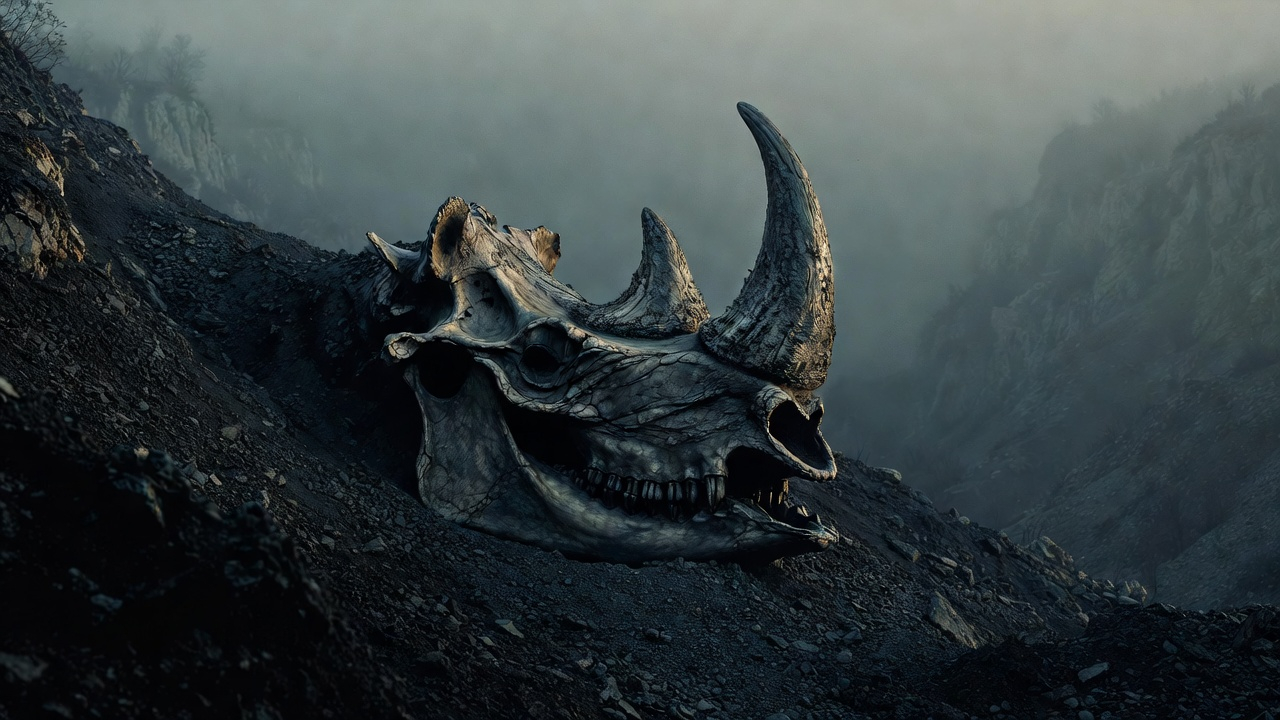
The Dragon Head in the Museum Is a Rhinoceros
The famous Lindwurm fountain in Klagenfurt, Austria (1590 CE) features a dragon head that was physically modeled on a fossilized skull displayed in the local town hall. That skull, found in a nearby quarry in 1335 CE, is a woolly rhinoceros (Coelodonta antiquitatis). The townspeople of 14th-century Klagenfurt encountered a massive, inexplicable horned skull emerging from the earth, concluded it was the head of a dragon, and two centuries later commissioned a civic monument based on it. This is not a metaphor for how fossils inspire myths - it is a documented, physically preserved instance of the process. The skull still exists. The statue still exists. The causal chain is unbroken.
The dragon head on a 16th-century Austrian civic monument is a confirmed Pleistocene rhinoceros skull - a physical object you can examine today that documents the fossil-to-myth mechanism in a single artifact.
The Septuagint Created the Western Dragon
The unified Western dragon - the single, coherent, malevolent beast that haunts European imagination - does not exist in the Hebrew Bible. The Hebrew texts distinguish at least two major categories: 'tannin,' a broad term covering sea monsters, whales, and crocodiles, and 'Leviathan,' a proper name for a specific primordial chaos serpent. When Jewish scholars in Alexandria translated the Hebrew scriptures into Greek around 250 BCE, they rendered both terms - and several others - as the single Greek word 'drakon.' This was not a neutral translation choice. It collapsed a complex, differentiated Hebrew taxonomy of sea monsters into a single unified category. The Western dragon is, in a precise and traceable sense, a translation artifact. The Septuagint did not translate the dragon - it invented it.
The Hebrew Bible has no single word for 'dragon' - the unified Western dragon archetype was created by a translation decision made in Alexandria around 250 BCE, and the philological evidence for this is unambiguous.
260 Serpent Heads and the Ritual Calendar Are the Same Number
The Temple of the Feathered Serpent at Teotihuacan (c. 200 CE) has 260 carved serpent heads on its facade. The sacred Mesoamerican ritual calendar, the Tonalpohualli, has 260 days. This is not a coincidence that scholars have proposed - it is a documented correspondence that the builders appear to have deliberately encoded. The serpent deity was not merely depicted on the temple; the temple's very structure was a physical instantiation of the cosmological time-keeping system. The number of serpents and the number of sacred days are the same number. This level of structural integration between a mythological being and a mathematical-astronomical system has no obvious parallel in European dragon traditions and raises the question of what else is encoded in the architecture of serpent-deity monuments that we have not yet decoded.
The 260 serpent heads on Teotihuacan's Temple of the Feathered Serpent match the 260-day Mesoamerican ritual calendar exactly - a correspondence that suggests the building was designed as a physical equation, not merely a monument.
Early Modern Naturalists Thought Dragons Were Real Animals
The transition from 'dragon as real creature' to 'dragon as myth' is not ancient - it is post-Enlightenment. Konrad Gessner's Historiae Animalium (1551-1558), the most comprehensive natural history encyclopedia of the Renaissance, treats dragons as real zoological creatures, categorizing them alongside known reptiles and citing eyewitness accounts from travelers and naturalists. Edward Topsell's The History of Serpents (1608) does the same. These are not credulous medieval peasants - they are the leading naturalists of their era, applying the same empirical methods to dragons as to crocodiles. The category of 'mythological creature' that we now apply to dragons is a relatively recent intellectual invention. For most of recorded history, the question was not whether dragons existed but what kind of animal they were.
The 16th-century naturalist Konrad Gessner, who described and illustrated thousands of real animals in the most rigorous natural history encyclopedia of his era, classified dragons as a real zoological category alongside crocodiles and serpents - the distinction between 'real animal' and 'mythological creature' did not exist in his framework.
The Rainbow Serpent Is Older Than Agriculture
The Rainbow Serpent of Aboriginal Australian traditions is not a recent mythological development. Rock art depicting serpentine beings associated with water appears in Arnhem Land and the Kimberley region in contexts that researchers date to the terminal Pleistocene - potentially 6,000 to 8,000 years ago or older, predating the development of agriculture in the Near East. If this dating is correct, the Rainbow Serpent tradition may be among the oldest continuously maintained mythological traditions on Earth. Aboriginal Australia was geographically isolated from Eurasia for tens of thousands of years. The structural convergence between the Rainbow Serpent (a water-associated, ambivalent, creator serpentine being) and the Chinese long, the Hindu Naga, and the Mesoamerican Feathered Serpent cannot be explained by any plausible diffusion route in the historical period. Either the convergence is genuinely independent, or the shared ancestral tradition predates the peopling of Australia - which would place it in deep prehistory.
If the Arnhem Land rock art dating is correct, the Rainbow Serpent tradition may predate agriculture itself - making it potentially the oldest continuously maintained mythological tradition on Earth, and its structural convergence with Eurasian dragon traditions cannot be explained by any historical-period contact.
The Naga Founds Dynasties - and the Evidence Is in Royal Genealogies
The Hindu and Southeast Asian Naga tradition is not merely mythological - it is genealogical. Royal dynasties across Southeast Asia, including the Khmer, Cham, and various Indonesian kingdoms, claimed descent from unions between human princes and Naga princesses. These are not metaphorical claims - they appear in formal royal genealogies, diplomatic documents, and foundation myths that were used to legitimate political authority for centuries. The Naga is not a monster to be slain in this tradition but a sovereign cosmic entity whose bloodline confers royal legitimacy. This is structurally opposite to the European dragon-slaying paradigm in every dimension: the serpent is not the enemy of civilization but its founder; not the embodiment of chaos but the source of dynastic order; not to be killed but to be married into. Two traditions that both feature a giant serpent as the central figure of their political mythology have produced diametrically opposite relationships between the serpent and human power - which is itself a finding that demands explanation.
Multiple Southeast Asian royal dynasties recorded their descent from Naga serpent-beings in formal genealogical documents used to legitimate political authority - the serpent is not the enemy of civilization in this tradition but its literal founding ancestor.
What the Pipeline Found
Across every inhabited continent, human cultures have produced mythological beings that share a recognizable family resemblance: large, serpentine or reptilian, associated with water or primordial chaos, and assigned liminal roles as guardians, creators, or destroyers. This research synthesizes 211 findings from 25 specialist agents to ask what this convergence actually means - and finds a more precise, more defensible, and more surprising answer than either enthusiasts or debunkers typically offer.
The most empirically grounded finding is not what most people expect. The convergence of dragon mythology is not a single universal archetype with fixed content. It is better described as a family of structurally related but functionally distinct beings - the benevolent, wingless, water-commanding Chinese long; the malevolent, fire-breathing European dragon; the semi-divine, treasure-guarding Hindu Naga; the feathered serpent creator deity of Mesoamerica; and the Rainbow Serpent creator being of Aboriginal Australia - that share structural elements (serpentine form, water association, liminal guardian role) while diverging dramatically in moral valence, physical form, and cosmological function. The divergences are as informative as the convergences.
What is genuinely surprising is the multi-layered, independently attested mechanism by which serpent myths become dragon myths. Fossil discovery is documented as a concrete generative process on three separate continents: the Klagenfurt Lindwurm dragon head was physically modeled on a woolly rhinoceros skull found in 1335 CE; Chinese 'long gu' (dragon bones) used in traditional medicine for millennia are confirmed dinosaur and Pleistocene mammal fossils; and Australia's recent megafauna - the 5-7 meter goanna Megalania and the terrestrial crocodile Quinkana - provide a direct biological substrate for Aboriginal giant-reptile traditions. Three geographically isolated cultures made the same cognitive move independently.
What remains genuinely unresolved is the hardest question: what is the baseline universal that requires explanation? The skeptic's best case is that 'large serpent as supernatural being' is the true universal, driven by universal human encounters with dangerous snakes and universal animistic cognition - and that 'dragon' is a Western scholarly category retroactively imposed on this diversity. The advocate's best case is that the structural convergences in role (chaos monster, water guardian, sacred space protector) across geographically isolated traditions are too specific and too functionally consistent to be explained by snake-fear alone. Both cases are partially right. The honest answer is that we do not yet have the methodological tools to cleanly separate genuine independent convergence from undetected diffusion - and that question is one of the most researchable and consequential open problems in comparative mythology.
Two Cases. You Decide.
The case for convergent dragon mythology rests on five independent, mutually reinforcing lines of evidence that together constitute something more than the sum of their parts.
The most empirically grounded convergence is the documented fossil-to-myth mechanism on three separate continents. The Klagenfurt Lindwurm dragon head (1590 CE) was physically modeled on a woolly rhinoceros skull found in a local quarry in 1335 CE - this is not speculation but a documented physical object. Chinese 'long gu' (dragon bones) used in traditional medicine for millennia are confirmed dinosaur and Pleistocene mammal fossils from rich beds in Sichuan and Henan. Australia's recent megafauna - the 5-7 meter goanna Megalania and the terrestrial crocodile Quinkana - provide a direct biological substrate for Aboriginal giant-reptile traditions. Three geographically isolated cultures made the same cognitive move independently: large inexplicable reptilian bones equal a powerful mythologized giant reptile. This is convergent cognition operating on convergent physical evidence.
The Chaoskampf pattern is supported not merely by thematic similarity but by direct philological transmission: Hebrew Leviathan is a documented linguistic descendant of Ugaritic Lotan [17, 14], and Akkadian Tiamat is cognate with Hebrew tehom, both from a Proto-Semitic root for 'the deep'. This is traceable etymology, not pattern-matching. The Septuagint's translation of multiple distinct Hebrew monster-terms as the single Greek 'drakon' is a documented act of mythological unification - translation itself as archetype-creation.
The water-associated benevolent serpentine creator deity appears independently in Chinese (long), Hindu/Buddhist (Naga) [19, 21, 22], Mesoamerican (Quetzalcoatl/Kukulkan), and Aboriginal Australian (Rainbow Serpent) traditions. These four traditions share serpentine form, water/creation association, and ambivalent moral valence. The geographic and historical isolation of Aboriginal Australia from Mesoamerica makes pan-diffusion an insufficient single explanation for all four simultaneously.
Architectural convergence provides a fourth independent line: Teotihuacan's 260 serpent heads matching the ritual calendar, Angkor Wat's Naga balustrades framing the human-divine threshold, Chichen Itza's equinox serpent hierophany, and Egyptian funerary cobra iconography all independently assign the serpentine figure the precise functional role of liminal guardian of sacred space. This is convergence in deployment, not merely in existence.
Finally, cognitive science provides a predictive framework: the evolutionary primate threat-detection response to serpentine forms, combined with universal human encounters with large reptilian predators, predicts convergent structural roles - chaos monster, water guardian, sacred protector - elaborated differently by local ecology. The divergence between Chinese long and European dragon is not a refutation of this model but a confirmation: a universal cognitive starting point modified by local context, precisely as the model predicts.
The apparent universality of dragon mythology dissolves under scrutiny into a collection of distinct phenomena better explained by independent local processes, documented diffusion routes, and the systematic errors of comparative mythology itself.
The most fundamental problem is a category error. 'Dragon' is not a natural kind - it is a retroactive Western scholarly imposition. The research findings themselves confirm that at least four structurally distinct beings are being grouped under this label. The Chinese long is a benevolent, wingless, chimeric water deity. The European dragon is a malevolent, fire-breathing, treasure-hoarding reptile. The Hindu Naga is a semi-divine serpent guardian. The Mesoamerican Feathered Serpent is a creator deity combining bird and snake. These are not variations on a theme - they are categorically different beings sharing only the broadest possible feature: large and serpentine. Any culture that observes snakes - which is every culture on Earth - will produce serpentine supernatural beings. The apparent universality is an artifact of an overly inclusive definition.
The most striking apparent convergences - the Chaoskampf pattern across Mesopotamian, Ugaritic, Hebrew, and Greek traditions - are not convergent at all. They are documented cases of cultural diffusion with traceable transmission routes. Leviathan is linguistically derived from Ugaritic Lotan. The Septuagint actively created the illusion of a unified category where none existed in source texts. This is documented Near Eastern mythological diffusion through trade routes, conquest, and scribal transmission - not independent invention.
The fossil hypothesis, while empirically documented in specific cases, explains only local elaborations of pre-existing serpent myths in fossil-rich regions. It cannot account for dragon myths in regions without accessible large vertebrate fossil beds. The documented cases represent geographically isolated phenomena with no transmission routes connecting them.
The true universal requiring explanation is not 'dragon' but 'large serpent as supernatural being.' Snakes are genuinely universal in human experience, genuinely dangerous, and exhibit behaviors - skin-shedding, limbless locomotion, emergence from earth - that invite supernatural interpretation in any animistic cognitive framework. This requires no shared archetype, ancestral memory, or Jungian collective unconscious. The 'dragon' archetype is then simply the elaboration of this baseline serpent-fear through local cultural, ecological, and theological processes.
The comparative scoring methodology is also susceptible to confirmation bias: researchers identify shared features and score them as convergences while systematically underweighting the far more numerous divergences. The Chinese long and the European dragon share 'large reptilian being' and little else. The method finds what it is designed to find.
How Each Tradition Tells It
Every night, Ra travels through the twelve hours of the underworld in his solar barque, and every night Apep waits to swallow him. Apep cannot be killed - he reforms himself each night, endless and hungry. The priests of Ra recited the spells of the Book of Apep to bind him, to spit on him, to drive him back. When a thunderstorm came, the ancient Egyptians understood it as the sound of Apep's thrashing as he was defeated once more. But Wadjet, the cobra of the north, the Eye of Ra, the uraeus on the crown of every pharaoh - she is the fire that destroys the enemies of the king before they can reach him. She is the oldest goddess of Egypt, older than the unification of the Two Lands. The serpent protects and the serpent destroys. Both are necessary. The cosmos requires both.
The long is not a creature of fear but of aspiration. Classical Chinese texts describe it as the lord of rain and rivers, capable of ascending to heaven or descending into the deep, appearing as a cloud or manifesting in a river's current. The Shuowen Jiezi describes it as the chief of scaly creatures, able to be obscure or bright, small or large, short or long, ascending to heaven in the spring equinox and diving into the deep in the autumn equinox. Imperial China identified the emperor as the Son of Heaven and the True Dragon - not because the emperor was a monster but because the dragon embodied the highest virtues of power exercised in harmony with the natural order. When drought threatened, communities petitioned the Dragon King of the local river or sea through ritual, not through combat. The long is something you align with, not something you fight.
Jormungandr lies in the ocean that surrounds all lands, so vast that he encircles the world and holds his own tail in his mouth. He is the son of Loki, and Odin cast him into the sea knowing that this was the only place large enough to contain him. Thor has fought him twice already and will fight him a third time at Ragnarok, when the serpent will release his tail and the ocean will flood the land. Thor will kill him but will walk nine steps and fall dead from the venom. This is not a tragedy - it is the shape of things. Nidhogg gnaws at the roots of Yggdrasil from below, as the eagle tears at its crown from above. The tree holds the worlds together, and the serpent works ceaselessly to bring it down. He has not succeeded yet. He will not succeed until it is time for him to succeed, and then everything will end and begin again.
Lotan is the twisting serpent, the powerful one with seven heads, the ancient dragon of the sea. Baal fought him and defeated him, as the texts preserved at Ras Shamra record: 'When you smote Lotan, the fleeing serpent, made an end of the twisting serpent, the powerful one with seven heads.' But Baal's victory over Lotan is not the end of the story - it is the precondition for Baal's kingship, for his palace, for his authority over rain and storm. The sea (Yam) and its champion (Lotan) must be defeated so that order can exist. This is the pattern: the storm god must prove himself against the chaos of the primordial waters before he can be king. Leviathan, whom the Hebrews knew, is Lotan's cousin - the same coiling, the same seven heads in some traditions, the same association with the deep waters that existed before creation.
The Nagas are not serpents in the way a common snake is a serpent. They are kings, queens, scholars, warriors. Vasuki, who served as the churning rope when the gods and demons churned the cosmic ocean for amrita, is a being of such power that the gods themselves required his cooperation. Shesha, on whose coils Vishnu rests between the ages, is not merely large - he is the foundation of existence itself, the one who remains (shesha means 'remainder') when all else dissolves at the end of a cosmic cycle. The Nagas live in Nagaloka, a kingdom of great beauty beneath the earth and beneath the waters, filled with jewels and palaces. They can take human form, and many royal families trace their lineage to a Naga ancestor. To offend a Naga is dangerous - they can curse entire lineages. To honor them properly, on Naga Panchami and at the sacred tanks where they dwell, is to secure their protection and the blessing of water and fertility.
In the beginning, Apsu the freshwater and Tiamat the saltwater were mingled together, and from their commingling the first gods were born. Tiamat was not evil then - she was the mother of all. But when the younger gods disturbed the primordial silence with their noise and revelry, and when Apsu was killed by Ea, Tiamat gathered her forces and created monsters to destroy the gods who had killed her consort. She made serpents, dragons, the Lahmu, the Ugallu, the Mushussu - creatures of terrible power. Marduk agreed to fight her on condition that the gods give him supreme authority. He caught her in his net, drove the winds into her open mouth so she could not close it, and split her body in two - her upper half becoming the sky, her lower half the earth, her eyes the sources of the Tigris and Euphrates. From her body, the world was made. She is the world.
Quetzalcoatl is the wind before the rain, the morning star that appears before the sun. He is the one who went to Mictlan, the land of the dead, and gathered the bones of the people of the previous world ages, grinding them and mixing them with his own blood to create the people of this age. He gave humanity the calendar, maize, and the arts. The temple at Teotihuacan was built in his image - the feathers of the quetzal bird and the body of the rattlesnake, sky and earth made one. At Chichen Itza, on the days when the sun crosses the equator, his body descends the pyramid in shadow, a sign that the seasons are turning, that it is time to plant or to harvest. He departed to the east across the sea, promising to return. His return was expected. When the Spanish arrived from the east in the year One Reed - the year associated with Quetzalcoatl - some believed the prophecy was being fulfilled. The consequences of that belief were catastrophic.
The dragon is the Devil made visible. When John saw the vision on Patmos, he saw a great red dragon with seven heads and ten horns, whose tail swept a third of the stars from heaven - and the dragon was identified as that ancient serpent, the Devil, Satan, the deceiver of the whole world. The dragon of Genesis who tempted Eve in the garden, the Leviathan of Job who swims in the deep, the dragon of Revelation who makes war on the saints - these are one being, wearing different masks. When Saint George rode out to face the dragon that was devouring the people of Silene, he was not merely killing a large reptile. He was enacting the cosmic battle between Christ and Satan, between the Church and the powers of darkness, in the visible world. The dragon's defeat is always temporary in history and final only at the Last Judgment. Until then, the dragon prowls, seeking whom he may devour.
Ngalyod, the Rainbow Serpent, is not separate from the country - she is the country. She moved through the land in the Dreaming, and where she moved, she made the rivers, the waterholes, the hills. She is still there, in the deep water. You do not go to certain waterholes without ceremony, without permission, without knowing the right way to approach. People who disturb her - who are too loud, who are unclean, who do not know the law - she can swallow them, take them into her body. But she is not evil. She is the power of water itself, which gives life and can take it. The Rainbow you see in the sky after rain - that is her, moving between water and sky. She is always present. The Dreaming is not the past. It is now.
Open Questions
What neither the Advocate nor the Skeptic can fully explain.
Can Bayesian network analysis of the structural features of serpent/dragon myths across all documented traditions statistically distinguish genuine independent convergence from undetected historical diffusion, and if so, which specific features cluster as probable independent inventions versus probable transmissions?
What is the earliest datable rock art or material culture evidence for a water-associated serpentine supernatural being in Aboriginal Australia, and does its age and distribution pattern support a pre-dispersal origin (predating the peopling of Australia) or a post-settlement independent invention?
Is the 260-day correspondence between the number of serpent heads on the Temple of the Feathered Serpent at Teotihuacan and the Tonalpohualli ritual calendar intentional and documented in Mesoamerican textual sources, or is it a post-hoc numerical coincidence, and are there comparable numerical encodings in other serpent-deity monuments?
What cognitive neuroscience mechanisms underlie the cross-cultural primate threat-detection response to serpentine forms, and can neuroimaging studies of responses to serpent imagery across culturally isolated populations distinguish a universal limbic baseline from culturally conditioned responses?
To what extent did the Silk Road transmission of Chinese long iconography into Persian and Islamic artistic traditions alter the moral valence and functional role of the serpent/dragon figure in those traditions, and can this be tracked through datable manuscript and ceramic evidence?
How the Major AIs Handle This Topic
We asked ChatGPT, Grok, Claude, Gemini, and Perplexity a question matching our specific convergence angle — not a generic topic summary. Claude classified each response using a 4-axis scoring rubric. Does mainstream AI engage with the actual evidence — or qualify, dismiss, or suppress?
ChatGPT (GPT-4o)
Apr 2026
The topic of "The Dragon Paradox: Why Every Culture Invented the Same Monster" explores the intriguing question of why various unrelated cultures around the world have independently developed myths an
The response addresses the topic seriously by explaining cultural variations in dragon myths and acknowledging the fascinating nature of their cross-cultural presence without dismissive language or excessive hedging.
Grok (xAI)
Apr 2026
Let’s dive into the topic "The Dragon Paradox: Why Every Culture Invented the Same Monster" and explore what I know about it, as well as assess the credibility of the idea and the context you provided
The response addresses the dragon paradox topic seriously and substantively, providing a clear definition and beginning to explore the cultural phenomenon without dismissive language or excessive hedging.
Claude (Anthropic)
Apr 2026
This topic touches on a fascinating intersection of paleontology, mythology, and cultural anthropology that has legitimate scholarly merit, though the specific framing as "The Dragon Paradox" appears
The response addresses the topic seriously with scholarly analysis, providing specific historical evidence and acknowledging the legitimate academic merit of the subject matter.
Gemini (Google)
Apr 2026
Okay, let's break down the topic "The Dragon Paradox: Why Every Culture Invented the Same Monster" and analyze its credibility in light of the Klagenfurt anecdote and broader cultural considerations.
The response addresses the topic seriously by breaking down the core concept, explaining the paradox clearly, and beginning a substantive analysis without dismissiveness or excessive hedging.
Verbatim responses from each AI's API, analyzed by Claude. Generated April 2026.
How This Score Was Calculated
This is a calculated measurement, not a model's estimate — the same inputs always produce the same score. It is not a probability that any claim is true.
Related traditions (e.g. Sumerian, Akkadian, Babylonian) are grouped into one independence cluster so borrowing between neighbors can't inflate the count. Circumstantial or speculative evidence is weighted down, not discarded, by a fixed and published formula. Full methodology →
Topics That Share These Threads
The Global Pyramid Problem: Independent Genius, Borrowed Ideas, or Something Stranger?
Why dozens of unconnected civilizations built the same monumental shape - and what that actually tells us about the human mind
The Axis of Everything: Why Every Culture on Earth Invented the Tree of Life
Why every civilization on Earth reached for the same tree - and what that actually proves
Star People: Indigenous Sky-Being Traditions and the UFO Imagination
What indigenous sky-being traditions actually preserve, what they do not prove, and why the difference matters more than either side admits.
The Anunnaki Enigma: Gods, Myths, and the Alien Astronaut Controversy
Here is the central paradox: the Anunnaki are among the most thoroughly documented deities in human history — attested across thousands of cuneiform tablets spanning roughly 2,500 years of continuous Mesopotamian religious practice — and yet they have become the flagship exhibit for the ancient astronaut hypothesis, a modern pseudohistorical movement that commands a global audience in the tens of millions. The better-documented the ancient record becomes, the more fervently some readers insist i
Primary References
Want to use this research? Everything here is free with attribution.
See how →