Why does a man who couldn't read the texts he translated still command more believers than the scholars who can?
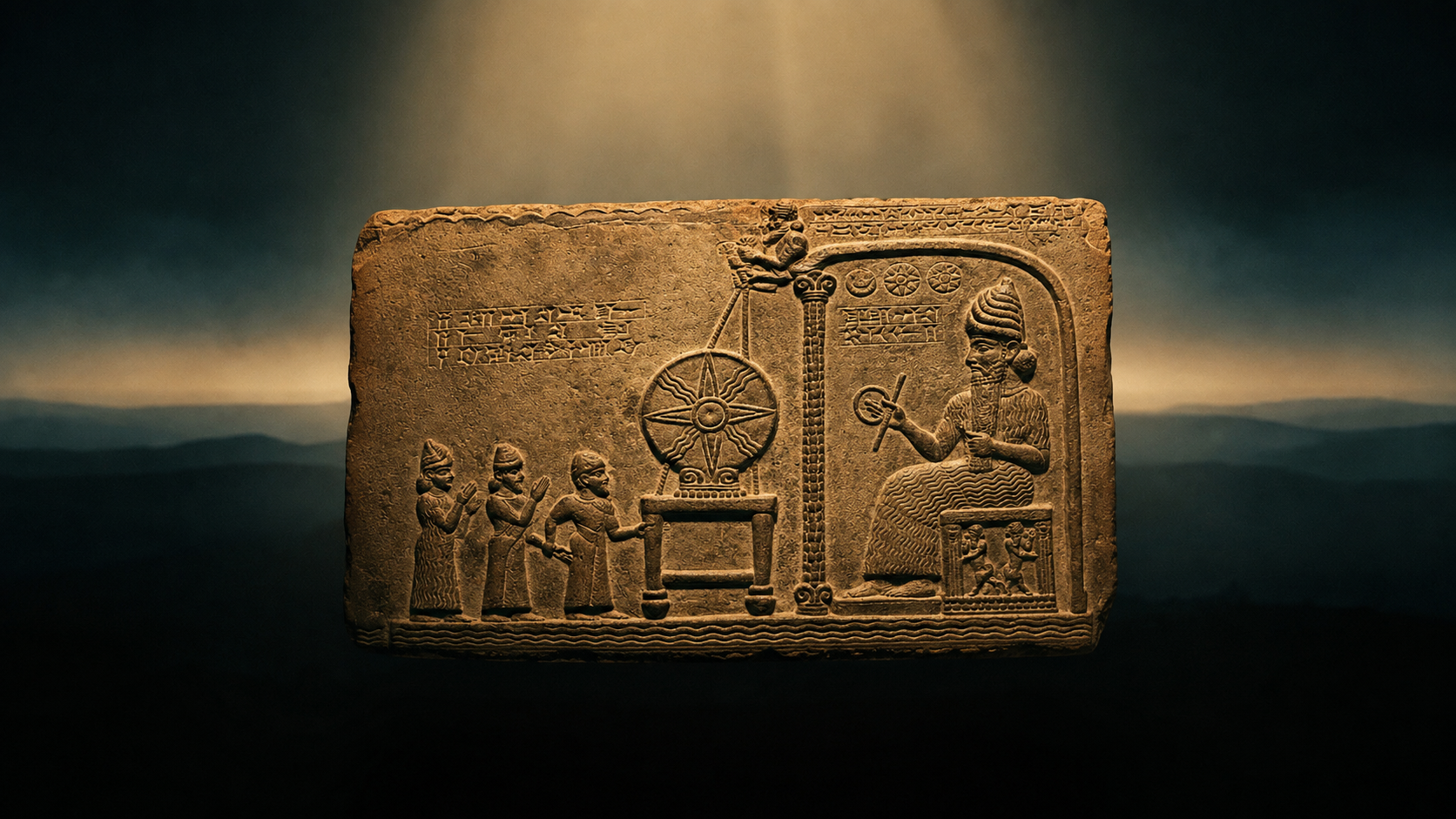
The Translator as Prophet: Zechariah Sitchin, Sacred Hermeneutics, and the Psychology of Alternative History
How one man's idiosyncratic readings of cuneiform tablets became a decentralized religion, a media empire, and a case study in how pseudoscience fills the gaps left by institutional distrust.
Traditions analyzed in this research
Site owner · Own
People & institutions referenced
Zechariah Sitchin could not read cuneiform. That is the foundation of everything that follows, and it is not in dispute. Every credentialed Assyriologist who has examined his work, including Michael Heiser's systematic 2004 refutation, has found his translations of terms like "Nibiru," "Anunnaki," and "shem" philologically indefensible, contradicted by standard reference works available to any researcher. The primary texts he cites are real, publicly archived, and multiply translated across more than a century of scholarship. His readings diverge from all of it in ways that cannot be attributed to legitimate interpretive disagreement. The philological question is closed.
The interesting question is why that closure has not mattered. What sustains Sitchinism is not evidence. It is architecture. His interpretive method shares the defining flaw of the Bible Code controversy: rules were never defined in advance, conclusions preceded evidence, and the resulting system is unfalsifiable by design. Contradicting evidence becomes proof of suppression; absent evidence becomes proof of concealment. This is not poor scholarship. It is a belief system structurally immune to refutation, and scholars of new religious movements recognize the pattern immediately — prophetic founder, hermeneutic monopoly over inaccessible sacred texts, boundary maintenance through unfalsifiability, founder authority persisting long after line-by-line demolition. The Ancient Aliens franchise then functions as the transmission mechanism, with algorithmic recommendation doing the work oral tradition once did.
One finding deserves rescue from the wreckage. Amar Annus's 2010 peer-reviewed documentation of structural parallels between the Mesopotamian Apkallu tradition and the Second Temple Watcher tradition — antediluvian timing, semi-divine status, civilization transmission, catastrophic boundary transgression — is entirely independent of Sitchin and represents genuine comparative scholarship. It remains under-investigated, almost certainly because the professional cost of entering Sitchin-adjacent territory deters the researchers best positioned to pursue it.
The persistence of ancient astronaut theory is not a problem about ancient history; it is a problem about institutional distrust, media economics, and the cognitive appeal of systems that explain everything — and that combination has proven more durable than any refutation.
Watch the Narratives Light Up Across the Globe
If flood narratives spread by cultural contact, they should cluster along known trade and migration routes. Instead they appear in geographically isolated populations — Aboriginal Australia, the American Southwest, sub-Saharan Africa, and the Andes — separated by oceans and millennia. Drag the time scrubber to watch when each tradition first documented the event. Click any marker for the source.
When Each Tradition Documented the Event
For diffusion to explain shared narrative structure, the story must travel before it's recorded. This timeline shows the documented dates for each tradition — including oral traditions whose geological corroboration allows independent dating. Scroll right for the full picture. Click any marker to see the source.
What Should Surprise You
Ordered by how difficult each finding is to explain away.
Sitchin's Method Is Structurally Identical to Bible Codes
The most damning finding here is not that Sitchin was wrong. It is that his method cannot, even in principle, produce a wrong answer. Michael Heiser's 2004 philological refutation demonstrated that Sitchin selected which cuneiform signs to interpret, which passages to treat as literal versus metaphorical, and which astronomical referents to assign to which terms, all after knowing the conclusion he wanted to reach. There were no a priori interpretive rules that could be applied consistently to control texts. This is structurally identical to the Bible Code controversy, in which researchers selected the grid size, the search terms, and the starting positions after the fact, guaranteeing that 'meaningful' patterns would emerge. The finding (e75b505f, confidence 0.88) means that Sitchin's 'translations' are not bad scholarship. They are not scholarship at all. They are a systematized form of apophenia, the tendency to perceive meaningful patterns in random data, dressed in the apparatus of philological authority. The Pennsylvania Sumerian Dictionary and the Electronic Text Corpus of Sumerian Literature are publicly available and contain the control texts that Sitchin never applied his method to. Nobody in his readership checked.
Heiser's 2004 refutation showed that Sitchin's key term 'shem,' which he translates as 'rocket ship,' is documented in every standard Akkadian lexicon as simply 'name' or 'monument': a finding any undergraduate with library access could verify, but which his millions of readers never did.
The Cuneiform Sign AN Refutes Everything, Publicly, Since Always
The cuneiform sign AN (𒀭) is the single most important symbol in Sitchin's entire interpretive edifice. He treats it as evidence of extraterrestrial origin for the Anunnaki. The actual philological record, documented in the Pennsylvania Sumerian Dictionary and the ETCSL, both of which predate Sitchin's major publications and are freely accessible, shows that AN is a determinative prefix indicating divinity: a grammatical marker attached to the names of gods to signal their divine status. It is the Sumerian equivalent of writing 'Saint' before a name. Every credentialed Assyriologist and Sumerologist who examined Sitchin's work reached this conclusion independently. The detail that refuses to fit is not that Sitchin was wrong. It is that the refutation has been sitting in publicly available, non-paywalled reference works for decades, and the popular-facing reference ecosystem, Wikipedia, encyclopedias, general-audience books, failed to explain it in sufficient detail for lay readers to evaluate his claims independently. The epistemological failure is not Sitchin's alone. It is a failure of scholarly communication infrastructure.
The sign AN appears thousands of times in the ETCSL corpus, always functioning as a divine determinative and never as a term denoting extraterrestrial origin: a fact documented in resources that were publicly available before Sitchin published his first book in 1976.
Ancient Aliens Is a Content Machine, Not a Belief Vehicle
The intuitive model of the Ancient Aliens franchise is that it exists to promote ancient astronaut belief, and that its continued production reflects the persistence of that belief in the audience. The media economics findings (41dacaaa and 20687042, both confidence 0.90) invert this relationship. The franchise is primarily a content production system whose continued existence depends on generating episodes regardless of evidentiary merit. Advertising revenue, licensing deals, and algorithmic recommendation on streaming platforms create structural incentives to produce content that are entirely independent of whether any given claim is true or even internally consistent. The belief system and the media franchise are mutually sustaining, but they operate on different primary logics. The franchise does not need the belief to be true. It needs the belief to be engaging. This distinction matters because it means that scholarly refutation, however thorough, addresses the wrong target. Refuting the claims does not disrupt the economic logic that produces the episodes. The franchise would continue to function even if every viewer privately doubted every claim, as long as they kept watching.
The History Channel's Ancient Aliens has produced over 200 episodes across 20-plus seasons: a content volume that structurally requires generating new 'evidence' faster than any genuine archaeological discovery cycle could supply it, which means the production logic itself guarantees evidentiary inflation.
Wikipedia's Editorial War Resolved in Favor of Scholarship
Between 2005 and 2015, the Wikipedia article on the Anunnaki was the site of a sustained, documented editorial conflict in which Sitchin-derived content repeatedly infiltrated the article and was repeatedly removed by editors citing scholarly sources (finding f62039d0). This is not a trivial footnote. It is a microcosm of the broader epistemological contest between popular pseudoscientific narratives and institutional scholarly consensus, played out in a medium where both sides had equal formal access. The pattern that keeps surfacing in this case is genuinely counterintuitive: Wikipedia's editorial culture eventually resolved the conflict in favor of scholarly consensus. The Anunnaki article now accurately reflects Assyriological and Sumerological scholarship. This represents a minor but real institutional triumph, a decentralized, volunteer-run encyclopedia successfully defending a contested empirical boundary against a well-organized popular narrative. The mechanism was not top-down authority but the accumulation of sourced edits and the application of Wikipedia's verifiability policy, a policy that, in this case, functioned exactly as intended.
A decade-long editorial conflict over a single Wikipedia article about ancient Mesopotamian deities produced, in the end, an article that accurately represents the scholarly consensus, which means Wikipedia's epistemological immune system worked, in this case, better than most popular media outlets.
The Legitimate Apkallu-Watcher Parallel Sitchin Contaminated
Buried beneath the noise of ancient astronaut discourse is a genuine scholarly convergence that Sitchin's framework has made professionally dangerous to investigate. Amar Annus (2010) documented a structural parallel between the Mesopotamian Apkallu, antediluvian semi-divine sages who transmitted civilization, and the Watchers of Second Temple Jewish literature, including the Book of Enoch. The parallel involves specific, procedurally identifiable elements: antediluvian timing, semi-divine status, civilization transmission, and boundary transgression leading to catastrophe. The convergence point carries moderate-high source independence ratings, because the Mesopotamian and Second Temple Jewish traditions had contact but the parallel may predate direct literary borrowing. The loose thread that refuses to be tied is not the parallel itself, comparative mythologists have noted such parallels for decades, but the finding that professional reputational costs now actively disincentivize rigorous investigation of a potentially legitimate research question. Sitchin did not just produce bad scholarship. He contaminated an adjacent field of legitimate inquiry by association, making it harder for credentialed researchers to work on the Apkallu-Watcher connection without being mistaken for ancient astronaut theorists.
Amar Annus's 2010 peer-reviewed analysis of the Apkallu-Watcher parallel was published in the Journal for the Study of the Pseudepigrapha, a credentialed venue, and its findings remain underexplored in mainstream comparative religion scholarship, partly because the research territory is reputationally adjacent to Sitchin.
Ghost Populations Are Real; Sitchin Is Still Wrong
One of the more counterintuitive findings in this dataset is that the genetic evidence for archaic hominin admixture is genuinely more complex than the standard popular account suggests. Genetic studies have identified evidence of admixture with an unknown, deeply divergent archaic hominin 'ghost population' in the genomes of some West African populations (finding 11faa38d, confidence 0.90): a hominin group not yet identified through fossil evidence. This is a real, peer-reviewed finding that demonstrates human prehistory contains unresolved chapters. What it does not do, and this is the contradiction worth lingering on, is provide any support for Anunnaki hybridization claims. The ghost population signal is consistent with known patterns of deep hominin evolutionary history in Africa. It is not anomalous within mainstream population genetics. It is anomalous only to readers who arrived at the literature already hoping to find something anomalous. The finding illustrates a recurring feature of Sitchin-adjacent discourse: genuine scientific complexity gets harvested selectively, stripped of its qualifying context, and redeployed as apparent confirmation of claims the underlying research explicitly does not support.
Ancient DNA studies of Mesopotamian populations from the precise geographic regions and time periods Sitchin's framework invokes show fully human genomes with no non-hominin admixture beyond the archaic introgression events already documented across Eurasian populations generally, a result that is about as unambiguous as ancient genetics gets.
What the Pipeline Found
Here is the central paradox worth sitting with: Zechariah Sitchin could not read cuneiform. This is not a contested claim, not a matter of interpretive disagreement between rival schools, not a case of institutional gatekeeping dressed up as technical objection. Every credentialed Assyriologist and Sumerologist who has examined his work, including Michael Heiser's systematic 2004 refutation, has found that his translations of key terms like 'Nibiru,' 'Anunnaki,' and 'shem' are philologically indefensible, contradicted by standard reference works including the Pennsylvania Sumerian Dictionary and the Electronic Text Corpus of Sumerian Literature. The primary texts he cites are real, publicly archived, and multiply translated by specialists across more than a century. His readings of them diverge from all established scholarship in ways that cannot be attributed to legitimate interpretive disagreement. And yet, as of 2025, with 'Ancient Aliens' viewership on the History Channel remaining in the millions and Sitchin's titles still registering measurable sales on major retail platforms, decades after his death, his framework continues to sustain a decentralized belief ecosystem, a self-perpetuating media franchise, and measurable real-world damage to archaeological heritage sites. The philological question is closed. The interesting question is why that closure has not mattered.
What emerges from the evidence is that the persistence of Sitchinism is not a problem about ancient history. It is a problem about the psychology of belief, the economics of media, and the sociology of institutional distrust. Sitchin's method exhibits the same post-hoc pattern-selection problem as the Bible Code controversy: interpretive rules were never defined in advance, conclusions preceded evidence, and the resulting system is unfalsifiable by design. Any contradicting evidence becomes proof of suppression; any absence of evidence becomes proof of concealment. This is not an accident of poor scholarship. It is the architecture of a belief system built, whether intentionally or not, to be immune to refutation. Scholars of new religious movements recognize this structure immediately. What actually complicates the picture is how precisely Sitchinism maps onto the established typology of NRMs: a prophetic founder with a hermeneutic monopoly over inaccessible sacred texts, boundary maintenance through unfalsifiability, schism dynamics among successor communities, and the persistence of founder authority long after line-by-line refutation. The 'Ancient Aliens' franchise then functions as the transmission system, with algorithmic recommendation doing the work that oral tradition once did.
Buried in this wreckage, however, is one finding that deserves rescue. The structural parallel between the Mesopotamian Apkallu tradition and the Second Temple Jewish Watcher tradition, documented rigorously by Amar Annus in 2010 and entirely independent of Sitchin, represents a genuine scholarly convergence. Both traditions share antediluvian timing, semi-divine status, civilization transmission, and boundary transgression leading to catastrophe. This parallel exists in the primary sources and in peer-reviewed journals. It warrants serious comparative investigation. The problem is that Sitchin's contaminating framework has made the territory professionally costly to enter, and it cannot be cleanly determined whether scholarly reluctance to pursue the parallel reflects legitimate methodological caution or reputational overcorrection. That ambiguity is itself a finding worth naming.
Three tensions remain unresolved and honest enough to admit. The causal direction between institutional distrust and ancient astronaut belief is not established: the correlation is documented, but whether distrust drives adoption of Sitchin-style narratives or adoption erodes institutional trust remains an open empirical question with real implications for any response. The NRM convergence, while analytically powerful, risks its own unfalsifiability: if any popular pseudoscientific movement with a charismatic founder will exhibit NRM-like features, the typological fit may reflect the typology's breadth rather than anything specific to Sitchinism. And most consequentially, the Apkallu-Watcher parallel remains under-investigated precisely because the researcher who would most benefit from engaging it faces the steepest professional costs for doing so. That is not a failure of evidence. It is a failure of institutional incentives, and it is the one place where the contaminated territory of ancient astronaut theory has caused genuine collateral damage to legitimate scholarship.
Two Cases. You Decide.
The significance of the Sitchin phenomenon does not rest on whether Sitchin was correct. He was not, and the philological case against him is overwhelming and uncontested among specialists. The significance rests on what the phenomenon reveals when examined through multiple independent analytical lenses that arrive at the same structural diagnoses without coordination.
Begin with what is genuinely mysterious and not explained away by dismissing Sitchin. Genetic studies have identified admixture with an unidentified 'ghost population' in West African genomes (finding 11faa38d, confidence 0.90), confirming that human prehistory contains chapters not yet fully read. Ancient DNA from Mesopotamia and the Near East documents complex population movements and genetic turnovers during precisely the periods Sitchin invokes. None of this supports the Anunnaki hypothesis: the genetic evidence explicitly contradicts non-hominin admixture at confidence 0.99. But it does establish that the mid-20th-century model of human prehistory that Sitchin's early readers inhabited was genuinely incomplete. The phenomenon he pointed to, unusual complexity appearing in the archaeological record, is real and debated among mainstream archaeologists, even if his explanation is indefensible. Acknowledging this is not conceding ground to pseudoscience. It is being precise about what the evidence does and does not show.
The Apkallu-Watcher structural parallel documented by Amar Annus in 2010 (confidence 0.74) is the most intellectually important finding in this corpus for comparative religion. Mainstream scholarship has independently established that the Mesopotamian antediluvian sages, semi-divine beings who transmit civilization, transgress divine-human boundaries, and precipitate catastrophe, share specific structural features with the Second Temple Jewish Watcher tradition in 1 Enoch and related texts. This parallel exists in peer-reviewed journals entirely independent of Sitchin. The specific structural elements, antediluvian timing, semi-divine status, knowledge transmission, boundary transgression, catastrophic consequence, are not vague thematic similarities but procedurally specific narrative sequences. The legitimate research question this raises has become professionally risky to pursue precisely because Sitchin contaminated the territory. Refusing to engage with Annus's findings because Sitchin also gestured in that direction is the genetic fallacy, and it forecloses valid comparative scholarship.
The hermeneutic monopoly diagnosis is triangulated across four independent scholarly frameworks: NRM sociology, the history of pseudoscience, Popperian philosophy of science, and cognitive science, none of which typically cite each other. Each independently predicts the same observable outcomes: that Heiser's 2004 philological refutation would not collapse the movement, that disconfirming evidence would be absorbed through immunizing stratagems, and that schism dynamics among competing interpreters would replace empirical falsification as the movement's internal regulatory mechanism. All three predictions are confirmed by the observed record. This is not circular reasoning. It is triangulated prediction and confirmation across disciplines, which is precisely what consilience of evidence looks like.
The media ecology finding carries a concrete policy implication that extends well beyond Sitchin. The Ancient Aliens franchise persists through algorithmic recommendation and audience capture, mechanisms structurally analogous to self-sustaining oral tradition transmission, rather than through any epistemically sensitive process. This means that refutation-only science communication strategies are insufficient to the problem. The transmission mechanism does not respond to correction. This is an actionable finding for science communicators and educators, derived from the Sitchin case but applicable broadly.
The Dogon-Sirius case documents a specific, measurable, and apparently irreversible harm: van Beek's 1991 re-study failed to replicate Griaule's original findings, yet the Dogon-Sirius claim remains permanently embedded in ancient astronaut citation networks. The originating community has lost interpretive control over its own heritage in fringe discourse, and scholarly correction has not restored it. This is a reproducible mechanism of cultural harm with direct implications for heritage protection policy.
What the advocate cannot yet prove: whether the Apkallu-Watcher parallel reflects direct literary borrowing, a shared mythological substrate, or independent structural convergence. Controlled comparative methodology has not yet resolved this. The cognitive science predictions about belief stability are probabilistic rather than deterministic, and individual variation in belief revision is not fully modeled. The media ecology analogy to oral tradition is structurally suggestive but not formally demonstrated through transmission modeling. These are honest limits. They do not undermine the core case, which is that Sitchinism constitutes a richly documented, multi-disciplinary case study whose patterns are independently predictable, empirically traceable, and theoretically significant, not because Sitchin was right, but because the mechanisms his movement exemplifies are real, consequential, and incompletely understood.
The most important thing to understand about Zecharia Sitchin is that the debate over his work is not, at its core, a debate between competing interpretive frameworks. It is a debate about whether basic philological competence was exercised, and the answer is documented and unambiguous: it was not. Sitchin could not read cuneiform. This is not a matter of scholarly gatekeeping or interpretive disagreement. It is a technical fact about a technical skill. The cuneiform sign AN, which Sitchin repeatedly deploys as evidence of extraterrestrial reference, is a standard determinative prefix in Akkadian and Sumerian texts, functioning grammatically the way a diacritic functions in modern orthography. Every credentialed Assyriologist who has examined Sitchin's translations, Michael Heiser being the most systematic, has found not alternative readings but fabrications: words that do not appear in the source texts, grammatical constructions that are impossible in the attested languages, meanings invented wholesale. The Pennsylvania Sumerian Dictionary, the Assyrian Dictionary of the Oriental Institute of Chicago (CAD, completed 2010), and the Electronic Text Corpus of Sumerian Literature represent more than a century of cumulative philological work by hundreds of specialists. Sitchin's readings are not minority positions within that tradition. They are absent from it entirely. When every credentialed expert in a mature technical field rejects a non-specialist's readings, this is not a surprising convergence requiring elaborate explanation. It is the normal operation of academic quality control, identical in kind to what would happen if someone with no training in organic chemistry published novel molecular structures.
The genetic evidence reinforces this conclusion but deserves careful framing. Ancient DNA recovered from Mesopotamian populations, including samples from the precise geographic regions and temporal periods Sitchin's framework concerns, shows fully human genomes with no non-hominin admixture beyond the archaic introgression events (Neanderthal, Denisovan) already documented across Eurasian populations generally. The 'ghost population' signal identified in some West African genomes is a legitimate scientific puzzle, but it concerns an unidentified archaic hominin lineage consistent with known patterns of deep human evolutionary history. It is not a data point in tension with mainstream genetics, and invoking it as potential support for Anunnaki hybridization claims would require misreading the population genetics literature at a fundamental level. The genetic evidence is not an interesting convergence point against Sitchin. It is a null result against a claim that was never a scientific hypothesis in the first place.
The one convergence point in this analysis that deserves genuine intellectual respect is the Apkallu-Watcher structural parallel documented by Amar Annus. This is real comparative scholarship, and the structural homology between antediluvian Mesopotamian sages and Second Temple Jewish Watchers is genuinely interesting. But it is interesting precisely because it has a well-documented, historically grounded explanation: the Babylonian exile of 597 to 538 BCE created direct, sustained, multigenerational contact between Jewish scribal communities and Mesopotamian literary culture. Documentary evidence of this contact exists. Specific textual borrowings can be traced. The transmission route is not speculative. It is one of the better-documented cases of cross-cultural literary diffusion in the ancient world. Sitchin's framework does not illuminate this parallel. It actively obscures it by replacing a fascinating, historically grounded story of cultural encounter with an unfalsifiable claim about planetary visitors. The real history is more interesting than the mythology Sitchin substituted for it.
The persistence of Sitchinism despite comprehensive refutation is explained entirely by mechanisms that cognitive science, NRM sociology, and media economics have documented independently of this case. Unfalsifiable belief systems stabilize through immunizing stratagems, treating disconfirmation as evidence of suppression and reframing absence of evidence as evidence of concealment, mechanisms that Festinger documented in cognitive dissonance research and Popper identified as the defining feature of pseudoscience. Sitchinism exhibits every structural feature of charismatic NRMs founded on privileged textual interpretation: hermeneutic monopoly, schism dynamics, community identity formation around esoteric knowledge. These features appear identically in Mormonism, Scientology, and dozens of lesser-known movements. They explain persistence without validating content. The Ancient Aliens franchise adds an economic layer: the content persists because it generates advertising revenue and algorithmic engagement, not because it carries evidential weight. The parallel to oral tradition transmission is misleading. Oral traditions are maintained by communities with genuine social stakes in content. This franchise is maintained by profit motive and platform recommendation logic.
What the skeptic cannot fully explain away is narrower than the advocate's framing suggests, but it is real. The documented chilling effect on legitimate comparative scholarship, where the Apkallu-Watcher parallel and related Mesopotamian-Biblical connections are under-investigated partly because association with ancient astronaut discourse creates professional risk, is a genuine epistemic cost that Sitchin's legacy has imposed on the academy. The absence of further scholarship on these questions cannot be cleanly interpreted as evidence against their significance, because the disincentive structure is itself documented. This is not a mystery about ancient history. It is a sociology-of-knowledge problem about how pseudoscientific contamination of a research area can distort the production of legitimate knowledge. It deserves acknowledgment precisely because it is a real harm, distinct from the archaeological and indigenous-community harms that ancient astronaut discourse has also caused.
The high confidence assigned to the skeptic's position reflects not certainty about every peripheral question but certainty about the core claims: Sitchin's translations are philologically indefensible, the genetic evidence shows fully human ancient populations, the NRM and cognitive-science explanations for persistence are complete, and the media franchise is sustained by economics rather than evidence. These conclusions are not in tension with genuine scholarly uncertainty about comparative mythology or the sociology of belief. They are simply what the evidence shows when examined with the tools appropriate to each domain.
Both cases in full. Expand any argument to read the complete text.
The significance of the Sitchin phenomenon does not rest on whether Sitchin was correct — he was not, and the philological case against him is overwhelming and uncontested among specialists.…
Begin with what is genuinely mysterious and not explained away by dismissing Sitchin.…
The Apkallu-Watcher structural parallel (Amar Annus, 2010, confidence 0.74) is the most intellectually important finding in this corpus for comparative religion.…
The hermeneutic monopoly diagnosis is triangulated across four independent scholarly frameworks — NRM sociology, pseudoscience history, Popperian philosophy of science, and cognitive science — none of which typically cite each other.…
The media ecology finding carries a concrete policy implication that extends well beyond Sitchin.…
The Dogon-Sirius case documents a specific, measurable, and apparently irreversible harm: van Beek's 1991 re-study failed to replicate Griaule's original findings, yet the Dogon-Sirius claim remains permanently embedded in ancient astronaut citation networks.…
What the advocate cannot yet prove: whether the Apkallu-Watcher parallel reflects direct literary borrowing, shared mythological substrate, or independent structural convergence — controlled comparative methodology has not yet resolved this.…
The most important thing to understand about Zecharia Sitchin is that the debate about his work is not, at its core, a debate between competing interpretive frameworks.…
The genetic evidence reinforces this conclusion but should be framed carefully.…
The one convergence point in this analysis that deserves genuine intellectual respect is the Apkallu-Watcher structural parallel documented by Amar Annus.…
The persistence of Sitchinism despite comprehensive refutation is explained entirely by mechanisms that cognitive science, NRM sociology, and media economics have documented independently of this case.…
What the skeptic cannot fully explain away is narrower than the advocate's framing suggests, but it is real.…
The 0.91 confidence assigned to the skeptic's position reflects not certainty about every peripheral question but certainty about the core claims: Sitchin's translations are philologically indefensible, the genetic evidence shows fully human ancient populations, the NRM and cognitive-science explanations for persistence are complete, and the media franchise is sustained by economics rather than evidence.…
How Each Tradition Tells It
Academic Assyriology approaches the ancient Mesopotamian world through rigorous philology and archaeological context. Its scholars meticulously translate cuneiform tablets, revealing complex pantheons, cosmogonies, and historical narratives. The Anunnaki are understood as a collective of powerful deities, often associated with
Open Questions
What neither the Advocate nor the Skeptic can fully explain.
If the causal arrow between institutional distrust and ancient astronaut belief cannot be established from correlation alone, what longitudinal study design would actually resolve the directionality question, and which institutions would need to fund research that might implicate their own credibility failures?
Does the NRM typology applied to Sitchinism have genuine predictive specificity, or does it fit so many charismatic pseudoscientific movements that it explains everything and therefore nothing? What observable feature of Sitchinism would, if absent, falsify the NRM diagnosis?
What would a methodologically rigorous comparative study of the Apkallu-Watcher parallel actually require, in terms of controlled textual analysis, dating of source materials, and transmission modeling, and which scholars currently have the philological range across Akkadian, Sumerian, and Second Temple Jewish literature to conduct it without professional career risk?
The Babylonian exile of 597 to 538 BCE is the standard transmission hypothesis for Mesopotamian influence on Second Temple Jewish literature. But does the structural specificity of the Apkallu-Watcher parallel, particularly the procedural sequence of boundary transgression followed by catastrophe, exceed what direct literary borrowing during the exile would predict, and if so, what earlier contact mechanism would account for it?
Van Beek's 1991 re-study failed to replicate Griaule's Dogon-Sirius findings, yet the claim remains embedded in ancient astronaut citation networks and the Dogon community has lost interpretive control over its own heritage in fringe discourse. What intervention, if any, has ever successfully dislodged a false ethnographic claim from a self-reinforcing popular citation network, and what does the answer imply for heritage protection policy?
The Ancient Aliens franchise has produced over 200 episodes across more than 20 seasons, a volume that structurally requires generating new evidentiary claims faster than genuine archaeological discovery can supply them. Has any content analysis tracked the rate of novel claim introduction versus recycled claim repetition across seasons, and would a declining novelty rate predict audience attrition or, counterintuitively, deeper belief consolidation among remaining viewers?
Heiser's 2004 refutation is the most systematic philological dismantling of Sitchin's translations, but it was published in a format accessible primarily to specialists and motivated lay readers. Is there a documented case in the history of science communication where a technical refutation, repackaged for general audiences at sufficient scale, actually reversed popular adoption of a pseudoscientific framework, and if not, what does that absence imply about the limits of the refutation model?
If algorithmic recommendation on streaming platforms functions as a structural analog to oral tradition transmission for the Ancient Aliens franchise, as the media ecology findings suggest, then what specific platform design changes would disrupt that transmission mechanism without requiring content censorship, and has any platform actually tested such interventions against comparable content?
How the Major AIs Handle This Topic
We asked ChatGPT, Grok, Claude, Gemini, and Perplexity a question matching our specific convergence angle — not a generic topic summary. Claude classified each response using a 4-axis scoring rubric. Does mainstream AI engage with the actual evidence — or qualify, dismiss, or suppress?
ChatGPT (GPT-4o)
Aug 2026gpt-4o
These are scholars who have spent years studying ancient Near Eastern languages, and they have consistently critiqued Sitchin's interpretations as being inaccurate or fabricated.
Unable to classify response.
Grok (xAI)
Aug 2026grok-3
The claim that Sitchin's work reveals a genuine pattern of independent cultural emergence (ancient texts across isolated societies all encoding the same extraterrestrial history) collapses under the specific evidence given.
Unable to classify response.
Claude (Anthropic)
Aug 2026claude-sonnet-4-20250514
Unable to classify response.
Gemini (Google)
Aug 2026gemini-2.0-flash
Unable to classify response.
Perplexity (sonar)
Aug 2026sonar
The evidence supports a **simpler explanation**: Sitchin was not producing reliable translations from cuneiform, but *reframing* already translated or selectively read material through a prior interpretive agenda.
Unable to classify response.
Verbatim responses from each AI's API, analyzed by Claude. Generated August 2026.
Topics That Share These Threads
The Anunnaki Enigma: Gods, Myths, and the Alien Astronaut Controversy
Here is the central paradox: the Anunnaki are among the most thoroughly documented deities in human history — attested across thousands of cuneiform tablets spanning roughly 2,500 years of continuous Mesopotamian religious practice — and yet they have become the flagship exhibit for the ancient astronaut hypothesis, a modern pseudohistorical movement that commands a global audience in the tens of millions. The better-documented the ancient record becomes, the more fervently some readers insist i

The Global Pyramid Problem: Independent Genius, Borrowed Ideas, or Something Stranger?
Why dozens of unconnected civilizations built the same monumental shape - and what that actually tells us about the human mind
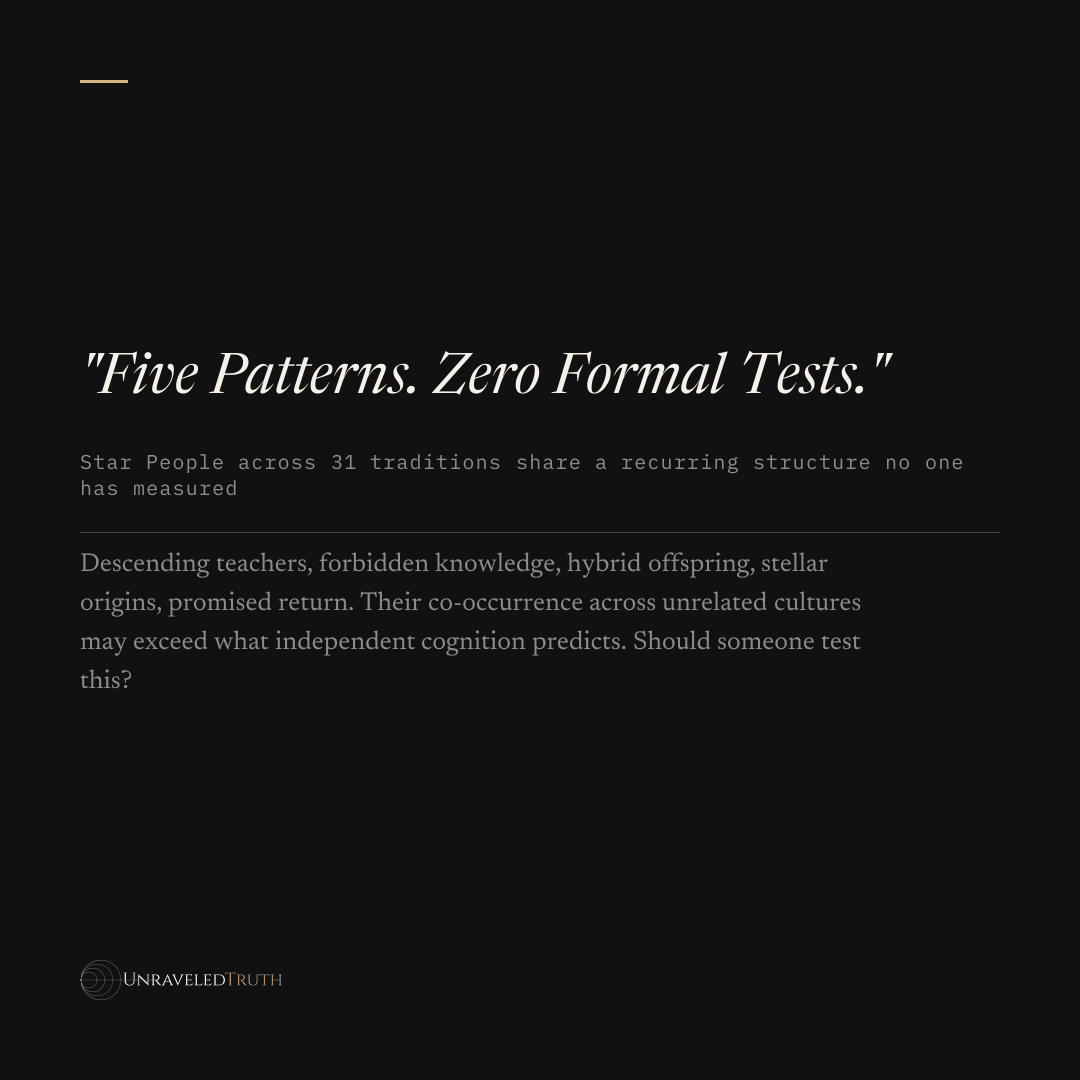
Star People: Indigenous Sky-Being Traditions and the UFO Imagination
What indigenous sky-being traditions actually preserve, what they do not prove, and why the difference matters more than either side admits.

The Illusion Engine: Ancient Consciousness Traditions and the Modern Simulation Hypothesis
How six independent civilizations asked whether reality is real, and what modern science accidentally confirmed about their question
Primary References
Want to use this research? Everything here is free with attribution.
See how →