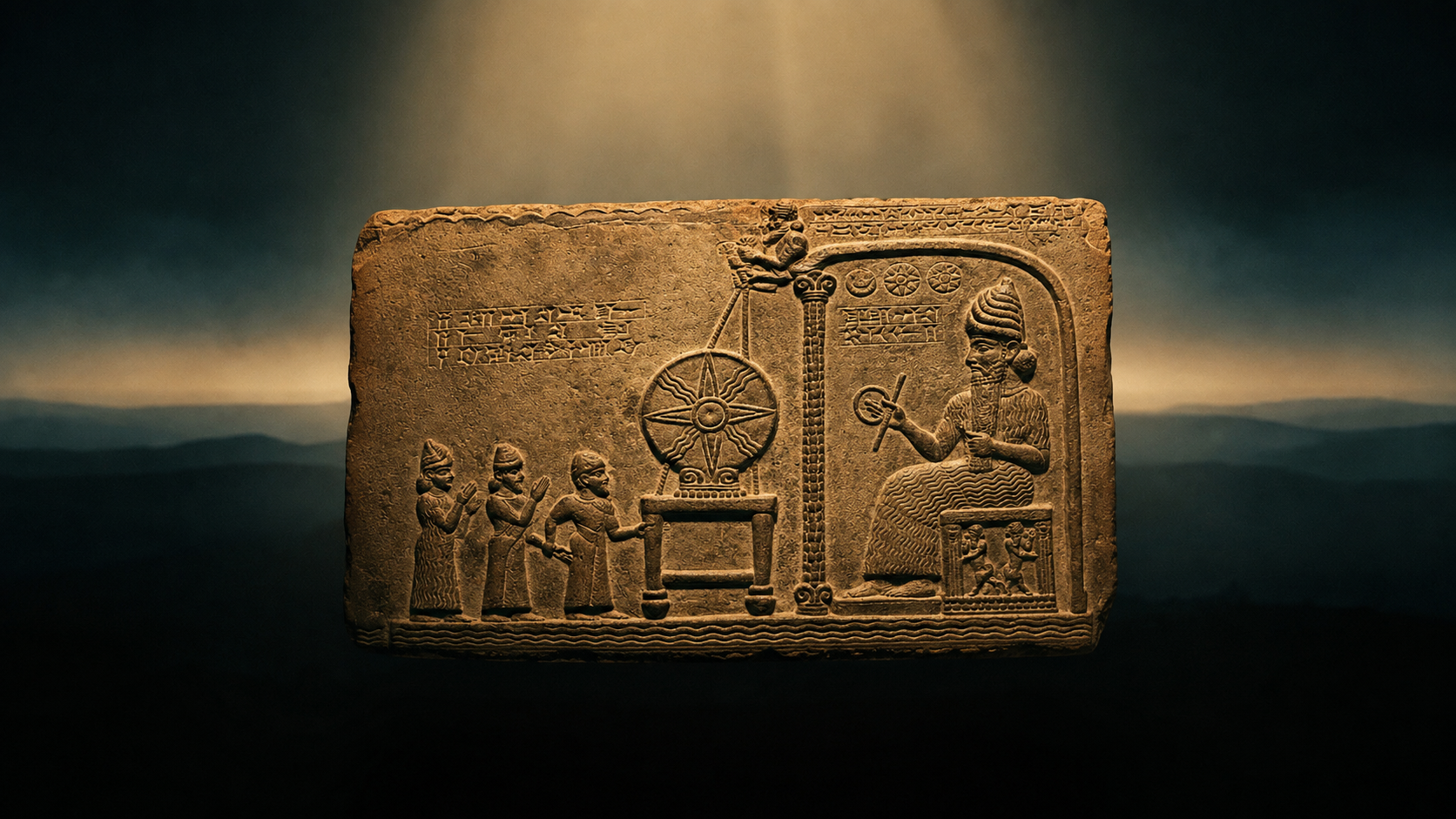
The Translator as Prophet: Zechariah Sitchin, Sacred Hermeneutics, and the Psychology of Alternative History
How one man's idiosyncratic readings of cuneiform tablets became a decentralized religion, a media empire, and a case study in how pseudoscience fills the gaps left by institutional distrust.
Traditions analyzed in this research
Site owner · Own
Zecharia Sitchin claimed ancient Sumerian tablets describe alien visitors who engineered humanity. Millions believed him. We wanted to know what happens when you check his translations against the actual texts.
Sitchin could not read cuneiform. That is not an insult. It is a documented fact. Every specialist who examined his work found fabricated meanings and impossible grammar. The original tablets are publicly archived. Anyone can check. But here is the strange part: thorough, line-by-line refutation did not slow the movement down at all. His books still sell. The TV franchise still runs. The belief system grew after the debunking, not before it.
And buried underneath all of it, one genuine scholarly discovery got contaminated. A real parallel between Mesopotamian and Jewish traditions exists in the primary sources. The question is whether anyone can study it now without career risk.
Zecharia Sitchin was a self-taught scholar born in the Soviet Union and raised in Palestine. He studied economics in London, then spent decades working as a shipping executive in New York. In 1976 he published The 12th Planet, claiming that ancient Sumerian texts described a race of extraterrestrial beings called the Anunnaki. These beings, he argued, came from a hidden planet called Nibiru and genetically engineered humans as a slave labor force.
The book sold millions of copies. Sitchin followed it with twelve more volumes over thirty years. He never held an academic position in Assyriology or any ancient language field. He presented himself as a rare outsider who could read the original tablets. His readers had no easy way to verify that claim. The actual tablets sit in museums and digital archives. The dictionaries are public. But bridging the gap between raw cuneiform and a lay reader requires exactly the kind of specialist knowledge Sitchin claimed to possess.
In 2004, ancient languages scholar Michael Heiser published a systematic refutation. He went sign by sign through Sitchin's key translations and showed they did not match the source texts. That refutation is freely available online. It did not slow the movement. The question is not whether Sitchin was right. It is why being wrong, provably and publicly, changed almost nothing.
The refutation trail is specific and public. Here is exactly what it shows, starting with how Sitchin's method actually worked.
Sitchin's Method Is Structurally Identical to Bible Codes
Sitchin picked which symbols to interpret and which meanings to assign only after deciding what he wanted them to say. No rules were set in advance. This is the same structural problem that sank the Bible Code craze. It is a system that literally cannot produce a wrong answer.
Heiser's 2004 refutation showed that Sitchin's key term 'shem,' which he translates as 'rocket ship,' is documented in every standard Akkadian lexicon as simply 'name' or 'monument': a finding any undergraduate with library access could verify, but which his millions of readers never did.
His method guaranteed the conclusion. But the proof is even simpler.
The Cuneiform Sign AN Refutes Everything, Publicly, Since Always
The key symbol in Sitchin's entire framework is the cuneiform sign AN. He read it as proof of extraterrestrial origins. It is actually a grammar marker meaning 'divine.' Think of it like writing 'Saint' before a name. This fact has been in free, public reference works for decades.
The sign AN appears thousands of times in the ETCSL corpus, always functioning as a divine determinative and never as a term denoting extraterrestrial origin: a fact documented in resources that were publicly available before Sitchin published his first book in 1976.
The refutation is public and airtight. So why hasn't it mattered?
Ancient Aliens Is a Content Machine, Not a Belief Vehicle
The Ancient Aliens franchise does not need its claims to be true. It needs them to be watchable. Advertising revenue and algorithmic recommendation keep episodes in production regardless of whether anyone believes the content. Refuting the claims does not touch the economic engine producing them.
The History Channel's Ancient Aliens has produced over 200 episodes across 20-plus seasons: a content volume that structurally requires generating new 'evidence' faster than any genuine archaeological discovery cycle could supply it, which means the production logic itself guarantees evidentiary inflation.
The evidence pins down what Sitchin got wrong and why correction failed. What it does not settle is what the failure of correction actually means.
The DebateTwo Cases. You Decide.
The philological case is closed. But the phenomenon it failed to stop is real, measurable, and still doing damage in directions that pure debunking cannot reach.
A real structural parallel between Mesopotamian sage traditions and Jewish Watcher mythology exists in peer-reviewed scholarship, completely independent of Sitchin. Scholars have documented it. But Sitchin's contamination of the territory has made it professionally dangerous to pursue. The most consequential damage may not be to the public. It may be to the research that never gets done.
Sitchin's translations are not minority readings. They are absent from the entire philological record. Every tool needed to verify this has been publicly available for decades. The lingering question is not whether he was wrong. It is why anyone treats the persistence of belief as evidence that something deeper must be going on.
That argument has modern academic language on both sides. But the deeper tension is older. Different traditions have been asking versions of this same question for millennia.
In Their Own WordsHow Different Cultures Tell It
Academic Assyriology approaches the ancient Mesopotamian world through rigorous philology and archaeological context. Its scholars meticulously translate cuneiform tablets, revealing complex pantheons, cosmogonies, and historical narratives. The Anunnaki are understood as a collective of powerful deities, often associated with
The full picture on The Translator as Prophet: Zechariah Sitchin, Sacred Hermeneutics, and the Psychology of Alternative History is free.
6 findings, 1 cultural perspective, full debate, timeline, sources with credibility ratings — everything, free with an account. No ads, no sponsors.