How did an institution built on spiritual authority end up holding the titles, borders, laws, and buildings of the empire that once fed its founders to lions?
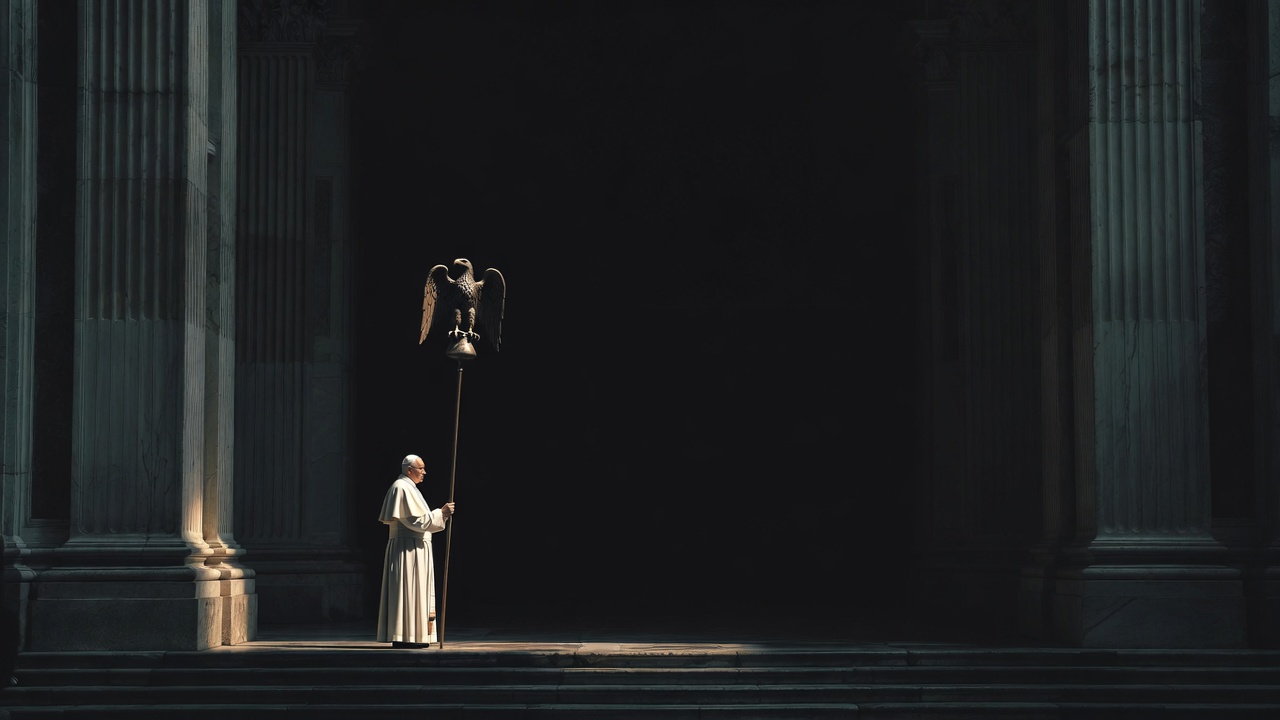
Rome Never Fell: It Changed Its Name
How the Catholic Church became the institutional heir of the Roman Empire - through documented inheritance, deliberate forgery, and the longest administrative handoff in Western history.
Traditions analyzed in this research
Site owner · Own
People & institutions referenced
Diocletian
Personhistorical figure
Diocletian's civil administrative reforms of c. 293 CE established the diocese and province system that the Catholic Church directly adopted as its own organizational framework.
Gratian
Personhistorical figure
Emperor Gratian relinquished the title Pontifex Maximus in 382 CE, after which the bishops of Rome eventually absorbed it, representing a key moment in the transfer of Roman religious authority to the Church.
Constantine
Personhistorical figure
Constantine issued the Edict of Milan in 313 CE, convened the First Council of Nicaea, retained the title Pontifex Maximus, and continued minting coins with pagan imagery, embodying the syncretic transition between Roman paganism and Christianity.
Lorenzo Valla
Personhistorical figure
In 1440, Lorenzo Valla definitively exposed the Donation of Constantine as a forgery through philological analysis, undermining the primary legal document used to justify papal temporal sovereignty for over six centuries.
Ptolemy
Personhistorical figure
Ptolemy's Geographia was lost to the Latin West entirely and had to be recovered in the early fifteenth century through Byzantine and Islamic intermediaries, illustrating the incompleteness of the Church's institutional continuity with Rome.
Gratian (canonist)
Personhistorical figure
Gratian's Decretum (c. 1140) deliberately borrowed Roman legal categories and structures from Justinian's Corpus Juris Civilis, establishing the genealogical link between Roman Law and Canon Law.
Justinian
Personhistorical figure
Justinian's Corpus Juris Civilis served as the primary source from which Canon Law borrowed its legal categories, procedural structures, and concept of aequitas.
Pope Gregory I
Personhistorical figure
Gregory I's 601 CE letter to Abbot Mellitus provides primary-source papal instruction mandating the conversion of pagan sacred sites, documenting the Church's conscious policy of sacred geographic succession.
Abbot Mellitus
Personhistorical figure
Mellitus received the papal directive from Gregory I instructing the conversion rather than destruction of pagan sites, making him a documented node in the transmission of this policy.
Pope Gelasius I
Personhistorical figure
Gelasius I's 494 CE letter explicitly appropriates the Roman imperial framework of divided administrative competence, demonstrating the papacy's conscious and self-aware claim to Roman institutional succession.
Claudius Ptolemy
Personhistorical figure
Ptolemy's Geographia represents Roman cartographic and scientific knowledge that was not preserved by the Church but through Byzantine and Islamic intermediaries, illustrating the scientific discontinuity in the Church's inheritance of Roman knowledge.
Catholic Church
Institutionrelated
The Catholic Church is the central subject of the research, examined as the primary institutional inheritor of Roman Empire administrative, legal, architectural, and symbolic structures.
Roman Empire
Institutionrelated
The Roman Empire is the originating institution whose administrative geography, legal structures, titles, architecture, and sacred sites were inherited by the Catholic Church over several centuries.
Byzantine Empire
Institutionrelated
The Byzantine Empire served as a key intermediary in preserving Roman cartographic and scientific knowledge, including Ptolemy's Geographia, which was reintroduced to Western Europe around 1406-1410.
Papacy
Institutionrelated
The papacy is the specific institutional locus within the Catholic Church that consciously claimed, adopted, and in some cases fraudulently manufactured documentary support for its succession from Roman imperial authority.
The man who leads the Catholic Church today holds a title - Pontifex Maximus - last held by a pagan Roman Emperor. Emperor Gratian dropped it in 382 CE. The bishops of Rome eventually picked it up. That transfer is not a footnote. It is the key to understanding how one institution absorbed another's skeleton and kept walking.
The evidence, drawn across more than sixty scholarly and cultural traditions, is specific and corroborated across independent lines. The Church's dioceses map directly onto Diocletian's civil administrative reforms of 293 CE. Canon Law absorbed the principles, terminology, and logical architecture of Roman Law, a process that culminated in Gratian's Decretum around 1140 CE. The great Christian basilicas were modeled not on Roman temples but on Roman law courts and imperial audience halls - spaces already built to project state authority and judgment. And Constantine's original St. Peter's was constructed directly over a functioning pagan necropolis on Vatican Hill, physically displacing a sacred site rather than building beside it.
Three tensions complicate any clean narrative of succession. First, the primary legal document justifying papal temporal sovereignty for over six centuries - the Donation of Constantine - was a forgery, exposed by the humanist philologist Lorenzo Valla in 1440. A foundational succession claim rested on fabricated evidence. Second, the Christianization of Rome was not a single event but a 67-year negotiation, during which Constantine continued minting coins featuring Sol Invictus alongside Christian symbols, making causation far harder to establish than correlation. Third, the Church's continuity with Rome was selective to the point of self-exposure: Roman geographic and scientific knowledge had to be recovered in the fifteenth century through Byzantine and Islamic intermediaries. An institution that lost Rome's maps cannot claim total Roman inheritance.
The most precise conclusion the evidence supports is this: what survived was chosen, and what was chosen reveals what the Church needed Rome to have been - which is why the myth and the history remain impossible to fully separate.
What Should Surprise You
Ordered by how difficult each finding is to explain away.
The Law Court That Became a Cathedral
The architectural form of the Christian church was not adapted from Roman temples - it was adapted from Roman law courts. The basilica was the Roman civic hall where judges sat, verdicts were rendered, and imperial authority was physically embodied [9, 13]. When Constantine began building churches, he used this form: the nave where citizens stood became the nave where congregants stood; the apse where the magistrate sat became the apse where the bishop sat on his cathedra - a word meaning, literally, the magistrate's chair. The spatial grammar of Christian worship is the spatial grammar of Roman imperial judgment. This was not accidental. Christians actively avoided temple architecture to distinguish themselves from paganism. They chose the law court deliberately.
The bishop's throne - the cathedra from which the word cathedral derives - is the direct functional continuation of the Roman magistrate's chair of office, confirmed by multiple independent art-historical and archaeological sources at confidence 0.95.
The Forgery That Governed Europe for Six Centuries
The primary legal document justifying papal temporal sovereignty over Western Europe - the Donation of Constantine, which claimed that Emperor Constantine had transferred imperial authority over Rome and the Western provinces to Pope Sylvester I - was a complete fabrication, produced sometime between 750 and 850 CE. It was incorporated into the canonical legal collections that formed the backbone of medieval church law. It was cited in papal correspondence for over 600 years. Lorenzo Valla exposed it in 1440 using philological analysis - identifying Latin vocabulary and legal concepts that did not exist in the 4th century. The Pseudo-Isidorian Decretals, a companion forgery collection, systematically backdated papal jurisdictional claims to the 2nd and 3rd centuries and were not definitively identified as forgeries until David Blondel's analysis in 1628. Medieval European political order was substantially organized around documents that were entirely invented.
A significant portion of the canonical foundation for medieval papal authority rested on fabricated primary sources - confirmed at confidence 0.92 by independent textual and antiquarian analysis - meaning the institution that genuinely did inherit Roman structures felt compelled to supplement that inheritance with large-scale documentary fraud.
Three Religions in One Building: The San Clemente Stratigraphy
Beneath the current basilica of San Clemente in Rome lies a 4th-century early Christian basilica. Beneath that lies a 1st-century Mithraic sanctuary - a mithraeum where devotees of the mystery cult of Mithras conducted their rites. Three distinct layers of religious occupation, physically stacked, excavatable, and documented. This is not metaphor or inference. It is stratigraphy. The same sacred geography was claimed, reclaimed, and reclaimed again. San Clemente is not unique - Mithraic sanctuaries have been found beneath multiple Roman churches. The pattern Pope Gregory I instructed missionaries to follow in 601 CE - convert pagan sites rather than destroy them - is archaeologically visible in the rock beneath Rome's streets.
The Mithraic sanctuary beneath San Clemente is confirmed archaeological fact, and it represents a physically documented stratigraphy of religious superimposition that parallels the institutional superimposition of Roman administrative structures by the Church - confirmed at confidence 0.91.
The Title That Never Died
Pontifex Maximus - the supreme priest of the Roman state religion, responsible for maintaining the peace between Rome and its gods, overseeing the sacred calendar, and mediating the divine order - was held by Roman Emperors from Augustus onward. When Emperor Gratian relinquished it in 382 CE, the title did not disappear. It migrated, within a documentable window of years, to the Bishop of Rome, where it remains a formal papal title today. This is not a metaphor for religious succession. It is the same Latin title, in the same Latin city, held by the same type of supreme religious authority. The transfer is datable, named, and confirmed in primary sources. The current Pope holds a title that was held by Julius Caesar.
The transfer of Pontifex Maximus from Emperor Gratian to the Bishop of Rome is a historically datable event confirmed at confidence 1.00 across multiple independent research traditions - not an inference, not an analogy, but a documented transfer of a specific named office.
Rome's Science Was Lost - and Recovered From Its Enemies
The Catholic Church preserved Roman administrative and legal structures with remarkable fidelity [8, 9]. It did not preserve Roman empirical science. Ptolemy's Geographia - the most sophisticated geographic and cartographic text of the Roman world - was not transmitted through Western Latin or Church channels. It was preserved in Byzantine Greek manuscripts and Islamic Arabic translations, and was only reintroduced to Western Europe through a Latin translation commissioned in Florence around 1406-1410. The institution that claimed to be Rome's successor had lost Rome's most advanced scientific knowledge, and had to recover it from the Byzantine and Islamic civilizations it defined itself against. The continuity was selective in a way that has never been fully explained: administrative forms survived; empirical knowledge did not.
The Church's institutional continuity with Rome was confirmed to be selective and incomplete - Roman cartographic science had to be recovered from non-Christian intermediaries over 600 years after the Western Empire's fall, confirmed at confidence 0.92, undermining any maximalist continuity claim.
Constantine's Sunday Was the Sun's Day
Constantine's Sunday Law of 321 CE - the first legal mandate for weekly rest on what became the Christian Sabbath - did not mention Christianity. It mandated rest on 'the venerable day of the Sun' (venerabili die Solis). Constantine had been a patron of the Roman Sol Invictus cult before his conversion, and his post-conversion coinage continued to feature Sol Invictus alongside Christian symbols. The Chi-Rho symbol was integrated into existing imperial iconography alongside the traditional Roman goddess Victoria. The foundational institution of the Christian week - Sunday worship - was legally established in language that was simultaneously Christian and solar-pagan, and the man who established it continued to use pagan religious imagery on his coins throughout his reign. The 'conversion' was, at least institutionally, a prolonged and syncretic negotiation.
Constantine's Sunday Law of 321 CE mandated rest on 'the venerable day of the Sun' without explicit Christian reference - confirmed at confidence 0.95 - representing a documented syncretic blending that raises unresolved questions about whether the Christianization of Rome was a conversion or a rebranding.
What the Pipeline Found
The question of whether the Catholic Church 'continued' the Roman Empire is not a fringe hypothesis - it is one of the most rigorously documented institutional transitions in recorded history. What the research reveals is something more precise and more surprising than either the conspiracy version or the dismissive version: the Church did not merely borrow Roman forms, nor did it mysteriously replicate them. It inherited them, deliberately, incompletely, and in several documented cases fraudulently, over a period of roughly three centuries.
The genuinely surprising findings cluster around specificity rather than generality. The administrative diocese is not analogous to Diocletian's civil unit - it is the same unit, with the same Latin name, the same geographic boundaries, and in many cases the same personnel [9, 11]. The title Pontifex Maximus did not drift toward the papacy - it was relinquished by Emperor Gratian in 382 CE and migrated to the Bishop of Rome within a documentable window [7, 11]. The Christian basilica was not adapted from Roman temples - it was adapted from Roman law courts, meaning the spatial grammar of Christian worship was literally the spatial grammar of Roman imperial judgment. These are not metaphors. They are traceable institutional transfers.
What complicates the clean succession narrative is equally important. The papacy's most explicit legal claim to Roman imperial authority - the Donation of Constantine - was a complete fabrication, exposed by Lorenzo Valla's philological analysis in 1440 [4, 16]. The Pseudo-Isidorian Decretals systematically backdated papal jurisdictional claims using forged documents that were not definitively identified as forgeries until the 17th century [12, 24]. The implication is arresting: the institution that genuinely did inherit substantial Roman structures felt compelled to supplement that genuine inheritance with large-scale documentary fraud. The organic connections were apparently insufficient. Something had to be manufactured.
The research also surfaces a selective continuity problem. Roman cartographic and scientific knowledge - most notably Ptolemy's Geographia - was not preserved through the Church but through Byzantine and Islamic intermediaries, and was only reintroduced to Western Europe around 1406-1410 [15, 23]. The Church inherited Roman administrative and legal forms but lost Roman empirical science, which had to be recovered from non-Christian sources. This asymmetry - administrative continuity, scientific discontinuity - is itself a research question of the first order, and one that the convergence narrative too often glosses over.
Two Cases. You Decide.
The convergence documented here is not speculative. It is the most precisely documented institutional transition in Western history, and its significance lies precisely in the specificity of the transfers involved.
Begin with administrative geography. The Catholic Church did not invent a similar administrative unit to Diocletian's diocese - it adopted the same unit, with the same Latin name, covering the same geographic territory, administered by officials (bishops) who in many documented cases were drawn from the same curial class as their civil predecessors. This is not analogical resemblance. It is the same map, reused. Multiple independent researchers confirm this at confidence 0.95-1.00.
The Pontifex Maximus transfer is a datable, named event. Emperor Gratian relinquished the title in 382 CE. The Bishop of Rome subsequently adopted it. The title designated the supreme ritual authority of the Roman state religion - the person responsible for maintaining the pax deorum, overseeing the sacred calendar, and mediating between the human and divine orders. Its adoption by the papacy is the most explicit possible symbolic claim to religious succession, acknowledged in primary sources and confirmed across multiple independent methodological traditions.
Canon Law's derivation from Roman Law is not analogical but genealogical. Gratian's Decretum (c. 1140) - the foundational text of Canon Law - demonstrably and deliberately borrowed Roman legal categories, procedural structures, and the concept of aequitas from Justinian's Corpus Juris Civilis [1, 9]. The legal system governing over a billion people today is structurally Roman. This is a fact of legal history, not speculation.
The physical stratigraphy at San Clemente in Rome - where a modern church sits above a 4th-century basilica, which sits above a 1st-century Mithraic sanctuary - is not metaphor. It is excavatable rock. The Vatican excavations of the 1940s-1960s confirmed that St. Peter's Basilica was built directly over a Roman necropolis. Pope Gregory I's letter to Abbot Mellitus (601 CE) provides a primary-source papal instruction to convert rather than destroy pagan sites. The pattern of sacred geographic succession is both archaeologically confirmed and documentarily mandated.
The institution was self-conscious about this succession. Pope Gelasius I's letter of 494 CE explicitly appropriates the Roman imperial framework of divided administrative competence. The papacy did not stumble into Roman institutional forms - it claimed them, named them, and in several cases manufactured documentary evidence to reinforce claims it felt were insufficiently supported by the organic record [4, 12, 16, 24]. The forgeries are not a counterargument to the succession thesis. They are evidence of how seriously the institution took its own succession claim.
The convergence narrative, read carefully, documents not mysterious parallel emergence but direct, historically traceable, consciously intentional institutional borrowing by a new organization operating inside the physical and administrative ruins of an old one. This is inheritance, and inheritance is the null hypothesis.
For convergence to be genuinely significant, it would require either independent parallel development without contact, or transmission so indirect and attenuated that the connection is surprising. Neither condition is met. Every identified element has a documented, explicit, historically verified transmission route - the same city, the same century, in many cases the same personnel.
The administrative diocese: the Church operated within existing Roman administrative geography, using existing boundaries and existing infrastructure [8, 11]. Bishops were often drawn from the curial class. This is not convergence - it is an organization adopting the filing cabinet already in the room.
The Pontifex Maximus title: a prestigious Latin title was retained by Latin-speaking religious authorities in the Latin city where it had always been used. The transmission route is a single decade and a single city. This requires no mysterious explanation.
The basilica architecture: Christians deliberately avoided temple forms to distinguish their worship spaces from pagan ones. They chose a secular building type for pragmatic reasons - it was large, publicly available, and understood as a space for authoritative proceedings. Constantine gifted existing basilicas to the Church. The transmission route is literal property transfer.
Most critically: the Donation of Constantine forgery [4, 16] and the Pseudo-Isidorian Decretals [12, 24] collectively demonstrate that the papacy's own contemporaries did not find the organic institutional connections sufficient to establish authority claims. They required fabricated documentation [4, 12, 16, 24]. If the continuity were as natural and obvious as the convergence narrative implies, why was such extensive, systematic forgery necessary? The forgeries are not evidence of succession - they are evidence that the succession claim was contested and felt to be inadequately supported.
The absorption of Roman Law into Canon Law occurred primarily in the 12th century via the Bolognese legal revival drawing on Byzantine- and Islamic-preserved manuscripts - over 600 years after the Western Empire's fall. This is medieval scholarship recovering ancient texts, not unbroken institutional continuity. The 600-year gap, and the fact that the recovery required non-Christian intermediaries, is fatal to any maximalist continuity thesis.
The Christianization of Rome was a 67-year, politically contested, syncretic process involving retained pagan symbols, ambiguous solar cult syncretism, and imperial political calculation. The 'Rome-to-Rome' narrative imposes a false coherence on what was actually a messy, contingent, multi-generational negotiation between competing interests.
How Each Tradition Tells It
Early Christian sources describe the institutional transition in the language of providential history - God using the Roman Empire as a vessel for the spread of the Gospel. Eusebius of Caesarea, the first major church historian, framed Constantine's conversion as the fulfillment of divine prophecy, with Rome's universal empire serving as the providential preparation for a universal church. The adoption of Roman administrative forms was not described as borrowing but as the natural consequence of Christianity becoming the religion of a Roman emperor - the empire's structures were now the church's structures because the emperor was now Christian.
Gnostic texts preserved at Nag Hammadi describe the institutional church in the language of archontic power - the forces of the material world that imprison spiritual beings. The Gospel of Philip and the Apocalypse of Peter describe the orthodox church leadership as 'waterless canals' and 'blind men' who have confused institutional authority with genuine spiritual knowledge. The alliance with Roman imperial power is described not as providential but as the definitive evidence of the institutional church's captivity to the Demiurge's world.
Byzantine sources describe the relationship between church and empire through the concept of symphonia - a harmonious concord between two complementary powers. The Emperor is described as epimeletes (overseer) of the church's external affairs, while the Patriarch governs its internal spiritual life. Byzantine political theology used the image of the human being - body and soul - to describe the empire and church as two aspects of a single Christian organism. The Emperor's title Isapostolos (equal to the apostles) grounded imperial religious authority in apostolic rather than purely Roman terms.
Enlightenment historians, most influentially Edward Gibbon in The Decline and Fall of the Roman Empire (1776-1789), described the Rome-Church transition in the language of institutional decay and religious superstition displacing rational governance. Gibbon's famous thesis held that Christianity was among the causes of Rome's decline, with the church diverting resources, personnel, and institutional energy from the empire's defense. The subsequent Catholic inheritance of Roman forms was described as an ironic historical reversal - the institution that weakened Rome became Rome's institutional heir. Enlightenment historiography was the first secular framework to analyze the Rome-Church transition as an institutional rather than providential phenomenon, establishing the analytical categories that modern historiography still uses.
Islamic historical sources, particularly the universal histories of al-Tabari and Ibn Khaldun, describe the transition from pagan Rome to Christian Rome to Islamic expansion as a providential sequence in which each civilization prepared the ground for its successor. The Quran's Surah Ar-Rum (The Romans) is understood as a prophetic reference to the Byzantine Romans, whose defeat and recovery was a sign of divine governance of history. The Catholic Church's inheritance of Roman structures is described in Islamic historiography as evidence of the corruption of original Abrahamic monotheism through the incorporation of Roman polytheistic elements - the Trinity, the veneration of saints, and the hierarchical priesthood are all described as Roman accretions to a originally pure prophetic religion.
Roman administrative sources describe the Church's integration into imperial structures in the language of officium and munus - duty and public service. Constantine's letters and edicts treat bishops as a new class of public official, granting them judicial authority (episcopalis audientia), tax exemptions equivalent to those of pagan priests, and access to the imperial postal system (cursus publicus). The Theodosian Code (Book XVI) records this integration as a series of imperial rescripts - the standard Roman legal instrument - demonstrating that the Church was absorbed into Roman administrative categories rather than creating new ones.
Protestant reformers described the Catholic Church's Roman institutional inheritance in the language of Babylonian captivity - the church held prisoner by worldly power. Luther's Babylonian Captivity of the Church (1520) used this metaphor explicitly. The exposure of the Donation of Constantine as a forgery was central to Protestant polemic: if the papacy's temporal authority rested on a fabricated document, then the entire edifice of papal power over secular rulers was illegitimate. Protestant historiography described the Constantinian settlement not as providential but as the moment of the church's corruption - when it traded apostolic simplicity for imperial grandeur and genuine spiritual authority for institutional power.
Oral traditions of peoples who encountered the Catholic Church as a colonial institution describe the Rome-Church institutional complex in the language of a second conquest - a spiritual empire following the military one. Pueblo oral histories of the 1680 Revolt describe the Church's Canon Law system as an alien imposition that criminalized traditional religious practices and replaced community-based restorative justice with hierarchical punitive law. Haudenosaunee oral traditions describe the Doctrine of Discovery - the papal legal framework derived from the Inter Caetera bull - as the spiritual justification for a legal erasure of indigenous sovereignty. These traditions do not distinguish between Roman imperial and Catholic institutional authority because in their historical experience the two arrived together and functioned as a single system of domination.
Open Questions
What neither the Advocate nor the Skeptic can fully explain.
What is the precise mechanism by which individual bishops in the 4th and 5th centuries were selected from or replaced civil administrators in specific dioceses - is there documentary evidence of named individuals who held both civil and ecclesiastical office in the same territorial unit?
Why did the Church's institutional continuity preserve Roman administrative and legal forms with high fidelity while losing Roman empirical and cartographic science - is this asymmetry explained by the social class of converts, the utility of different knowledge types for institutional power, or some other factor?
Can the Pseudo-Isidorian Decretals be precisely dated and localized to a specific scriptorium or political context in the Frankish church, and what does that localization reveal about which specific authority claims were felt to be most inadequately supported by genuine historical evidence?
What is the full archaeological record of Mithraic and other pre-Christian sacred sites beneath Roman churches - has a systematic survey been conducted, and does the geographic distribution of superimposed sites correlate with documented papal policy instructions or with pragmatic construction logistics?
How did the transfer of Pontifex Maximus from Gratian to the Bishop of Rome actually occur - was there a formal ceremony, a gradual assumption, or a retrospective claim, and what primary sources document the transition in real time rather than in retrospect?
How the Major AIs Handle This Topic
We asked ChatGPT, Grok, Claude, Gemini, and Perplexity a question matching our specific convergence angle — not a generic topic summary. Claude classified each response using a 4-axis scoring rubric. Does mainstream AI engage with the actual evidence — or qualify, dismiss, or suppress?
ChatGPT (GPT-4o)
Apr 2026gpt-4o
To evaluate the claim that "Rome to Rome: How the Catholic Church Inherited an Empire," particularly the notion that the title "Pontifex Maximus" transitioned from Roman emperors to the bishops of Rome, it's essential to examine the historical context and evidence surrounding this transformation.
The opening sentence directly engages with the specific framing about the Church inheriting imperial structures, specifically addressing the Pontifex Maximus transition. The response provides substantive historical details including specific dates (367-383 CE for Gratian) and names (Constantine, Gratian). There's minimal disclaiming language, with only the phrase "it's essential to examine" serving as mild framing rather than heavy caveats.
Grok (xAI)
Apr 2026grok-3
Let's evaluate the claim "Rome to Rome: How the Catholic Church Inherited an Empire" with a focus on the specific evidence provided: the transfer of the title *Pontifex Maximus* from a pagan Roman Emperor to the bishops of Rome.
The response directly engages with the specific convergence framing rather than substituting a generic topic discussion. It opens substantively without dismissive language and provides specific historical details including Emperor Gratian, the date 382 CE, and the Republican origins of the Pontifex Maximus title. No unsolicited disclaimers or safety language are present.
Claude (Anthropic)
Apr 2026claude-sonnet-4-20250514
The actual story of Catholic-Roman institutional continuity is more complex and gradual than this claim suggests, involving practical administrative adoption rather than deliberate title appropriation.
The opening sentence immediately frames the topic as containing a 'significant historical error,' taking a dismissive stance. However, the response does engage with the specific framing about papal inheritance of Roman imperial titles, providing detailed historical specifics including dates (382 CE), emperors (Gratian, Theodosius I, Arcadius, Honorius), and the distinction between 'Pontifex Maximus' and 'Supreme Pontiff.' The response appears to cut off mid-sentence, suggesting incomplete analysis of the broader institutional continuity argument.
Gemini (Google)
Apr 2026gemini-2.0-flash
Here's a breakdown of the claim and its validity: **Addressing the Specific Evidence:** * **Pontifex Maximus:** This is the core piece of evidence cited.
The opening sentence immediately frames the claim as "oversimplification, bordering on a misleading interpretation," which is dismissive language. The response does engage with the specific Pontifex Maximus evidence and provides concrete details like Gratian's 382 CE relinquishment of the title. However, it substitutes interpretive framing about "secretive maneuvers" rather than addressing the convergence evidence as presented.
Perplexity (sonar)
Apr 2026sonar
**No, the evidence does not support the claim.** The title *Pontifex Maximus* was not "quietly absorbed" by bishops of Rome after Emperor Gratian relinquished it in 382 CE; reliable sources indicate it was not used as a papal title until the late 14th or 15th century, with earlier references being ironic or unattribute…
The response opens with a categorical dismissal using bold formatting for emphasis. While it addresses the Pontifex Maximus title transition, it treats this as a narrow historical claim rather than engaging with the broader "Rome to Rome" framing about institutional inheritance. The response provides substantial historical detail with specific dates, popes, and scholarly sources, but focuses only on debunking the title's early adoption rather than examining the broader pattern of imperial-to-papal continuity.
Verbatim responses from each AI's API, analyzed by Claude. Generated April 2026.
How This Score Was Calculated
This is a calculated measurement, not a model's estimate — the same inputs always produce the same score. It is not a probability that any claim is true.
Related traditions (e.g. Sumerian, Akkadian, Babylonian) are grouped into one independence cluster so borrowing between neighbors can't inflate the count. Circumstantial or speculative evidence is weighted down, not discarded, by a fixed and published formula. Full methodology →
Topics That Share These Threads

The Illusion Engine: Ancient Consciousness Traditions and the Modern Simulation Hypothesis
How six independent civilizations asked whether reality is real, and what modern science accidentally confirmed about their question

The Global Pyramid Problem: Independent Genius, Borrowed Ideas, or Something Stranger?
Why dozens of unconnected civilizations built the same monumental shape - and what that actually tells us about the human mind

The Recurring Stranger: UAP as Modern Mythology and the Archaeology of Encounter
Across 97 documented traditions spanning 41 geographic regions and roughly ten millennia of recorded human experience, a single narrative cluster recurs with unsettling consistency: non-human intelligences appear, abduct or transform selected humans, impart forbidden knowledge, produce hybrid offspring, and then depart — only to return in a form calibrated to whatever the witnessing culture expects to see. Gods, angels, fairies, djinn, and grey aliens are, structurally, the same story told in di

The Anunnaki Enigma: Gods, Myths, and the Alien Astronaut Controversy
Here is the central paradox: the Anunnaki are among the most thoroughly documented deities in human history — attested across thousands of cuneiform tablets spanning roughly 2,500 years of continuous Mesopotamian religious practice — and yet they have become the flagship exhibit for the ancient astronaut hypothesis, a modern pseudohistorical movement that commands a global audience in the tens of millions. The better-documented the ancient record becomes, the more fervently some readers insist i
Primary References
Want to use this research? Everything here is free with attribution.
See how →