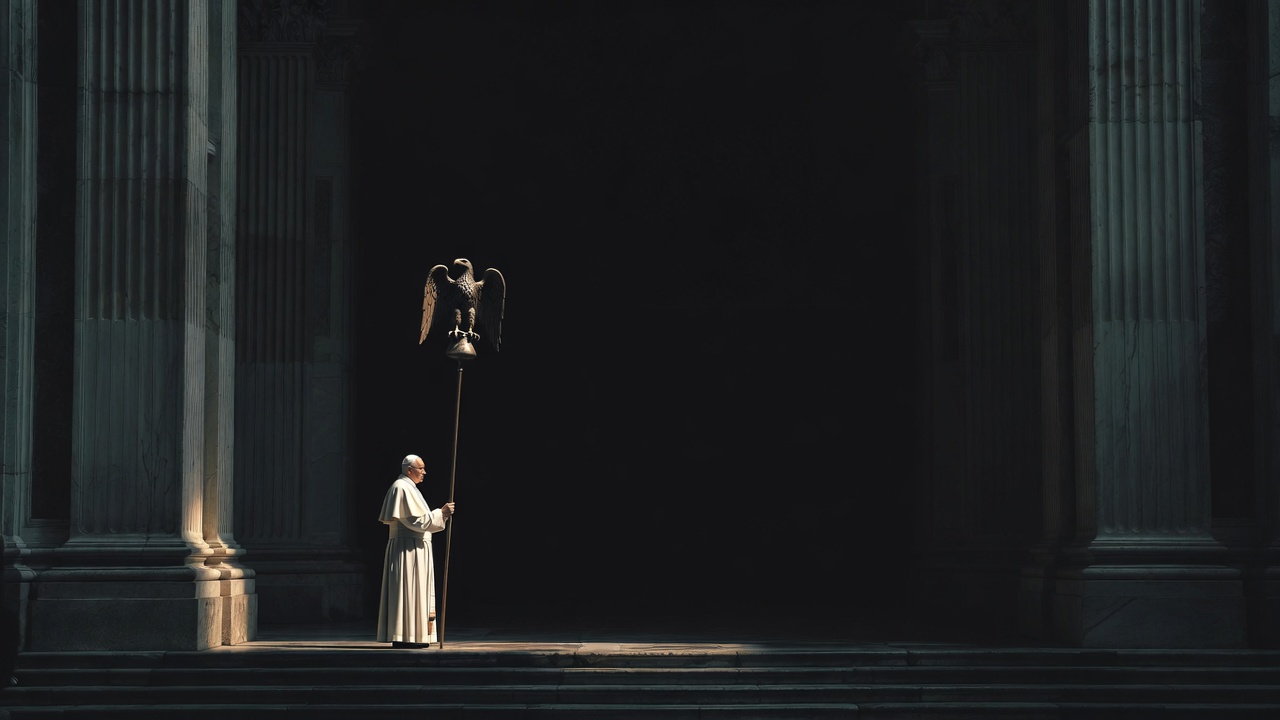
Rome Never Fell: It Changed Its Name
How the Catholic Church became the institutional heir of the Roman Empire - through documented inheritance, deliberate forgery, and the longest administrative handoff in Western history.
Traditions analyzed in this research
Site owner · Own
How did a religious institution end up running the same administrative map as a fallen empire? The Catholic Church didn't just look Roman. It used Rome's actual boundaries, titles, legal logic, and buildings. The question is whether that makes it Rome's continuation or just its tenant.
The answer is more specific than anyone expects. Church dioceses aren't modeled on Roman civil districts. They are the same districts, same names, same borders. The title Pontifex Maximus didn't drift toward the pope. A specific emperor dropped it in 382 CE, and the Bishop of Rome picked it up. Christian churches weren't built to look like temples. They were literally Roman law courts, repurposed. These aren't parallels. They are documented transfers.
But here's what makes this genuinely strange. The institution that inherited all of this still felt the need to forge documents to prove it. Why would an organization with real Roman bones fabricate an entire legal skeleton on top of them?
When Diocletian reorganized the Roman Empire in the late third century, he carved it into administrative units called dioceses. Each had defined borders, a bureaucratic hierarchy, and a Latin name tied to its geography. The system was designed for tax collection and military logistics, not salvation. But the empire's collapse did not erase its paperwork. Provincial boundaries, courthouse buildings, and administrative titles outlasted the political authority that created them. Someone was going to use all of that infrastructure. The question was who.
The Bishop of Rome was uniquely positioned. By the fourth century, Christianity had gone from persecuted sect to imperial religion in barely two generations. Constantine's legalization in 313 CE and Theodosius's establishment of Christianity as the state religion in 380 CE didn't just give the Church legitimacy. They gave it access to Roman institutional machinery at exactly the moment that machinery was losing its original operator. The Western Empire's final collapse in 476 CE left a vacuum that was administrative as much as political. Roads still connected cities. Courts still had buildings. Districts still had names and borders. The Church stepped into a functioning skeleton.
What makes this story worth examining closely is not the broad fact of inheritance. Historians have acknowledged that for centuries. The real puzzle is the pattern of what transferred and what didn't, what was genuine and what was later fabricated to fill gaps the real inheritance left behind.
The transfers are traceable to exact dates, exact buildings, and in some cases exact people. Here's where the paper trail starts.
The Law Court That Became a Cathedral
Early Christians deliberately avoided building churches that looked like pagan temples. Instead, they used Roman law courts — the basilica, where judges sat and verdicts were handed down. The nave where citizens once stood became the nave for worshippers. The raised seat where a magistrate delivered judgment became the bishop's chair. Christian worship literally inherited the architecture of Roman state power.
The bishop's throne - the cathedra from which the word cathedral derives - is the direct functional continuation of the Roman magistrate's chair of office, confirmed by multiple independent art-historical and archaeological sources at confidence 0.95.
The buildings tell one story. The paperwork tells a stranger one.
The Forgery That Governed Europe for Six Centuries
For over six hundred years, popes cited a document saying Emperor Constantine had handed them political authority over Western Europe. It was completely fake. Produced sometime around 750–850 CE, the Donation of Constantine was finally exposed in 1440 when a scholar noticed the Latin contained words and legal ideas that didn't exist in Constantine's era. Medieval Europe's political order was built partly on a forgery nobody caught for centuries.
A significant portion of the canonical foundation for medieval papal authority rested on fabricated primary sources - confirmed at confidence 0.92 by independent textual and antiquarian analysis - meaning the institution that genuinely did inherit Roman structures felt compelled to supplement that inheritance with large-scale documentary fraud.
But the most unsettling evidence isn't on paper. It's underground.
Three Religions in One Building: The San Clemente Stratigraphy
Beneath a working church in Rome called San Clemente, archaeologists found a fourth-century Christian basilica. Beneath that, a first-century temple to the mystery god Mithras. Three religions stacked in literal rock layers, each one claiming the same sacred ground. This isn't a one-off. Mithraic sanctuaries sit beneath multiple Roman churches. The pattern was even official policy — Pope Gregory I told missionaries in 601 CE to convert pagan sites, not destroy them.
The Mithraic sanctuary beneath San Clemente is confirmed archaeological fact, and it represents a physically documented stratigraphy of religious superimposition that parallels the institutional superimposition of Roman administrative structures by the Church - confirmed at confidence 0.91.
Each piece of evidence sharpens the same uncomfortable question rather than answering it. People who agree on every fact still reach opposite conclusions about what the facts mean.
The DebateTwo Cases. You Decide.
The real inheritance is well documented. The forgeries that propped it up are equally well documented. That combination — real continuity supplemented by systematic fraud — is the part neither side can fully explain away.
This isn't speculation or loose analogy. The same administrative map, the same title, the same legal architecture, the same physical ground — all transferred through documented, datable events. Even the forgeries prove the point: the papacy took its own Roman succession so seriously that it manufactured extra evidence when the organic record felt incomplete.
An organization headquartered in Rome, staffed by Latin-speaking Roman elites, reused Roman buildings and Roman titles. That's not mysterious convergence. That's an office tenant keeping the old furniture. The real tell is the forgeries — if the continuity were natural and obvious, six centuries of fabricated legal documents wouldn't have been necessary to defend it.
That disagreement isn't new. Communities across centuries and continents have wrestled with the same tension between institutional continuity and institutional reinvention.
In Their Own WordsHow Different Cultures Tell It
Early Christian sources describe the institutional transition in the language of providential history - God using the Roman Empire as a vessel for the spread of the Gospel. Eusebius of Caesarea, the first major church historian, framed Constantine's conversion as the fulfillment of divine prophecy, with Rome's universal empire serving as the providential preparation for a universal church. The adoption of Roman administrative forms was not described as borrowing but as the natural consequence of Christianity becoming the religion of a Roman emperor - the empire's structures were now the church's structures because the emperor was now Christian.
Gnostic texts preserved at Nag Hammadi describe the institutional church in the language of archontic power - the forces of the material world that imprison spiritual beings. The Gospel of Philip and the Apocalypse of Peter describe the orthodox church leadership as 'waterless canals' and 'blind men' who have confused institutional authority with genuine spiritual knowledge. The alliance with Roman imperial power is described not as providential but as the definitive evidence of the institutional church's captivity to the Demiurge's world.
Extraordinary convergence
Not a truth score. This measures how consistently unconnected cultures describe the same specific narrative elements — nothing more. How it's calculated →
The full picture on Rome Never Fell: It Changed Its Name is free.
6 findings, 8 cultural perspectives, full debate, timeline, sources with credibility ratings — everything, free with an account. No ads, no sponsors.
People & institutions referenced
Diocletian
Personhistorical figure
Diocletian's civil administrative reforms of c. 293 CE established the diocese and province system that the Catholic Church directly adopted as its own organizational framework.
Gratian
Personhistorical figure
Emperor Gratian relinquished the title Pontifex Maximus in 382 CE, after which the bishops of Rome eventually absorbed it, representing a key moment in the transfer of Roman religious authority to the Church.
Constantine
Personhistorical figure
Constantine issued the Edict of Milan in 313 CE, convened the First Council of Nicaea, retained the title Pontifex Maximus, and continued minting coins with pagan imagery, embodying the syncretic transition between Roman paganism and Christianity.
Lorenzo Valla
Personhistorical figure
In 1440, Lorenzo Valla definitively exposed the Donation of Constantine as a forgery through philological analysis, undermining the primary legal document used to justify papal temporal sovereignty for over six centuries.
Ptolemy
Personhistorical figure
Ptolemy's Geographia was lost to the Latin West entirely and had to be recovered in the early fifteenth century through Byzantine and Islamic intermediaries, illustrating the incompleteness of the Church's institutional continuity with Rome.
Gratian (canonist)
Personhistorical figure
Gratian's Decretum (c. 1140) deliberately borrowed Roman legal categories and structures from Justinian's Corpus Juris Civilis, establishing the genealogical link between Roman Law and Canon Law.
Justinian
Personhistorical figure
Justinian's Corpus Juris Civilis served as the primary source from which Canon Law borrowed its legal categories, procedural structures, and concept of aequitas.
Pope Gregory I
Personhistorical figure
Gregory I's 601 CE letter to Abbot Mellitus provides primary-source papal instruction mandating the conversion of pagan sacred sites, documenting the Church's conscious policy of sacred geographic succession.
Abbot Mellitus
Personhistorical figure
Mellitus received the papal directive from Gregory I instructing the conversion rather than destruction of pagan sites, making him a documented node in the transmission of this policy.
Pope Gelasius I
Personhistorical figure
Gelasius I's 494 CE letter explicitly appropriates the Roman imperial framework of divided administrative competence, demonstrating the papacy's conscious and self-aware claim to Roman institutional succession.
Claudius Ptolemy
Personhistorical figure
Ptolemy's Geographia represents Roman cartographic and scientific knowledge that was not preserved by the Church but through Byzantine and Islamic intermediaries, illustrating the scientific discontinuity in the Church's inheritance of Roman knowledge.
Catholic Church
Institutionrelated
The Catholic Church is the central subject of the research, examined as the primary institutional inheritor of Roman Empire administrative, legal, architectural, and symbolic structures.
Roman Empire
Institutionrelated
The Roman Empire is the originating institution whose administrative geography, legal structures, titles, architecture, and sacred sites were inherited by the Catholic Church over several centuries.
Byzantine Empire
Institutionrelated
The Byzantine Empire served as a key intermediary in preserving Roman cartographic and scientific knowledge, including Ptolemy's Geographia, which was reintroduced to Western Europe around 1406-1410.
Papacy
Institutionrelated
The papacy is the specific institutional locus within the Catholic Church that consciously claimed, adopted, and in some cases fraudulently manufactured documentary support for its succession from Roman imperial authority.