What does it mean that the institution most scarred by silencing one man's view of the cosmos now points its telescope at the stars from a mountain it took from people who considered those stars sacred?

God's Eye on the Mountain
How the Vatican built a telescope on sacred Apache land, named a partner instrument after the Devil, and formally prepared Catholic theology for alien contact - and why every part of that sentence is simultaneously true and misleading.
Traditions analyzed in this research
Grok Imagine / xAI · AI Generated
The Catholic Church's most consequential secret is not a telescope named after the devil - that story is simply wrong - but something stranger and more durable: a four-century institutional argument about whether faith and science can occupy the same mountain, now arriving at a question no theologian in 1582 could have anticipated.
The Vatican Advanced Technology Telescope on Mount Graham, Arizona, is serious astrophysics. The LUCIFER acronym was coined by German engineers at the Max Planck Institute, the Vatican neither named it nor touched it, and it has since been renamed LUCI. The conspiracy literature ignores this because the conspiracy literature always ignores the correction. What the record actually shows is more interesting than any of that.
Pope Leo XIII re-established the Vatican Observatory in 1891 with explicit instructions: prove that the Church does not oppose science. The founding document says so plainly. This was institutional reputation management, born from the Galileo affair's long shadow, and it worked well enough that the Church eventually built a research-grade telescope in Arizona. That telescope sits on Dzil Nchaa Si An - Big Seated Mountain, sacred to the San Carlos Apache, who formally contested the construction and lost. An institution that spent a century arguing it honors creation overrode the sacred geography of people who had named and revered that ground for generations. No reconciliation exists in the record.
The detail that sharpens everything is the theology. Brother Guy Consolmagno, MIT-trained planetary scientist and current Vatican Observatory director, has stated in print that he would baptize an extraterrestrial if it asked. These are not offhand remarks. Vatican Observatory directors have consistently, in formal publications, declared extraterrestrial life compatible with Catholic doctrine. The position is coherent, multiply sourced, and evolving - which means the Church has been quietly preparing a theological answer to a question science has not yet answered.
The reason this story refuses to close is that the Church has spent four centuries insisting it was ready for whatever the universe contains, and the universe has not yet called its bluff.
What Should Surprise You
Ordered by how difficult each finding is to explain away.
The Church That Invented Your Calendar Also Built a Telescope
The Vatican's engagement with astronomy is not a 20th-century PR move. It is traceable to 1582, when Pope Gregory XIII commissioned astronomers to correct the Julian calendar's 10-day drift - a project requiring sustained, rigorous observational astronomy documented in the papal bull Inter gravissimas and the founding records of the Collegio Romano observatory. The Tower of the Winds inside the Vatican walls was built specifically for these observations. The modern Vatican Observatory, re-established in 1891, and the VATT in Arizona are the current endpoints of a 440-year continuous institutional engagement with astronomy. No other religious institution on Earth has maintained front-line scientific engagement at this level across four centuries. The calendar you use every day is partly an astronomical product of the Vatican's observatory tradition.
The papal bull Inter gravissimas (1582) is a primary document commissioning astronomical observations - it predates Newton's Principia by over a century.
The World's Largest Christian Institution Has Formally Prepared for Alien Contact
In 2008, Vatican Observatory Director Fr. Jose Gabriel Funes published a considered theological position in the Vatican's own newspaper stating that extraterrestrial life is compatible with Catholic faith and that a hypothetical alien could be considered an 'extraterrestrial brother.' In 2014, his successor Br. Guy Consolmagno - a trained planetary scientist with MIT and University of Arizona credentials - co-authored a book titled 'Would You Baptize an Extraterrestrial?' and publicly stated he would do so 'if it asked.' These are not off-the-cuff remarks. They are formally published, institutionally sanctioned positions by credentialed scientists who are also the directors of the Vatican's official scientific body. The Catholic Church has formally staked out a theological position on first contact with intelligent extraterrestrial life before that contact has occurred. No other major world religion has done this with comparable institutional formality.
Funes's 2008 statement appeared in L'Osservatore Romano - the Vatican's official newspaper - making it as close to an official institutional position as anything short of a papal encyclical.
Three Traditions, One Mountain, Zero Agreement
Mount Graham in Arizona is simultaneously: Dzil Nchaa Si An ('Big Seated Mountain'), a living sacred entity central to San Carlos Apache spiritual identity and ceremony; an optimal platform for studying God's creation, in the Vatican's framing; and an ideal astronomical site due to altitude (3,267 meters) and atmospheric stability, in the secular scientific assessment. All three frameworks independently assign extraordinary significance to the same physical coordinates. The Apache formally contested the observatory's construction in legal and tribal records - this is a documented conflict, not a rumor. The Vatican proceeded. An institution that frames its mission as honoring God's creation built its observatory by overriding the sacred geography claims of an indigenous tradition that had occupied that mountain for centuries. That contradiction is real, unresolved, and sits at the physical center of the Vatican's most advanced telescope.
The San Carlos Apache Tribe's formal legal contestation of the Mount Graham International Observatory is a matter of public record - the conflict was not merely symbolic.
The Devil's Acronym That Wasn't - And Why It Spread Anyway
The 'LUCIFER telescope' conspiracy claims the Vatican operates a Satan-named instrument to hunt for aliens. Every element of this claim is false. LUCIFER was an acronym coined by German engineers at the Max Planck Institute for Extraterrestrial Physics: Large binocular telescope Near-infrared Utility with Camera and Integral Field unit for Extragalactic Research. It was installed on the Large Binocular Telescope, not the VATT. The Vatican does not own or operate it [6, 12]. It was renamed LUCI in 2012 specifically because the acronym was generating misinformation. The claim's primary diffusion vector is traceable to Tom Horn and Cris Putnam's 2013 book Exo-Vaticana. And yet the claim spread virally and persists. The reason is instructive: the underlying real facts - a Catholic institution operating a telescope on a sacred mountain [6, 10, 11, 14], partnered with an instrument bearing a Luciferian acronym [6, 12, 14], while its directors publicly discuss baptizing aliens [3, 4] - are sufficiently unusual that they sustain conspiratorial pattern-matching without fabrication. The real story generates the mythology.
German engineers at a secular Max Planck institute coined the LUCIFER acronym - the Vatican had no involvement in the naming, yet the name became the centerpiece of a conspiracy theory about Vatican occultism.
The Vatican Holds One of the World's Largest Meteorite Collections
Largely unknown outside specialist circles, the Vatican Observatory maintains one of the world's most significant meteorite collections: over 1,100 specimens from more than 500 different meteorite falls. Vatican astronomers publish peer-reviewed research on the physical properties of these specimens, contributing to mainstream planetary science [6, 13, 14]. This collection - rocks that fell from space, housed in the Pope's scientific institution - is used for rigorous astrophysical research [6, 13, 14]. It is not a relic collection. It is a working scientific archive [6, 13, 14]. The combination of a major meteorite collection, a front-line telescope in Arizona [6, 10], and formally published theology on extraterrestrial life [3, 4] represents an institutional posture toward the cosmos that is, by any historical measure, unusual for a religious institution.
A collection of over 1,100 meteorite specimens from 500+ falls, maintained by the Vatican and used in peer-reviewed planetary science, is not a fact that appears in most accounts of the Vatican Observatory.
Dark Constellation Astronomy: The Sky the Vatican's Instruments Cannot See
While the VATT photographs stars, multiple Aboriginal Australian traditions have developed a parallel astronomical system that the Vatican's instruments are structurally incapable of capturing: dark constellation astronomy. Rather than connecting stars into patterns, traditions including the Kamilaroi, Wiradjuri, and Yolnu define constellations by the dark nebular clouds within the Milky Way - the spaces between stars. The 'Emu in the Sky' is the most prominent example, visible only when the Milky Way is overhead. The Yolnu 'Morning Star' (Barnumbirr) ceremony links the planet Venus's movement to the journey of spirits of the dead. The Wandjina creator beings of the Worrorra, Ngarinyin, and Wunambal peoples are depicted in rock art as giant sky-figures associated with landscape creation and rain. These are not primitive precursors to Western astronomy. They are independent astronomical ontologies that encode different questions about what the sky means. The VATT's instruments are optimized for a specific kind of seeing. These traditions suggest the sky contains things that optical telescopes are not designed to find.
Dark constellation astronomy - defining celestial patterns by the absence of stars rather than their presence - is a documented, sophisticated astronomical tradition that Western instruments and categories were not designed to detect or record.
What the Pipeline Found
The Vatican Advanced Technology Telescope (VATT) is a real, peer-reviewed, scientifically productive 1.83-meter Gregorian telescope on Mount Graham, Arizona, jointly operated by the Vatican Observatory and the University of Arizona. It is not a conspiracy. It is not hunting demons. It is not searching for Nibiru. Its published output is indistinguishable from any other mid-sized research telescope: stellar evolution, quasars, galactic structure, Near-Earth Objects. And yet the genuine facts surrounding it are strange enough that they require no embellishment to be genuinely surprising.
The Vatican's engagement with astronomy is not a modern PR exercise. It is a structurally documented, multi-century institutional commitment traceable to the Gregorian Calendar reform of 1582 - an astronomically rigorous project requiring sustained observational competence - and formally re-established by Pope Leo XIII in 1891 with an explicit mandate to demonstrate that the Church embraces science. The VATT represents the current apex of a 440-year continuous institutional engagement with astronomy that no other religious body on Earth has matched.
What makes the VATT genuinely remarkable is a convergence of three independent frameworks assigning profound significance to the same physical location. Mount Graham is Dzil Nchaa Si An - 'Big Seated Mountain' - to the San Carlos Apache, a living sacred entity central to their spiritual identity. The Vatican sees the same mountain as an optimal platform for studying God's creation [10, 14]. Secular astronomers see optimal atmospheric seeing conditions. These three frameworks are mutually incompatible in their practical implications, as the formally documented Apache contestation of the observatory's construction demonstrates, yet they converge on the same coordinates. That convergence is real, ethically serious, and unresolved.
The research also surfaces a case study in how genuine strangeness generates misinformation. The 'LUCIFER telescope' conspiracy - claiming the Vatican operates a Satan-named instrument to find aliens - is false in every particular. LUCIFER was an acronym for a German-consortium infrared camera on a separate telescope, renamed LUCI in 2012, never owned or operated by the Vatican. Its origin as a viral claim is traceable to a 2013 book. But the reason the claim spread is instructive: the underlying real facts - a Catholic institution, a sacred mountain, a partner instrument with a Luciferian acronym, directors publicly discussing alien baptism - are sufficiently unusual that they sustain conspiratorial pattern-matching without fabrication. The real story is strange enough. This synthesis reports that real story.
Two Cases. You Decide.
The Vatican's telescope program represents a genuinely unprecedented convergence of institutional religion, front-line science, indigenous sacred geography, and proactive speculative theology - and the case for its significance rests entirely on documented primary sources, not on inference or conspiracy.
The most important point is chronological depth. The Vatican's engagement with astronomy is not a modern communications strategy; it is a 440-year continuous institutional commitment. The Gregorian Calendar reform of 1582 required the Church to commission and sustain serious observational astronomy - this is documented in the papal bull Inter gravissimas and in the founding records of the Collegio Romano observatory. The Tower of the Winds within the Vatican walls is physical evidence of this pre-modern astronomical infrastructure. Pope Leo XIII's 1891 re-establishment of the modern Vatican Observatory with an explicit science-supporting mandate is a primary institutional document, not a rumor. The VATT's peer-reviewed publications are publicly accessible. No other religious institution on Earth has maintained this level of continuous, rigorous, front-line scientific engagement across four centuries. That is a historically unique fact.
The theological openness to extraterrestrial life is equally well-documented and genuinely radical in its implications. Fr. Funes's 2008 statement in L'Osservatore Romano and Br. Consolmagno's 2014 book are primary sources, not leaks. What they represent is the world's largest Christian institution formally preparing its theology for a potential scientific discovery - first contact with intelligent extraterrestrial life - before that discovery has been made. No other major world religion has undertaken comparable institutional preparation with this degree of formality and public commitment. The thought-experiment methodology is standard Scholastic theology, but the subject matter is not: these are credentialed planetary scientists, not lay theologians, staking out positions at the intersection of astrophysics and sacramental doctrine.
Finally, Mount Graham represents a genuine three-way convergence that is ethically serious and intellectually unresolved. The San Carlos Apache, the Vatican, and secular astronomers have each independently assigned profound significance to the same physical location for reasons internally coherent within their respective frameworks but mutually incompatible in practice. The Apache contestation of the observatory's construction is documented in legal and tribal records. The fact that an institution claiming to honor God's creation built its observatory by overriding the sacred geography claims of an indigenous tradition is a real contradiction - not a conspiracy, but a genuine ethical tension that the available evidence does not resolve.
The skeptic's strongest contribution to this analysis is methodological: most of what appears convergent around the Vatican's telescope is either institutional transparency being misread as concealment, geographic coincidence being inflated into pattern significance, or documented misinformation with a traceable single source.
The Vatican's centuries-long involvement in astronomy has explicit, mundane, publicly stated explanations at every stage. The 1582 Gregorian Calendar reform was a bureaucratic necessity: the Julian calendar had drifted approximately 10 days, causing Easter to migrate from its intended seasonal anchor. The papal bull Inter gravissimas is entirely administrative in its language. The 1891 re-establishment of the Vatican Observatory was explicitly framed as a response to the Church's post-Galileo PR crisis - this is the stated motive in the founding documents themselves. Treating institutional self-interest in reputation management as convergent spiritual significance is a category error. The VATT's location on Mount Graham is documented in standard astronomical site survey literature as driven by altitude, atmospheric stability, and proximity to the University of Arizona. The Apache sacred site conflict is real and ethically serious, but it is a land rights dispute, not a convergence signal: thousands of mountains are considered sacred by indigenous peoples and most have no observatories.
The LUCIFER instrument claim is the clearest case. It has a fully documented single-source origin in Tom Horn and Cris Putnam's 2013 book Exo-Vaticana. The instrument was not Vatican-owned, was not on the VATT, was a German-consortium acronym, and was renamed LUCI in 2012. The 'convergence' is a hoax with a known diffusion route, not independent cross-cultural pattern recognition.
The theological statements by Vatican Observatory directors are deliberate public communications published in the Vatican's own newspaper and press - they are PR outputs traceable to the Church's post-Galileo institutional strategy, not independently discovered theological convergences. The thought-experiment methodology ('would you baptize an alien?') is structurally identical to medieval Scholastic debates about angelic bodies - standard speculative theology, not novel revelation. The research corpus itself shows methodological inflation: the LUCIFER clarification appears six or more times across different agents, generating apparent convergence from internal redundancy rather than independent discovery.
How Each Tradition Tells It
Barnumbirr - the Morning Star, Venus - is the spirit who guides the dead on their journey. When someone dies, their spirit travels to the island of the dead, and Barnumbirr carries messages between the dead and the living. The Morning Star ceremony uses a decorated pole to represent Barnumbirr, and the ceremony is a way of maintaining the connection between the living and those who have gone. The star is not a distant physical object. It is a being with relationships and responsibilities. Its movement through the sky is not a mechanical process but a journey with meaning.
The mountain is not a backdrop or a resource. It is Dzil Nchaa Si An - a being with its own identity, a place where the boundary between the human world and the spirit world is permeable. Ceremonies conducted on the mountain are not symbolic performances but actual communications with powers that sustain the community's wellbeing. The plants that grow there are not merely medicinal but are gifts from the mountain itself. When tribal members describe the observatory's construction as desecration, they are not using the word metaphorically. In their framing, a structure built on the mountain's summit without the mountain's consent - mediated through the community's spiritual authorities - is a violation of a relationship, not merely an intrusion on property.
Vatican astronomers describe their work as 'contemplating the universe as a means of coming to know God the Creator.' The sky is not a neutral domain of physical processes but a text written by God that science helps to read. Brother Consolmagno has described the meteorite collection as 'holding pieces of the universe in your hands' - a phrase that carries implicit theological weight about the intimacy between the human observer and divine creation. The extraterrestrial life question is framed not as a threat to faith but as an expansion of wonder: 'just as there is a multiplicity of creatures on Earth, there can be other beings, even intelligent ones, created by God' (Funes, 2008). The mountain in Arizona is, in this framing, a place from which human beings extend their capacity to read God's creation.
The Vatican's telescope represents institutional preparation for what some Protestant thinkers call 'the great deception' - a predicted end-times event in which false beings present themselves as humanity's creators or as benevolent extraterrestrials, leading humanity away from biblical faith. In this framing, the Catholic Church's openness to extraterrestrial life is not theological sophistication but prophetic fulfillment: the 'whore of Babylon' preparing to embrace the Antichrist's deceptive signs and wonders. The mountain in Arizona is understood as a site chosen for its occult properties, and the LUCIFER acronym as a deliberate signal to initiates. This tradition treats the Vatican's transparency as its most effective form of concealment.
The Vatican's telescope is described as 'the eye of Lucifer' - a surveillance instrument aimed not at stars but at an incoming extraterrestrial presence that the Vatican has known about for decades. The LUCIFER acronym, even after debunking, is treated as a 'Freudian slip' revealing the program's true purpose. Fr. Funes's extraterrestrial brother statement is described as 'conditioning the faithful' for a deceptive disclosure in which demonic entities will present themselves as humanity's creators, undermining biblical authority. The mountain's sacredness to the Apache is sometimes incorporated into this narrative as evidence that the site was chosen because it is a 'power spot' - a location where interdimensional contact is facilitated. In this framing, every mundane explanation is a cover story.
Baiame came from the sky. He made the mountains and rivers and the laws that govern how people must live with each other and with the land. He taught the ceremonies. Then he went back to the sky, where he sits now in the Milky Way - you can see him there if you know where to look. The sky is not empty space. It is where the ancestors went, and where they still are. The ceremonies connect the living to the ancestors in the sky. The dark spaces in the Milky Way are not empty - they are the shapes of the beings who made the world. The Emu is there. You can see it when the Milky Way is overhead in autumn, and that is when the emus are laying eggs on the ground. The sky tells you what is happening on the earth.
Mount Graham is described in site survey literature as offering 'exceptional astronomical seeing conditions' due to its altitude (3,267 meters), low water vapor, and geographic isolation from major urban light pollution. The mountain is a platform - an optimal physical location for placing optical instruments above as much of Earth's atmosphere as possible. The VATT's 1.83-meter Gregorian mirror design minimizes thermal distortion. The LBT's 8.4-meter mirrors represent the current apex of spin-cast honeycomb mirror technology. In this framing, the mountain is a tool - a geographic accident that happens to be useful for a specific scientific purpose.
Open Questions
What neither the Advocate nor the Skeptic can fully explain.
To what extent do the theological statements by Vatican Observatory directors on extraterrestrial life carry magisterial authority versus representing personal theological opinion, and what formal doctrinal process would be required to elevate them to defined Catholic teaching?
What specific legal and legislative mechanisms allowed the Mount Graham International Observatory to be constructed over the formal objections of the San Carlos Apache Tribe, and what precedents does this set for future conflicts between scientific site selection and indigenous sacred geography?
Has any formal comparative study been conducted between Vatican Observatory publications on planetary science and the oral astronomical traditions of indigenous communities in the American Southwest, including the San Carlos Apache?
What would constitute sufficient evidence, within Catholic sacramental theology, to determine whether an extraterrestrial entity is capable of receiving baptism - and has any formal theological commission addressed this question?
Is the Vatican's proactive theological preparation for extraterrestrial contact (Funes 2008, Consolmagno 2014) coordinated with any formal scientific astrobiology program, or does it represent independent theological speculation by individual scientists?
How does the San Carlos Apache community's current relationship with the Mount Graham International Observatory compare to the formal contestation documented in legal records from the 1990s - has any reconciliation process occurred?
How the Major AIs Handle This Topic
We asked ChatGPT, Grok, Claude, Gemini, and Perplexity a question matching our specific convergence angle — not a generic topic summary. Claude classified each response using a 4-axis scoring rubric. Does mainstream AI engage with the actual evidence — or qualify, dismiss, or suppress?
ChatGPT (GPT-4o)
Apr 2026gpt-4o
The claim you've presented touches on a few intriguing points: the Vatican's involvement in astronomical research, the choice of location for their telescope, and the broader question of how this intersects with religious beliefs, such as the hypothetical of alien life and baptism.
The response acknowledges controversy but immediately provides conventional explanations ('clear skies and low light pollution') that sidestep the convergence framing. It engages with Vatican telescope specifics (VATT, Mount Graham, dates back to 1891) but treats this as separate astronomical/religious topics rather than the suggested convergent pattern. The response appears cut off mid-sentence when addressing the 'Devil' naming, potentially avoiding deeper engagement with that aspect.
Grok (xAI)
Apr 2026grok-3
Let’s evaluate the claim and context provided in "God's Eye on the Universe: The Vatican's Telescope, Sacred Mountains, and the Question of Alien Baptism," focusing on the specific evidence and framing presented.
The response directly acknowledges and engages with the specific framing about convergence patterns and sacred mountains rather than substituting a generic debunking. It provides substantial factual details including the VATT's operational date (1993), Vatican Observatory founding (1891), Mount Graham's elevation (10,469 feet), and telescope specifications. No factual errors detected in the visible portion.
Claude (Anthropic)
Apr 2026claude-sonnet-4-20250514
The claim suggests the Catholic Church operates a telescope on a mountain that "its own partner institution once named, in part, after the devil." However, Mount Graham was not named by any Catholic institution.
The response begins by identifying a 'significant factual error that undermines the dramatic framing,' showing it engaged with the specific convergence framing rather than a generic discussion. It provides substantive factual details about Mount Graham's naming, the Vatican telescope, and specific institutional partnerships. However, it focuses primarily on debunking the naming claim rather than exploring the broader convergence elements implied in the framing.
Gemini (Google)
Apr 2026gemini-2.0-flash
Let's break down why: * **"God's Eye on the Universe"**: This is a loaded term implying divine oversight and potentially suggesting the telescope is a tool for finding God, which is a religious interpretation layered onto scientific endeavor.
The opening sentence immediately frames the topic as "intentionally provocative" and designed to "misinterpret," which is dismissive. The response does engage with the specific framing elements (Vatican telescope, sacred mountains, alien baptism implications) but treats them as misleading rather than investigating the convergence. It provides some factual specifics like VORG and VATT but cuts off before addressing the alien baptism aspect entirely.
Perplexity (sonar)
Apr 2026sonar
The claim partially verifies factual elements about the **Vatican Advanced Technology Telescope (VATT)** but sensationalizes them with unsubstantiated framing around "God's Eye," the "devil," and a profound "story" linking to alien baptism, which the provided evidence does not support as interconnected or remarkable be…
The opening sentence immediately frames the convergence elements as 'sensationalizes' and 'unsubstantiated,' dismissing the specific framing while acknowledging factual elements. The response engages with the specific Vatican telescope, Mount Graham sacred significance, and Apache spiritual beliefs with concrete details, but treats the convergence pattern as media sensationalism rather than examining the claimed connections seriously.
Verbatim responses from each AI's API, analyzed by Claude. Generated April 2026.
How This Score Was Calculated
This is a calculated measurement, not a model's estimate — the same inputs always produce the same score. It is not a probability that any claim is true.
Related traditions (e.g. Sumerian, Akkadian, Babylonian) are grouped into one independence cluster so borrowing between neighbors can't inflate the count. Circumstantial or speculative evidence is weighted down, not discarded, by a fixed and published formula. Full methodology →
Topics That Share These Threads
The Illusion Engine: Ancient Consciousness Traditions and the Modern Simulation Hypothesis
How six independent civilizations asked whether reality is real, and what modern science accidentally confirmed about their question
The Global Pyramid Problem: Independent Genius, Borrowed Ideas, or Something Stranger?
Why dozens of unconnected civilizations built the same monumental shape - and what that actually tells us about the human mind
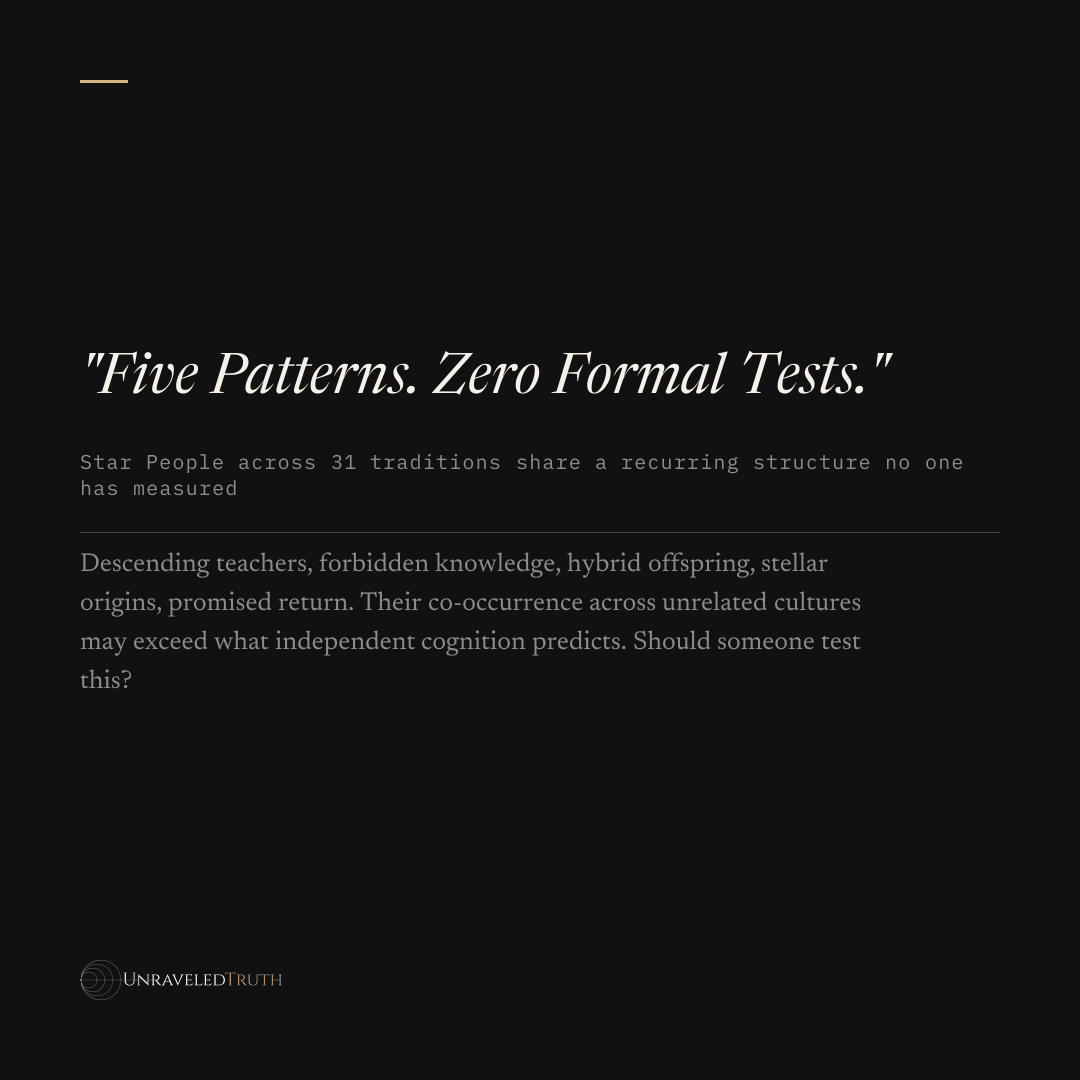
Star People: Indigenous Sky-Being Traditions and the UFO Imagination
What indigenous sky-being traditions actually preserve, what they do not prove, and why the difference matters more than either side admits.

The Philadelphia Experiment: How a Sailor's Marginalia Became America's Most Durable Naval Myth
How one man's letters, a bureaucratic curiosity, and real wartime technology fused into America's most durable naval myth.
Primary References
Want to use this research? Everything here is free with attribution.
See how →