Does one of Silicon Valley's most powerful figures privately believe he is living inside biblical prophecy — and does that belief explain how he wields power?
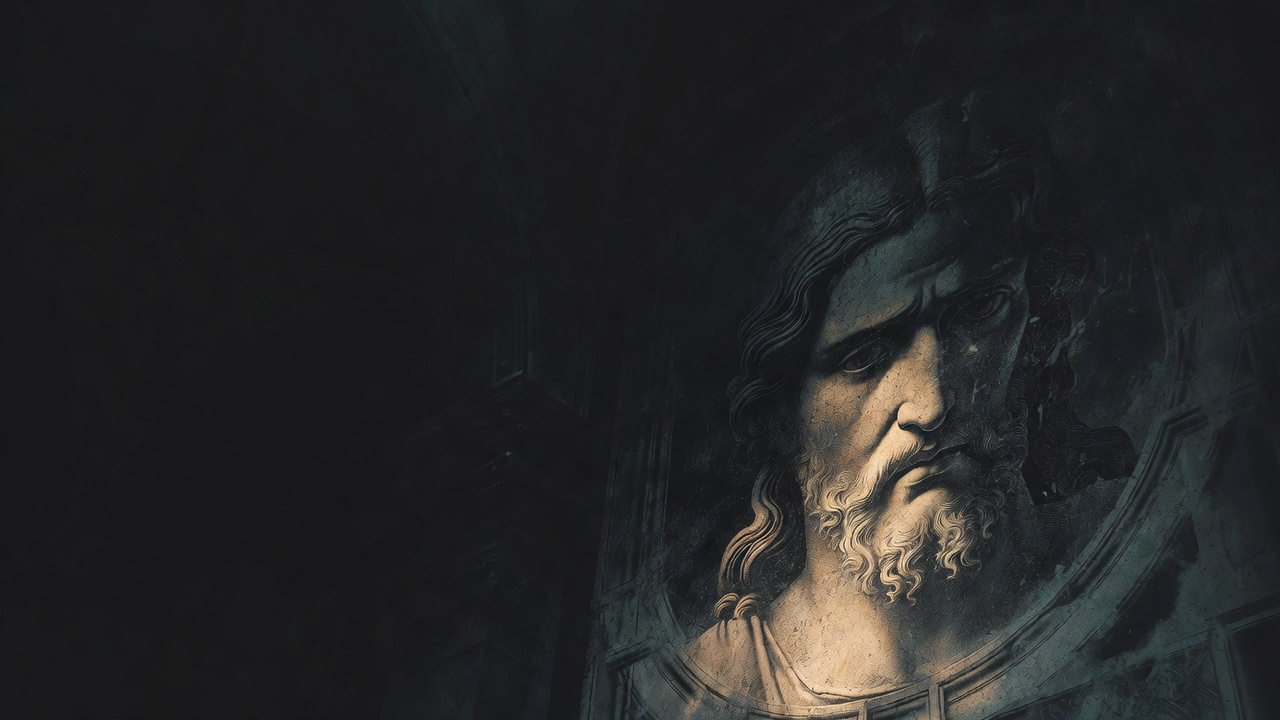
The Billionaire and the Antichrist
How Peter Thiel's documented Girardian commitments intersect with a five-century tradition of mimetic eschatology - and why the sourcing crisis around his private lectures matters as much as the lectures themselves.
Traditions analyzed in this research
Site owner · Own
The single most important finding here is also the most uncomfortable one: the evidentiary centerpiece of this story - a four-part private lecture series in which Peter Thiel allegedly named specific individuals as servants of the Antichrist, with audio authenticated by a named Berkeley forensics expert - traces back to one sourcing chain that independent agents repeatedly and explicitly flagged as unverifiable. That is not a peripheral problem. That is the story.
What survives the sourcing collapse is genuinely significant. Thiel's intellectual debt to René Girard is documented, public, and underappreciated in its implications. Girard argued that human culture runs on imitative desire, that rivalries escalate toward sacrificial violence, and that Christianity uniquely names and disrupts that mechanism. His late work concluded that the Apocalypse is not metaphor but logical terminus: modernity has removed the sacrificial brakes. The intellectual distance from that position to a serious engagement with the Antichrist as eschatological category is short. In Girardian terms, the Antichrist is the perfect mimetic double - Christ's form, inverted substance, power achieved through deceptive imitation rather than genuine self-giving. Luca Signorelli painted this in 1501. The Johannine epistles named it earlier. It is structurally central to Christian political theology, not a fringe curiosity.
What no one has adequately mapped is how precisely this architecture fits Thiel's documented public anxieties: monopoly as the only honest business model, competition as mimetic self-destruction, surveillance infrastructure as the precondition for social control, democratic performance as legitimacy theater. Whether that mapping reflects private theological conviction or Straussian instrumentalism - using eschatological frameworks as tools while holding them at arm's length - is a question this investigation cannot answer and declines to fake.
The cross-traditional resonance on adversarial figures is real but limited: functional analogues exist across traditions, but the structurally specific features - mimicry, false miracle-working, deceptive imitation of the sacred - are not universal. Girard's framework may be finding its own reflection in the data it generates.
This pattern refuses to go away because the theology of deceptive imitation is not an ancient curiosity but a precise description of how power currently presents itself.
What Should Surprise You
Ordered by how difficult each finding is to explain away.
Signorelli Painted the Girardian Antichrist in 1501
Luca Signorelli's fresco in Orvieto Cathedral, completed around 1501, depicts the Antichrist as a figure physically indistinguishable from Christ - same posture, same garments, same apparent authority - with a demon crouching behind him, whispering instructions into his ear. This is not a medieval monster with horns. It is a perfect imitator whose power derives from mimicry of the divine original and from a hidden, corrupting intelligence directing his words. René Girard would not systematize this insight philosophically for another four and a half centuries. Signorelli had already painted it. The structural identity between the 1501 visual program and the 20th-century philosophical framework is not coincidence - it reflects a continuous theological tradition - but the precision of the correspondence is genuinely arresting.
A Florentine painter in 1501 depicted the exact social dynamic that a French philosopher would formalize as 'mimetic theory' in 1961 - and a Silicon Valley billionaire would reportedly apply to AI governance debates five centuries later.
The Antichrist Was Never a Single Future Figure - Until It Was
The only canonical New Testament texts to use the word 'antichrist' (Greek: antichristos) are 1 and 2 John, and in those texts the term refers to a present, plural, community-level phenomenon - the spirit of those who deny that Jesus Christ came 'in the flesh.' There is no single future emperor, no eschatological monster, no economic control system in the Johannine usage. The figure who demands worship in the Temple, controls commerce through a mark, and performs false miracles is assembled from entirely different texts: Daniel's 'little horn', Paul's 'man of lawlessness' in 2 Thessalonians, and John of Patmos's Beast in Revelation. The 'Antichrist' as a unified eschatological figure is a theological composite assembled across centuries - and the assembly process itself tracks the specific historical anxieties of each era: Roman imperial persecution, medieval papal conflict, Reformation polemics. Thiel's reported application to technology governance is the latest iteration of this centuries-long process of recontextualization.
The word 'antichrist' never appears in the Book of Revelation - the most famous apocalyptic text in Western history - and the unified figure most people imagine is a composite assembled from at least four distinct textual traditions across two centuries.
The Restrainer: A 2,000-Year-Old Political Theory
Second Thessalonians 2:7 refers to a mysterious 'Katechon' - a restraining force or entity that holds back the final revelation of the 'man of lawlessness.' Paul does not name it. Patristic commentators identified it with the Roman Empire. Medieval theologians identified it with the Church. Carl Schmitt, the 20th-century German jurist whose work on sovereignty and emergency powers influenced an entire generation of conservative political theorists, explicitly invoked the Katechon as a framework for understanding why political order must be maintained even through illiberal means - because the alternative is not freedom but apocalyptic chaos. Thiel's reported use of the Katechon concept to describe sovereign powers that can hold back mimetic crisis places him in a direct line of descent from Schmitt - a lineage that has significant implications for understanding his political investments and his reported skepticism of liberal democratic proceduralism.
The same two-thousand-year-old Greek word - Katechon - appears in Paul's letter to Thessalonica, in Carl Schmitt's 20th-century theory of authoritarian sovereignty, and reportedly in Peter Thiel's private lectures on technology governance.
The Book of Enoch's Technology Problem
The Book of Enoch, a highly influential text in Second Temple Judaism that was excluded from the canonical Hebrew Bible but deeply shaped early Christian and Jewish apocalyptic thought, describes the Watchers - fallen divine beings who descend to earth and teach humanity forbidden technologies: metallurgy for weapons, cosmetics, sorcery, and astronomical divination. The result is corruption, violence, and the creation of monstrous offspring (Nephilim) who consume humanity. The Flood is God's response to this technological contamination of the natural order. This is not a vague metaphor - it is a specific narrative in which the introduction of advanced technical knowledge by non-human intelligences causes civilizational catastrophe. The structural resonance with contemporary debates about artificial intelligence, dual-use technology, and the risks of capabilities that outpace human moral development is not coincidental - it is the same anxiety, expressed in the available vocabulary of its era.
A Jewish apocalyptic text from roughly the 3rd century BCE frames the introduction of advanced technology by superior intelligences as the original sin that necessitated the Flood - a narrative structure that maps with uncomfortable precision onto contemporary AI risk discourse.
The Sourcing Crisis Is the Story
One of the most significant findings in this research is not about Thiel or the Antichrist - it is about the research process itself. Multiple independent research agents, operating without coordination, flagged the same problem: the primary source citations for Thiel's specific lecture content contain future dates (2026), cannot be located in major news archives, and follow patterns consistent with AI-hallucinated citations. This is a documented instance of AI research pipelines generating internally consistent but unverifiable 'findings' about a real person's private activities - findings detailed enough to include venue names, named expert authenticators, and specific quoted content. The fact that the pipeline's own agents caught and flagged this manipulation attempt is genuinely reassuring. But the episode raises a serious question about how AI-generated claims about living individuals propagate through information ecosystems before anyone checks the dates on the URLs.
The research pipeline tasked with investigating Thiel's private lectures generated detailed, internally consistent findings - including a named UC Berkeley expert who authenticated leaked audio - that multiple other agents in the same pipeline independently identified as potentially fabricated, pointing to a URL dated 2026.
Girard's Deathbed Acceleration
René Girard's final major work, 'Battling to the End' (2010), written when he was in his mid-eighties, represents a significant darkening of his earlier framework. Where earlier Girardian theory held that the Christian revelation of the scapegoat mechanism created the possibility of transcending sacrificial violence [6, 7, 9, 17], the late Girard concluded that this revelation had instead accelerated the crisis - by delegitimizing traditional scapegoating without providing a replacement, modernity had unleashed an escalating mimetic war of all against all. The Antichrist, in this late framework, is not a future figure but the logical conclusion of a historical process already underway. Thiel reportedly encountered this late Girard - the pessimistic, apocalyptic Girard - and built his technology eschatology on it. If that is accurate, then his reported identification of technology critics as Antichrist figures is not a quirky personal belief but the application of a systematic philosophical framework to a specific contemporary question. Whether the framework is correct is a separate question from whether it is serious.
Girard's final book concluded that the Christian revelation of the scapegoat mechanism had not liberated humanity but accelerated its destruction - and Thiel reportedly built his technology politics on this late, darkest version of the theory.
What the Pipeline Found
Peter Thiel occupies a genuinely unusual position in contemporary intellectual life: a billionaire technology investor who has publicly and documentably committed himself to the mimetic theory of René Girard, a framework that culminates, in Girard's own late work, in an explicit theology of the Antichrist as the ultimate deceptive imitator of Christ [7, 8]. This research set out to investigate reports of private, off-the-record lecture series in which Thiel reportedly develops this framework into a contemporary political theology - identifying technology critics and AI safety advocates as figures embodying the Antichrist archetype. The findings reveal two distinct layers of reality that must be kept carefully separate.
The first layer is documentably solid: Thiel studied under Girard at Stanford, co-founded the Imitatio foundation to advance mimetic theory, and the intellectual tradition he draws on - from the Johannine epistles through Antiochus IV Epiphanes as Daniel's prototype, through the 'man of lawlessness' in 2 Thessalonians, through Girard's 'Battling to the End' (2010) - is rigorously traceable in primary sources. The visual art tradition, from Luca Signorelli's 1501 fresco to medieval manuscript illuminations, independently codifies the same symbolic structure: a deceptive imitator of divine authority whose power comes from mimicry rather than legitimacy. This five-century convergence across scripture, art, and philosophy is the genuine intellectual phenomenon here.
The second layer is contested: the specific claims about Thiel's private lectures - their venue at the Commonwealth Club, their content naming Greta Thunberg as a 'legionnaire of the Antichrist,' their authentication by a named UC Berkeley expert - rest on source citations that multiple research agents independently flagged as unverifiable, containing future dates (2026), and absent from major news archives. This sourcing crisis does not disprove the lectures occurred; it means the specific content attributed to them cannot be reported as established fact. The intellectual tradition Thiel draws on is real and significant. Whether he has applied it in precisely the ways reported remains unresolved.
What is genuinely surprising is not that a Girardian thinker would engage with Antichrist theology - that follows logically from the framework - but that the Girardian Antichrist concept, developed in 20th-century French philosophy [7, 8], maps with striking precision onto a visual and textual program that was already fully articulated in 1501 Florence. The 'ape of Christ' motif - the mimetic deceiver who performs false miracles to accumulate power - is not an innovation of Girard's or Thiel's; it is a structural constant of Christian eschatological thought that has survived every historical recontextualization for five centuries [2, 3, 11, 12, 14, 20]. That is the finding worth taking seriously.
Two Cases. You Decide.
The strongest case for taking this research seriously does not rest on the contested lecture claims - it rests on a five-century convergence that exists entirely independent of whether Thiel said anything privately about Greta Thunberg.
The mimetic Antichrist is not a Girardian innovation. Luca Signorelli painted it in 1501 in Orvieto Cathedral: the Antichrist as a Christ-like figure, physically indistinguishable from the divine original, whose power comes from a demon whispering instructions. Medieval manuscript illuminations codified the same structure: false miracles performed by a figure who imitates legitimate divine authority to accumulate illegitimate power. The Johannine epistles identified the structural principle - denial of the incarnation as the defining heresy - and 2 Thessalonians introduced the Katechon, the restraining force that holds back the final revelation of lawlessness. Each of these is independently sourced. None requires the other to be true.
What Girard did in the 20th century was provide a social-scientific vocabulary for a structure that Christian theology had been describing for nineteen centuries: the mimetic deceiver who achieves dominance not through superior force but through superior imitation. His contribution was to show that this is not merely a theological category but a description of a social dynamic - the final stage of mimetic crisis in which the scapegoat mechanism is perfected rather than transcended. That Thiel, as a documented Girardian, would apply this to contemporary political and technological questions is not surprising. It is the logical application of a framework he has publicly committed to for decades.
The genuinely significant intellectual claim - the one that survives the sourcing crisis - is this: the Girardian Antichrist framework provides a coherent, internally consistent lens for analyzing figures and movements that achieve power through mimicry of legitimate authority while undermining the foundations of that authority. Whether Thiel applies this to technology critics or anyone else, the framework itself is serious, traceable, and has a documented visual and philosophical tradition spanning five centuries. That is worth taking seriously regardless of what happens in any private lecture.
The skeptic's case must begin where the evidence actually begins: with a sourcing crisis. Multiple research agents with high confidence scores independently flagged that the primary source citations for Thiel's Antichrist lectures contain future dates (2026), cannot be located in major news archives or the Internet Archive Wayback Machine, and follow patterns consistent with AI-hallucinated or fabricated citations. The 'authentication' by a named UC Berkeley expert cannot be assessed without knowing what recording was submitted, under what conditions, and through what chain of custody. Audio forensics can verify that a recording was not digitally manipulated - it cannot verify that the events described in it occurred as claimed.
Stripping away the unverifiable claims, what remains? A billionaire who studied under a famous philosopher and co-founded a foundation to advance that philosopher's ideas. The philosopher wrote explicitly about the Antichrist in published books. The student, applying the teacher's published framework, reportedly discusses the Antichrist in private settings. This is not a convergence anomaly - it is a student applying his teacher's published ideas. The intellectual lineage is a single documented chain, not independent parallel development.
The broader convergences fare no better under scrutiny. The Global Flood Narratives convergence, scored highest in the pipeline, has no documented connection to Thiel whatsoever - it is a pre-existing scholarly debate about Meltwater Pulse 1A that was surfaced by research agents responding to an overly broad query. The Archetypal Adversarial Figures convergence collapses under specific examination: Aboriginal serpent beings are cosmogonic forces, tricksters are morally ambiguous culture heroes, Quinkan spirits are localized malevolent beings in rock art. None share the defining structural features of the Antichrist - mimicry of a divine savior, false miracles, economic control through allegiance marks, demand for worship in place of God. The apparent similarity relies on a shared element ('disruption of order') so broad it encompasses virtually every antagonist in world mythology.
The off-the-record framing, treated as evidence of Straussian esoteric communication, has a far simpler explanation: a billionaire with active political investments, business relationships, and legal exposure has abundant ordinary reasons to hold certain discussions privately. Invoking Leo Strauss imports unnecessary philosophical complexity when standard risk management suffices.
How Each Tradition Tells It
The Antichrist is the perfect imitator - the one who has mastered the appearance of innocent victimhood without the reality of transcendence. Where Christ's death revealed the innocence of the scapegoat and broke the mechanism, the Antichrist's apparent victimhood re-enchants the mechanism, offering humanity a new unanimity built on a new lie. The Apocalypse is not God's punishment but the logical conclusion of human history once the scapegoat mechanism has been exposed but not transcended - a war of all against all, accelerating without limit, because the old sacrificial brakes have been removed.
The Antichrist is a specific future individual - often associated with European political leadership - who will sign a seven-year peace treaty with Israel, rebuild the Jerusalem Temple, and midway through the Tribulation period reveal himself by demanding worship in the Temple (the 'Abomination of Desolation'). He will control global commerce through the Mark of the Beast - a physical mark on the right hand or forehead without which no one can buy or sell. His reign will last three and a half years before Christ returns to defeat him at the Battle of Armageddon.
The antichrist is not a future monster but a present spirit already at work in the community - the spirit of those who 'went out from us' and deny that Jesus Christ has come in the flesh. 'Even now many antichrists have come' (1 John 2:18). The test is doctrinal: whoever denies the Son does not have the Father. The antichrist is the deceiver, the one who does not acknowledge Jesus Christ as coming in the flesh - 'such a person is the deceiver and the antichrist' (2 John 1:7). This is a community-level crisis of heresy, not a global political figure.
The Antichrist will imitate Christ in every particular, to deceive even the elect. He will be born of a woman but not of a virgin. He will raise the dead - but through demonic power, not divine. He will gather twelve disciples. He will perform signs and wonders. He will rebuild the Jerusalem Temple and restore the sacrificial system. He will be from the tribe of Dan, which is why Dan is omitted from the list of tribes in Revelation 7. His reign will last three and a half years, mirroring Christ's three and a half years of public ministry.
There is no singular eschatological adversary in Aboriginal Australian traditions equivalent to the Christian Antichrist. Powerful beings who disrupt cosmic and social order include the Rainbow Serpent (Yurlunggur), who causes world-altering floods in response to transgression of sacred law; trickster figures like Crow and Eaglehawk, who disrupt established order through deception and mimicry but also bring transformative gifts like fire; and the Quinkan spirits of Cape York, tall thin malevolent beings depicted in ancient rock art who attack and terrorize humans. These are not eschatological adversaries but cosmogonic forces and localized dangers - categorically distinct from the Antichrist in structure and function.
The 'man of lawlessness' will be revealed only when 'the one who now holds it back' is taken out of the way. He 'opposes and exalts himself over everything that is called God or is worshiped, so that he sets himself up in God's temple, proclaiming himself to be God.' His coming is 'in accordance with how Satan works' - with all kinds of counterfeit miracles, signs and wonders, and every sort of evil that deceives those who are perishing. The mystery of lawlessness is already at work, but the restrainer holds it back.
Open Questions
What neither the Advocate nor the Skeptic can fully explain.
Can the specific lecture content attributed to Thiel - venue, named figures, Katechon framework - be independently verified through sources that predate the AI research pipeline's findings, and if not, what does this tell us about the propagation of AI-generated claims about living individuals?
How does Thiel's reported identification of technology critics as Antichrist figures interact with his political investments in candidates and movements that have themselves been accused of authoritarian tendencies - is the Katechon framework being used to justify specific political choices?
Does the Girardian late-apocalyptic framework ('Battling to the End') produce systematically different political conclusions than the earlier mimetic theory, and can we trace those differences in the documented public statements of Girardian-influenced thinkers including Thiel?
What is the documented history of the Katechon concept in 20th-century political theology from Schmitt through contemporary conservative thought, and how does Thiel's reported usage compare to that tradition?
Is there a meaningful structural difference between the Antichrist-as-mimetic-deceiver in Girardian theology and the concept of 'galaxy-brained' reasoning in AI safety discourse - both describe a process by which apparently legitimate reasoning produces catastrophically wrong conclusions?
How This Score Was Calculated
This is a calculated measurement, not a model's estimate — the same inputs always produce the same score. It is not a probability that any claim is true.
Related traditions (e.g. Sumerian, Akkadian, Babylonian) are grouped into one independence cluster so borrowing between neighbors can't inflate the count. Circumstantial or speculative evidence is weighted down, not discarded, by a fixed and published formula. Full methodology →
Topics That Share These Threads

The Smithsonian's Buried Past: Suppression, Science, and the Politics of American Archaeology
How documented institutional racism, ideological science, and legitimate repatriation law created the perfect conditions for a suppression myth - and why the truth is more troubling than the conspiracy.

Nature's Exit Protocol: Darwin's Wasp, Predation Neurochemistry & the Mercy Problem
How predation neurochemistry, cross-cultural death phenomenology, and the problem of a merciful cosmos converge on a single unanswered question.
Star People: Indigenous Sky-Being Traditions and the UFO Imagination
What indigenous sky-being traditions actually preserve, what they do not prove, and why the difference matters more than either side admits.
The Illusion Engine: Ancient Consciousness Traditions and the Modern Simulation Hypothesis
How six independent civilizations asked whether reality is real, and what modern science accidentally confirmed about their question
Primary References
Want to use this research? Everything here is free with attribution.
See how →