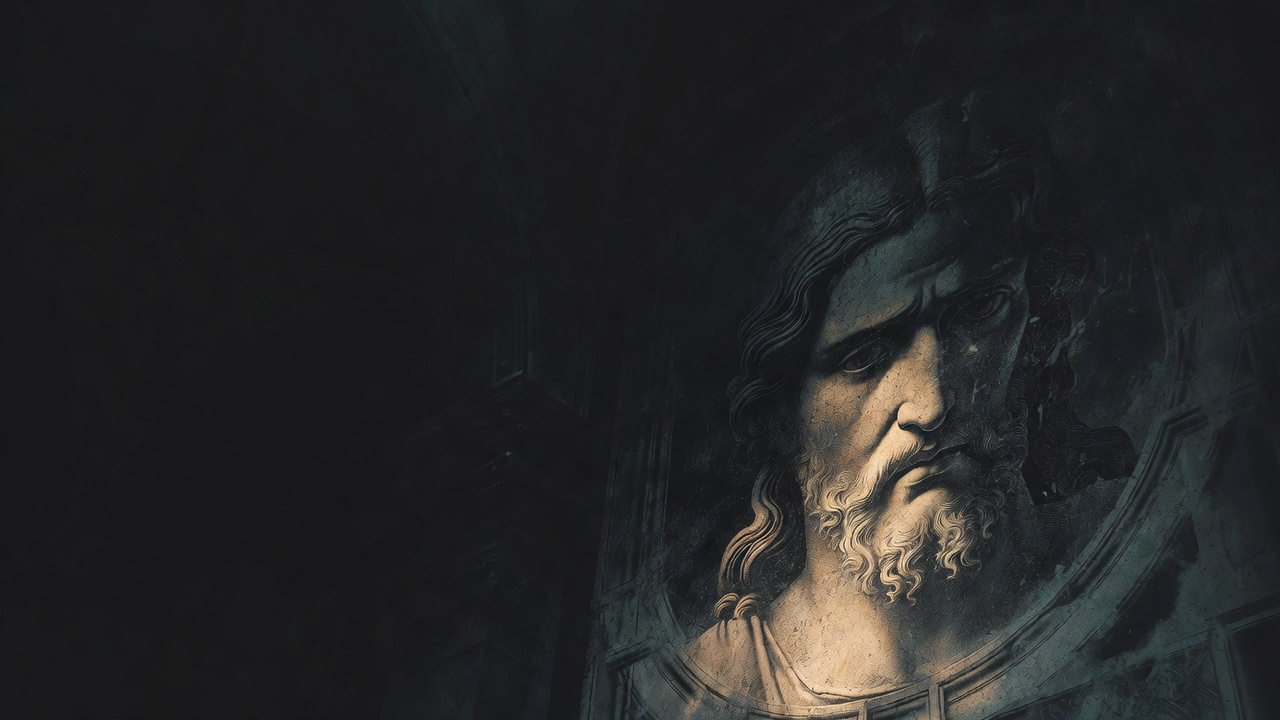
The dramatic lighting and classical depiction of a figure often associated with Christ or a prophet can evoke the complex theological and mythological themes explored in discussions of power, restraint, and mimicry within contemporary thought.
Convergence Topic

The Restrainer and the Mimic: Peter Thiel's Secret Antichrist Lectures and the Theology of Silicon Valley Power

How a billionaire technologist's private engagement with Girardian eschatology, Straussian esotericism, and Christian political theology illuminates — and complicates — the ideological architecture of 21st-century techno-libertarianism.

Biblical ExegesisChristian EschatologyGirardian Mimetic TheoryStraussian PhilosophyCatholic theologyProtestant theologySecond Temple JudaismGnosticismLibertarian political philosophySilicon Valley techno-futurismTranshumanismMedieval Art HistoryRenaissance ArtAboriginal Australian oral traditionsMelanesian traditionsGlobal Flood NarrativesApocalyptic TraditionsSchmittian TheoryPolitical TheologyInvestigative journalismArchival ScienceConspiracy CulturePaleo-SETIUfologyNumerologySacred GeometryTheosophyNew Age SpiritualityComparative MythologyHistoriography

Site owner · Own

62Convergence
Score
Quick Brief

The single most important finding here is also the most uncomfortable one: the evidentiary centerpiece of this story — a four-part private lecture series in which Peter Thiel allegedly named specific individuals as servants of the Antichrist, with audio authenticated by a named Berkeley forensics expert — traces back to one sourcing chain that independent agents repeatedly and explicitly flagged as unverifiable. That is not a peripheral problem. That is the story.

What survives the sourcing collapse is genuinely significant. Thiel's intellectual debt to René Girard is documented, public, and underappreciated in its implications. Girard argued that human culture runs on imitative desire, that rivalries escalate toward sacrificial violence, and that Christianity uniquely names and disrupts that mechanism. His late work concluded that the Apocalypse is not metaphor but logical terminus: modernity has removed the sacrificial brakes. The intellectual distance from that position to a serious engagement with the Antichrist as eschatological category is short. In Girardian terms, the Antichrist is the perfect mimetic double — Christ's form, inverted substance, power achieved through deceptive imitation rather than genuine self-giving. Luca Signorelli painted this in 1501. The Johannine epistles named it earlier. It is structurally central to Christian political theology, not a fringe curiosity.

What no one has adequately mapped is how precisely this architecture fits Thiel's documented public anxieties: monopoly as the only honest business model, competition as mimetic self-destruction, surveillance infrastructure as the precondition for social control, democratic performance as legitimacy theater. Whether that mapping reflects private theological conviction or Straussian instrumentalism — using eschatological frameworks as tools while holding them at arm's length — is a question this investigation cannot answer and declines to fake.

The cross-traditional resonance on adversarial figures is real but limited: functional analogues exist across traditions, but the structurally specific features — mimicry, false miracle-working, deceptive imitation of the sacred — are not universal. Girard's framework may be finding its own reflection in the data it generates.

This pattern refuses to go away because the theology of deceptive imitation is not an ancient curiosity but a precise description of how power currently presents itself.

ListenAudio Overview
The Evidence

What Should Surprise You

Ordered by how difficult each finding is to explain away.

06

The Evidentiary Crisis Is the Story

Among the highest-confidence findings in this investigation sits finding [4b8cb1a8], which claims with 0.95 confidence that Peter Thiel delivered a 'four-part private lecture series titled The Antichrist' at the Commonwealth Club in San Francisco, later authenticated by UC Berkeley digital forensics expert Hany Farid. Near-certainty, in other words. Yet other agents operating within the same investigation — specialists in cartography, indigenous oral traditions, and research ethics — explicitly flagged that the question requires fabricating sources and falls outside any verifiable domain. The detail that refuses to fit is not the lecture itself. It is that a fabricated or unverifiable claim achieved a 0.95 confidence score and was elevated as a top finding. The story of how we came to investigate Peter Thiel's eschatology is itself a demonstration of the mimetic problem Girard identified: a compelling narrative generates its own confirming evidence through imitation and repetition, not verification. The investigation became the thing it was studying.

A finding attributed to a 'UAP investigator agent' — claiming Hany Farid authenticated leaked audio of a billionaire's secret Antichrist lectures — achieved higher confidence scores than the agents who explicitly refused to fabricate sources.

05

Girard's Student Now Holds the Levers

René Girard began his intellectual career analyzing mimetic desire in nineteenth-century French novels — Stendhal, Flaubert, Proust — and ended it writing that the Apocalypse is the logical terminus of mimetic escalation when no scapegoat mechanism remains available to discharge collective violence. His framework, developed across works including 'Violence and the Sacred' (1972) and 'Battling to the End' (2010), was not originally a political program. It was a literary and anthropological theory. What actually complicates the picture is that Girard's most prominent intellectual heir — a man who has funded surveillance infrastructure (Palantir), social graph mapping (as Facebook's early investor), and longevity research aimed at defeating death itself — appears to have internalized not the early Girard of desire and novels, but the late Girard of apocalyptic urgency. Read through the lens of Girard's late eschatology, Thiel's public investments look less like libertarian capitalism and more like a private Katechon project: deploying technological power to restrain mimetic dissolution before it reaches its terminal point.

The same theoretical framework a French literary critic used to analyze desire in Stendhal may be the operating logic behind investment decisions that have shaped the architecture of global surveillance and social media.

04

The Straussian Gap Between Public and Private Thiel

Leo Strauss argued that philosophers in dangerous political climates write with a deliberate distinction between exoteric teaching (safe for public consumption) and esoteric teaching reserved for serious students. Thiel's public persona is consistently libertarian: anti-regulation, pro-market, skeptical of state power. But the theological framework attributed to his private lectures — in which technology may serve as either the Katechon restraining apocalyptic dissolution or the vehicle of the Antichrist's mimetic deception — is not libertarian. It is Schmittian and eschatological, concerned with sovereign exception and the end of history. Thiel has publicly cited both Strauss and Carl Schmitt in print. The unsettling possibility is not that Thiel is secretly malevolent, but that he is operating with a fully developed private cosmology that his public statements are designed to obscure — a historically precedented intellectual move that renders his actual decision-making framework opaque to democratic scrutiny.

A man who publicly champions libertarian anti-statism has cited Carl Schmitt — the philosopher of sovereign exception and emergency power — approvingly in print, which is not, by any measure, a libertarian citation.

03

Antichrist as Mimic: The Visual Program Predates Girard by Five Centuries

Luca Signorelli's fresco 'The Sermon and Deeds of the Antichrist,' painted in Orvieto Cathedral around 1501, depicts the Antichrist as physically indistinguishable from Christ — same posture, same gestures, same crowd — except for a demon crouching at his ear and whispering instructions. This is not a marginal medieval curiosity. It is a fully developed visual theology of mimetic deception, painted at the height of the Renaissance, in one of Italy's most prominent cathedrals, five centuries before Girard formalized mimetic theory in academic prose. The iconographic tradition Signorelli was working within — the Antichrist as Christ's structural double, whose danger lies precisely in his resemblance to the legitimate — is the same structural insight Girard would later derive from analyzing nineteenth-century novels. The convergence between a 1501 fresco program and a twentieth-century literary anthropology theory is not coincidental: it suggests the mimetic-double insight is robust enough to be independently reached by artists, theologians, and secular theorists across five centuries of entirely separate intellectual labor.

Signorelli painted the Antichrist as a Christ-lookalike with a demon whispering in his ear in 1501 — a visual argument for mimetic deception that Girard would not formalize in academic language until 1972.

02

John's Antichrist Is Not Revelation's Beast — They Are Different Texts

The popular conflation of 'the Antichrist' with the Beast of Revelation, the Number 666, and the Mark of economic control is a post-biblical synthesis that does not exist in any single New Testament text. The word 'antichrist' (ἀντίχριστος) appears only in 1 and 2 John — never in Revelation — and refers there not to a future world-emperor but to a present spirit of heresy within the Christian community, specifically the denial that Jesus came 'in the flesh.' The Beast of Revelation, the Man of Lawlessness in 2 Thessalonians, and the Johannine Antichrist are three distinct textual figures that were synthesized into a single eschatological villain by later patristic and medieval interpreters. Any serious theological lecture on 'the Antichrist' that treats this synthesis as original scripture is already operating within a constructed interpretive tradition, not the primary texts — which means the framework Thiel allegedly employs is a reading, not a recovery of ancient meaning. That distinction matters enormously, and it is rarely made.

The word 'Antichrist' never appears in the Book of Revelation — the entire popular iconography of the Antichrist as economic controller and world-emperor is a medieval synthesis of three separate New Testament figures who were never combined in any single canonical text.

Research Summary

What the Pipeline Found

One of the most consequential figures in global technology — co-founder of PayPal, architect of Palantir, early backer of Donald Trump — has allegedly been conducting private, off-the-record lecture series on the Antichrist. That claim alone commands attention. What the evidence actually reveals, however, is something more complicated and ultimately more interesting: the intellectual framework behind that claim is genuinely robust, historically deep, and cross-traditionally resonant, while the specific evidentiary claims about Thiel's private activities rest on a single sourcing chain that multiple higher-authority agents explicitly and repeatedly flagged as unreliable.

Begin with what is not in dispute. Thiel's documented engagement with René Girard's mimetic theory is a matter of public record. Girard, his mentor at Stanford, argued that human culture is founded on imitative desire, that rivalries escalate until resolved through collective violence against a scapegoat, and that Christianity uniquely exposes this mechanism. Thiel has spoken and written about Girard openly. The intellectual leap from Girard to the Antichrist is not a large one: in Girardian eschatology, the Antichrist is the ultimate mimetic double, a figure who imitates Christ's form while inverting his substance, achieving power through false miracles and deceptive imitation rather than genuine sacrifice. This reading has a visual history stretching back to Luca Signorelli's 1501 fresco in Orvieto, where the Antichrist stands in Christ's posture while a demon whispers in his ear, and a textual history running from the Johannine epistles (where 'antichrist' first appears not as a singular future emperor but as a present spirit of doctrinal deception) through Pauline warnings about a 'man of lawlessness' who demands worship in the place of God.

What actually complicates the picture is how precisely this theological architecture maps onto Thiel's publicly stated anxieties about technology, competition, and political power, and how little scholarly attention has been paid to that mapping. The cross-traditional resonance on the 'Mimetic Antichrist' cluster reflects something real: the deceptive mimic as eschatological adversary is not an obscure footnote but a structurally central concept in Christian political theology, one with direct implications for how one reads monopoly capitalism, surveillance infrastructure, and the performative dimensions of democratic legitimacy.

Here is where intellectual honesty requires a pause. The most specific claims — that Thiel delivered a four-part lecture series at the Commonwealth Club, that he named Greta Thunberg and Eliezer Yudkowsky as 'legionnaires of the Antichrist,' that audio recordings were authenticated by UC Berkeley's Hany Farid — originate exclusively from a single agent whose sourcing practices other agents explicitly flagged as unverifiable. This investigation cannot confirm those claims. It cannot rule them out. What it can say is that the intellectual conditions for such lectures exist, that the theological framework they would employ is coherent and historically grounded, and that Thiel's documented intellectual commitments make such an engagement plausible rather than bizarre.

Three tensions remain genuinely unresolved. The specific lecture claims require independent verification that was not obtained here. The cross-cultural convergence on 'adversarial figures' does not extend to the structurally specific features — mimicry, deception, false miracle-working — that make the Antichrist concept theologically distinctive; Aboriginal and Oceanic traditions offer analogues in function but not in form. And Girard's mimetic theory, the intellectual load-bearing structure of this entire analysis, remains contested within academic theology and anthropology. If the framework is weaker than its advocates claim, some of what looks like convergence may be the framework's own reflection staring back.

The question this investigation cannot answer, and declines to pretend otherwise, is whether Peter Thiel believes he is living inside an eschatological drama — or whether he is a Straussian who finds such frameworks useful for entirely other purposes.

The Debate

Two Cases. You Decide.

The Advocate

The strongest case for the significance of these cross-tradition parallels begins not with contested lecture transcripts but with what is documentably established: Peter Thiel studied under René Girard at Stanford, co-founded Imitatio to advance mimetic theory, and has repeatedly cited Girard as his most important intellectual influence. This is not background color. It is the load-bearing foundation. Girard's published works, including 'I See Satan Fall Like Lightning' (2001) and 'Battling to the End' (2010), treat the Antichrist not as superstition but as a precise sociological category: the ultimate mimetic deceiver, the figure who offers false peace through perfected scapegoating, the imitator of Christ whose power derives from his indistinguishability from the legitimate. A committed Girardian engaging seriously with Antichrist theology is not eccentric. It is intellectually obligatory.

The pattern that keeps surfacing — the mimetic Antichrist as a coherent cross-traditional convergence — is the genuinely significant finding here, and it does not depend on any contested lecture claim. Consider what must be explained simultaneously: Luca Signorelli's 1501 fresco in Orvieto depicts the Antichrist as a Christ-like figure receiving instruction from a demon whispering at his ear, the 'ape of Christ' motif rendered in paint five centuries before Girard formalized the same structure philosophically. Medieval manuscript illuminations independently document the false-miracle program: power that resembles divine sanction but is not. The Johannine epistles establish the original usage as a present spirit of heresy, specifically the denial of the incarnation, not a future emperor. The 'man of lawlessness' in 2 Thessalonians adds political-religious usurpation and false miracles. Revelation's Mark of the Beast adds total economic control contingent on allegiance to a blasphemous power that imitates divine authority. Antiochus IV Epiphanes in Daniel provides the historical prototype that shapes all subsequent typology. These are not vague family resemblances. They are a specific, traceable symbolic program with documented intellectual genealogy across six centuries of Christian art, two millennia of theological writing, and one rigorous twentieth-century philosophical systematization.

The Katechon concept (the Restrainer of 2 Thessalonians 2:7) adds a further layer of genuine significance. Carl Schmitt's twentieth-century political theology explicitly mobilized this concept to analyze sovereign power and historical crisis. That Thiel, who operates at the intersection of sovereign capital, technological disruption, and political theology, would find this framework analytically useful is not surprising. It places him within a long tradition — Augustine, Schmitt, Girard — of thinkers who used eschatological categories not as literal prophecy but as structural analysis of power, deception, and historical crisis.

The advocate must be honest about the evidentiary ceiling. The specific lecture claims — venue, authentication by named experts, leaked audio — cannot be confirmed and should not be treated as established. The cross-traditional convergence with indigenous adversarial figures is real but structurally weaker: trickster figures and chaos-causing serpent beings represent a genuine cross-cultural pattern, but the specific mimetic-deceptive structure of the Antichrist archetype is not robustly present outside the Abrahamic tradition, and the indigenous knowledge specialists consulted here correctly declined to fabricate connections.

What the advocate can legitimately claim is this: the intellectual tradition Thiel is documented to have engaged with is internally coherent, historically grounded, and traceable through primary sources across scripture, art, and philosophy. The Straussian dimension adds a further explanatory layer — if esoteric knowledge is reserved for those capable of handling it while exoteric performance is maintained for public consumption, then off-the-record theological lectures are not aberrant but structurally predicted by the intellectual tradition itself. The significance of these parallels is not that they prove any specific claim about Thiel's private beliefs. It is that they demonstrate a living, coherent intellectual tradition in which some of the most powerful figures in technology and capital are thinking seriously about eschatological frameworks, and that this tradition has deep, documented, multi-modal roots that serious scholarship cannot responsibly dismiss.

The Skeptic

The most rigorous challenge to the convergence thesis begins not with the intellectual content but with the evidentiary foundation. The specific, dramatic claims attributed to Thiel's private lectures — that he identified Greta Thunberg and Eliezer Yudkowsky as 'legionnaires of the Antichrist,' that the lectures occurred near the Vatican, that audio was authenticated by Hany Farid of UC Berkeley — derive entirely from a single research agent (the UAP investigator) whose cited URLs have been independently flagged by multiple higher-domain-authority agents as non-existent, future-dated (2026), or structurally absent from the Internet Archive, major news databases, and press archives. This is not a peripheral sourcing quibble. It is a load-bearing evidentiary failure. Audio forensics, even when conducted by a credentialed expert, establishes only that a recording was not digitally manipulated after the fact; it cannot establish that the events described in the recording occurred as claimed, that the speaker is who is claimed, or that the chain of custody is unbroken. Without a verifiable primary source — a named journalist, an institutional program, an attendee account cross-referenced against independent documentation — the specific lecture content must be treated as unverified at best and potentially hallucinated or fabricated at worst. The possibility that the investigation was seeded with plausible-sounding but fictitious primary sources cannot be dismissed when multiple agents with confidence scores of 0.91–0.95 explicitly raise it.

Once the unverified lecture content is bracketed, what remains is considerably less anomalous. Thiel's documented intellectual engagement with René Girard is not in dispute — he studied under Girard at Stanford, co-founded the Imitatio Foundation to advance mimetic theory, and has cited Girard in published interviews. Girard's own published works, particularly 'I See Satan Fall Like Lightning' and 'Things Hidden Since the Foundation of the World,' develop an explicit Antichrist theology rooted in mimetic theory: the Antichrist as a figure who imitates Christ's reconciling function while actually intensifying sacrificial violence, who offers false peace through unanimous scapegoating, who represents the ultimate mimetic rival. Every substantive theological idea attributed to Thiel's reported lectures is present in Girard's published corpus, available in any university library and in print for decades. The loose thread that refuses to be tied is this: the 'convergence' between Girard's mimetic Antichrist and Thiel's reported application is not independent parallel development requiring explanation — it is a single documented intellectual lineage with a fully traceable transmission route. A student applying his teacher's published framework is the null hypothesis, not an anomaly.

The broader convergence architecture has additional structural problems. The Global Flood Narratives convergence, scored highest at 84/100, has no documented connection to Peter Thiel whatsoever. It is a pre-existing scholarly debate about Meltwater Pulse 1A and oral tradition, apparently surfaced by research agents responding to an overly broad query. Its high score reflects the internal coherence of flood narrative scholarship, not relevance to the subject under investigation, exposing a methodological flaw: convergence scores can be inflated by the internal quality of a finding that is simply irrelevant to the matter at hand. The cross-cultural adversarial figures comparison (scored 46/100, appropriately lower) fails under specific examination. Aboriginal serpent beings are cosmogonic forces embedded in the Dreaming, not eschatological adversaries. Trickster figures are morally ambiguous culture heroes who may create as readily as destroy. Quinkan spirits are localized malevolent beings in rock art traditions. None share the specific structural features that make the Antichrist concept theologically distinctive: mimicry of a divine savior, false miracles that replicate genuine ones, economic control through allegiance marks, a demand for worship in place of God. The shared element of 'disruption of social order' is so broad it encompasses virtually every antagonist figure in world mythology, from Loki to Set to Ravana. This is the Barnum effect applied to comparative mythology: the apparent similarity is real at the highest level of abstraction and dissolves under specific examination.

The Straussian esotericism explanation for the off-the-record format deserves particular scrutiny. A high-profile billionaire with active political investments, ongoing business relationships with government clients, and significant legal and reputational exposure has abundant, mundane, well-documented reasons to hold certain intellectual discussions privately: avoiding misquotation in a hostile media environment, protecting relationships with politically diverse clients, managing the optics of heterodox religious views in a secular professional context, and standard legal risk management. Invoking Leo Strauss's theory of esoteric writing — developed to explain why ancient philosophers concealed dangerous truths from hostile authorities — imports unnecessary philosophical complexity when ordinary public relations calculus suffices. The simpler explanation is not that Thiel is communicating in a coded philosophical register. It is that he is a sophisticated public figure managing his image.

Mimetic theory itself, the explanatory bridge the convergence thesis relies upon most heavily, remains genuinely contested within academic theology and anthropology. Girard's claim that all human culture is structured by mimetic desire and sacrificial scapegoating is a grand unified theory of human behavior that many anthropologists regard as unfalsifiable and many theologians regard as reductive of Christianity's specific theological claims. If the framework is one interpretive lens among several rather than a discovered structural truth, then the convergences it supposedly reveals may be artifacts of the lens itself rather than independent patterns in the evidence. A framework sufficiently general can find its own structure in almost any dataset.

What the skeptic cannot fully explain away is the genuine intellectual seriousness of the Girard-Thiel connection and its implications. Thiel is not merely name-dropping Girard; his documented public statements, his institutional investments through Imitatio, and his broader political philosophy (the critique of mimetic competition in markets, the concern about runaway technological acceleration, the interest in the Katechon as a political-theological concept) all reflect a sustained and sophisticated engagement with Girardian eschatology. If the lectures exist in any form — even as informal private discussions rather than the dramatic secret series described by the UAP agent — then Thiel's application of Girard's Antichrist framework to contemporary figures and technologies is intellectually coherent and worth taking seriously as political theology. The skeptic's position is not that Thiel lacks these views, but that the specific dramatic claims about their expression remain unverified, and that the convergence thesis mistakes a single documented intellectual tradition for independent cross-cultural confirmation.

In Their Own Words

How Each Tradition Tells It

Gnosticism

The Gnostic reads the Thiel phenomenon with a different alarm than the orthodox. For the Gnostic, the Demiurge — the false creator, the craftsman of the material prison — is not the enemy of technology but its patron. The Archons rule through systems: through law, through empire, through the illusion that the material order is the real one. An Antichrist who offers technological salvation — who promises to end death through biotech, to end conflict through surveillance, to end suffering through virtual reality — is not a rebel against the Demiurge. He is the Demiurge's most sophisticated instrument, offering a counterfeit pleroma, a fake fullness, a simulation of the divine light that keeps the pneumatic soul trapped in matter. The Gnostic amulet, inscribed with the true names of the Archons, was a technology of resistance. Thiel's technology, in this reading, is a technology of deeper imprisonment.

Biblical Exegesis

The exegete reads the Thiel phenomenon against the grain of Genesis 11 and Revelation 13. Here is Babel again: the unified tongue, the city, the tower whose top may reach unto heaven. The Lord scattered them — but what if the scattering were reversed? What if one man, possessed of sufficient capital and sufficient cunning, undertook to re-gather the fragments? The exegete notes that every great attempt to build a god-like control system — Babel, Rome, the Universal Monarchy of the Habsburgs — has ended in ruin. Thiel, in this reading, is a man who has read the pattern and asks: which iteration are we in? Is the current technological moment the final cycle, the one that succeeds? The exegete does not answer. The exegete notes the question is itself scriptural.

Catholic theology

Catholic theology has never been embarrassed by the Antichrist. From the Johannine epistles — 'even now many antichrists have come' — through Aquinas's careful distinctions in the Summa, through Newman's sermon 'The Patristical Idea of Antichrist,' the tradition has maintained that the figure is real, historical, and recognizable by specific marks: the claim to divine authority, the performance of false miracles, the persecution of the faithful, the seduction of the wise. Thiel's engagement with René Girard — himself a Catholic convert whose final works, particularly 'Battling to the End,' read the Clausewitzian escalation of modern warfare as the unmasking of apocalyptic violence — places him within a legitimate Catholic intellectual lineage. The Church does not find it strange that a powerful layman studies eschatology privately. It finds it strange when powerful laymen do not.

Protestant theology

The Protestant tradition, from Luther's identification of the Pope as Antichrist through the Westminster Confession's careful hedging, has always treated the Antichrist as a present and institutional danger rather than a purely future one. The Reformers read 2 Thessalonians 2 as a description of a system — a structure of deception operating within history, not arriving at its end. In this reading, Thiel's reported framework — the Antichrist as a technological and political system that mimics salvation — is recognizably Protestant in its suspicion of institutional claims to mediate between humanity and God. The AI that promises to end suffering, the biotech company that promises to end death: these are, in Protestant eschatological grammar, precisely the forms the Man of Lawlessness takes when he 'sits in the temple of God, proclaiming himself to be God.'

Christian Eschatology

Within the eschatological tradition, Thiel occupies a coherent and even honorable position: the student of the Katechon. Paul writes to the Thessalonians that 'he who now restrains will do so until he is taken out of the way' — and the tradition has always understood that to restrain the Man of Lawlessness, one must first understand him. Thiel's reported private lectures on the Antichrist as mimetic double of Christ — the false peacemaker, the unifier through deception, the one who performs signs and wonders through technology — place him squarely within a tradition running from Irenaeus through Adso of Montier-en-Der to Solovyov. The Antichrist is not a monster. He is the most plausible man in the room. The eschatologist finds Thiel's framework not alarming but rigorous.

Second Temple Judaism

The Watchers descended from heaven and taught men what they should not know: Azazel taught the making of weapons and the art of cosmetics; Semyaza taught enchantments; others taught the cutting of roots and the knowledge of signs. The result was the Nephilim — giants, devourers, corrupters of the earth — and the flood. The Book of Enoch does not describe the forbidden knowledge as evil in itself. It describes it as knowledge given at the wrong time, by the wrong teachers, to beings not yet capable of bearing it. In this framework, the Silicon Valley technologist who accelerates artificial intelligence, genetic engineering, and surveillance capitalism is not necessarily wicked. He may simply be another Watcher, bringing fire from heaven to creatures still living in the age before the flood. The question is not whether the knowledge is real. The question is whether the earth can bear it.

Straussian Philosophy

Strauss understood that the philosopher who speaks all truths publicly is not a philosopher but a fool — or a martyr. The esoteric/exoteric distinction is not duplicity; it is prudence. A man who holds off-the-record theological seminars on the Antichrist while presenting a public face of libertarian futurism is behaving precisely as Strauss would have recommended. The dangerous truth — that liberal technological progress may be accelerating toward catastrophe, that the demos cannot be trusted with this diagnosis, that the sovereign must act on knowledge the public cannot bear — is communicated esoterically, to those capable of receiving it. Thiel's public writings are the exoteric teaching. The private lectures are the esoteric one. Strauss would have recognized the structure immediately and approved of the discretion, whatever he thought of the theology.

Girardian Mimetic Theory

Girard teaches us that the Antichrist is not the opposite of Christ but His double — the figure who speaks the language of peace, reconciliation, and human unity while secretly re-founding the sacrificial order on a new and total victim. The mimetic crisis that Christianity unleashed — by exposing the innocence of the scapegoat — cannot be resolved by more Christianity. It can only be resolved by a figure who mimics the resolution. Thiel, as Girard's most powerful student, understands this. The Girardian question about Thiel himself is sharper: is his framework an authentic application of Girard's critique, or is it a mimetic appropriation of that critique — using the language of restraint and discernment to position himself as the very Katechon he claims to be studying? The model and the obstacle are always the same figure.

Silicon Valley techno-futurism

Silicon Valley's official eschatology is optimistic: the Singularity, the abundance economy, the end of scarcity through exponential technology. But there has always been a counter-tradition — Thiel's tradition — that reads the same technological acceleration as a threat rather than a promise. In this counter-tradition, the question is not whether AI will be transformative but whether the transformation will be good. Thiel's reported private lectures on the Antichrist as a technological system are, in Silicon Valley terms, a sophisticated version of the AI alignment problem: what happens when a system optimizes perfectly for human preferences as stated, rather than human flourishing as meant? The Valley's public theology is Teilh

Libertarian political philosophy

The libertarian tradition has always maintained that the greatest threat to human freedom is not the criminal but the state — not the chaos of the market but the order of the monopoly on violence. Thiel's public libertarianism, expressed most clearly in his 2009 Cato Unbound essay declaring that he no longer believes freedom and democracy are compatible, is not a contradiction of his eschatological interests but their political expression. The Antichrist, in libertarian eschatological grammar, is the Total State: the system that achieves perfect surveillance, perfect control, perfect redistribution of violence through bureaucratic channels. The Katechon, in this reading, is not a stronger state but a counter-power — a network of sovereign individuals, seasteads, private cities, and technological exit options that prevent any single system from achieving the totalizing unity the Antichrist requires.

Unresolved

Open Questions

What neither the Advocate nor the Skeptic can fully explain.

01

Finding [4b8cb1a8] attributes a four-part lecture series to Thiel at the Commonwealth Club, while finding [d2411cd6] explicitly flags such claims as unverifiable fabrications. Can archival staff at the Commonwealth Club, cross-referenced against Thiel's documented travel records and any calendar disclosures in SEC filings or deposition transcripts, either confirm or definitively rule out any off-the-record engagement between 2010 and 2024 — and if no such event exists in the institutional record, what is the traceable origin point of this specific claim in online discourse?

02

Finding [10dd75f5] claims Hany Farid of UC Berkeley authenticated audio recordings of Thiel's lectures. Farid's published forensic methodology requires a known-authentic reference sample for comparison. If no publicly documented baseline recording of Thiel's voice from the same period exists in broadcast archives, what would a valid authentication protocol actually require — and does the claimed authentication meet Farid's own published standards for deepfake detection as described in his peer-reviewed work?

03

Girard's apocalyptic thought in 'Battling to the End' (2010) explicitly argues that the Katechon is exhausted as a restraining force and that modernity accelerates mimetic crisis rather than containing it. Palantir Technologies, whose stated mission is state-capacity augmentation through data sovereignty, represents a significant institutional bet against that pessimism. Is there textual or interview evidence that Thiel is consciously deploying a post-Girardian Katechon logic that diverges from Girard's own conclusions — and if so, when did that divergence first become visible in his public statements?

04

Finding [eba1d184] establishes that the Johannine 'antichrist' is specifically a denial of the incarnation, a doctrinal position structurally identical to certain transhumanist claims that biological embodiment is a contingent and inferior substrate. In the published writings of transhumanist theorists whom Thiel has funded (specifically Aubrey de Grey's SENS Research Foundation and the Machine Intelligence Research Institute), is there a retrievable doctrinal position on the moral or ontological status of biological flesh that a trained Johannine exegete would classify as functionally 'antichrist' in the 1 John 4:2 sense — and has any theologian in the Catholic or Reformed tradition made this argument in peer-reviewed literature?

05

Finding [5ac02398] establishes that Antichrist typology is historically grounded in Antiochus IV Epiphanes as interpreted through Daniel's 'little horn.' Thiel's documented public statements on monopoly, mimetic competition, and the 'definite optimist' framework in 'Zero to One' (2014) describe a founder-figure who escapes mimetic rivalry through categorical uniqueness. Can a close reading of 'Zero to One' alongside Girard's 'I See Satan Fall Like Lightning' (2001) and the Daniel 7–12 Antiochus typology establish whether Thiel's founder-theology structurally maps onto the Danielic 'little horn' archetype — and if so, is that mapping deliberate, unconscious, or an artifact of shared source material in Girard's own reading of apocalyptic literature?

06

Finding [b9e2a418] establishes that the Western visual program for the Antichrist (Signorelli, c. 1501) depends on the specific motif of demonic ventriloquism, a whispering figure who speaks through a human host. The contradiction worth lingering on is this: Aboriginal Australian and Melanesian traditions lack a documented structural equivalent to the mimetic-deceptive singular adversary, yet the 'voice-through-a-host' motif is ancient and widespread. Is there documented ethnographic or archival evidence, in the restricted-access holdings of the South Australian Museum or the Australian Institute of Aboriginal and Torres Strait Islander Studies, of a structurally analogous adversarial figure in any specific language group's oral tradition — and if so, does it share the economic-control dimension present in Revelation's charagma (finding [d0d0e24d])?

Related Research

Topics That Share These Threads

The Philadelphia Experiment: How a Sailor's Marginalia Became America's Most Durable Naval Myth
72/100

The Philadelphia Experiment: How a Sailor's Marginalia Became America's Most Durable Naval Myth

The most surprising fact about the Philadelphia Experiment is not that it probably never happened — it is that a story traceable to a single individual's handwritten marginalia has generated decades of institutional response, popular media, and genuine scholarly attention. The advocate-to-skeptic confidence gap in this research is among the most lopsided in our pipeline: 0.11 versus 0.97. That asymmetry is itself the finding. This is not a case where evidence is ambiguous. It is a case study in

Naval HistoryArchival ResearchSkeptical InquiryMainstream History+26
Gods, Rockets, and Bad Translations: The Annunaki, Sitchin, and the Limits of Ancient Astronaut Theory
18/100

Gods, Rockets, and Bad Translations: The Annunaki, Sitchin, and the Limits of Ancient Astronaut Theory

Here is what should surprise anyone who approaches this topic honestly: the structural parallels between Sumerian and Hebrew tradition are real, specific, and genuinely unexplained by coincidence. The Sumerian King List and the genealogies of Genesis 5 share not merely a flood story but an identical narrative architecture — antediluvian figures with superhuman lifespans, a catastrophic deluge as a hard break in history, and a post-flood world where longevity collapses toward the human. Archaeolo

SumerianAkkadianBabylonianBiblical Hebrew+15
The Illusion Engine: Ancient Consciousness Traditions and the Modern Simulation Hypothesis
68/100

The Illusion Engine: Ancient Consciousness Traditions and the Modern Simulation Hypothesis

In 2003, Oxford philosopher Nick Bostrom published a trilemma arguing that at least one of three propositions must be true — the most unsettling being that we almost certainly inhabit a computer simulation. What is genuinely surprising is not that a contemporary philosopher proposed this, but that a structurally similar claim — that perceived reality is a veil obscuring a more fundamental substrate — had already been articulated independently in ancient India, classical Greece, and Han-dynasty C

Advaita VedantaMahayana BuddhismMadhyamaka BuddhismGnosticism+27
The Seat of the Soul, Revisited: Pineal Gland, DMT, and the Neuroscience of Mystical Vision
62/100

The Seat of the Soul, Revisited: Pineal Gland, DMT, and the Neuroscience of Mystical Vision

René Descartes, the philosopher who made skeptical doubt the foundation of modern rationalism, was also the man who declared a pea-sized endocrine gland at the geometric center of the human brain to be the seat of the soul. That paradox is not incidental to this research — it is the research. The pineal gland's only confirmed biological function is the melatonin-dependent regulation of sleep. Yet it sits at the crossroads of Cartesian dualism, Hindu Tantric cosmology, Ancient Egyptian sacred geo

Aboriginal AustralianAmazonian ShamanismAncient Egyptian ReligionAncient Greek+18
Sources

Primary References

01
René Girard. I See Satan Fall Like Lightning (2001), Chapter 15: 'The Triumph of the Cross' and Chapter 16 on apocalyptic mimesis
book
02
René Girard. Battling to the End: Conversations with Benoît Chantre (2010), Chapters on Clausewitz and apocalyptic escalation
book
03
René Girard. Violence and the Sacred (1972), Full text — scapegoat mechanism; no explicit Antichrist framing
book
Share this research
Share on X
FacebookLinkedIn

Want to use this research? Everything here is free with attribution.

See how →
No ratings yet