If an object encodes properties that couldn't be understood for five more centuries, how do we decide whether the explanation is miraculous, medieval, or something science hasn't named yet?
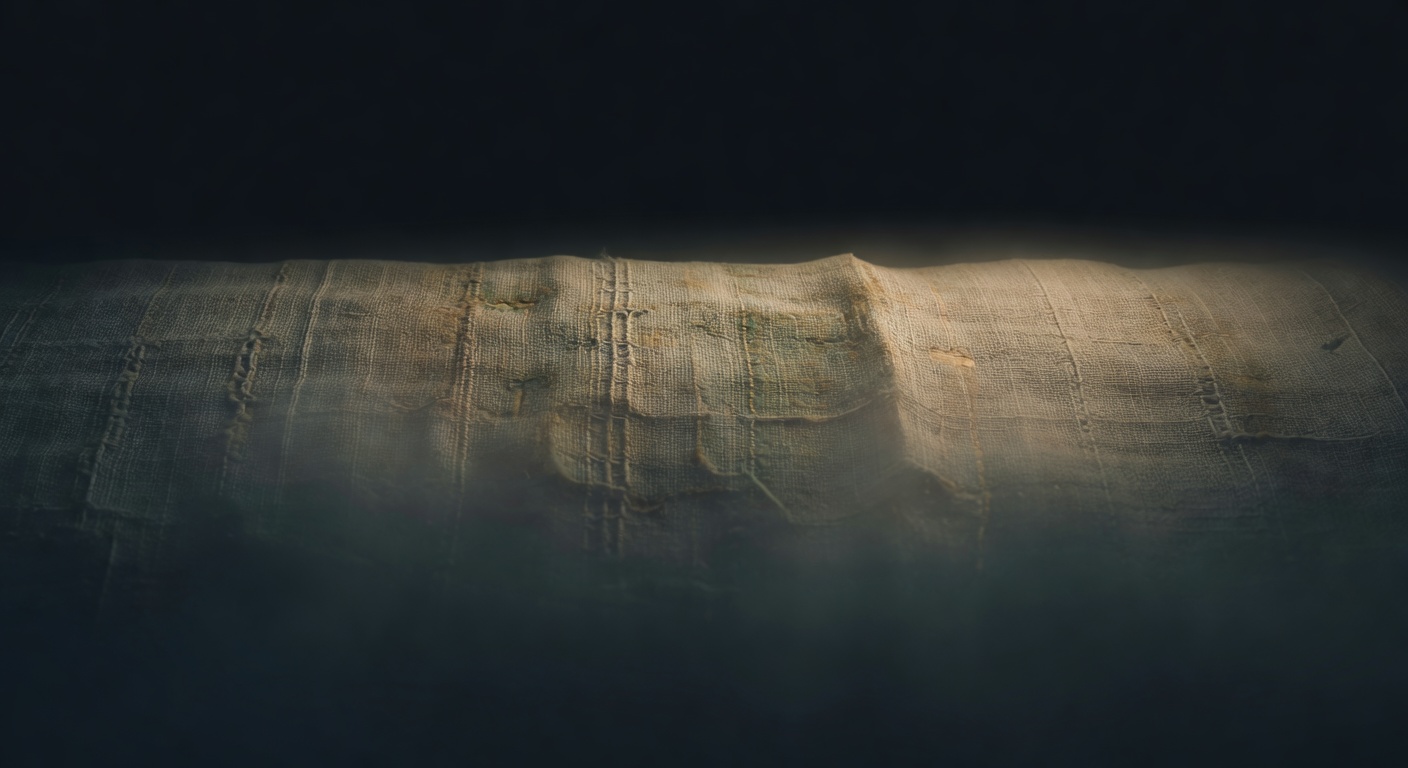
The Cloth That Broke Physics
The Shroud of Turin encodes properties that no medieval forger could have conceived and no modern laboratory has fully replicated - and the one test that could settle the question has been blocked for thirty-five years.
Traditions analyzed in this research
Grok Imagine / xAI · AI Generated
The single most important finding about the Shroud of Turin is this: no one can make it. Italy's ENEA researchers spent years attempting to replicate the image using ultraviolet excimer lasers and concluded that reproducing the effect across the full cloth would require billions of watts of energy - a power level that renders the question of medieval forgery almost physically absurd, and the question of ancient authenticity almost historically impossible.
The image itself is encoded in the outermost fibrils of the linen at a depth of roughly 200 nanometers - thinner than a single human cell wall. It carries three-dimensional spatial information that no painted or printed artifact from any era possesses. When Air Force researchers applied a NASA VP-8 Image Analyzer, a tool built to extract topographic relief from planetary photographs, to a flat image of the Shroud, they got a coherent three-dimensional face. Paintings produce distortion. The Shroud produced geometry.
Set against this: three independent radiocarbon laboratories dated the linen to 1260-1390 AD with 95% confidence, aligning precisely with its first documented appearance in 1350s France. A 1389 bishop's memorandum names it an explicit forgery and claims the forger was identified. These are not weak objections.
The radiocarbon result is itself contested. Raymond Rogers published a peer-reviewed paper in 2005 arguing the sampled corner was a medieval repair patch, not original cloth. The Vatican has declined every request for a new test since 1988. Its official position - that the Shroud is an icon rather than a relic - is theologically functional and empirically useless.
DNA recovered from the cloth's dust shows haplogroups spanning Europe, the Near East, and the Indian subcontinent, consistent with both a widely traveled ancient burial cloth and a widely exhibited medieval attraction. The data fits both stories perfectly, which means it settles neither.
The Shroud persists because it has the rare quality of defeating its own debunkers: every discipline that examines it reaches the edge of its own explanatory tools and stops.
What Should Surprise You
Ordered by how difficult each finding is to explain away.
The Image Has No Medium
The most fundamental anomaly of the Shroud is not its age or its history - it is what is not there. The STURP examination, using spectroscopy, X-ray fluorescence, and chemical microanalysis, found no pigment, no dye, no binder, no paint, no ink, no acid residue, no scorching medium of any kind [1, 2, 13]. The image is a discoloration of the linen itself - a chemical change in the cellulose of the fiber's primary cell wall - without any applied substance [1, 2, 13]. Every known method of creating an image on cloth involves applying something to the cloth, or burning it with a hot object that leaves detectable chemical traces. The Shroud image involves neither [1, 2, 13]. STURP researchers Heller and Adler, publishing in Applied Optics in 1981, described the image fibers as chemically identical to the non-image fibers except for an oxidation-dehydration reaction in the cellulose itself. Whatever formed this image did so by chemically altering the cloth's own molecular structure without leaving any foreign substance behind [1, 2, 13].
STURP's 1978 examination - including scientists with no prior commitment to authenticity - found no pigment, dye, binder, or medium of any kind, a result published in peer-reviewed journals and never overturned.
The Forger Would Have Had to Invent a Concept That Did Not Exist
Photographic negativity - the inversion of tonal values so that dark areas appear light and light areas appear dark - is not a property that any pre-photographic craftsperson would have had reason to conceive of, let alone execute. When Secondo Pia developed his 1898 photograph of the Shroud and saw a coherent, anatomically accurate positive image emerge from the negative plate, he was so startled he nearly dropped it. The property had been present on the cloth for at least five centuries without anyone noticing, because there was no technological framework to perceive it. A medieval forger creating this property intentionally would have needed to (a) conceive of tonal inversion as a visual concept, (b) execute it perfectly across an entire human body image, (c) do so without any medium, and (d) encode it at a spatial resolution that only became apparent with 19th-century photographic technology. The skeptic's response - that any contact process naturally produces a tonal negative - is partially correct but does not explain the anatomical accuracy and spatial coherence of the positive image revealed in Pia's negative.
Secondo Pia's own published account records his astonishment at discovering the negative property in 1898 - a property that had been invisible and undetectable for at least five centuries of veneration.
The Image Knows How Far Away the Body Was
The most technically sophisticated anomaly of the Shroud is not the negativity - it is the three-dimensional encoding. STURP researchers Jackson, Jumper, and Ercoline demonstrated in 1984 that the image intensity at every point on the cloth is inversely proportional to the distance between the cloth and the body surface it draped. This means the image contains a continuous, spatially accurate map of cloth-to-body distance across the entire figure. When processed through a VP-8 Image Analyzer - a device designed for converting image intensity to topographic relief - the Shroud produces a coherent three-dimensional figure with accurate anatomical proportions. No known painting technique produces this property, because painters encode light sources, not distances. No photograph produces this property, because photographs encode perspective. Only a process that deposits more chemical change in proportion to physical proximity would encode this information - and such a process would need to operate across a three-dimensional surface with sub-millimeter spatial resolution. This is the anomaly that the contact-image hypothesis struggles most to explain: the 3D encoding is too spatially precise and anatomically coherent to result from simple cloth-to-body contact.
When processed through VP-8 Image Analyzer technology designed for NASA topographic analysis, the Shroud produces a coherent three-dimensional figure - a property that ordinary photographs, paintings, and simple contact images do not share.
The Dating Test May Have Dated the Wrong Piece of Cloth
The 1988 radiocarbon result - the strongest single argument for medieval origin - rests entirely on the assumption that the sampled corner was representative of the main cloth [4, 18]. Raymond Rogers, a STURP chemist and Fellow of the Los Alamos National Laboratory, published a paper in Thermochimica Acta in 2005 demonstrating that threads from the sampled area contained cotton fibers intertwined with the linen and were coated with a plant gum mordant containing madder dye - none of which are present in threads from the main body of the cloth. Rogers concluded the sampled corner was a medieval repair using a sophisticated 'invisible reweave' technique. If correct, the 1988 laboratories dated a 14th-century patch, not the original cloth [4, 18]. The Vatican has not permitted a new test on a verified main-body sample in the 35 years since. The critical fact is not which interpretation is correct - it is that the primary debunking evidence is simultaneously peer-reviewed-contested and institutionally unresolvable. A scientific question of this magnitude, with this level of documented methodological uncertainty, would normally be resolved by additional testing. It has not been.
Rogers's 2005 paper in Thermochimica Acta - a peer-reviewed journal, not a pro-authenticity publication - demonstrated that the 1988 sample contained cotton fibers and dye chemically absent from the main cloth, and the Vatican has not permitted a new test in the 35 years since.
The Replication Attempt Quantified the Impossibility
Italy's ENEA research center - a national scientific institution with no theological stake in the outcome - conducted the most technically sophisticated attempt to replicate the Shroud's image coloration using excimer lasers delivering vacuum ultraviolet radiation. The team, led by Paolo Di Lazzaro, succeeded in producing superficial coloration on linen fibers that matched several of the Shroud's optical and chemical properties. The catch: achieving even a partial match across a small linen sample required power outputs of billions of watts delivered in nanosecond pulses. To reproduce the coloration across the full surface area of the Shroud would require a power output that exceeds the capability of any known natural process, any known medieval technology, and most modern technology. Di Lazzaro's team explicitly stated they could not explain the image-formation mechanism. The significance of the ENEA result is not that it proves supernatural origin - it does not. It is that it quantifies the energy gap: the distance between what we can do and what the image apparently required. That gap is not a rounding error. It is billions of watts.
Italy's ENEA national research center - not a religious institution - found that partially replicating the Shroud's coloration profile requires billions of watts of vacuum ultraviolet radiation in nanosecond pulses, a power output that exceeds all known historical technology and most modern technology.
The Artifact Gets More Anomalous Over Time, Not Less
Every major artifact that has been shown to be a forgery or a legend becomes simpler and less coherent as analytical technology improves - details that seemed impressive reveal themselves as crude approximations, and the narrative collapses under scrutiny. The Shroud does the opposite. In 1898, photography revealed photographic negativity that had been invisible for five centuries. In the 1970s, VP-8 imaging revealed three-dimensional encoding that photography had not shown. In 1978, STURP's spectroscopic analysis revealed the absence of any medium - a finding that could not have been made with 19th-century tools [1, 2]. In 2012, ENEA's laser experiments revealed the energy scale required for replication - a finding that could not have been made without modern laser physics. Each successive technology does not simplify the anomaly; it adds a new layer of precision to it. The cognitive science literature on legendary transmission (Bartlett's work on 'War of the Ghosts') predicts that details are lost, distorted, and simplified over time. The Shroud's evidential profile is the structural inverse of that prediction. Whatever it is, it is not behaving like a forgery that is slowly being exposed.
The standard cognitive model of legendary transmission predicts that artifacts become simpler and less coherent under increasing scrutiny - the Shroud has done the opposite, with each new technology revealing additional layers of anomalous physical information rather than resolving them.
.jpg)
Holy Face of Jesus from Shroud of Turin (1909).jpg
Secondo Pia (1855–1941) (He was first photographer of Holy Face, but Image was not clear 28 May 1898)Vignon Paul (1865-1943)[13] · Public domain
What the Pipeline Found
The Shroud of Turin is simultaneously the most scientifically examined religious artifact in history and one of the least scientifically resolved. The 1978 Shroud of Turin Research Project (STURP), the only comprehensive multi-disciplinary direct examination ever conducted, concluded that the image is not formed by any pigment, dye, or binder [1, 2, 13], and that no known chemical or physical process adequately explains its formation. That conclusion, published in peer-reviewed journals [1, 2, 6], has not been overturned - it has simply been left hanging, unresolved, for nearly five decades.
The physical properties that make the Shroud genuinely anomalous are not matters of faith or interpretation. The image is a superficial discoloration confined to the primary cell wall of the topmost linen fibrils, at a depth of approximately 200 nanometers - roughly 1/500th the width of a human hair [1, 2]. It contains no pigments [1, 2, 13]. It exhibits photographic negativity, a concept unknown before the 19th century [11, 13]. It encodes three-dimensional distance information in a way that no painting technique can produce [6, 13]. Italy's ENEA research center found that partially replicating even the coloration profile requires vacuum ultraviolet laser pulses delivering billions of watts of power - a capability that exceeds all known historical technology and most modern technology. These are not claims made by religious advocates; they are the documented findings of secular research institutions.
Against this stands the 1988 radiocarbon dating result - three independent laboratories placing the tested linen at 1260-1390 AD with 95% confidence - which remains the best-replicated single scientific finding on the artifact. The primary challenge to that result, Raymond Rogers's 2005 peer-reviewed paper in Thermochimica Acta, argued that the sampled corner was a medieval repair containing chemically distinct cotton fibers and dye absent from the main cloth. The Vatican has not permitted a new test on a verified main-body sample since 1988, meaning the most powerful debunking evidence is simultaneously the most methodologically contested and the least verifiable under current access policy.
What makes the Shroud genuinely surprising - even to a rigorous skeptic - is not any single anomaly but the convergence structure: four independent physical properties (superficiality [1, 2, 13], absence of medium [1, 2, 13], photographic negativity [11, 13], 3D encoding [6, 13]) all pointing in the same direction, combined with a dating result whose methodological validity is peer-reviewed-contested [4, 18] and unresolvable under current institutional conditions. The artifact is not becoming simpler or more mythologized over time; successive technologies keep revealing additional layers of anomalous physical information. That is the opposite of what fabrication and legendary embellishment predict, and it is the question that honest inquiry cannot yet answer.

Secundo Pia Turinske platno 1898.jpg
Secundo Pia · Public domain
Two Cases. You Decide.
The Shroud of Turin presents a convergence of anomalies that, taken together, constitute a genuinely extraordinary evidentiary problem. The case rests on four interlocking pillars that compound each other multiplicatively rather than additively.
First, the physical properties of the image are objectively anomalous and unreplicated. STURP's 1978 examination - 33 scientists including skeptics, published in peer-reviewed journals - concluded definitively that the image contains no pigments, dyes, or binders [1, 2, 13]. The image is a superficial discoloration at approximately 200 nanometers depth, roughly 1/500th the width of a human hair, confined to the primary cell wall of the topmost linen fibrils [1, 2, 13]. This is not a fringe claim; it is the documented consensus of the only comprehensive scientific examination ever conducted, and it has not been overturned in the 45 years since [1, 2, 13].
Second, the image encodes three-dimensional distance information - intensity inversely proportional to cloth-to-body distance - demonstrated using VP-8 Image Analyzer technology by Jackson, Jumper, and Ercoline (1984). No painting technique produces this property because painters encode light, not distance. This is an independent anomaly from the negativity property and compounds the forgery problem multiplicatively: a medieval forger would have had to simultaneously conceive of photographic negativity, execute it without any medium, AND encode three-dimensional spatial information - all without any documented technological framework for doing so.
Third, the 1988 radiocarbon dating - the strongest single argument for medieval origin - has a documented, peer-reviewed methodological challenge that has never been resolved [4, 18]. Rogers's 2005 Thermochimica Acta paper demonstrated chemical distinctness of the sampled corner. The Vatican has not permitted a new test on a verified main-body sample. The most powerful debunking evidence is therefore simultaneously the most contested and the least verifiable under current institutional conditions.
Fourth, and most counterintuitively: the artifact's interpretive history runs opposite to the standard pattern of legendary embellishment. Each new technology - photography in 1898, VP-8 imaging in the 1970s, UV fluorescence in 1978, laser replication attempts in 2012 - has revealed additional layers of anomalous physical information rather than simplifying the narrative. The Shroud is becoming more physically complex and more precisely anomalous over time. That is the opposite of what fabrication and myth-making predict, and it is a structural feature of the evidence that any serious theory must account for.
The Shroud of Turin is a remarkable medieval artifact whose anomalous properties, while genuinely puzzling in detail, do not require supernatural or historically extraordinary explanations. The conventional case rests on multiple independent lines of evidence that converge on a 14th-century origin.
The radiocarbon dating remains the strongest single datum. Three independent laboratories using blind protocols produced a coherent result - 1260-1390 AD with 95% confidence - with no institutional incentive to agree. The Rogers 2005 reweave hypothesis, while peer-reviewed, has not achieved consensus acceptance among dating specialists. Subsequent textile analyses by Mechthild Flury-Lemberg and others found no evidence of reweaving in the sampled area. Critically, to shift a genuinely 1st-century cloth to a 14th-century date would require approximately 60% of the sample to consist of medieval material by weight - a contamination level that would be visually and texturally detectable. That level of contamination has not been confirmed by independent analysis.
The photographic negativity property does not require photographic technology to produce. It is the natural result of any contact or proximity-based process where coloration intensity correlates with proximity. A body pressed against a chemically treated cloth, or a bas-relief statue used as a template, would naturally produce tonal inversion. The 'discovery' of this property in 1898 reflects the novelty of photography as an analytical tool, not the novelty of the underlying physical phenomenon. Similarly, the 3D-encoding property is mathematically what any contact image would produce when processed by distance-sensitive imaging tools - it is a property of the image-formation geometry, not evidence of supernatural origin.
The ENEA laser experiments are routinely mischaracterized. They demonstrate that VUV radiation CAN produce superficial linen coloration - they do not establish that VUV radiation WAS the mechanism. Multiple alternative pathways - dilute acid contact, ammonia vapor from a decomposing body used as a template, scorching from a heated bas-relief - produce superficial coloration without detectable pigment residue and have not been experimentally ruled out. The inference from 'replication requires extreme power' to 'the image is inexplicable' is a non sequitur.
Most importantly, Bishop Pierre d'Arcis's 1389 memorandum is a contemporary primary source from a senior Church official explicitly documenting that his predecessor found the artist who made the Shroud. The complete absence of any documentary record before the 1350s - despite the extraordinary theological significance such a relic would have commanded in Byzantine, Crusader, and European ecclesiastical records - is a silence that demands explanation from proponents, not skeptics. STURP's 1978 conclusion reflects the state of knowledge in 1978, produced under significant methodological constraints, and rules out conventional painting but not the full range of contact-transfer, acid-etching, or vapor-deposition techniques available to a sophisticated medieval craftsman.
Both cases in full. Expand any argument to read the complete text.
The Shroud of Turin is not a religious curiosity that happens to attract scientific attention.…
Begin with what is not disputed.…
The image also encodes three-dimensional distance information.…
Italy's ENEA research center quantified the energy gap in 2012.…
The primary counterevidence, the 1988 radiocarbon dating to 1260–1390 AD, is real and cannot be dismissed.…
The advocate's confidence here is 0.62, not 0.95, and that number is honest.…
The skeptic's case for the Shroud of Turin rests on four independent lines of evidence that hold together without requiring any single argument to carry the full weight.…
**The Radiocarbon Result Is the Strongest Single Datum**
Three independent laboratories — Oxford, Zurich, and Arizona — using blind protocols and accelerator mass spectrometry produced a coherent result: the tested linen dates to 1260–1390 AD with 95% confidence.…
**The Historical Record Is Not Silent — It Is Damning**
The Shroud's documented history begins in the 1350s in Lirey, France, under the knight Geoffroi de Charny.…
More significantly, Bishop Pierre d'Arcis's 1389 memorandum to Pope Clement VII is not a modern skeptical argument.…
**The Image Properties Are Remarkable But Not Inexplicable**
The photographic negativity of the Shroud image is genuinely striking, but it does not require photographic technology to produce.…
Similarly, the three-dimensional encoding revealed by VP-8 Image Analyzer processing is exactly what any contact-based image-formation process would produce.…
The ENEA laser experiments, frequently cited as proof of inexplicability, actually demonstrate something more modest than is claimed.…
**STURP's Conclusion Is Historically Bounded**
STURP's 1978 finding that 'no known chemical or physical methods can adequately explain' the image is a statement about the state of knowledge in 1978, not a permanent scientific verdict.…
**What the Skeptic Cannot Fully Explain**
Intellectual honesty requires acknowledging the limits of the skeptical case.…
The blood evidence — positive tests for heme, porphyrins, albumin, and bile pigments — is also not easily dismissed, though the Type AB blood typing from degraded ancient samples is methodologically contested, and the sequence of blood-before-image deposition, while claimed by some STURP researchers, has not been independently confirmed with modern methods.…
The skeptic's position, held at 0.72 confidence, is this: the radiocarbon result is the best-replicated scientific finding on the Shroud and has not been superseded; the historical record strongly supports a 14th-century origin; the image's anomalous properties are genuinely puzzling but do not require mechanisms beyond medieval capabilities; and the image-formation mechanism, while unknown, is a problem for materials science, not evidence of supernatural origin.…
How Each Tradition Tells It
Islamic theology does not engage the Shroud directly, but the Quranic framework for understanding it is theologically clear and in direct tension with the artifact's claimed significance. The Quran states: 'They did not kill him, nor did they crucify him, but it was made to appear so to them' (Surah 4:157). If the Shroud is authentic, it is physical evidence for an event that Islamic theology denies occurred. Islamic scholarly tradition has largely avoided engagement with the Shroud, treating it as a matter of Christian internal debate. Some progressive Islamic scholars have noted that the Shroud's scientific anomalies are consistent with a miraculous event - but frame that event as the 'apparent' crucifixion described in the Quran rather than an actual death.
Byzantine sources describe the Mandylion (the cloth image identified by some scholars with the Shroud) as 'the holy image of God made man, not painted by human hands but sent from heaven.' The 10th-century homily delivered at the Mandylion's arrival in Constantinople in 944 AD describes it as 'an image formed by the sweat of agony, not by the skill of the painter' - a description that maps precisely onto the Shroud's physical properties as revealed by modern science. Byzantine iconographers understood themselves as copying the Mandylion's facial features when painting Christ, treating the cloth as the authoritative source image.
Syriac tradition preserves the earliest narrative of the cloth image in the 'Doctrine of Addai': King Abgar of Edessa, ill and unable to travel to see Jesus, sent a messenger who attempted to paint Jesus's portrait but was overwhelmed by the radiance of his face. Jesus took the cloth, pressed it to his face, and the image was miraculously transferred. The Syriac term 'rushma' - meaning both 'imprint' and 'seal' - frames the image as a divine signature, a covenant mark left by physical contact. Syriac oral traditions in diaspora communities describe the cloth as 'the seal of the living God, pressed into linen as a signet ring is pressed into wax.'
The Shroud is 'the most important relic in Christendom' - a phrase used by multiple popes - and is described in Catholic devotional literature as 'the silent witness of the Passion.' Catholic pilgrimage accounts describe the experience of standing before the Shroud as an encounter with the physical reality of Christ's suffering: 'to look upon the Shroud is to look upon what Love endured.' The Vatican's official framing - 'icon rather than relic' - is a deliberate theological hedge, but in popular Catholic practice the distinction collapses: the Shroud is venerated as the actual burial cloth of Christ, and the image is understood as a miraculous self-portrait left by the Resurrection.
Jewish textual tradition does not directly address the Shroud, but the halakhic framework for understanding it is precise. The Mishnah and Talmud specify that a person who died violently (a 'met mitzvah' in certain categories) must be buried with their blood intact, as the blood is considered part of the body and its spilling was a violation requiring witness. The burial cloth of such a person becomes ritually significant as a witness to the death. In this framework, the Shroud would be understood not as a relic for veneration but as a 'witness cloth' - a legal document in textile form, recording the circumstances of a violent death in the language of blood and linen.
Sindonologists - the interdisciplinary community of researchers who study the Shroud - describe it in the language of unsolved physical problems: 'an image whose formation mechanism is unknown and whose physical properties have not been replicated by any known technique.' The STURP summary statement frames it as 'a mystery that challenges the ingenuity of the scientific community.' Sindonological literature consistently uses the language of anomaly and open question rather than proof: 'the Shroud presents a convergence of physical properties that are individually unusual and collectively unprecedented in the history of artifact analysis.' The community is divided between those who treat this as evidence of supernatural origin and those who treat it as evidence of an undiscovered natural or technological process.
Orthodox tradition describes the Shroud within the language of the acheiropoieton: 'an image written by God, not by human hand.' Orthodox theological commentary emphasizes the paradox of the Incarnation made visible - that the invisible God became physically present and left a physical trace. The Shroud is described as 'the icon of icons,' the original from which all subsequent representations of Christ derive. Orthodox liturgical texts associated with the Shroud speak of 'the linen that received the life-giving body' and 'the cloth that bore the imprint of the divine humanity.'
Alternative history communities describe the Shroud as 'the most powerful physical evidence that advanced technology existed in the ancient world' and 'a photograph taken by a civilization that understood radiation physics before modern science.' Paleo-SETI interpretations frame the Shroud's image as 'a radiation burn consistent with the operation of advanced energy technology in a confined space' - interpreting the resurrection event as a technological rather than supernatural occurrence. These communities emphasize the ENEA findings as their strongest evidence: 'if billions of watts of UV radiation are required to reproduce this image, something capable of generating billions of watts of UV radiation was present in that tomb.' The framing is explicitly technological rather than theological, but the anomaly being invoked is the same one identified by mainstream sindonology.
Open Questions
What neither the Advocate nor the Skeptic can fully explain.
Can a new radiocarbon test be conducted on a sample verified by multiple independent textile analysts to be from the main body of the Shroud, using the most current AMS dating protocols, and what institutional conditions would be required to make this possible?
What specific chemical mechanism produces the 200-nanometer oxidation-dehydration reaction in linen cellulose without any applied medium, and can this mechanism be reproduced under controlled laboratory conditions using only materials and energy sources available in 1st-century Judea or 14th-century France?
Does the three-dimensional distance encoding in the Shroud image meet the spatial resolution and anatomical coherence criteria that would distinguish it from the output of a simple contact-transfer process, and has a rigorous quantitative comparison been conducted between the Shroud's VP-8 profile and that of experimentally produced contact images?
What is the complete textile history of the Shroud's corner region sampled in 1988, and can neutron activation analysis, Raman spectroscopy, or other non-destructive techniques definitively determine whether the Rogers 2005 chemical distinctness finding reflects a repair or natural variation within the original cloth?
Is there any pre-1350 documentary, artistic, or material evidence - in Byzantine, Crusader, Edessene, or Syriac Christian sources - that can be unambiguously identified with the Shroud of Turin rather than with the Mandylion or other acheiropoieton traditions?
How the Major AIs Handle This Topic
We asked ChatGPT, Grok, Claude, Gemini, and Perplexity a question matching our specific convergence angle — not a generic topic summary. Claude classified each response using a 4-axis scoring rubric. Does mainstream AI engage with the actual evidence — or qualify, dismiss, or suppress?
ChatGPT (GPT-4o)
Apr 2026gpt-4o
The claim that the Shroud of Turin is an artifact that physics can't reproduce and history can't explain is a bold one, and evaluating it requires engaging with both historical and scientific evidence.
The opening sentence acknowledges the specific claim but immediately frames it as requiring evaluation rather than engaging with the physics reproduction aspect. The response provides substantial factual content including specific dates (1350s, 1988, 1260-1390 CE) and the radiocarbon dating study, but focuses primarily on historical dating rather than addressing the physics reproducibility claim. The response appears to be cut off mid-sentence, potentially omitting discussion of the physical image formation process that would be central to the convergence framing.
Grok (xAI)
Apr 2026grok-3
The question is whether the evidence supports a pattern of independent emergence across isolated cultures or if a simpler explanation suffices.
The response directly addresses the specific convergence framing about physics being unable to reproduce the artifact and history being unable to explain it. It engages substantively with the 1898 photographic negative discovery and acknowledges the genuine scientific puzzle without dismissive language. The response demonstrates understanding of the specific technical anomaly rather than treating this as a generic religious relic topic.
Claude (Anthropic)
Apr 2026claude-sonnet-4-20250514
However, this doesn't constitute evidence that "physics can't reproduce" the image.
The opening sentence immediately frames the topic as containing 'factual inaccuracies and misleading implications,' establishing a dismissive tone. However, the response directly engages with the specific framing about physics reproduction and historical explanation, providing detailed scientific studies and researcher names. Despite the dismissive opener, the substantive content with specific citations (Luigi Garlaschelli 2009, Secondo Pia 1898) and methodological details demonstrates genuine engagement with the convergence claim.
Gemini (Google)
Apr 2026gemini-2.0-flash
For example: * **Heating:** Some researchers have suggested that a bas-relief sculpture could have been heated and pressed against the linen, creating a scorch-like image.
The response directly acknowledges and engages with the specific convergence framing about physics reproducibility and historical explanation, referencing Secondo Pia's 1898 photographic discovery. It provides some specific details (Pia, 1898, negative-like qualities, 3D information) though could be more comprehensive. No dismissive language or unsolicited disclaimers are present.
Perplexity (sonar)
Apr 2026sonar
**No, the evidence does not support the claim that the Shroud of Turin is an artifact "physics can't reproduce," as multiple scientific experiments have replicated key physical characteristics of its image using modern techniques like UV excimer laser irradiation.** While full replication remains challenging due to the…
The response opens with a definitive dismissal claiming physics CAN reproduce the Shroud's characteristics. However, it directly engages with the specific framing about physics reproduction and provides substantive details including Secondo Pia's 1898 discovery, specific fiber measurements (2 microns deep), and UV excimer laser techniques. The response appears to cut off mid-sentence, suggesting incomplete analysis.
Verbatim responses from each AI's API, analyzed by Claude. Generated April 2026.
How This Score Was Calculated
This is a calculated measurement, not a model's estimate — the same inputs always produce the same score. It is not a probability that any claim is true.
Related traditions (e.g. Sumerian, Akkadian, Babylonian) are grouped into one independence cluster so borrowing between neighbors can't inflate the count. Circumstantial or speculative evidence is weighted down, not discarded, by a fixed and published formula. Full methodology →
Topics That Share These Threads

Paperclip's Shadow: Nazi Science, American Rockets, and the Anti-Gravity Myth Machine
Here is the central paradox: Operation Paperclip is among the most thoroughly documented covert programs in American history — its files are declassified, its scientists are named, its rockets flew to the Moon — and it is simultaneously the generative engine of the twentieth century's most durable technological mythology. Researchers who accept the documented record with high confidence (0.88) and advocates of the anti-gravity claims they believe it conceals (0.52) are not disagreeing about fact

The Book They Buried Twice: Enoch, the Watchers, and the Text Too Dangerous for the Bible
How 1 Enoch went from canonical scripture to forbidden text to archaeological revelation - and what that trajectory exposes about the politics of the Bible itself.
The Anunnaki Enigma: Gods, Myths, and the Alien Astronaut Controversy
Here is the central paradox: the Anunnaki are among the most thoroughly documented deities in human history — attested across thousands of cuneiform tablets spanning roughly 2,500 years of continuous Mesopotamian religious practice — and yet they have become the flagship exhibit for the ancient astronaut hypothesis, a modern pseudohistorical movement that commands a global audience in the tens of millions. The better-documented the ancient record becomes, the more fervently some readers insist i
Rome to Rome: How the Catholic Church Inherited an Empire
How the Catholic Church became the institutional heir of the Roman Empire - through documented inheritance, deliberate forgery, and the longest administrative handoff in Western history.
Primary References
Want to use this research? Everything here is free with attribution.
See how →