The Billionaire and the Antichrist
How Peter Thiel's documented Girardian commitments intersect with a five-century tradition of mimetic eschatology - and why the sourcing crisis around his private lectures matters as much as the lectures themselves.
Traditions analyzed in this research
Site owner · Own
What happens when a billionaire tech investor takes the Antichrist seriously? Not as metaphor. As a working theory of how power operates through imitation and deception. Peter Thiel studied under René Girard, the philosopher who argued all human conflict runs on mimetic desire. Girard's late work reached a blunt conclusion: the Antichrist is the ultimate mimic. A figure indistinguishable from Christ in appearance, whose power comes from perfect imitation.
The explosive claims—that Thiel gave secret lectures naming specific people as agents of the Antichrist—rest on sources that multiple independent researchers flagged as unverifiable. Some citations contained future dates. None appeared in major archives. But what survives that collapse is genuinely striking. The theology of the deceptive imitator is not fringe. It is a five-century intellectual tradition with a direct line from Renaissance cathedrals to Stanford classrooms.
Thiel's documented public ideas—monopoly over competition, skepticism of democratic performance, surveillance as social architecture—map onto the Antichrist framework with unsettling precision. Whether that mapping is private conviction or strategic tool is the question nobody can yet answer.
René Girard arrived at Stanford in 1981 and spent three decades building one of the most unusual intellectual legacies in American academic life. His core idea was deceptively simple. All desire is borrowed. We want what others want because they want it. From that seed grew a theory of violence, sacrifice, and scapegoating that earned him election to the Académie française and a following that crossed disciplinary lines. Thiel was his student in the late 1980s, and the relationship stuck. Thiel co-founded the Imitatio foundation to fund mimetic theory research. He cited Girard in his bestselling business book. He delivered a eulogy when Girard died in 2015.
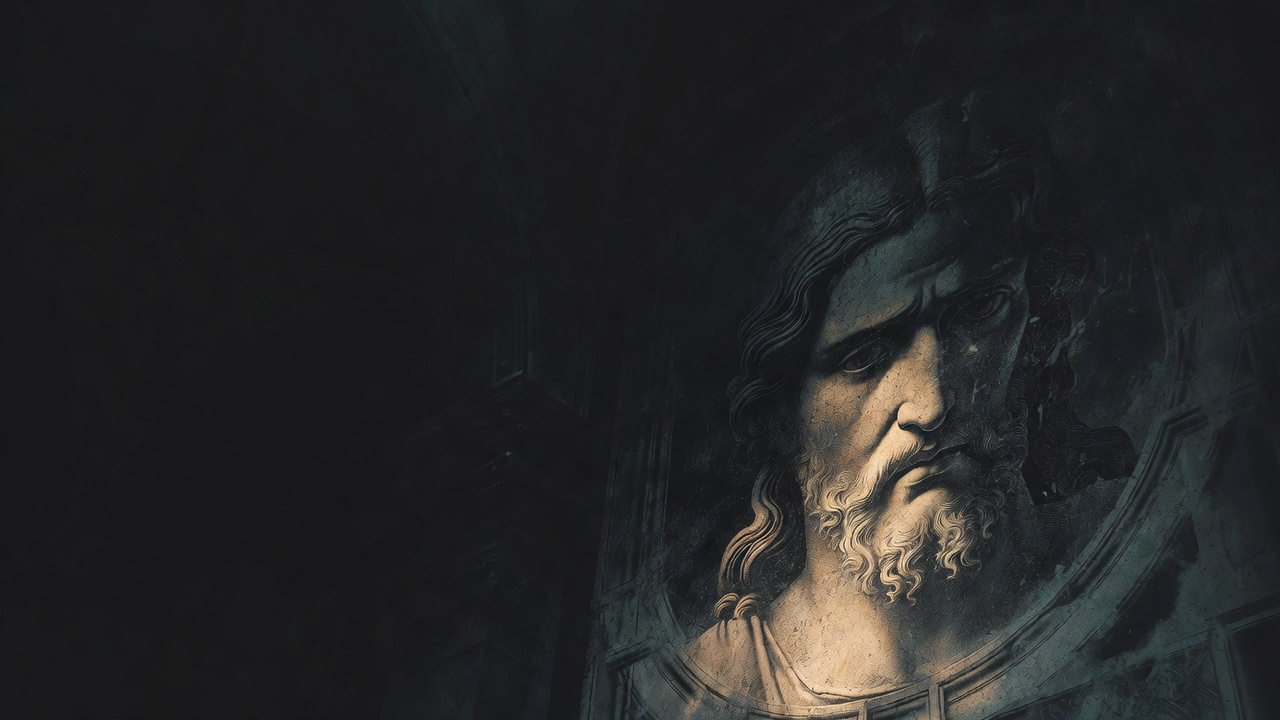
What fewer people tracked was where Girard's own thinking went in its final phase. In "Battling to the End," published in 2010, Girard stopped treating the Antichrist as allegory. He argued that mimetic escalation, left unchecked, produces a figure who perfectly imitates the sacred while hollowing it out. Not a horned devil. A convincing copy. This was not new theology so much as a recovery of very old theology. The Johannine epistles warn of "many antichrists" already present. Paul's second letter to Thessalonica describes a "man of lawlessness" who seats himself in the temple. By 1501, Luca Signorelli had painted the concept into the cathedral at Orvieto: a calm, Christ-like figure whispering to crowds while demons orchestrate chaos behind him.
Thiel inherited all of this. The question is what he did with it. The documented public record and the unverifiable private claims tell very different stories, and the gap between them is where the real tension lives.
The trail has two halves: one carved in stone and paint, the other dissolving under scrutiny. Here's what each actually contains.
Signorelli Painted the Girardian Antichrist in 1501
In 1501, painter Luca Signorelli depicted the Antichrist not as a horned monster but as a Christ lookalike. Same robes, same posture, same authority—with a demon whispering in his ear. This is mimetic deception rendered in fresco four centuries before Girard gave it a name. The philosophical insight was already there, fully formed, on a cathedral wall.
A Florentine painter in 1501 depicted the exact social dynamic that a French philosopher would formalize as 'mimetic theory' in 1961 - and a Silicon Valley billionaire would reportedly apply to AI governance debates five centuries later.
But Signorelli was painting a figure that technically didn't exist yet.
The Antichrist Was Never a Single Future Figure - Until It Was
The word 'antichrist' appears only in the letters of John. There it means something plural and present—people denying Christ's incarnation. The singular tyrant who demands worship, controls commerce, and performs false miracles? That figure was assembled over centuries from Daniel, Thessalonians, and Revelation. Each era rebuilt the composite to match its own anxieties. Thiel's reported version is just the latest renovation.
The word 'antichrist' never appears in the Book of Revelation - the most famous apocalyptic text in Western history - and the unified figure most people imagine is a composite assembled from at least four distinct textual traditions across two centuries.
That restraining force has its own dark intellectual history.
The Restrainer: A 2,000-Year-Old Political Theory
Paul mentions a mysterious 'Restrainer' holding back lawlessness. He never says who or what it is. Early Christians said it was Rome. Medieval thinkers said the Church. In the twentieth century, jurist Carl Schmitt used it to argue that strong sovereign power prevents apocalyptic collapse. Thiel's reported use of this concept places him in Schmitt's direct intellectual lineage—with all the implications that carries for his political investments.
The same two-thousand-year-old Greek word - Katechon - appears in Paul's letter to Thessalonica, in Carl Schmitt's 20th-century theory of authoritarian sovereignty, and reportedly in Peter Thiel's private lectures on technology governance.
Each finding sharpens the same uncomfortable split: a genuinely significant intellectual tradition attached to a set of specific claims that keep failing verification. The question is what you do with that combination.
The DebateTwo Cases. You Decide.
The five-century theological tradition is real and traceable. The specific claims linking Thiel to secret Antichrist lectures are not. That gap between the framework's seriousness and the evidence's fragility is the actual problem.
The theology of deceptive imitation is not ancient trivia. It is a precise description of how modern power presents itself—legitimate form, inverted substance. Thiel has publicly committed to the framework that produces this analysis. The five-century convergence across scripture, art, and philosophy exists whether or not any private lecture ever happened.
Strip away the unverifiable lecture claims and what remains is a billionaire applying his college professor's published ideas. The sourcing crisis is not a footnote—it was the story's centerpiece. And the cross-cultural parallels collapse on inspection: nothing outside Christianity shares the Antichrist's specific structural features.
That divide is not unique to this moment. Communities across centuries and continents have wrestled with the figure of the sacred imitator—and reached conclusions that share almost nothing except the anxiety itself.
In Their Own WordsHow Different Cultures Tell It
The Antichrist is the perfect imitator - the one who has mastered the appearance of innocent victimhood without the reality of transcendence. Where Christ's death revealed the innocence of the scapegoat and broke the mechanism, the Antichrist's apparent victimhood re-enchants the mechanism, offering humanity a new unanimity built on a new lie. The Apocalypse is not God's punishment but the logical conclusion of human history once the scapegoat mechanism has been exposed but not transcended - a war of all against all, accelerating without limit, because the old sacrificial brakes have been removed.
The Antichrist is a specific future individual - often associated with European political leadership - who will sign a seven-year peace treaty with Israel, rebuild the Jerusalem Temple, and midway through the Tribulation period reveal himself by demanding worship in the Temple (the 'Abomination of Desolation'). He will control global commerce through the Mark of the Beast - a physical mark on the right hand or forehead without which no one can buy or sell. His reign will last three and a half years before Christ returns to defeat him at the Battle of Armageddon.
Strong convergence
Not a truth score. This measures how consistently unconnected cultures describe the same specific narrative elements — nothing more. How it's calculated →
The full picture on The Billionaire and the Antichrist is free.
6 findings, 6 cultural perspectives, full debate, timeline, sources with credibility ratings — everything, free with an account. No ads, no sponsors.
People & institutions referenced
Luca Signorelli
Personhistorical figure
Italian Renaissance painter whose c. 1501 fresco 'The Sermon and Deeds of the Antichrist' in Orvieto depicts the Antichrist as a Christ-like figure receiving demonic instruction, establishing a visual program directly relevant to the Girardian mimetic interpretation of the Antichrist discussed in connection with Thiel.
Greta Thunberg
Personrelated
Climate activist named in unverified claims about Thiel's private lectures, where she is allegedly characterized as a 'legionnaire of the Antichrist' due to her criticism of technology and industry. The research flags this claim as unverified.
René Girard
Personresearcher
French philosopher and Stanford professor whose mimetic theory — positing that human culture is founded on imitative desire resolved through scapegoating — forms the documented intellectual framework for Thiel's engagement with Antichrist concepts. Girard wrote explicitly about the Antichrist as a theological-sociological category.
Paul
Personhistorical figure
The Apostle Paul's description of being 'caught up to the third heaven' is identified as a canonical first-person account of an out-of-body experience, a core phenomenon in modern NDE research, linking scriptural tradition to the dossier's cross-cultural convergence argument.
Peter Andreas Thiel
Personrelated
Studied under René Girard at Stanford, co-founded the Imitatio foundation, and is the central subject of contested claims about private lectures applying Antichrist theology to contemporary political and technological figures.
Leo Strauss
Personhistorical figure
Invoked in the research as a possible framework for interpreting Thiel's off-the-record lectures as Straussian esoteric communication, though the text argues this explanation is unnecessarily complex.
Antiochus IV Epiphanes
Personhistorical figure
Identified in the text as the prototype for the Antichrist archetype in the Book of Daniel, forming part of the traceable theological lineage central to the research.
Imitatio Foundation
Institutionfunder
Co-founded by Peter Thiel to advance René Girard's mimetic theory, serving as documented evidence of Thiel's intellectual commitment to the Girardian framework.
Stanford University
Institutionrelated
The institution where Peter Thiel studied under René Girard, establishing the documented intellectual lineage between Thiel and mimetic theory.
University of California, Berkeley
Institutionrelated
A named but unspecified expert from UC Berkeley is cited in contested claims as having authenticated recordings of Thiel's alleged private lectures, though this authentication cannot be independently assessed.
Commonwealth Club
Institutionrelated
Cited in unverified source claims as the venue for Thiel's alleged private Antichrist lectures, though this cannot be confirmed through major news archives or the Internet Archive.
Internet Archive Wayback Machine
Institutioninvestigator
Used by research agents as a verification tool to check source citations for Thiel's alleged lectures, with searches returning no confirming results.
Orvieto Cathedral
Institutioncustodian
Houses Luca Signorelli's 1501 fresco depicting the Antichrist as a mimetic deceiver, cited as a primary visual artifact in the five-century theological tradition under analysis.