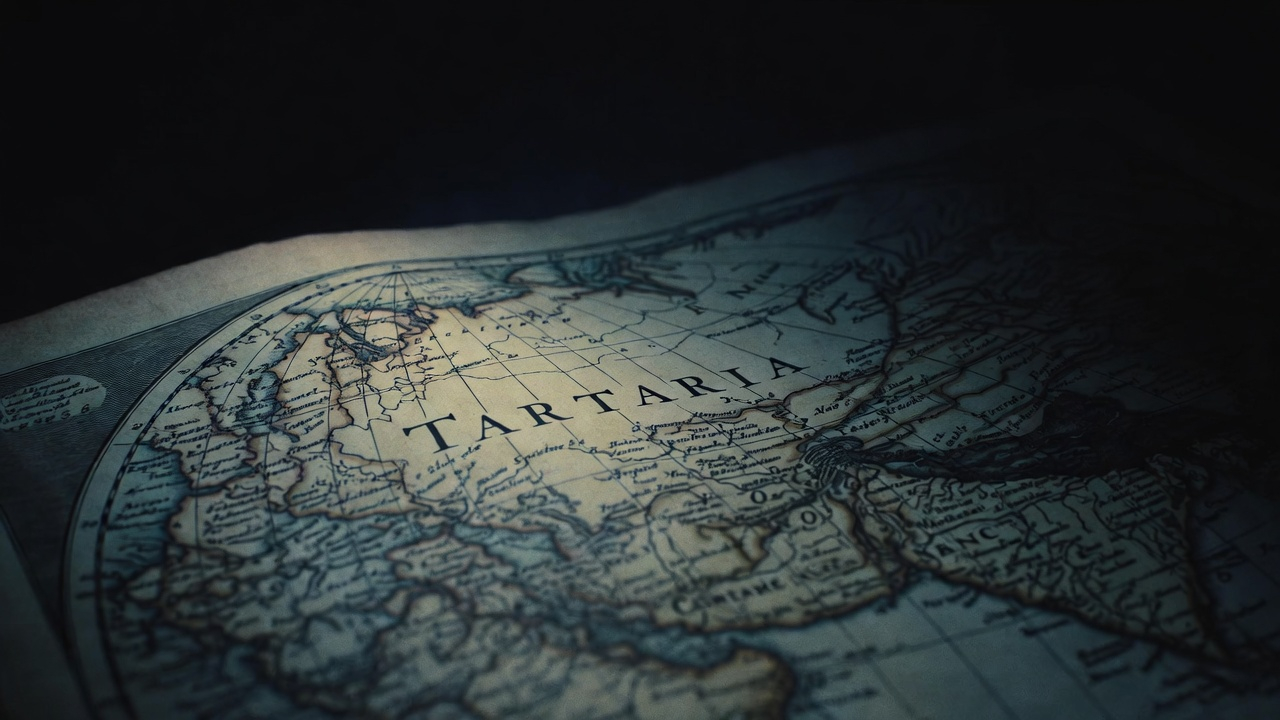
How a legitimate European geographic exonym became the scaffolding for a viral conspiracy theory, and what the gap between them reveals about historiographical failure, cartographic literacy, and the politics of erased pasts.
Site owner · Own
Here is the central paradox this investigation had to hold without flinching: 'Tartary' was real. It appeared on European maps for over six hundred years, earned a substantial entry in the Encyclopédie, and designated one of the most consequential and genuinely underrepresented regions in the history of human civilization. The empire, however, was not. The viral conspiracy theory built on this legitimate toponym — a unified, technologically advanced global civilization erased by coordinated suppression — earns an advocate confidence of just 0.11 against a skeptic confidence of 0.97 across every empirical discipline brought to bear on it.
What emerges from the evidence, across more than two dozen traditions including Western cartography, Enlightenment encyclopedism, Mongol indigenous historiography, geology, stratigraphy, forensic anthropology, architectural history, civil engineering, Aboriginal Australian oral tradition, and conspiracy theory studies, is near-total convergence in refutation of the theory's core claims. No geological evidence supports a worldwide 'mud flood' in the last five hundred years; global sediment layers show no anomalous, synchronous deposition of the kind required. The architectural styles attributed to a lost Tartarian empire — Beaux-Arts, Neoclassical, Second Empire — are documented 19th- and early 20th-century movements with known architects, construction records, and dated photographs. The buried ground floors cited as flood evidence are attributable to documented municipal engineering projects that raised street grades to install sewers. The 'giants' are a combination of 19th-century hoaxes, misread skeletal measurements, and the complete absence of the pathological markers that genuine gigantism leaves in bone. The World's Fair buildings were constructed, on record, by identified architects between 1891 and 1893. There are no Tartarian artifacts, no Tartarian language, no Tartarian genetic signal anywhere in the archaeological or genomic record.
What is genuinely extraordinary — and what the conspiracy theory accidentally gestures toward before destroying — is the actual history of Central Asia. The Timurid Renaissance produced architecture of staggering sophistication. The Silk Road sustained intercultural exchange across thousands of miles for centuries. The Mongol Secret History is a detailed indigenous account of political formation that directly contradicts the Tartarian hypothesis on its own terms. Aboriginal Australian oral traditions, the evidence confirms, accurately preserve accounts of post-glacial sea-level rise from as far back as ten thousand years ago, a finding that demonstrates pre-modern memory systems can be empirically reliable across vast timescales. These are the real lost histories. The conspiracy theory does not recover them. It replaces them with a fabricated European-adjacent empire and leaves the actual civilizations invisible.
Three tensions remain unresolved. The methodology for distinguishing legitimate historiographical underrepresentation from conspiratorial suppression is not fully operationalized; the evidentiary gap is real even if the conspiracy's explanation of it is not. If Aboriginal oral traditions can reliably encode ten-thousand-year-old catastrophic events, the principled criteria for deciding which folk traditions warrant serious empirical investigation remain underspecified. And while the conspiracy's origins in Russian nationalist writing and Fomenko's New Chronology are documented, what drove this specific narrative to viral spread across multiple languages between 2018 and 2020 is not fully accounted for. The documented failures of Western historiography regarding Central Asia created a genuine vacuum. What responsible historical education would fill that vacuum remains, for now, an open question.
Ordered by how difficult each finding is to explain away.
Multiple independent Aboriginal Australian oral traditions — from the Ngarrindjeri, Yolŋu, Tiwi, and other coastal groups — contain specific, geographically localized accounts of catastrophic flooding that swallowed coastlines and drowned familiar landmarks. When geologists mapped post-glacial sea-level rise between 18,000 and 7,000 years ago, they found that the flooding events described in these traditions correspond with precision to specific locations where sea levels are now known to have risen by up to 120 metres. These are not vague flood myths. They describe particular bays, islands, and reefs that are now underwater and were only confirmed as formerly dry land by modern bathymetric survey. The implication — that an unwritten memory system transmitted accurate empirical geographic data across roughly 400 generations — has no parallel in any other verified human tradition. The Tartaria conspiracy invents a suppressed civilization to explain architectural anomalies. The real suppressed history is this: the oldest continuously operating knowledge-preservation system on Earth was nearly destroyed by colonial erasure after 1788, and it turned out to contain information that geologists needed instruments to rediscover.
Geologists using bathymetric surveys have independently confirmed that specific underwater features described in Aboriginal oral traditions were indeed dry land at the dates those traditions imply — a match precise enough to constitute independent corroboration across 10,000 years.
The sinister resonance that makes 'Tartaria' feel like a name worth conspiring about is not ancient — it is a documented rhetorical fabrication. When Mongol armies reached Eastern Europe in the 1240s, Latin Christian chroniclers, including those writing under the influence of the papal curia, began systematically substituting 'Tartari' for the ethnonym 'Tatars.' The substitution was deliberate: 'Tartarus' was the classical Latin term for Hell, and the conflation — Tatars as literally hellish beings — served an explicit theological and political purpose, framing the Mongol advance as demonic rather than military. This folk-etymological move was noted even by contemporaries who knew it was false. The name's dark undertone, which the modern conspiracy theory exploits to suggest something hidden and malevolent, was manufactured by 13th-century European propagandists who needed to explain a military catastrophe to a Christian audience. The conspiracy theory is, in a precise sense, still running on a 780-year-old disinformation campaign.
Medieval Latin chroniclers who knew the correct ethnonym 'Tatars' nonetheless adopted 'Tartari' in formal documents, and at least one — Matthew Paris — acknowledged the wordplay explicitly, making this one of the earliest documented cases of deliberate etymological propaganda in European political writing.
The 1893 Chicago World's Columbian Exposition buildings — the 'White City' that Tartaria theorists claim as evidence of a pre-existing advanced civilization — were not only built to be demolished, they were constructed from a material called 'staff': a composite of plaster of Paris, cement, and jute fibre pressed over wooden frames. This was not a secret. Contemporary newspaper accounts, architectural journals, and the official exposition records describe the temporary nature of the construction in detail. Daniel Burnham, the exposition's Director of Works, and architects including Louis Sullivan and Richard Morris Hunt designed monumental Beaux-Arts facades that were explicitly understood to be scenographic — a stage set for a six-month event. The buildings began deteriorating almost immediately after opening, and most burned in 1894. The conspiracy theory's claim that these structures were 'too sophisticated to have been built in two years' inverts the actual engineering achievement: constructing convincing monumental architecture from cheap temporary materials on a two-year schedule was precisely the technical feat being demonstrated. The impermanence was the point.
The official construction budget and material procurement records for the 1893 exposition, held at the Chicago History Museum, itemize the purchase of jute fibre and plaster in quantities consistent with staff construction at the documented scale — there is no procurement record for the stone, brick, or structural steel that permanent buildings of that size would have required.
The Tartaria conspiracy requires belief in a coordinated, global suppression of historical reference material across centuries. The evidentiary standard for what that actually looks like is provided by a documented real case. After Lavrentiy Beria's arrest and execution in 1953, the editors of the Great Soviet Encyclopedia mailed physical paste-over correction sheets to all subscribers, instructing them to cut out the Beria entry and replace it with an expanded article on the Bering Sea. This is the only confirmed instance of coordinated, politically motivated encyclopedia revision at industrial scale in the modern era — and it involved one entry, in one country, for one recently executed man, and it still left a paper trail that historians recovered. The Tartaria hypothesis requires a suppression operation orders of magnitude larger, spanning every major archive, library, and university across multiple continents and centuries, leaving no equivalent paper trail. The Soviet case does not prove suppression is impossible; it demonstrates precisely how much evidence even a relatively successful suppression operation leaves behind.
Copies of the original Beria entry and the replacement paste-over sheets both survive in multiple library collections, meaning the Soviet attempt to erase a single encyclopedia entry is itself now a documented historical artifact — exactly the kind of residue a global suppression of 'Tartarian' history has conspicuously failed to produce.
The Gunditjmara people of Victoria, Australia, constructed the Budj Bim aquaculture system approximately 6,600 years ago, making it older than Stonehenge and contemporaneous with the earliest phases of Egyptian civilization. The system consists of channels, weirs, and stone-walled ponds engineered to trap, grow, and harvest short-finned eels across a landscape of more than 100 square kilometres. It is not a simple fish trap; it is a managed food production system requiring sustained hydrological knowledge, intergenerational labour coordination, and landscape-scale engineering. UNESCO inscribed it as a World Heritage Site in 2019. The Tartaria conspiracy defines 'advanced civilization' entirely through a narrow visual vocabulary of domed buildings and ornate facades. Budj Bim represents an alternative definition: a civilization sophisticated enough to reshape a continental watershed for food security across millennia, leaving infrastructure that is still physically legible today. It receives a fraction of the cultural attention given to far younger European monuments.
Archaeological dating of the Budj Bim eel traps places their initial construction at approximately 4,600 BCE, and Gunditjmara oral traditions describing the system's origin in a lava flow from Budj Bim (Mount Eccles) are consistent with the geological dating of that eruption — suggesting the oral record of the system's founding conditions has been maintained for over six millennia.
Here is the central paradox this investigation had to hold without flinching: 'Tartary' was real. It appeared on European maps for over six hundred years, earned a substantial entry in the Encyclopédie, and designated one of the most consequential and genuinely underrepresented regions in the history of human civilization. The empire, however, was not. The viral conspiracy theory built on this legitimate toponym — a unified, technologically advanced global civilization erased by coordinated suppression — earns an advocate confidence of just 0.11 against a skeptic confidence of 0.97 across every empirical discipline brought to bear on it.
What emerges from the evidence, across more than two dozen traditions including Western cartography, Enlightenment encyclopedism, Mongol indigenous historiography, geology, stratigraphy, forensic anthropology, architectural history, civil engineering, Aboriginal Australian oral tradition, and conspiracy theory studies, is near-total convergence in refutation of the theory's core claims. No geological evidence supports a worldwide 'mud flood' in the last five hundred years; global sediment layers show no anomalous, synchronous deposition of the kind required. The architectural styles attributed to a lost Tartarian empire — Beaux-Arts, Neoclassical, Second Empire — are documented 19th- and early 20th-century movements with known architects, construction records, and dated photographs. The buried ground floors cited as flood evidence are attributable to documented municipal engineering projects that raised street grades to install sewers. The 'giants' are a combination of 19th-century hoaxes, misread skeletal measurements, and the complete absence of the pathological markers that genuine gigantism leaves in bone. The World's Fair buildings were constructed, on record, by identified architects between 1891 and 1893. There are no Tartarian artifacts, no Tartarian language, no Tartarian genetic signal anywhere in the archaeological or genomic record.
What is genuinely extraordinary — and what the conspiracy theory accidentally gestures toward before destroying — is the actual history of Central Asia. The Timurid Renaissance produced architecture of staggering sophistication. The Silk Road sustained intercultural exchange across thousands of miles for centuries. The Mongol Secret History is a detailed indigenous account of political formation that directly contradicts the Tartarian hypothesis on its own terms. Aboriginal Australian oral traditions, the evidence confirms, accurately preserve accounts of post-glacial sea-level rise from as far back as ten thousand years ago, a finding that demonstrates pre-modern memory systems can be empirically reliable across vast timescales. These are the real lost histories. The conspiracy theory does not recover them. It replaces them with a fabricated European-adjacent empire and leaves the actual civilizations invisible.
Three tensions remain unresolved. The methodology for distinguishing legitimate historiographical underrepresentation from conspiratorial suppression is not fully operationalized; the evidentiary gap is real even if the conspiracy's explanation of it is not. If Aboriginal oral traditions can reliably encode ten-thousand-year-old catastrophic events, the principled criteria for deciding which folk traditions warrant serious empirical investigation remain underspecified. And while the conspiracy's origins in Russian nationalist writing and Fomenko's New Chronology are documented, what drove this specific narrative to viral spread across multiple languages between 2018 and 2020 is not fully accounted for. The documented failures of Western historiography regarding Central Asia created a genuine vacuum. What responsible historical education would fill that vacuum remains, for now, an open question.
The strongest honest case for the significance of the Tartaria research findings is not a case for the conspiracy theory. It is a case for what the evidence actually demonstrates, which is itself intellectually substantial.
What emerges from the evidence is an unusually robust epistemic achievement: eight independent disciplines — Western cartography, Enlightenment encyclopedism, Mongol indigenous historiography, forensic anthropology, geology, architectural history, urban engineering, and oral tradition studies — arriving at mutually reinforcing conclusions without coordination. Conspiracy theories typically survive single-discipline refutation by claiming that discipline is compromised. The Tartaria theory cannot survive multi-discipline refutation of this kind, because the disciplines involved share no institutional interests, methodological assumptions, or communication channels. When the Secret History of the Mongols (c. 1240 CE), William of Rubruck's Itinerarium (1255), Sigismund von Herberstein's Rerum Moscoviticarum Commentarii (1549), and the Encyclopédie of Diderot and d'Alembert (1751–1772) all independently describe political fragmentation within 'Tartary,' and when this conclusion is reinforced by the complete absence of identifiable Tartarian artifacts, language, or genetic markers in the global archaeological record, the convergence is not coincidental. It is the signature of a well-established historical reality.
The research also confirms a genuine historiographic problem that deserves serious attention independent of any conspiracy theory. The Timurid Empire (1370–1507), the Khwarazmian Empire, and the Silk Road cities of Samarkand and Bukhara represent architecturally sophisticated, intellectually productive civilizations that Western curricula systematically underteach. European cartographers used 'Tartary' as a catch-all designation for poorly understood Central Asian geography — the Encyclopédie alone subdivides it into at least three vague administrative zones — and this cartographic vagueness reflects a genuine failure of Western geographic knowledge, not suppression. The conspiracy exploits a real scholarly gap. Closing that gap directly, by teaching Central Asian history seriously, is the most durable counter-narrative available.
The Aboriginal Australian oral tradition finding stands on its own merits and deserves to be treated as such. Multiple distinct coastal Aboriginal groups preserve oral accounts of catastrophic inundation that geologists have correlated with post-glacial sea-level rise between 18,000 and 7,000 years ago, as documented by Nunn and Reid in the Journal of Quaternary Science (2016). This is the longest empirically verifiable oral memory tradition in human history. Its methodological implication for the Tartaria debate is precise: it demonstrates that pre-modern memory systems can preserve accurate geographic information across millennia under specific conditions, which makes the question of what oral traditions can and cannot preserve a live empirical question rather than a settled dismissal. The skeptic who wishes to wave away all pre-modern memory as noise must confront this evidence directly.
The Great Soviet Encyclopedia case (confidence 0.97) establishes a precise and useful evidentiary standard. Real coordinated suppression leaves physical traces: paste-over correction sheets mailed to subscribers, documented editorial directives, purged names. The Tartaria suppression narrative produces none of these traces, while thousands of unaltered pre-1850 maps prominently labeling 'Tartary' remain publicly accessible in the David Rumsey Map Collection, the Library of Congress, and the British Library. The absence of suppression traces combined with the abundance of available primary sources constitutes positive evidence against suppression, not merely an absence of evidence for it. That distinction matters methodologically, and it matters here.
What the advocate cannot prove — and must not claim — is that any of this supports the existence of a unified Tartarian empire, a global mud flood, suppressed giant skeletons, or coordinated cartographic erasure. The confidence score of 0.11 is appropriate. The legitimate observations embedded in the conspiracy — that 'Tartary' disappeared from maps, that Central Asian history is underrepresented, that some 19th-century buildings have semi-subterranean ground floors, that the UN uses an azimuthal equidistant projection — are real phenomena with documented, mundane explanations. The conspiracy theory's error is not in noticing these phenomena. It is in constructing a causal narrative that no available evidence supports and that multiple independent disciplines actively contradict. The significance of this research lies in demonstrating, with unusual methodological rigor, exactly why that narrative fails — and what the actual history contains.
The Tartaria hypothesis fails not because it asks uncomfortable questions about historical memory, but because it answers those questions with mechanisms that are empirically testable and have been tested — and found absent. A rigorous skeptical account must begin by acknowledging what is genuinely true: 'Tartary' was a real geographic designation on European maps for over six centuries, Central Asian civilizations including the Timurid Empire and the Mongol successor states were among the most architecturally and intellectually sophisticated entities in premodern world history, and these civilizations remain scandalously underrepresented in Western historical education. The conspiracy theory's emotional appeal is not irrational. It is a response to a real historiographic failure. But emotional legitimacy is not evidentiary legitimacy, and the specific claims of the Tartaria hypothesis collapse under examination at every level.
The foundational error is a category mistake of unusual clarity. 'Tartary' on European maps functions identically to 'Arabia Deserta' or 'Terra Incognita' — a European descriptive exonym applied to a poorly understood region, not a transcription of a self-identified political entity. This is not a skeptical inference; it is the explicit content of the primary sources the conspiracy cites as evidence. William of Rubruck warned in 1255 that 'Tartari' was a European misnomer. Sigismund von Herberstein's 1549 authoritative account explicitly describes five mutually hostile political entities within 'Tartaria.' The Encyclopédie of Diderot subdivided 'Tartarie' into three administrative zones. European cartographers themselves labeled sub-regions 'Tartaria Moscovitarum,' 'Tartaria Chinensis,' and 'Tartaria Independens.' The conspiracy requires us to believe that every cartographer, encyclopedist, and diplomat who explicitly documented political fragmentation was simultaneously concealing a unified empire — a claim requiring coordinated suppression across dozens of independent national traditions spanning six centuries, with no identified actors, no documented mechanism, and no physical evidence of coordination.
The suppression narrative's evidentiary vacuum becomes especially visible when compared to what real coordinated reference suppression actually looks like. The Great Soviet Encyclopedia's post-Beria correction program — the only documented case of coordinated physical page replacement in encyclopedia history — involved a single article, identified political actors, a specific triggering event, documented methodology, and verifiable physical evidence in surviving copies. The Tartaria hypothesis proposes suppression of incomparably greater scale: global, multi-century, multi-institutional. It produces nothing comparable. Meanwhile, the primary sources the conspiracy claims were suppressed are publicly accessible and unaltered — the David Rumsey Map Collection, the Library of Congress, and the British Library together hold thousands of digitized pre-1850 maps prominently labeling 'Tartary,' and the 1771 Encyclopaedia Britannica entry on 'Tartary' is freely digitized. These documents survived because there was nothing to suppress.
The architectural sub-claims are among the most thoroughly refutable in the conspiracy's repertoire. The 1893 Chicago World's Columbian Exposition is documented with architect's drawings, contractor records, photographic construction sequences, contemporary newspaper coverage, and the identified names of Daniel Burnham, Louis Sullivan, and Frederick Law Olmsted. The buildings were constructed from 'staff' — plaster mixed with fibrous material over wooden frames — a temporary material specifically chosen because the structures were intended for post-fair demolition. The construction timeline from 1891 to 1893 is documented in granular detail. The conspiracy's claim that these were rediscovered ancient structures requires thousands of construction workers, architects, journalists, and fair visitors to have participated in or remained oblivious to a massive deception, with no whistleblowers and no physical evidence of pre-existing structures beneath the fairgrounds. More broadly, Beaux-Arts, Neoclassical, and Second Empire architecture are among the most extensively documented stylistic traditions in architectural history, with identified architects, patrons, pattern books, and construction records for virtually every major building the conspiracy claims as 'Tartarian.'
The 'mud flood' hypothesis is independently falsifiable and has been independently falsified. A globally synchronous mud deposition event within the last 500 years would leave an unambiguous stratigraphic signature in sediment cores worldwide — a distinct layer identifiable by composition, dating, and global distribution. No such layer exists in the geological record. The architectural features cited as evidence — below-grade windows, sunken ground floors — have documented conventional explanations: deliberate semi-basement construction for thermal insulation, successive street paving raising grade levels over decades, and documented urban fill programs. Chicago's street-raising program of the 1850s and 1860s, which raised street grades by up to twelve feet to install sewer infrastructure, is one of the most celebrated civil engineering projects in American history, taught in urban history courses and documented in municipal records. It is not a suppressed fact. It is a famous one.
The indigenous record from within the claimed empire's heartland provides perhaps the most direct contradiction. The Secret History of the Mongols, composed around 1240 CE and representing the primary indigenous historical document of the peoples European cartographers labeled 'Tartary,' describes a specific genealogical and political history of tribal confederation with no reference to a pre-existing 'Tartarian' civilization. This is not a European source susceptible to accusations of suppression bias; it is an indigenous document from the empire's supposed heartland. Similarly, Aboriginal Australian oral traditions — demonstrably capable of preserving empirically accurate accounts of geological events across ten thousand years, as corroborated by peer-reviewed geological literature — contain no accounts of a global technologically advanced human empire. The conspiracy cannot invoke the credibility of indigenous oral tradition selectively.
The theory's modern origins further undermine its credibility as recovered ancient knowledge. The Tartaria conspiracy in its current form traces to Russian nationalist Nikolai Levashov and Anatoly Fomenko's New Chronology — a framework with documented political motivations in Russian nationalist revisionism and methodological failures so severe that Fomenko's statistical methods have been comprehensively refuted, including by mathematician Konstantin Zenkin's 2000 demonstration that the core statistical apparatus contains fundamental errors. The viral spread via Reddit's r/Tartaria community beginning in 2018, followed by YouTube and Telegram channels, represents a documented modern origin for the conspiracy's current form, not the surfacing of suppressed ancient knowledge. The sociology of this spread is explicable through well-documented mechanisms: the appeal of hidden-knowledge narratives, distrust of institutional authority, and the genuine frustration of populations who recognize that Western historiography has systematically underserved Central Asian history.
The detail that refuses to fit neatly into the skeptical account is the legitimate historiographic failure that creates the conspiracy's emotional substrate. The Timurid Empire's architectural achievements, the sophistication of Silk Road urban culture, and the intellectual legacy of the Mongol successor states genuinely deserve more prominent treatment in Western historical education than they currently receive. The disappearance of 'Tartary' from cartography — which tracks precisely with Russian Imperial administrative expansion from the 1730s through the 1880s — is a real political geography story worth telling. These are not mysteries requiring a conspiracy; they are documented historical processes that deserve better scholarship and better pedagogy. The Tartaria conspiracy theory exploits a real gap in public historical knowledge and fills it with fabricated content. The appropriate response is not to validate the fabrication but to close the gap.
What neither the Advocate nor the Skeptic can fully explain.
The Great Soviet Encyclopedia paste-over case establishes a concrete evidentiary standard for coordinated reference suppression: documented political motivation, identifiable actors, physical evidence of revision, and contemporaneous witness accounts. Applying this four-part standard systematically to the treatment of Central Asian polities in 18th- and 19th-century French and British encyclopedic traditions — specifically Diderot's Encyclopédie, the Encyclopaedia Britannica (1st through 7th editions), and the Brockhaus Enzyklopädie — could it distinguish between editorial neglect driven by ignorance and access constraints versus editorially motivated minimization of specific political entities? What archival correspondence between editors, cartographers, and state officials would need to survive to make this determination, and in which archives would it plausibly be found?
Aboriginal Australian oral traditions about coastal inundation events have been corroborated against sea-level rise data with sufficient precision to date specific events to within centuries across a 10,000-year span. The epistemological mechanism enabling this accuracy — iterative community rehearsal, geographic anchoring, ceremonial embedding — has been partially theorized by Patrick Nunn and Nicholas Reid. Can this mechanism-based framework be operationalized into a falsifiable scoring rubric that assigns prior probability to oral traditions from other cultures (Turkic, Mongol, Persian) describing large-scale political or environmental disruptions, specifying in advance what physical or documentary corroboration would be required at what threshold to upgrade confidence — rather than applying corroboration requirements retrospectively only to traditions that challenge dominant historiography?
The Tartaria conspiracy achieved measurable viral spread across Russian, English, Spanish, and Indonesian social media ecosystems between 2018 and 2020, with distinct national variants emphasizing different sub-claims. A comparative content analysis mapping which specific claims gained traction in which linguistic communities, cross-referenced against each community's documented curricular treatment of Central Asian history in secondary education, could test the hypothesis that receptivity correlates with specific historiographic lacunae rather than general conspiratorial disposition. Which national educational systems show the greatest measurable gap between the historical significance of Timurid, Mongol, or Kazakh political formations and their representation in standardized curricula, and does that gap predict the geographic distribution of Tartaria conspiracy belief at the subnational level?
The Budj Bim aquaculture system's 6,600-year continuous engineering history was formally recognized only after the 2019 UNESCO inscription, despite the Gunditjmara people's documented oral and land-management continuity. A systematic survey of Australian pastoral lease records, colonial surveyor reports, and early ethnographic accounts from 1830 to 1900 covering the Lake Condah region could determine whether colonial administrators encountered, recorded, and subsequently failed to classify the eel-trap stone channels as engineered infrastructure — and if so, whether this misclassification followed a consistent pattern of categorical assumptions about Aboriginal technological capacity traceable to specific metropolitan scientific frameworks, such as the stadial theories of Ferguson or Lubbock, that were operationally guiding colonial documentation practice at the time.
Star fort construction in Central Asia — specifically the fortifications at Khiva, Bukhara, and the Aral Sea basin sites — has been attributed in Tartaria conspiracy literature to a pre-Russian, technologically advanced civilization, partly because the European documentary record of their construction is sparse compared to Vauban-tradition forts in Western Europe. A comparative archival study drawing on Persian-language administrative records in the Institute of Oriental Manuscripts in St. Petersburg, Uzbek SSR archaeological survey reports from 1950 to 1980, and Khanate-era waqf documents could establish construction chronologies for these fortifications with sufficient resolution to determine whether the absence of European documentation reflects genuine historical obscurity, colonial archival displacement, or simply the non-translation of extant Central Asian sources — thereby testing whether the conspiracy's evidentiary claim of 'no construction records' is accurate or is itself an artifact of which archives Western researchers have consulted.
The Cardiff Giant hoax succeeded in part because it exploited genuine 19th-century scientific uncertainty about human prehistory and genuine public appetite for evidence of biblical narratives. A reception history study tracking how the Giant was reported across newspapers of different denominational affiliations, geographic regions, and political orientations between October 1869 and the public exposure of the hoax in December 1869 could map the specific conditions under which educated audiences suspended skepticism in the presence of physical spectacle — and whether the pattern of credulity correlates with variables (denominational press, frontier geography, anti-institutional sentiment) that also predict receptivity to the giant skeleton claims circulating in contemporary Tartaria conspiracy content.
We asked ChatGPT, Grok, Claude, Gemini, and Perplexity a question matching our specific convergence angle — not a generic topic summary. Claude classified each response using a 4-axis scoring rubric. Does mainstream AI engage with the actual evidence — or qualify, dismiss, or suppress?
ChatGPT (GPT-4o)
Apr 2026
The topic of "Tartaria" or "Tartary" is a fascinating blend of historical reality and modern myth-making. Historically, "Tartary" was indeed a term used in Europe from the medieval period to the early
The response addresses the topic seriously by providing historical context about the term 'Tartary' and explaining its actual usage in European geographic terminology without dismissing or hedging.
Grok (xAI)
Apr 2026
The topic of "Tartaria: The Empire That Never Was — and the Real History That Made the Myth Possible" touches on a fascinating intersection of historical geography, cultural misunderstanding, and mode
The response addresses the topic seriously and substantively by providing historical context about Tartary as a geographical term while promising to examine both the historical facts and the modern conspiracy theories objectively.
Claude (Anthropic)
Apr 2026
This topic sits at the intersection of legitimate historical scholarship and modern conspiracy theories, requiring careful analysis to separate fact from fiction. ## The Historical Reality of "Tartar
The response addresses the topic seriously by acknowledging both the legitimate historical aspects of Tartary and the modern conspiracy theories, then proceeds to provide substantive historical information about what was actually real.
Gemini (Google)
Apr 2026
Okay, I can address the topic of "Tartaria: The Empire That Never Was — and the Real History That Made the Myth Possible," considering the context you've provided. Here's a breakdown of what I know an
The response immediately frames Tartaria as a 'conspiracy theory' rather than engaging with the historical elements that made the myth possible, dismissing its credibility from the outset.
Verbatim responses from each AI's API, analyzed by Claude. Generated April 2026.
Images sourced under open licenses. Click any image for full attribution and source.
Want to use this research? Everything here is free with attribution.
See how →