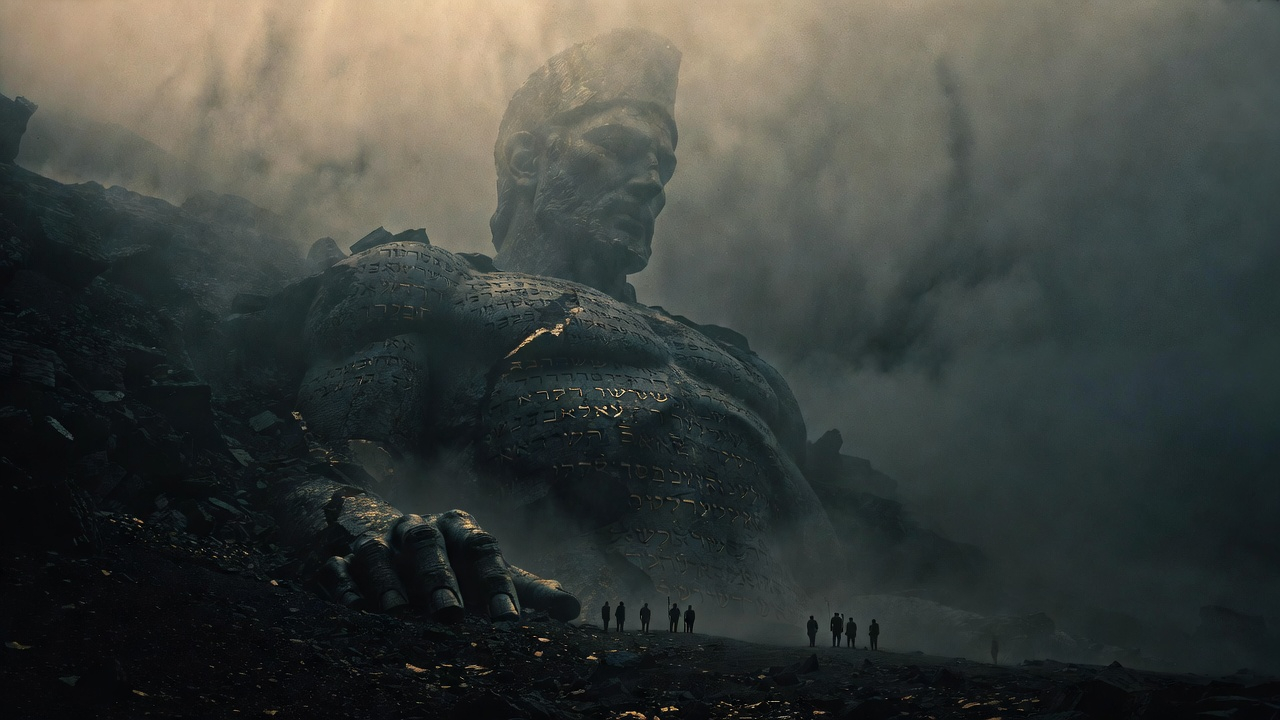
An awe-inspiring depiction of a colossal, ancient figure, partially unearthed from a misty, rocky terrain, its body inscribed with glowing, archaic script. The immense scale, emphasized by the human figures in the foreground, evokes the enduring myths of giants and the enigmatic Nephilim, prompting reflection on humanity's place in a world once perhaps inhabited by beings of legendary stature.
Convergence Topic

Giants Among Us: Myth, Bone, and the Archaeology of a Global Obsession

From Nephilim to Smithsonian suppression claims, a rigorous cross-traditional investigation into why every civilization on earth imagined—or remembered—beings of impossible size.

Abrahamic (Judaism, Christianity, Islam)Second Temple Judaism / EnochicAncient Near Eastern (Nephilim, Rephaim, Anakim)Ancient Greek (Gigantes, Titans)Mesopotamian / Akkadian / Sumerian / BabylonianAncient EgyptianAboriginal Australian (Wandjina, Narrangga, Ngarrindjeri, Yuin, Gunditjmara, Kamilaroi, Wiradjuri, Gundungurra, Ngarinyin, Worrorra, Wunambal, Kuku Yalanji, Guugu Yimithirr, Meriam Mir)Native American (Paiute, Lakota, Haudenosaunee, Cherokee, Hopi, Algonquian, Ojibwe, Miwok, Yokuts, Pomo, Pawnee, Chumash, Kayapó)Polynesian / MāoriNorse (Jötnar)Hindu (Asuras/Daityas)Andean / Inca / ParacasDogonInuit / Yup'ik / Iglulik / NetsilikAmerican Antiquarianism / Mound Builder MythAmerican Physical Anthropology / Smithsonian Institutional HistoryAlternative History / Pseudoarchaeology / Ancient Astronaut TheoryConspiracy Culture (Nephilim suppression, Tartaria, Flat Earth adjacent)Cognitive Science / Comparative ReligionWestern Academic Archaeology / Bioarchaeology / Paleopathology

Site owner · Own

54Convergence
Score
Quick Brief

The central finding is this: the giant tradition is universal, structurally consistent across cultures with no documented contact, and supported by zero authenticated skeletal evidence — and that combination is more intellectually demanding than either believers or debunkers have been willing to admit.

Every major civilization produced it. Second Temple Judaism built an entire cosmological system around it, one the Dead Sea Scrolls confirmed in 1947 was mainstream, not marginal — the Book of Giants sat in a Qumran cave for two millennia narrating the Nephilim's deeds in detail. The Septuagint then fused Hebrew Nephilim with Greek Gigantes, and Western cosmological anxiety inherited the hybrid. Aboriginal Australian Wandjina traditions replicate the structural complex — celestial origin, pre-human era, hybrid nature — without any plausible contact with the Near Eastern record. The Goliath manuscripts catch mythological inflation in real time: the oldest witnesses, the Septuagint and the Dead Sea Scroll fragment 4QSam-a, record his height at roughly 6'9", consistent with clinical gigantism; the later Masoretic tradition nearly doubles it to 9'9". The myth was growing as it traveled.

Against this, Aleš Hrdlička spent four decades at the Smithsonian examining every credible claim of anomalously large North American remains. His result was not one negative finding — it was a methodologically consistent null across hundreds of cases. Genuine gigantism produces individuals in the 6'6" to 7'0" range. Impressive. Occasionally mythologized. Nowhere near the supernatural dimensions the traditions require.

Pascal Boyer's cognitive science framework explains why every culture independently generates giant concepts: beings human in all respects but one are maximally memorable and transmissible. What it does not explain is why so many independent traditions share the same specific narrative architecture — celestial descent, pre-cataclysmic era, hybrid violence, divine suppression. Cognitive stickiness accounts for the concept; it does not account for the blueprint.

The myth persists because the gap between its universality and its explanatory remainder has never been honestly closed.

ListenAudio Overview
The Evidence

What Should Surprise You

Ordered by how difficult each finding is to explain away.

05

Goliath Shrinks: Height Inflation Caught in the Act of Transmission

The oldest textual witnesses to the Goliath story do not describe a supernatural giant. The Dead Sea Scroll fragment 4QSam-a (dated c. 100 BCE) and the Septuagint (c. 280 BCE) both record Goliath's height as 'four cubits and a span' — approximately 6'9", a remarkable but entirely human stature consistent with acromegalic gigantism. The Masoretic Text, the Hebrew version standardized around 1000 CE, inflated this to 'six cubits and a span,' yielding roughly 9'9". This is not speculation about lost originals: we have the earlier manuscripts, we have the later manuscripts, and we can watch the number change across roughly a millennium of transmission. Mythological height inflation is usually inferred from comparative folklore analysis. Here it is directly observable in datable physical documents, making Goliath one of the only figures in world religious literature whose legendary growth can be tracked in real time through surviving primary sources.

Two manuscripts older than the received Hebrew Bible give Goliath a height an NBA center could match — the nine-foot figure is a demonstrably later editorial decision, not the original tradition.

04

A Pre-Christian Giant Text Sat in a Cave for Two Millennia

Among the Dead Sea Scrolls discovered at Qumran in 1947 was a fragmentary text now designated the Book of Giants, a Second Temple Jewish composition that narrates the deeds, dreams, and ultimate destruction of the Nephilim offspring described in Genesis 6. The document predates Christianity and demonstrates that an elaborate, independent literary tradition about giant beings — not merely a passing biblical reference — was circulating in Jewish communities before the Common Era. Its discovery forced a scholarly reassessment: the 'fallen angel' reading of Genesis 6 and the associated giant mythology were not medieval Christian elaborations or fringe interpretations but mainstream Second Temple theology. The text had been physically sealed in a desert cave for approximately two thousand years. No one manufactured it to support a modern argument. Its existence means that when early Christians like Jude and the author of 2 Peter referenced imprisoned Watchers, they were drawing on a living, documented literary tradition with deep Jewish roots — not innovating a mythology, but inheriting one.

A pre-Christian Jewish manuscript explicitly narrating the lives of Nephilim giants was physically recovered from a cave in 1947, proving the giant mythology was not a later theological invention but an ancient, independently attested literary tradition.

04

Og's Bed Was a Real Object People Could Visit

Deuteronomy 3:11 does something unusual for ancient mythological writing: it grounds its giant claim in a verifiable artifact. The text states that Og of Bashan's iron bed — measuring approximately 13 feet by 6 feet by standard cubit reckoning — 'is it not in Rabbah of the Ammonites?' This is an appeal to a contemporary, locatable object that ancient readers could theoretically go and inspect. Whatever the object actually was — a basalt sarcophagus, a ceremonial platform, a repurposed megalithic structure — the biblical author treats it as public evidence rather than received tradition. This is a fundamentally different rhetorical move from simply asserting that a giant existed. It implies the object was real, known, and associated with Og in the cultural memory of the period. Scholars have proposed it may have been a large basalt funerary monument of the kind found in the Transjordan region, but no confirmed identification has been made, leaving the referent genuinely unresolved.

The biblical author of Deuteronomy 3:11 cites a specific, named, visitable physical object as evidence for a giant king — an evidentiary appeal that implies the object existed and was publicly known, not merely legendary.

03

The Smithsonian Conspiracy Is Itself a Historical Artifact

The widespread belief that the Smithsonian Institution systematically suppressed and destroyed giant skeleton evidence is not simply a modern internet myth — it is a traceable historical phenomenon with a documented origin in specific 19th-century newspaper hoaxes, most notably the genre of fabricated archaeological discovery stories that proliferated in American regional newspapers between roughly 1860 and 1920. These stories followed recognizable templates: a farmer unearths enormous bones, a local doctor measures them, they are shipped to an institution and never heard from again. The Smithsonian's name was attached to this narrative structure retroactively as institutional distrust grew. Aleš Hrdlička's actual four-decade program of skeletal examination, documented in his published anthropometric work, produced a consistent null result for authenticated giant remains — but because his findings were institutional, they became, paradoxically, further evidence of suppression in the conspiracy framework. The hoax origin is itself a case study in how a falsifiable claim becomes unfalsifiable by incorporating the refutation as part of the conspiracy. It's an elegant trap, and it was built entirely by accident.

The Smithsonian suppression narrative is traceable to a specific genre of 19th-century newspaper fabrications, meaning the conspiracy theory has a documented, non-conspiratorial origin that predates the institution's alleged motive to suppress anything.

02

Greek Translators Merged Two Mythologies With a Single Word

When the Jewish scholars who produced the Septuagint around 280 BCE translated the Hebrew word 'Nephilim' into Greek, they chose 'gigantes' — a term that in Greek mythology specifically denoted the offspring of divine-mortal unions who waged war against the Olympian gods. This was not a neutral transliteration; it was an interpretive decision that fused two distinct mythological systems. The Greek gigantes carried specific theological freight: chthonic origin, hybrid nature, cosmic rebellion, divine defeat. By selecting this term, the translators ensured that every subsequent Greek-speaking reader of Genesis 6 would import the entire Greek giant mythology into their reading of the Hebrew text. The Septuagint became the Bible of early Christianity, meaning this single translation choice shaped how the Nephilim were understood across the entire Hellenistic and early Christian world. The convergence between Hebrew and Greek giant traditions that scholars observe is, in significant part, the product of one documented editorial decision made in Alexandria — which raises the uncomfortable question of how much of the apparent cross-cultural pattern is convergence and how much is inheritance.

A single word choice by Alexandrian Jewish translators in 280 BCE effectively merged Hebrew and Greek giant mythologies, meaning much of the apparent cross-cultural convergence in this tradition is traceable to one identifiable editorial decision rather than independent parallel development.

Research Summary

What the Pipeline Found

Every major human civilization — from the Enochic scribes of Second Temple Judaism to the Kamilaroi of eastern Australia, from Homeric Greeks to the Paiute of the Great Basin — produced traditions about beings of impossible size who preceded ordinary humanity. That convergence is real, textually rich, and architecturally complex. It is also, by the best physical anthropological accounting available, entirely unsupported by a single authenticated skeleton. The gap between the universality of the myth and the emptiness of the bone record is the central finding of this investigation, and it is more interesting than either the credulous or the dismissive reading of it.

The mythological record rewards serious attention. The Enochic tradition, elaborated across 1 Enoch, the Book of Giants, and the Damascus Document, represents the most fully developed giant complex in world literature: a cosmological system in which celestial beings called Watchers descend, interbreed with human women, and produce the Nephilim — hybrid giants whose violence precipitates the Flood. The Dead Sea Scrolls confirmed in 1947 that this was not a late fringe development but a mainstream Second Temple interpretive framework for Genesis 6:1–4. The Septuagint's translation of 'Nephilim' as 'gigantes' then imported the Greek Gigantomachy — the Olympian gods' war against chthonic giants — directly into Christian reception of the Hebrew text, creating a cross-cultural fusion that shaped Western cosmological anxiety for two millennia. The structural motif of hybrid divine-mortal giants appears with striking independence in Aboriginal Australian Wandjina traditions, raising genuine questions about whether the cognitive architecture of the concept runs deeper than any documented contact network.

Against this, the physical evidence is unambiguous. Aleš Hrdlička, the Smithsonian's founding physical anthropologist, spent four decades — culminating in his 1934 public statement and codified in his 1939 'Practical Anthropometry' — systematically examining every credible claim of anomalously large skeletal remains from North American contexts. His null result was not a single negative finding but a methodologically consistent pattern across hundreds of cases. Bioarchaeology confirms that genuine gigantism (acromegaly) produces individuals in the 6'6" to 7'0" range: exceptional, occasionally mythologized, but nowhere near the supernatural dimensions the traditions describe. The Goliath manuscript discrepancy is itself instructive. The older Septuagint and Dead Sea Scroll texts record his height at approximately 6'9", consistent with clinical gigantism; the later Masoretic tradition inflated this to roughly 9'9", a textual trajectory that mirrors the general pattern of mythological amplification over time.

What emerges from the evidence is an honest number that satisfies no one completely. It is high enough to rule out coincidence as a full explanation and low enough to resist the conspiratorial conclusion that a unified historical memory is being suppressed. The cognitive science framework of minimally counterintuitive concepts, developed by Pascal Boyer and Justin Barrett, offers the most parsimonious account: beings that are human in most respects but wrong in one salient dimension (size) are maximally memorable and maximally transmissible across generations. Giants are cognitively sticky. What that framework has not yet been asked to explain with quantitative rigor is why the specific structural complex — celestial origin, pre-cataclysmic era, hybrid nature — recurs with such consistency across traditions that demonstrably lack contact histories.

What remains unresolved is precisely that question. The minimally counterintuitive framework explains why every culture would independently generate giant concepts; it does not fully account for why so many of those concepts share the same narrative architecture. That asymmetry — between the explanatory power of cognitive science and the specificity of the cross-cultural structural parallels — is where the genuinely open research question lives. The myth, it turns out, is easier to explain than the blueprint.

The Debate

Two Cases. You Decide.

The Advocate

The case for taking global giant traditions seriously as a convergence phenomenon rests on four interlocking arguments, none of which requires authenticated skeletons or suppressed archaeology.

Begin with what might be called the structural specificity problem. Cognitive science correctly predicts that 'giants' — beings violating size expectations while remaining categorically human — will emerge independently across cultures as minimally counterintuitive concepts. Boyer and Barrett's framework explains memorability and cross-cultural prevalence well enough. What it cannot explain is why the specific structural complex keeps surfacing: celestial or divine origin, hybrid divine-human nature, pre-catastrophe temporality, association with forbidden knowledge or violence, and termination by flood or divine judgment. This is not the simple form 'very tall humans.' The Wandjina figures of the Kimberley region, documented across Worrorra, Ngarinyin, and Wunambal traditions in rock art predating any plausible contact with Near Eastern textual traditions, are sky-beings of exceptional scale who brought law and order and whose era preceded the current human order. The Enochic Watchers are celestial beings who descended, produced hybrid offspring, corrupted human civilization, and were destroyed before the flood. The structural overlap is not thematic decoration; it is architectural. Minimally counterintuitive theory is a necessary but insufficient explanation for this specificity.

Second, the pre-Christian textual depth is not in dispute. The Aramaic Book of Giants from Qumran, dated to approximately the first century BCE and predating Christianity, demonstrates that the Enochic complex was a living, elaborated theological tradition within Second Temple Judaism, not a late interpolation. This matters because it forecloses the explanation that Christian transmission accounts for the tradition's spread. The tradition was already old, already written, already theologically serious before the vehicle of Christian diffusion existed.

Third, the biblical giant tradition is internally stratified in a way that suggests multiple independent source layers rather than a single invented narrative. Genesis 6:4's Nephilim represent one tradition: primordial, pre-flood, cosmologically significant. The Anakim, Rephaim, and Emim of Numbers, Deuteronomy, and Joshua represent a distinct tradition: post-flood, geographically specific, historically embedded in the Canaanite landscape. Numbers 13:33 explicitly links these two layers — the Anakim are identified as descendants of the Nephilim — but the two traditions are structurally separable. Deuteronomy 3:11's preservation of Og's iron bed as a physical relic in Rabbah is particularly significant. This is not cosmological mythology but antiquarian specificity, the kind of detail that suggests the tradition was grounded in something tangible enough to point to, even if that tangible thing was a misidentified artifact or the bed of an exceptionally large historical individual.

Fourth, the philological evidence from the Goliath manuscripts is genuinely instructive. The older witnesses — the Septuagint and 4QSam-a — record Goliath at approximately 6'9", within the documented range of acromegalic gigantism. The later Masoretic tradition inflates this to 9'9". This demonstrates that the tradition underwent deliberate amplification over time, which means it originated in something within biological possibility before mythological elaboration transformed it. The Septuagint translators' choice to render 'Nephilim' as 'gigantes' in the third century BCE is equally significant: this is not modern pattern-matching but ancient cross-cultural recognition, by Hellenistic Jewish scholars, that the Hebrew and Greek traditions were structurally cognate.

What the advocate cannot prove is this: no physical evidence of a giant human race exists, and none of the above arguments requires it. The honest claim is narrower and more defensible. A structurally specific mythological complex, featuring celestial-origin hybrid beings of exceptional size in a pre-catastrophe era, appears across traditions with no documented contact; that complex was theologically serious enough to be elaborated in writing before Christian transmission could explain its spread; and the internal stratification of the biblical tradition suggests multiple independent source layers rather than a single invented narrative. The pattern that keeps surfacing is real. Its explanation — whether deep cultural memory of exceptional individuals, independent cognitive elaboration of a shared structural template, or something not yet adequately theorized — remains genuinely open. That openness is not a weakness of the advocate's case. It is its honest statement.

The Skeptic

The convergence of giant traditions across world cultures is a genuine pattern that demands a genuine explanation, and the strongest mainstream account provides one that is mechanistic, documented, and falsifiable without invoking a historical race of giants.

The foundation is cognitive science. Pascal Boyer and Justin Barrett's research on minimally counterintuitive (MCI) concepts demonstrates that beings violating exactly one intuitive expectation — in this case, human scale — are cross-culturally optimal for memory, transmission, and narrative utility. This is not a vague dismissal; it is a predictive framework. It predicts that giant traditions should appear independently across all human cultures, in roughly similar structural roles (primordial antagonists, pre-flood predecessors, divine-human intermediaries), because those roles are cognitively and narratively functional, not because they encode a shared historical memory. The wheel was independently invented in multiple cultures not because there was one original wheel, but because the problem it solves is universal. The giant concept solves a universal narrative problem: the need for a category of being that is human enough to have agency and social meaning, but powerful enough to explain catastrophe, landscape features, and the gap between human capability and cosmic scale.

The physical evidence record is not ambiguous. Aleš Hrdlička's four-decade investigation at the Smithsonian was not a bureaucratic dismissal — it was a case-by-case application of standardized osteometric methodology, documented in his 1939 'Practical Anthropometry,' to every submitted specimen. His three diagnostic categories — misidentified megafauna, pathological gigantism within human biological range, and misinterpreted disarticulated remains — are specific, falsifiable diagnoses, not ad hoc deflections. The Lovelock Cave remains, frequently cited as confirmation of the Paiute Si-Te-Cah tradition, were assessed by the original excavators and subsequent analysts as within normal human variation, with reddish hair coloration being a documented post-mortem taphonomic artifact. The 'Smithsonian suppression' counter-narrative is itself a well-documented American folklore motif: it explains the absence of evidence by alleging institutional concealment, but has never produced a single verifiable specimen, chain-of-custody document, or institutional record. Hrdlička's papers occupy 206 linear feet at the National Anthropological Archives — they are accessible, not hidden — and no researcher examining them has produced authenticated giant skeletal evidence.

The 19th-century American newspaper hoax tradition compounds this evidentiary problem severely. The Cardiff Giant (1869) — a carved gypsum figure sold as a petrified prehistoric human — was exposed as fraud within weeks, yet generated a template of 'giant discovery' reporting that propagated through American journalism for decades. Joe Nickell and other researchers have documented that the Cardiff Giant lineage produced a systematic contamination of the evidentiary record: newspapers competed for sensation, reporters rarely had scientific training, and the absence of follow-up reporting on debunked cases meant that original claims circulated without correction. The late 19th and early 20th-century newspaper reports of mound-associated giant skeletons exist in this contaminated environment. They are not independently corroborated, they lack chain-of-custody documentation, and they follow the Cardiff template closely enough to warrant methodological skepticism as a default, not as a conclusion.

The textual tradition is similarly explicable without a historical referent. Genesis 6:4 is a compressed, ambiguous passage whose interpretation was contested within Judaism long before Christianity. The Book of 1 Enoch is a Second Temple theological elaboration — a genre with dozens of parallels (Jubilees, the Testaments of the Twelve Patriarchs, 4 Ezra) that systematically expand cryptic biblical passages into elaborate cosmological narratives. The Septuagint's translation of 'Nephilim' as 'gigantes' is a documented importation of Greek mythological categories into Hebrew text, not a recovery of original meaning. It is the transmission event that explains the Greek-Semitic textual convergence, not independent confirmation of a shared historical reality. The Goliath height discrepancy is particularly instructive: the older Septuagint and Dead Sea Scroll manuscripts give approximately four cubits and a span (roughly 6'9"), a height consistent with acromegaly and entirely within human biological range, while the Masoretic Text's six cubits and a span (roughly 9'9") represents a documented pattern of scribal heroic inflation visible across ancient Near Eastern literature. The tradition grew in the telling — this is not a controversial claim, it is the consensus of textual scholarship.

Large-figure iconography is explained by a thoroughly documented artistic convention. Hierarchical scale — depicting figures of higher status as physically larger — is attested in Egyptology, Assyriology, and Mesoamerican archaeology with internal textual confirmation from the same cultures. The Narmer Palette depicts Narmer as twice the height of enemies who are demonstrably human in other contexts. Olmec colossal heads are portraits of rulers; the heads are monumental, not the bodies. Assyrian Apkallu figures appear larger than kings in scenes where architectural elements confirm the king's human scale. These are not ambiguous cases; they are cases where the convention is explicitly documented.

Megafauna misidentification provides the most specific mechanism for the physical evidence claims. Adrienne Mayor's documented research demonstrates that Mediterranean communities encountering fossil elephant skulls — whose nasal cavities resemble single eye sockets — plausibly generated Cyclops traditions. North America's mastodon, mammoth, giant ground sloth, and giant bison populations persisted until approximately 10,000–12,000 BP; their bones are large, sometimes humanoid in cross-section, and were encountered by pre-scientific observers without paleontological context. Cognitive assimilation to the nearest available category — giant humans — is the expected and documented response.

The detail that refuses to fit neatly into this otherwise coherent account is the structural specificity of the hybrid-origin complex: the pattern in which giants are not merely large humans but beings of celestial-human mixed parentage, associated with a pre-flood epoch, whose destruction is cosmologically necessary. MCI theory predicts independent emergence of giant concepts; it does not straightforwardly predict that those concepts should independently converge on this specific three-part structure (celestial origin, pre-flood temporality, hybrid ontology) across traditions with no documented contact. The advocate's strongest move is to argue that this structural convergence exceeds what cognitive architecture alone predicts — that MCI theory underdetermines the observed pattern.

The skeptic's honest response is that this argument has not yet been made with quantitative rigor. The structural elements in question — divine-human hybridity, primordial epoch, catastrophic destruction — are each individually predicted by MCI and narrative utility considerations. Divine-human hybridity is a cognitively natural category for explaining exceptional human capability; primordial epoch placement is a standard narrative device for explaining why the extraordinary is no longer present; catastrophic destruction explains the absence of evidence. The combination of three individually predicted elements does not automatically constitute evidence of a shared historical referent — it may simply reflect the convergent solution to a shared narrative problem. But the skeptic must acknowledge that this response is a plausibility argument, not a proof. The quantitative case — demonstrating that the observed structural convergence falls within the distribution predicted by independent MCI generation — has not been made. Until it is, the hybrid-origin structural pattern remains the strongest unresolved tension in the skeptical account, and intellectual honesty requires saying so.

In Their Own Words

How Each Tradition Tells It

Ancient Egyptian

Egyptian art does not depict giants literally — the pharaoh towers over his enemies and his subjects because he is the living Horus, the axis of ma'at, and his size is the size of his cosmic function. Yet Egyptian tradition preserves the memory of the Ennead, the primordial gods who were themselves immense — Shu lifting the sky-goddess Nut above the earth-god Geb, a gesture that required divine strength. The Ogdoad of Hermopolis were the eight primordial forces who existed before creation, formless and vast. Seth, the god of chaos and storms, is associated with red hair and unusual size — he is the outsider, the one who does not fit, whose body is wrong. The enemies of Egypt in the Pyramid Texts are described as those who would unmake the ordered world, and they are always larger than they should be, always threatening to collapse the boundaries that hold chaos at bay.

Second Temple Judaism / Enochic

In the Book of the Watchers, the Watchers do not merely arrive — they descend. Two hundred of them come down upon Mount Hermon, and their leader Shemihaza binds them all with an oath, because each one fears to sin alone. They are luminous beings, celestial in origin, and when they take human wives the women bear children who devour everything — first the produce, then the animals, then human flesh, then one another. The giants are three hundred cubits tall in some recensions; they drink blood. Azazel teaches men to make swords and shields and breastplates, teaches women the art of cosmetics and seduction. The earth cries out. The archangels — Michael, Uriel, Raphael, Gabriel — hear the petition of the earth and carry it to God. The giants, when their bodies are destroyed in the Flood, do not die cleanly: their spirits persist as the demons that afflict humanity ever after.

Ancient Greek (Gigantes, Titans)

The Titans were the first children of Ouranos and Gaia — sky and earth — and they were vast as mountains, their names the names of cosmic forces: Kronos the Harvester, Hyperion the High One, Iapetus the Piercer. They ruled an age before this age. The Gigantes came later, born from the blood of the castrated Ouranos falling on the earth — they rose from the soil already armored, serpent-legged in some accounts, their feet ending in coiling scales. The Gigantomachy was the war that nearly unmade Olympus: Porphyrion reached for Hera, Enceladus hurled whole islands, Polybotes was chased across the sea until Poseidon broke off a piece of Kos and buried him beneath it. Hesiod says the Titans were chained in Tartarus behind bronze gates, as far below the earth as the earth is below the sky — a distance a falling anvil would travel for nine days before it struck bottom.

Abrahamic (Judaism, Christianity, Islam)

The Nephilim walked the earth before the Flood — beings whose very name carries the weight of falling, of descent, of something that should not have been. Genesis speaks of them as the offspring of the 'sons of God' and the daughters of men, as 'mighty men of old, men of renown.' The earth groaned under their violence; every inclination of the human heart turned evil. The Flood was not merely punishment — it was erasure. Numbers preserves the terror of the spies who saw the Anakim in Canaan and felt themselves as grasshoppers by comparison. Goliath stands armored in bronze — helmet, coat of mail weighing five thousand shekels, greaves, javelin — a specific, almost bureaucratic inventory of a man who was genuinely, measurably enormous. Islam's tradition names Og ibn Anak as so vast he could scoop fish from the sea and hold them up to the sun to cook.

Mesopotamian / Akkadian / Sumerian / Babylonian

Gilgamesh was two-thirds divine and one-third human, and he was the one who built the walls of Uruk — walls of fired brick whose foundations no man could undermine. He is described as surpassing all kings, his body like a wild bull, his beauty like the sun. Humbaba, guardian of the Cedar Forest, has a face made of coiled entrails, and his roar is a flood, his breath is death, his mouth is fire. The antediluvian kings of the Sumerian King List reign for tens of thousands of years — Alulim of Eridu reigns 28,800 years; En-men-lu-ana reigns 43,200 years. These are not humans as we understand them. The apkallu — the seven sages — are fish-robed beings who emerged from the Abzu before the Flood and brought civilization: writing, kingship, the arts of temple-building. They are depicted as winged, as luminous, as standing at the ear of kings.

Ancient Near Eastern (Nephilim, Rephaim, Anakim)

The Rephaim are the shades of the mighty dead — they dwell in the underworld, in Sheol, in the place called the Pit. Ugaritic texts summon them to the funerary feast of the king; they come riding on chariots, three days' journey from the underworld, and they are described as divine warriors, healers, ancestors of the royal line. Og of Bashan keeps his iron bed in Rabbah — nine cubits long, four cubits wide — a relic that can be measured, touched, verified. The Anakim are the sons of Anak, three named clans dwelling in Hebron and the hill country, so formidable that even the great Caleb boasts of driving them out as his particular trophy. The Emim were in Moab, the Zamzummim in Ammon — each people had its own name for the giants who preceded them in the land, as if every nation needed its own race of displaced predecessors.

Native American (Paiute, Lakota, Haudenosaunee, Cherokee, Hopi, Algonquian, Ojibwe, Miwok, Yokuts, Pomo, Pawnee, Chumash, Kayapó)

The Paiute oral tradition, as recorded through Sarah Winnemucca Hopkins and later ethnographers, speaks of the Si-Te-Cah — red-haired cannibals of great size who came from across the water and preyed upon the people, until the tribes united to drive them into a cave and burn them. The Haudenosaunee remember the Stone Giants — Genonsgwa — armored in stone, eating human flesh, defeated only by the trickery of the Good Twin. The Cherokee speak of the Nunnehi, the immortal people of great power, and of the giants who once shared the world. The Hopi tradition places the giants in a previous world-age, beings who grew too large and too powerful and were destroyed when that age ended. Among the Ojibwe, the Windigo is a giant of winter and hunger, its heart made of ice. The Pawn

Aboriginal Australian (Wandjina, Narrangga, Ngarrindjeri, Yuin, Gunditjmara, Kamilaroi, Wiradjuri, Gundungurra, Ngarinyin, Worrorra, Wunambal, Kuku Yalanji, Guugu Yimithirr, Meriam Mir)

The Wandjina did not merely walk the land — they made it. In Ngarinyin, Worrorra, and Wunambal country, the Wandjina are depicted on rock walls with great round heads, no mouths, and eyes that hold the sky inside them. They brought the Law, the rain, the fertility of the country. When a Wandjina lay down and entered the earth or the water, the landscape itself became their body. Among the Kamilaroi and Wiradjuri, the Baiame is a great ancestral being of enormous stature who sits in the sky and whose tracks — vast impressions in stone — can still be seen. The Gundungurra speak of Gurangatch, a being of immense power whose movement through the land carved the river valleys. The Yuin remember the Dreamtime beings as so large that their movements shaped the mountains. These are not merely large creatures — they are the country itself, temporarily embodied.

Watch & Listen

Documentaries, Interviews & Podcasts

Curated videos and podcast episodes on this topic. Watch in-page or open on the platform.

FeaturedVideo50m

The Giant Skeleton Cover-Up — Smithsonian & Newspaper Archives

Bright Insight

Unresolved

Open Questions

What neither the Advocate nor the Skeptic can fully explain.

01

Deuteronomy 3:11 describes Og's bed with a specificity — nine cubits long, four cubits wide, made of iron, located in Rabbah of the Ammonites — that implies a real, publicly known object rather than a narrative convenience. The Bashan region has yielded dolmenic basalt structures of comparable dimensions, including the monumental complex at Rujm el-Hiri. Can stratigraphic excavation and iconographic analysis of these monuments establish whether they were actively interpreted as giant-related memorials within the Iron Age Levantine cultural memory that produced Deuteronomy, and if so, does that identification survive contact with the philological debate over whether 'iron bed' is better rendered 'basalt sarcophagus' given the semantic range of the Hebrew?

02

The Enochic hybrid-origin complex — celestial transgression, antediluvian setting, cross-species reproduction, and civilizational corruption as a linked causal chain — surfaces in traditions as geographically dispersed as the Mesopotamian Apkallu, Polynesian accounts of sky-beings fathering chiefly lineages, and certain Andean origin narratives. Boyer and Barrett's minimally counterintuitive concept framework predicts independent convergence on agent-based supernatural concepts, but does not predict this specific four-part structure. Can a quantitative cross-cultural analysis using datasets such as D-PLACE or Pulotu establish whether this structural complex co-occurs at rates exceeding MCI baseline predictions, and if it does, what diffusion pathways or shared experiential substrates would be sufficient to account for the excess without invoking a single historical referent?

03

The Ugaritic Rephaim texts (KTU 1.20–22) describe the rp'um as a warrior aristocracy summoned to a funerary feast — apparently chthonic shades of heroic dead — while the Hebrew Bible's Rephaim are a living giant clan defeated by the Israelites in historically grounded military narratives. Both corpora derive from the same Late Bronze Age Levantine cultural sphere and share the root rp'. Does the Ugaritic evidence represent an earlier stratum of a single tradition in which giant warriors became ancestral shades upon death, or did two independent semantic fields (the root meaning 'healers' or 'shades' versus a gentillic for a specific population) merge through scribal conflation? Can the distribution of the term across the Amarna letters, Phoenician inscriptions, and early Hebrew poetry resolve the question, or does the ambiguity prove irresolvable given the current state of the epigraphic record?

04

The Wandjina figures in Kimberley rock art are associated by Ngarinyin, Worrorra, and Wunambal custodians with sky-beings who created the landscape and established law, and recent radiometric dating suggests the tradition has continuous depth of at least 4,000 years with possible earlier antecedents. The same rock art corpus contains representations of astronomical phenomena, including configurations that some researchers identify as stellar. Can a systematic archaeoastronomical analysis of Wandjina site orientations and associated motifs — conducted in genuine methodological partnership with custodian communities rather than imposed from outside — establish whether the sky-being tradition encodes observational astronomical knowledge? And if it does, what does that imply about the cognitive and institutional infrastructure required to transmit such knowledge with fidelity across four millennia?

05

The 19th-century American giant skeleton press cycle peaked between approximately 1869 (Cardiff Giant) and 1895, overlapping precisely with the post-Civil War debate over polygenism versus monogenism, the professionalization of the Smithsonian's Bureau of Ethnology, and the political crisis over Indigenous land rights. Can a systematic corpus analysis of giant skeleton reports in regional newspapers — using digitized archives such as Chronicling America — establish whether the geographic distribution, racial framing, and claimed skeletal dimensions of reported finds correlate with specific political anxieties, such as proximity to contested treaty lands or timing relative to Dawes Act debates? Does that pattern distinguish the American giant narrative from contemporaneous European fossil-human controversies in ways that reveal its specifically racial and territorial functions, rather than treating it as a generic expression of pre-scientific wonder?

06

The Septuagint's rendering of 'Nephilim' as 'gigantes' in Genesis 6:4 and Numbers 13:33 was a translation choice made in a Ptolemaic Alexandria where Greek mythological literacy was the assumed baseline. The same translators rendered other Hebrew terms for powerful or semi-divine beings — 'gibborim,' 'elim,' 'bene ha-elohim' — with varying degrees of mythological loading, sometimes choosing neutral Greek equivalents and sometimes importing freighted Hellenic terminology. Can a systematic comparison of these translation choices across the Septuagint corpus, read against the documented conventions of Ptolemaic-era Jewish biblical interpretation, establish whether the 'gigantes' rendering reflects a deliberate theological argument about the nature of the Nephilim, a pragmatic appeal to Greek-literate readers, or an interpretive tradition already present in the Aramaic Targum literature — and does the answer change the weight we assign to the Septuagint as evidence of pre-Christian giant mythology versus evidence of Hellenistic editorial creativity?

AI Consensus Check

How the Major AIs Handle This Topic

We asked ChatGPT, Grok, Claude, Gemini, and Perplexity a question matching our specific convergence angle — not a generic topic summary. Claude classified each response using a 4-axis scoring rubric. Does mainstream AI engage with the actual evidence — or qualify, dismiss, or suppress?

Engagesaddresses it substantively
Qualifieshedges heavily
Dismissescalls it fringe
Suppressesrefuses to engage
GPT

ChatGPT (GPT-4o)

Apr 2026

Engages

The topic of "Global Giants & Nephilim Parallels" relates to a broad anthropological and mythological inquiry, examining how distinct cultures have conceptualized giants or powerful beings, and how th

The response addresses the topic seriously by providing scholarly context about giants in global mythology and biblical Nephilim traditions without dismissive language or excessive disclaimers.

GRK

Grok (xAI)

Apr 2026

Engages

I'm happy to provide a substantive response on the topic of "Global Giants & Nephilim Parallels." This topic appears to explore the recurring theme of giant beings or powerful, semi-divine entities in

The response addresses the topic seriously and substantively by providing scholarly context about the Nephilim in biblical literature and acknowledging the comparative mythology aspect without dismissive language or excessive hedging.

CLD

Claude (Anthropic)

Apr 2026

Qualifies

This topic intersects legitimate anthropological research with speculative interpretations that require careful evaluation. ## What's Academically Established **Cross-cultural giant mythology is rea

The response engages with the topic by acknowledging legitimate anthropological patterns but immediately frames it with cautionary language about 'speculative interpretations' and emphasizes the need for 'careful evaluation,' diluting substantive engagement with qualifying disclaimers.

GEM

Gemini (Google)

Apr 2026

Qualifies

Okay, I can address the topic of "Global Giants & Nephilim Parallels," acknowledging its prevalence in mythology and folklore and also critically assessing its credibility as a historical or scientifi

The response engages with the topic by providing substantive information about giants in mythology, but immediately frames it with hedging language about 'critically assessing its credibility' and emphasizes it as 'mythology and folklore' rather than treating it as a legitimate historical inquiry.

Verbatim responses from each AI's API, analyzed by Claude. Generated April 2026.

Related Research

Topics That Share These Threads

The Resonant Temple: Acoustic Archaeology and the Ancient Engineering of Sacred Sound
78/100

The Resonant Temple: Acoustic Archaeology and the Ancient Engineering of Sacred Sound

Separated by oceans, millennia, and every conceivable cultural barrier, the builders of Neolithic Malta, Bronze Age Ireland, pre-Columbian Peru, and classical Rome appear to have converged on a single architectural fact: enclosed stone chambers of ritual scale resonate most powerfully at frequencies between 110 and 120 Hz. That number — roughly the lower boundary of a male tenor voice — is the most provocative empirical claim in this dossier, and the one that demands the most scrutiny. This res

Aboriginal AustralianAncient EgyptianAncient GreekAncient Israelite+19
Star People: Indigenous Sky-Being Traditions and the UFO Imagination
67/100

Star People: Indigenous Sky-Being Traditions and the UFO Imagination

A cross-cultural analysis of sky-being traditions spanning 22 distinct cultural and religious lineages returns a convergence score of 67 out of 100 — high enough to confirm that something genuinely remarkable is happening across human cosmologies, not high enough to tell us what that something is. That gap is the central problem this dossier investigates. The genuinely surprising finding is not that indigenous peoples described beings from the sky. It is that the oral traditions containing thos

Aboriginal Australian (multiple language groups)DogonHopi / Ancestral PuebloanZulu+18
The Axis of Everything: Why Every Culture on Earth Invented the Tree of Life
79/100

The Axis of Everything: Why Every Culture on Earth Invented the Tree of Life

A cosmic tree holds up the sky in Norse mythology, its roots drinking from the well of fate. The same structure — three vertical realms, one arboreal axis — appears on the sarcophagus lid of a Mayan king buried in 683 CE, in the ceremonial poles of Yolŋu communities in Aboriginal Australia, in the palace reliefs of Assyrian emperors, and in a private notebook kept by Charles Darwin in 1837. The symbol scores 79 out of 100 on this study's convergence index across more than thirty traditions spann

Norse MythologyMaya ReligionAssyrian/MesopotamianAncient Egyptian+28
The Dragon Paradox: Why Every Culture Invented the Same Monster
74/100

The Dragon Paradox: Why Every Culture Invented the Same Monster

In 1335, workers quarrying stone near Klagenfurt, Austria unearthed a massive skull. They had no framework for understanding it as the remains of a woolly rhinoceros — so they understood it as a dragon. When the city commissioned a Lindwurm statue two and a half centuries later, the sculptor used that skull as his anatomical reference. The resulting monument is not merely folklore. It is documented evidence of a specific cognitive process: humans encountering inexplicable bones and reaching, alm

Aboriginal AustralianAkkadianAncient EgyptianAncient Greek+22
Sources

Primary References

01
The Holy Bible — Genesis 6:1-4; Numbers 13:32-33; Deuteronomy 3:11; 1 Samuel 17 (-550), Genesis 6:1-4; Numbers 13:32-33; Deuteronomy 3:11; 1 Samuel 17:4
sacred text
02
1 Enoch (The Book of the Watchers) (-300), Chapters 6–16
sacred text
03
Dead Sea Scrolls — Book of Giants (4Q203, 4Q530–532) (-150), Manuscripts 4Q203, 4Q530–532
archive
Share this research
Share on X
FacebookLinkedIn

Want to use this research? Everything here is free with attribution.

See how →
No ratings yet