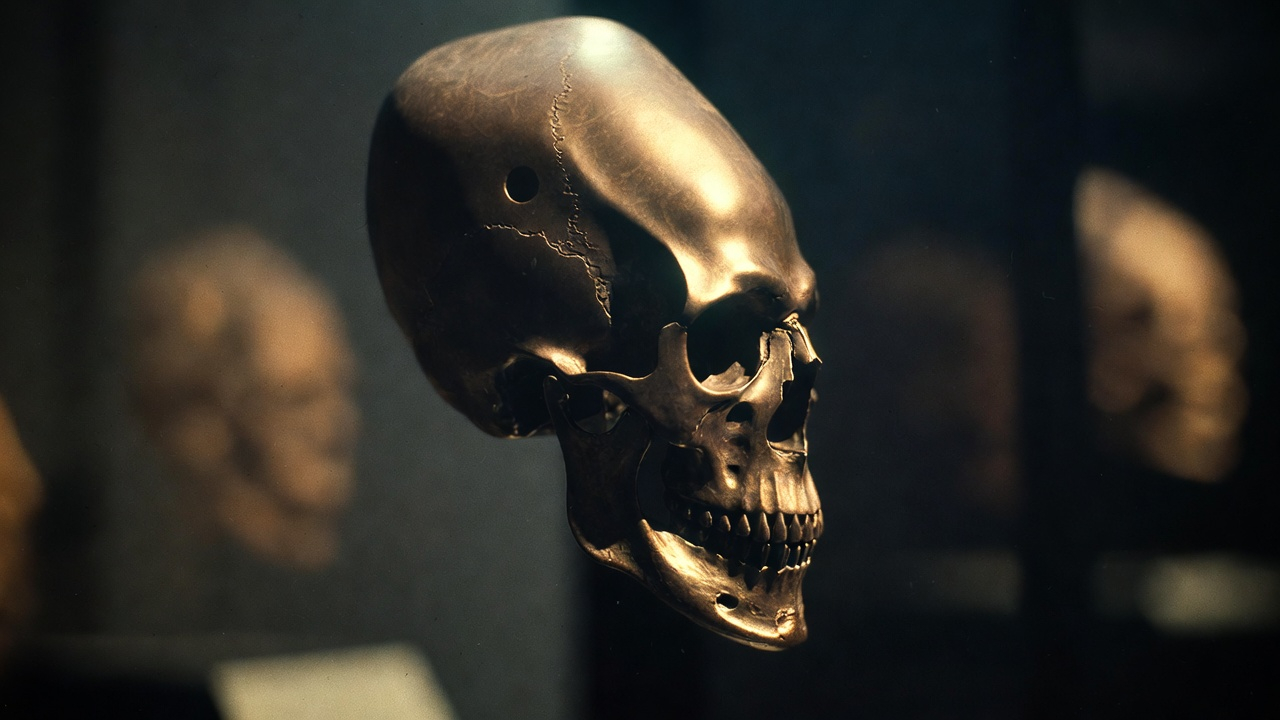
How a near-universal human practice of cranial reshaping became the unlikely canvas for ancient astronaut mythology, contested DNA claims, and genuine archaeological puzzles.
Site owner · Own
Here is the central paradox: one of the most visually striking phenomena in world archaeology — skulls stretched to dramatic elongation across dozens of unconnected cultures on every inhabited continent — has a thoroughly documented, scientifically uncontroversial explanation, and yet that explanation coexists with a thriving counter-narrative claiming extraterrestrial or hybrid-human origins. The practice of artificial cranial deformation (ACD), achieved by binding infants' heads with cloth, boards, or rope during the window when cranial bones remain plastic, is attested from the Neolithic to the early twentieth century. It appears among the Chinookan peoples of the Pacific Northwest, the Mangbetu of Central Africa, the Huns and Goths of the Eurasian steppe, the Maya, the Inca, and dozens of Andean cultures. Hippocrates described it in the fifth century BCE. The Smithsonian catalogued it systematically in the nineteenth century. This is not a close call.
What is genuinely interesting, then, is not the skulls themselves but the cultural machinery that has grown around them. The epicenter of controversy is the Paracas culture of coastal Peru (ca. 800 BCE–100 CE), whose burial sites — excavated by Julio C. Tello in the 1920s — yielded skulls exhibiting the most extreme annular deformation in the archaeological record. It is precisely this extremity that has made Paracas the preferred canvas for alternative claims. Brien Foerster and associates have promoted DNA analyses purporting to show that the skulls carry mutations 'unknown in any human, primate, or animal known so far.' These claims, amplified by Erich von Däniken's foundational 1968 framing in Chariots of the Gods?, have reached mass audiences. What emerges from the evidence unambiguously is that none of these DNA results have appeared in a peer-reviewed scientific journal — not one, after more than a decade of public assertions. The absence of a sagittal suture, cited as anomalous by alternative theorists, is a known medical condition (sagittal craniosynostosis), not a marker of non-human ancestry. No geological or stratigraphic evidence from Paracas burial sites suggests anything other than a terrestrial human population.
Three genuine unresolved tensions prevent a perfectly clean resolution, and intellectual honesty requires stating them plainly. The diffusion of ACD across the Eurasian steppe during the Migration Period — from Hunnic groups outward to Goths, Alans, and Burgundians — complicates the independent-invention argument for some regional clusters, since the evidence does not always permit clean separation of fresh discovery from cultural transmission. More substantively: if ACD was practiced across the Andes by multiple cultures, what specifically drove the Paracas to the most extreme documented form? The generic 'elite status marker' hypothesis does not explain the escalation, and no peer-reviewed study has directly addressed this cultural dynamics question. The Amarna Period iconographic elongation remains genuinely contested among Egyptologists as well — the royal family of Akhenaten is depicted with dramatically elongated skulls across art of unambiguous confidence, but whether this reflects actual ACD practice, deliberate artistic stylization, or a pathological condition such as Marfan syndrome has not been resolved.
This is, finally, a story about human meaning-making as much as osteology. Cultures across millennia reshaped their children's skulls to signal status, identity, and belonging — a practice simultaneously intimate and political. That the same skulls now anchor claims of alien contact tells us something important about how anomaly and desire interact when evidence is incomplete. The skulls haven't changed; only the stories we need them to tell have.
Ordered by how difficult each finding is to explain away.
Bioarchaeological analysis of Migration Period cemeteries in central Europe — particularly sites associated with Gothic, Alanic, and Burgundian populations — has revealed a striking pattern: within communities that practiced artificial cranial deformation, the individuals with deformed skulls are disproportionately female, and isotopic analysis of their teeth shows they were not born locally. They were genetic and geographic outsiders who had been incorporated into communities that then marked them with the host group's elite cranial signature. The most parsimonious interpretation is that ACD was applied to exogamous brides, women traded across tribal boundaries as alliance-sealing gifts, and that the skull modification served as a permanent, visible declaration of adopted membership in the receiving elite. This transforms ACD from a simple status marker into a technology of political incorporation, readable on the body for a lifetime. The skull, in other words, was also a passport — and it could not be forged or revoked.
Strontium isotope ratios in tooth enamel from deformed skulls in Burgundian burial sites indicate the individuals grew up in geographically distinct regions from the communities where they were interred — a finding that status-marking alone cannot explain.
In 'Airs, Waters, Places,' written in the fifth century BCE, Hippocrates describes a people he calls the Macrocephali — 'Long-heads' — living near the Black Sea, and correctly identifies their elongated skulls as the result of deliberate infant head-binding, not natural variation. He notes that the practice began as intentional but that, over generations, the community came to believe the shape was becoming hereditary. This is not merely an early ethnographic observation; it is a remarkably accurate two-part analysis: first, that the morphology is mechanically produced, and second, an intuitive proto-Lamarckian hypothesis about perceived heritability. The oldest written account of ACD in the Western tradition is also, by the standards of its era, one of the most scientifically precise, predating the rediscovery of the practice's mechanics by modern osteology by roughly 2,400 years. That a physician working without microscopes, without skeletal collections, and without a concept of developmental biology got the mechanism essentially right is, on reflection, more astonishing than the skulls themselves.
Hippocrates' mechanical explanation for Macrocephali skull shape — tight binding applied in infancy before the cranial bones consolidate — is structurally identical to the explanation given in modern forensic anthropology textbooks, written without reference to his account.
When Hunnic groups moved into Europe in the late fourth and early fifth centuries CE, they brought with them a well-established tradition of annular cranial deformation as an elite marker. Within two to three generations, Gothic, Alanic, Gepid, and Burgundian aristocracies had adopted the practice — not under coercion, but apparently through cultural prestige mimicry. The archaeological record shows the spread as a wave: deformed skulls appear in non-Hunnic elite burials progressively further west across the Migration Period horizon. This is one of the most clearly documented cases of a body modification practice spreading through cultural aspiration rather than conquest. It also means that a significant proportion of the post-Roman European aristocracy was deliberately reshaping the skulls of their infants to resemble the people who had terrorized their grandparents — which is either a profound tribute to the power of status anxiety, or the darkest possible endorsement of a conqueror's aesthetic.
Cemetery evidence from Gepid and Burgundian sites dated to within 50–75 years of initial Hunnic contact shows ACD appearing exclusively in high-status grave assemblages, confirming that the practice jumped ethnic boundaries while remaining confined to elite burials — prestige diffusion, not coerced assimilation.
Across the global record of artificial cranial deformation, two mechanically distinct techniques were independently developed: annular deformation, which uses circumferential bands wrapped around the skull to produce a conical or tubular elongation, and tabular deformation, which uses rigid boards pressed against the frontal and occipital bones to flatten and expand the skull laterally. These techniques appear in populations with no plausible contact — annular in the Andes and among Eurasian steppe peoples, tabular among the Maya and some North American Pacific Coast groups. Both produce skulls that, to an untrained eye, look dramatically similar: elongated, high-vaulted, and visually distinct from unmodified crania. This convergent morphological outcome from divergent mechanical methods is precisely the kind of pattern that generates false diffusionist hypotheses, because the end-products resemble each other without sharing any origin. The skulls look like cousins. They are strangers.
Osteometric analysis can reliably distinguish annular from tabular deformation by the distribution of cranial flattening and the position of maximum vault height — meaning skulls that appear nearly identical to non-specialists are mechanically and culturally unrelated, a distinction that collapses most cross-cultural 'common origin' arguments.
The extraordinary preservation of Paracas skeletal material — including soft tissue, hair, and textile wrappings on some specimens — is not the result of deliberate mummification technique but of a geological accident. The Paracas Peninsula sits in the hyperarid coastal desert of southern Peru, a climate created by the convergence of two independent geographic systems: the cold Humboldt Current running northward along the Pacific coast, which suppresses rainfall by cooling the air above it, and the Andean rain shadow, which blocks moisture from the Amazon basin. The result is one of the driest environments on Earth, with some areas recording near-zero annual precipitation for decades at a time. Bodies buried here desiccate faster than decomposition can proceed. The 2,000-year-old organic material that alternative theorists cite as evidence of anomalous preservation is, in fact, evidence of anomalous geology — and that geology is thoroughly understood. The mystery, such as it is, belongs to climatology, not archaeology.
Radiocarbon dates on textile wrappings from Paracas burial bundles are internally consistent with the established cultural chronology of 800 BCE to 100 CE, confirming that the preservation quality, which superficially suggests recent interment, is entirely a product of the depositional environment rather than any anomaly in the remains themselves.
The Mangbetu people of the northeastern Democratic Republic of Congo practiced a form of annular cranial deformation called Lipombo well into the twentieth century, documented by ethnographers and photographers in the colonial and post-colonial periods. Infants' heads were bound with tight cloth strips beginning shortly after birth, gradually elongating the skull into the characteristic shape that Mangbetu elites considered beautiful and socially distinguished. Photographs from the early twentieth century show both the binding process on infants and the resulting adult morphology. This is not ancient history requiring archaeological inference — it is a practice ongoing within the lifetimes of people alive today, documented with photographic evidence and reported by living informants, held in multiple institutional archives. The fact that ACD was still being practiced in the twentieth century fundamentally undermines any framing of elongated skulls as a mysterious ancient anomaly requiring exotic explanation. The mystery has a living address.
Ethnographic photographs of Mangbetu women with fully elongated skulls, taken in the early-to-mid twentieth century and held in multiple institutional archives, constitute direct visual documentation of the adult outcome of a practice that alternative theorists treat as an inexplicable ancient mystery.
Here is the central paradox: one of the most visually striking phenomena in world archaeology — skulls stretched to dramatic elongation across dozens of unconnected cultures on every inhabited continent — has a thoroughly documented, scientifically uncontroversial explanation, and yet that explanation coexists with a thriving counter-narrative claiming extraterrestrial or hybrid-human origins. The practice of artificial cranial deformation (ACD), achieved by binding infants' heads with cloth, boards, or rope during the window when cranial bones remain plastic, is attested from the Neolithic to the early twentieth century. It appears among the Chinookan peoples of the Pacific Northwest, the Mangbetu of Central Africa, the Huns and Goths of the Eurasian steppe, the Maya, the Inca, and dozens of Andean cultures. Hippocrates described it in the fifth century BCE. The Smithsonian catalogued it systematically in the nineteenth century. This is not a close call.
What is genuinely interesting, then, is not the skulls themselves but the cultural machinery that has grown around them. The epicenter of controversy is the Paracas culture of coastal Peru (ca. 800 BCE–100 CE), whose burial sites — excavated by Julio C. Tello in the 1920s — yielded skulls exhibiting the most extreme annular deformation in the archaeological record. It is precisely this extremity that has made Paracas the preferred canvas for alternative claims. Brien Foerster and associates have promoted DNA analyses purporting to show that the skulls carry mutations 'unknown in any human, primate, or animal known so far.' These claims, amplified by Erich von Däniken's foundational 1968 framing in Chariots of the Gods?, have reached mass audiences. What emerges from the evidence unambiguously is that none of these DNA results have appeared in a peer-reviewed scientific journal — not one, after more than a decade of public assertions. The absence of a sagittal suture, cited as anomalous by alternative theorists, is a known medical condition (sagittal craniosynostosis), not a marker of non-human ancestry. No geological or stratigraphic evidence from Paracas burial sites suggests anything other than a terrestrial human population.
Three genuine unresolved tensions prevent a perfectly clean resolution, and intellectual honesty requires stating them plainly. The diffusion of ACD across the Eurasian steppe during the Migration Period — from Hunnic groups outward to Goths, Alans, and Burgundians — complicates the independent-invention argument for some regional clusters, since the evidence does not always permit clean separation of fresh discovery from cultural transmission. More substantively: if ACD was practiced across the Andes by multiple cultures, what specifically drove the Paracas to the most extreme documented form? The generic 'elite status marker' hypothesis does not explain the escalation, and no peer-reviewed study has directly addressed this cultural dynamics question. The Amarna Period iconographic elongation remains genuinely contested among Egyptologists as well — the royal family of Akhenaten is depicted with dramatically elongated skulls across art of unambiguous confidence, but whether this reflects actual ACD practice, deliberate artistic stylization, or a pathological condition such as Marfan syndrome has not been resolved.
This is, finally, a story about human meaning-making as much as osteology. Cultures across millennia reshaped their children's skulls to signal status, identity, and belonging — a practice simultaneously intimate and political. That the same skulls now anchor claims of alien contact tells us something important about how anomaly and desire interact when evidence is incomplete. The skulls haven't changed; only the stories we need them to tell have.
The cross-tradition parallels in artificial cranial deformation represent a genuinely significant anthropological phenomenon, and the strongest case for their significance doesn't require extraordinary claims. It requires taking the ordinary evidence seriously.
The foundational observation is this: the independent discovery, across geographically isolated cultures on every inhabited continent, of the same non-obvious biological fact — that the infant skull is malleable during a narrow developmental window and can be permanently reshaped through sustained mechanical pressure — is not trivially explained. This is not like independently discovering fire or sharp-edged tools, where the phenomenon is immediately visible and the intervention obvious. Cranial reshaping requires a specific causal theory about infant development, a commitment to sustained intervention over months, and a cultural framework that makes the result desirable. That at least two independent mechanical solutions (annular binding and tabular board pressure) were arrived at separately across the Americas, Eurasia, and Africa represents genuine convergent technological invention, confirmed at high confidence across multiple independent forensic and archaeological sources. That deserves explanation, not dismissal.
The pattern that keeps surfacing is the convergence of ACD with elite status. The Paracas culture, Hippocrates' Macrocephali (fifth century BCE), the Hunnic and Alanic steppe cultures, the Chinookan peoples of the Pacific Northwest, and the Mangbetu of Central Africa all independently associated cranial elongation with nobility or high-status identity, documented across multiple independent source traditions. The specific choice of cranial elongation — permanent, visible from birth, requiring sustained parental investment — as the preferred elite marker across these unconnected cultures suggests something important about how human societies encode hierarchy into bodies. Status signaling through bodily modification is universal; the specific convergence on the skull is not.
The textual traditions reinforce this pattern from a different angle. The Book of Enoch's description of Noah's anomalous appearance, the Genesis Nephilim narrative, and the Akkadian apkallu tradition of semi-divine sages all associate physical distinctiveness with divine or semi-divine status. These texts do not prove contact with non-human beings. What they demonstrate is a cross-cultural cognitive framework: if divine beings are imagined as physically distinct from ordinary humans, then artificially creating that distinction in elite infants is a rational strategy for claiming divine proximity. This framework makes the global adoption of ACD as an elite marker anthropologically coherent without requiring diffusion or contact.
The Paracas case is the most important legitimate puzzle. The skulls, excavated by Julio C. Tello in the 1920s and dated by radiocarbon analysis to ca. 800 BCE–100 CE, represent the most extreme documented form of annular cranial deformation in the archaeological record. Peer-reviewed genomic analysis confirms fully human ancestry with Native American haplogroups. Cranial volume remains within normal human range. The Foerster DNA claims are unpublished, unvalidated, and should not be cited as evidence of anything except the persistence of their promoter. What remains genuinely unexplained is the cultural escalation question: what specific social, religious, or political pressures drove the Paracas elite to push this practice to extremes unmatched anywhere else in the world? The mainstream answer — status marking — is almost certainly correct but incomplete, and the intensity of the Paracas commitment implies an ideological framework of unusual force that has not been fully reconstructed.
The Amarna iconographic evidence presents a separate legitimate question. The systematic depiction of Akhenaten, Nefertiti, and their children with elongated skulls across statues, reliefs, and stelae represents a radical departure from Egyptian artistic convention, documented at high confidence across two independent source traditions. Whether this reflects actual ACD, a pathological condition such as Marfan syndrome or familial dolichocephaly, or a deliberate iconographic program to signal divine transcendence remains genuinely contested among Egyptologists. The coincidence of this iconographic revolution with Akhenaten's theological revolution — the most radical religious reform in Egyptian history — is a legitimate convergence that deserves more systematic scholarly attention than it has received.
The loose thread that refuses to be tied: there is no peer-reviewed ancient DNA study specifically addressing the Paracas skulls with modern sequencing methods. This methodological gap is real. It does not support the Foerster claims, but it does mean that the strongest genomic confirmation of the mainstream position remains indirect, drawn from broader Andean population studies rather than Paracas-specific analysis. Filling that gap with rigorous, published research would be the single most valuable contribution mainstream archaeology could make to this debate. ACD is a universal human technology for encoding social hierarchy into the body, independently invented, consistently applied to elites, and embedded in cosmological frameworks associating physical anomaly with sacred authority. The Paracas escalation question and the Amarna pathology-versus-iconography question are real scholarly puzzles — not because they point toward extraterrestrial contact, but because they illuminate something genuine and underexplored about how ancient societies constructed the boundary between human and divine.
The mainstream explanation for elongated skulls across global cultures — including the celebrated Paracas specimens — is not merely adequate but constitutes one of the most thoroughly supported cases in all of bioarchaeology. The skeptic's high confidence in this position reflects a genuine evidentiary asymmetry, not ideological commitment, and understanding why requires engaging seriously with both the strength of the conventional case and the precise nature of its remaining uncertainties.
The foundational argument rests on developmental biology. Human infant crania are uniquely plastic during the first eighteen to twenty-four months of life, with unfused fontanelles and cranial plates that respond predictably to sustained directional pressure. This is not esoteric knowledge requiring cultural transmission — it is a directly observable biological fact available to any attentive caregiver in any society. The 'technology' of artificial cranial deformation requires no accumulated technical knowledge base, no specialist guild, no written instruction. A cloth band, a cradleboard, or a carrying device applied consistently during infancy produces the result. The independent invention barrier is, as a matter of developmental mechanics, essentially zero. This distinguishes ACD categorically from genuinely complex independent inventions — writing, metallurgy, agriculture — where convergence demands explanation. When the mechanism is this accessible, global distribution is expected, not anomalous.
The social logic is equally universal and independently derivable. Every documented human culture employs visible body modification to signal social hierarchy, group identity, or ritual status. The head is the most socially salient anatomical region — the site of identity, cognition, and face-to-face recognition — making it a natural target for status inscription across independent cultural traditions. That multiple unconnected societies chose to mark elite membership through head shape is no more surprising than that multiple societies independently adopted ear piercing or tattooing. The convergence in motivation reflects universal human social psychology, not shared cultural transmission or shared biological origin.
The specific anomalous claims about Paracas skulls require direct falsification rather than mere skepticism, and the evidence permits exactly that. The claim of 25% greater cranial volume is physically incoherent: deformation redistributes the cranial plates without adding bone or brain tissue, and every peer-reviewed morphometric study of ACD populations confirms that endocranial volume remains within normal human variation. This is not a contested finding — it is a basic physical constraint confirmed by independent measurement across multiple research teams. The claim of absent sagittal sutures conflates two distinct phenomena: congenital craniosynostosis, a documented medical condition occurring in approximately 1 in 2,500 births, and the normal age-related obliteration of sutures that occurs in all human skulls. A skeletal assemblage of sufficient size will contain multiple individuals with craniosynostosis by chance alone, and suture obliteration in older individuals is entirely routine.
The DNA claims advanced by Brien Foerster represent the most methodologically significant failure in this entire discourse. After more than a decade of public announcements — including specific claims of mitochondrial DNA 'with mutations unknown in any human, primate, or animal known so far' — not a single peer-reviewed publication has appeared. The identity of the geneticist performing the analysis has not been independently verified. The laboratory has not been named in any verifiable context. This is not a procedural delay. Peer review exists precisely to validate methodology, sample provenance, contamination controls, and analytical interpretation, and the consistent failure to submit these findings for validation across ten-plus years and multiple public claims constitutes strong negative evidence. By contrast, peer-reviewed ancient DNA analysis of Andean individuals with artificially modified crania consistently returns Native American haplogroups consistent with Beringian migration ancestry — the expected result given everything else known about pre-Columbian South American population history.
Where genuine diffusion of ACD occurred, the evidence is specific and traceable. The Migration Period spread through Europe — Gothic, Alanic, and Burgundian populations adopting the practice — is directly documented in contemporary written sources including Ammianus Marcellinus and Jordanes, and confirmed by the geographic and chronological distribution of deformed crania in the archaeological record. This is what documented diffusion looks like: named populations, identified contact mechanisms, corroborating written attestation, and matching archaeological chronology. The complete absence of any equivalent documentation for trans-Pacific transmission between Paracas and any Old World population is not a gap awaiting discovery. It is a structural absence that, combined with the ease of independent invention, makes independent derivation the parsimonious explanation.
The Egyptian Amarna case deserves particular care. The iconographic elongation of Akhenaten's court art almost certainly represents theological convention rather than documentary portraiture: the distortions extend systematically to the entire royal body — elongated necks, pendulous abdomens, wide hips — as part of a documented program emphasizing divine androgyny and cosmic fertility. The convention disappeared immediately upon Akhenaten's death, exactly as expected for an ideological program rather than a biological trait. Actual skeletal remains from the Amarna Period do not show systematic cranial deformation in the royal family. Marfan syndrome has been proposed for Akhenaten's distinctive physique, but this remains contested among Egyptologists and doesn't require supernatural explanation in any case.
The contradiction worth lingering on is this: the skeptic must honestly acknowledge three genuine unresolved tensions. The Paracas skulls represent the most extreme documented form of ACD in the Andean record, and no peer-reviewed study has directly addressed what specific cultural dynamics drove this escalation beyond the generic 'status marker' hypothesis — a real explanatory gap, though not evidence of non-human origin. The Amarna iconographic evidence cannot be cleanly categorized as either artistic convention or documentary record, which means it can't be straightforwardly integrated into or excluded from the ACD convergence argument. And while the Foerster DNA claims are methodologically disqualified by their non-publication, the legitimate scientific question — what would a rigorous, published ancient DNA study of the full Paracas collection reveal about haplogroup distribution and population history? — remains genuinely open. None of these tensions approach the threshold required to support non-human origin hypotheses. The alternative narrative follows a well-documented pattern of anomaly inflation: normal morphological variation reframed as extraordinary, unpublished private analyses treated as suppressed discoveries, and the global distribution of a trivially independent-inventable practice cited as evidence of a single supernatural source. The sociological infrastructure of this narrative — the History Channel platform, the Foerster-Marzulli network operating entirely outside peer review, the framing of non-publication as institutional suppression — is itself a methodological red flag. The small uncertainty the skeptic retains reflects those three genuine open questions, not any credibility in the extraordinary claims.
In the Classic Maya world, the ideal human head did not end at the crown — it continued upward, sloping back in a long, elegant curve that mirrored the profile of the maize god himself. Maya mothers bound their infants' heads between two boards, front and back, shaping the skull toward the divine template. The maize god's elongated, tasseled head was the model of beauty, fertility, and sacred lineage. To carry that shape on your own body was to announce your kinship with the source of life. Maya iconography — on stelae, on painted pots, in the Dresden Codex — depicts lords and gods with identical cranial profiles. The king's head was a living image of the maize god's head. Cranial modification was not cosmetic. It was theology performed on the body of a child.
The colossal basalt heads of the Olmec — those massive, helmeted faces staring from the Gulf Coast lowlands — do not show elongated skulls. But among the smaller Olmec figurines and the 'were-jaguar' tradition, we find beings whose heads blur the boundary between human and supernatural. Some heterodox authors have linked Olmec iconography to cranial modification traditions, reading the sloping foreheads of certain figures as evidence of binding. The archaeological record of actual Olmec skeletal remains is thin, and the iconographic evidence is genuinely ambiguous. What is clear is that the Olmec established the Mesoamerican template for sacred kingship — and that template, carried forward by the Maya and others, included the elongated, maize-god cranium as a mark of divine authority. The Olmec may have planted the seed of a tradition that the Maya brought to full flower.
A Mangbetu mother who bound her infant's head was not deforming her child — she was completing her child. The practice called lipombo was an act of love performed in the first days of life, wrapping the soft skull in cloth or cord so that it would rise into the elongated shape that announced, for all who saw it, that this person belonged to the aristocracy of beauty and mind. The Mangbetu said the elongated head was more beautiful, more intelligent, more majestic — a head worthy of a chief's compound. European visitors in the nineteenth century photographed Mangbetu noblewomen with their extraordinary coiffures built up to emphasize the skull's height, and the women understood perfectly what they were displaying: not a curiosity, but a crown. Lipombo was the aristocracy made visible on the body.
The dead of Paracas were wrapped in layer upon layer of the finest textiles on earth — and when Julio Tello's workers cut open the great mummy bundles at Cerro Colorado in 1927, they found skulls that rose like towers from the wrappings. These were not ordinary people. The elongated head — achieved through binding in infancy, maintained as a lifelong mark — announced membership in a lineage that traced itself toward the divine. The Paracas elite carried the shape of the gods on their own bodies. The skull was a living emblem, a portable altar. Burial with trophy heads, embroidered mantles showing supernatural beings with elongated crania, and the sheer labor of the funerary wrapping all speak the same language: this head shape was the visible grammar of sacred authority on the south Peruvian coast.
The Scythians and their Alanic successors on the Pontic steppe left behind kurgans — burial mounds — filled with gold, weapons, and skulls. Among the Sarmatians and Alans especially, archaeologists have found high rates of artificial cranial deformation, the annular type produced by tight head-binding in infancy. These were horse peoples, warrior peoples, whose identity was carried in the body as much as in the sword. The elongated skull appears in elite burials, suggesting it was a marker of the ruling stratum. When the Alans were pushed westward by the Huns in the late fourth century, they carried their skull-shaping practice with them into Gaul and Iberia, where it appears in late Roman and early medieval cemeteries as a ghostly signature of steppe origin. The modified skull was a passport that announced: I come from the world of horses and open sky.
On the lower Columbia River, the shape of your head told every stranger whether you were free or enslaved. Chinookan mothers placed their infants in the cradleboard and applied a padded board to the forehead, pressing the frontal bone backward and upward over months until the skull took the flattened, elevated shape that marked a free person. Slaves — taken in war, purchased, inherited — were not subjected to the practice. Their unmodified skulls announced their status as surely as any collar. Lewis and Clark recorded their astonishment at the practice in 1805, and Franz Boas confirmed it ethnographically decades later. The Chinook did not call this deformation. They called it the mark of a human being who belonged to themselves. The flat head was freedom written in bone.
In the cemeteries of Merovingian Gaul — the world that emerged from the ruins of Rome — archaeologists have found a striking pattern: artificially elongated skulls clustered in the graves of high-status individuals, particularly in the fifth and sixth centuries CE. These are Franks, Visigoths, Burgundians — Germanic peoples who had absorbed the prestige of Hunnic cranial modification during the Migration Period and made it their own aristocratic marker. The Merovingian kings, those long-haired rulers whom later chroniclers called the 'do-nothing kings,' may have been distinguished not only by their uncut hair but by their shaped skulls. The practice fades from the archaeological record by the seventh century as Merovingian power consolidates and new markers of status emerge. For two centuries, the elongated skull was the Frankish aristocracy's most intimate badge of rank.
When the Huns swept westward across the steppe in the fourth century CE, they carried with them a practice that would reshape the skulls of half of Europe's aristocracy within two generations. Hunnic warriors bound their sons' heads in infancy with tight bandages, producing the high, rounded, annular cranium that announced membership in the most feared military caste on earth. The prestige of this shape was so overwhelming that Gothic, Alanic, Sarmatian, and Germanic elites adopted it wholesale — not because they were conquered, but because they wanted to look like the people who had conquered everyone else. Archaeologists find these artificially elongated skulls in Migration Period graves from the Hungarian plain to the Rhine, worn by people whose grave goods are otherwise entirely Germanic. The Hunnic skull shape crossed every ethnic and linguistic boundary because power is always worth imitating.
Herodotus placed them at the edge of the known world — the Macrocephali, the Long-Heads, dwelling somewhere beyond Libya or the Caucasus, depending on which ancient author you consult. For the Greeks, the elongated head was a marker of the barbarian periphery, a sign that one had traveled far enough from the civilized center to encounter human beings shaped by different customs or different nature. Hippocrates, writing in the fifth century BCE, offered the first rational account: the Macrocephali originally bound their infants' heads because they believed a long head was noble; over generations, he argued, nature began to cooperate with custom, and the shape became partly heritable. This is a remarkable moment — a Greek physician observing that culture can reshape biology, and doing so with an empiricism that would not be surpassed for two millennia.
In the hymns composed for the Aten, Akhenaten is not merely a king — he is the sole body through which the solar disk speaks to earth. The Amarna artists rendered this singularity in stone and pigment: the royal family's skulls flow backward and upward in a curve that no other Egyptian dynasty depicted. Whether this reflects a theological program — the divine form made visible — or a stylistic convention of the Amarna school, or the actual appearance of a royal family with a heritable cranial trait, the Egyptians themselves left no explanatory text. The images speak: Nefertiti, the princesses, the king himself — all share the elongated occiput. The form says: these are not ordinary flesh. The Aten shines through a body shaped differently from yours.
What neither the Advocate nor the Skeptic can fully explain.
What specific social, ecological, or ideological pressures within Paracas society drove the escalation of annular cranial deformation to morphological extremes unmatched elsewhere in the Andes — and can bioarchaeological analysis of burial context, grave goods, and skeletal stress markers at Cerro Colorado and Wari Kayan distinguish whether the most extreme cases cluster by lineage, gender, geographic origin, or chronological phase within the Paracas sequence?
Do the royal mummies and skeletal remains from Amarna-period burials — including the KV55 individual tentatively identified as Akhenaten or Smenkhkare — show osteological evidence of artificial cranial deformation, craniosynostosis, or connective tissue disorder consistent with Marfan or Antley-Bixler syndrome, and can ancient DNA from these remains resolve whether the dolichocephalic iconography reflects a heritable condition confined to the 18th Dynasty royal line?
Given that ACD is documented as absent from the Aboriginal Australian skeletal record despite its presence across every other inhabited continent, is this absence confirmed by systematic survey of Australian bioarchaeological collections held at institutions including the Australian Institute of Aboriginal and Torres Strait Islander Studies and the South Australian Museum, or does it reflect differential preservation, repatriation-driven collection gaps, or a genuine cultural prohibition whose social logic can be reconstructed from ethnographic sources?
Can whole-genome sequencing of Paracas skeletal remains held in secure, provenanced museum collections — specifically those excavated by Julio C. Tello and curated at the Museo Nacional de Arqueología, Antropología e Historia del Perú — establish mitochondrial haplogroup frequencies and autosomal population structure sufficient to determine whether Paracas individuals fall within the known genetic diversity of pre-Columbian Andean populations, and whether the individuals with the most extreme cranial morphology are genetically distinguishable from those with moderate or absent deformation?
Did artificial cranial deformation practices in Polynesia and Melanesia — documented ethnographically in Vanuatu and inferred from skeletal material in the Lapita cultural complex — derive from a common ancestral practice carried during the Austronesian expansion, or do the Pacific cases represent independent invention, and can phylogenetic network analysis of ACD binding techniques and skull morphology across Polynesian, Melanesian, and South American Pacific-coast samples test whether the practice crossed the Pacific in either direction?
What is the stratigraphic and chronological relationship between the intensification of ACD practice in Paracas society and the documented periods of political consolidation, interregional trade expansion, or conflict with neighboring Nasca and Topará cultures — and does the frequency and morphological extremity of ACD in Paracas burials increase, decrease, or remain stable across the transition from the Paracas Cavernas to Paracas Necrópolis phases, and what does that trajectory imply about the social function of the practice at each stage?
Why does the Hippocratic account of the Macrocephali in 'On Airs, Waters, and Places' describe ACD as originating in an aesthetic preference that became naturalized over generations — implying an early Greek theory of acquired characteristics — and can osteological analysis of Black Sea region skeletal assemblages from the 5th–3rd centuries BCE identify populations matching the Macrocephali's geographic location and determine whether their ACD morphology is consistent with the binding techniques Hippocrates describes, thereby testing the reliability of his ethnographic observation against the physical record?
We asked ChatGPT, Grok, Claude, Gemini, and Perplexity a question matching our specific convergence angle — not a generic topic summary. Claude classified each response using a 4-axis scoring rubric. Does mainstream AI engage with the actual evidence — or qualify, dismiss, or suppress?
ChatGPT (GPT-4o)
Apr 2026
The phenomenon of elongated skulls refers to the practice of cranial modification or cranial deformation, which is a form of body modification that has occurred across various cultures throughout hist
The response addresses elongated skulls seriously as a documented historical and anthropological phenomenon, providing factual information about cranial modification practices across various cultures without dismissive language or excessive hedging.
Grok (xAI)
Apr 2026
Thank you for bringing up such an intriguing topic. Let’s dive into the subject of elongated skulls, exploring what is known, the scientific consensus, cultural contexts, and the credibility of variou
The response addresses the topic seriously by acknowledging it as intriguing, providing factual information about cranial deformation practices across cultures, and promising a reasoned scientific assessment without dismissive language or excessive hedging.
Claude (Anthropic)
Apr 2026
## What We Know About Elongated Skulls Elongated skulls are indeed found across many ancient cultures worldwide, from the Paracas culture of Peru to ancient Egypt, from the Huns of Central Asia to ce
The response addresses the topic seriously with factual information about artificial cranial modification, providing scientific context and archaeological evidence without dismissive language or excessive hedging.
Gemini (Google)
Apr 2026
Okay, let's break down the topic of elongated skulls and address its credibility. **What I Know About Elongated Skulls:** * **Physical Phenomenon:** Elongated skulls are found archaeologically acr
The response addresses the topic seriously by providing factual information about elongated skulls as archaeological phenomena and explaining the scientific consensus on cranial deformation without dismissive language or excessive hedging.
Verbatim responses from each AI's API, analyzed by Claude. Generated April 2026.

Gods, Rockets, and Bad Translations: The Annunaki, Sitchin, and the Limits of Ancient Astronaut Theory
Here is what should surprise anyone who approaches this topic honestly: the structural parallels between Sumerian and Hebrew tradition are real, specific, and genuinely unexplained by coincidence. The Sumerian King List and the genealogies of Genesis 5 share not merely a flood story but an identical narrative architecture — antediluvian figures with superhuman lifespans, a catastrophic deluge as a hard break in history, and a post-flood world where longevity collapses toward the human. Archaeolo

The Resonant Temple: Acoustic Archaeology and the Ancient Engineering of Sacred Sound
Separated by oceans, millennia, and every conceivable cultural barrier, the builders of Neolithic Malta, Bronze Age Ireland, pre-Columbian Peru, and classical Rome appear to have converged on a single architectural fact: enclosed stone chambers of ritual scale resonate most powerfully at frequencies between 110 and 120 Hz. That number — roughly the lower boundary of a male tenor voice — is the most provocative empirical claim in this dossier, and the one that demands the most scrutiny. This res

The Dragon Paradox: Why Every Culture Invented the Same Monster
In 1335, workers quarrying stone near Klagenfurt, Austria unearthed a massive skull. They had no framework for understanding it as the remains of a woolly rhinoceros — so they understood it as a dragon. When the city commissioned a Lindwurm statue two and a half centuries later, the sculptor used that skull as his anatomical reference. The resulting monument is not merely folklore. It is documented evidence of a specific cognitive process: humans encountering inexplicable bones and reaching, alm

The Illusion Engine: Ancient Consciousness Traditions and the Modern Simulation Hypothesis
In 2003, Oxford philosopher Nick Bostrom published a trilemma arguing that at least one of three propositions must be true — the most unsettling being that we almost certainly inhabit a computer simulation. What is genuinely surprising is not that a contemporary philosopher proposed this, but that a structurally similar claim — that perceived reality is a veil obscuring a more fundamental substrate — had already been articulated independently in ancient India, classical Greece, and Han-dynasty C
Want to use this research? Everything here is free with attribution.
See how →