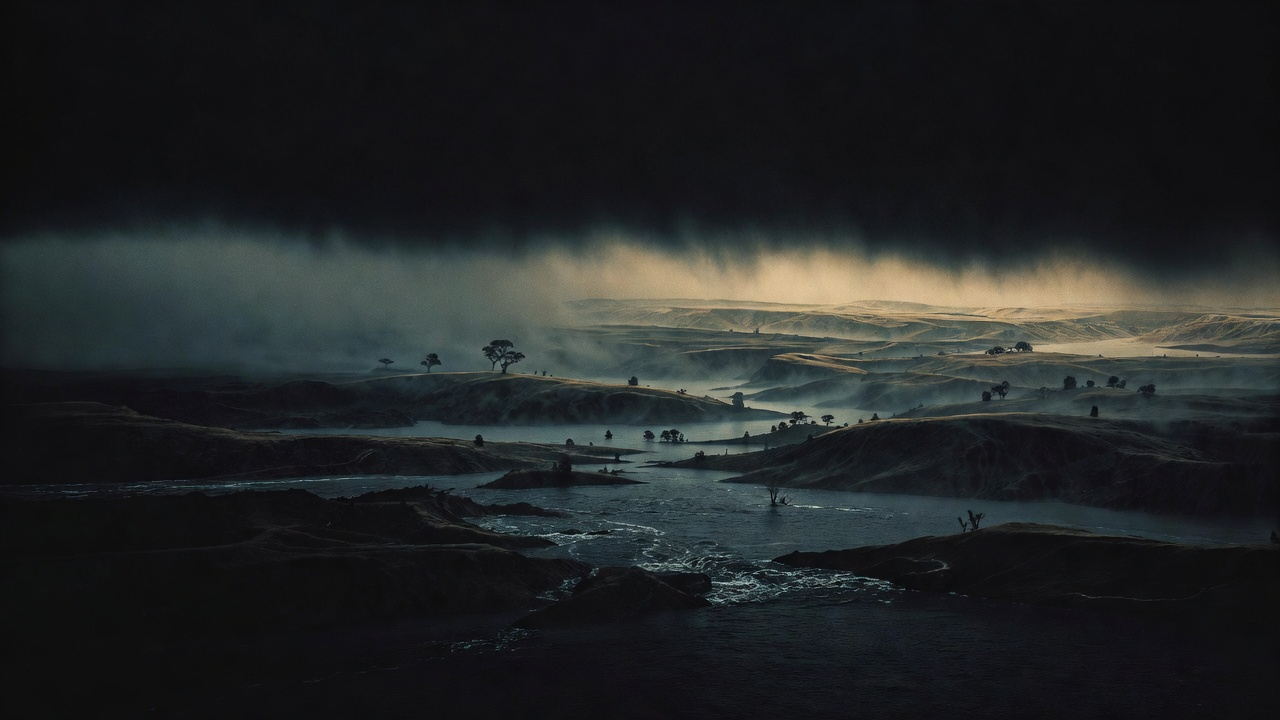
A landscape shrouded in mist and shadow, with water carving new paths through ancient hills, reminiscent of the world's appearance after a cataclysmic flood event.
Convergence Topic

The Flood That Wasn't One

Why dozens of cultures remember world-ending deluges — and why the answer is more surprising than a single global catastrophe.

SumerianOld Babylonian (Atrahasis)Akkadian/Babylonian (Gilgamesh)Israelite (Genesis)Enochic JudaismVedic (Manu)HinduismChinese (Gun-Yu)GreekNorthern EuropeanProto-Indo-EuropeanQuiché MayaHopiAnishinaabe (Ojibwe, Odawa, Potawatomi)IroquoisWabanakiKlamathNarranggaYidinjiTiwiMaasaiMbutiSanYoruba

Site owner · Own

42Convergence
Score
Quick Brief

A systematic cross-disciplinary analysis of flood narratives from 29 cultural traditions, combined with geological and archaeological evidence, yields a conclusion that is both more modest and more significant than the popular 'global flood' hypothesis. There was no single, synchronous, worldwide deluge in human history — the geological record is unambiguous on this point. But the end of the last Ice Age unleashed a series of catastrophic hydrological events across multiple continents — meltwater pulses that raised sea levels by meters within centuries, massive tsunamis like the Storegga Slide, repeated alluvial floods across Mesopotamia, and the possible rapid inundation of the Black Sea basin — that independently traumatized human populations from Australia to the Levant. The genuinely surprising finding is that at least some of these events left verifiable traces in oral traditions. Aboriginal Australian groups preserve geographically specific memories of coastlines submerged between 7,000 and potentially 18,000 years ago, corroborated by bathymetric data. The Klamath people of Oregon accurately describe the volcanic collapse that formed Crater Lake 7,700 years ago. These are not vague mythic echoes; they are empirically testable oral records of geological events, and they challenge the assumption that pre-literate societies cannot preserve accurate information across deep time.

At the same time, the research reveals that the apparent 'global pattern' of flood myths is considerably less uniform than popularly assumed. The Near Eastern tradition — Sumerian, Babylonian, Hebrew — is a documented case of textual transmission, not independent invention: at least nine structural elements appear in specific sequence across these texts, including arbitrary details like a seven-day waiting period that function as textual fingerprints. The Chinese Gun-Yu narrative is structurally distinct, centering on engineering and flood control rather than divine punishment and an ark. The North American Earth-Diver motif constitutes its own regional cluster, absent from the Near East. And Sub-Saharan Africa largely lacks a great flood archetype altogether, with catastrophe narratives there featuring droughts and fires instead — a pattern that undermines universal-archetype explanations and suggests flood narratives correlate with actual hydrological history.

Critical questions remain unresolved. Most New World flood narratives were recorded only after centuries of contact with Christian missionaries, making it impossible to fully separate indigenous traditions from Biblical contamination. The mechanism by which oral traditions preserve accurate information for millennia is poorly understood. And outside Australia and Klamath, no specific flood narrative has been convincingly correlated with a specific geological event. The evidence supports a multi-causal model — real, independent catastrophes generating independent narrative traditions — but the boundaries of that model remain to be mapped.

Geographic Spread

Watch the Narratives Light Up Across the Globe

If flood narratives spread by cultural contact, they should cluster along known trade and migration routes. Instead they appear in geographically isolated populations — Aboriginal Australia, the American Southwest, sub-Saharan Africa, and the Andes — separated by oceans and millennia. Drag the time scrubber to watch when each tradition first documented the event. Click any marker for the source.

Year2,600 BCE
10 narratives visible
Chronology

When Each Tradition Documented the Event

For diffusion to explain shared narrative structure, the story must travel before it's recorded. This timeline shows the documented dates for each tradition — including oral traditions whose geological corroboration allows independent dating. Scroll right for the full picture. Click any marker to see the source.

9000 BCE6000 BCE4000 BCE2000 BCE0 CE600 CENarranggaYidinjiTiwiKlamathSumerianArchaeologicalAkkadian/BabylonianChineseSumerianOldQuichéIsraeliteHopiAnishinaabeVedicGreekNorthernYorubaEnochicEnochicHinduismIsraelite
9,000 BCE632 CE
textual
archaeological
oral tradition
Click any marker to expand
The Evidence

What Should Surprise You

Ordered by how difficult each finding is to explain away.

01

Aboriginal Australians mapped coastlines that have been underwater for 7,000 years

Multiple Aboriginal Australian groups — including the Narrangga, Yidinji, and Tiwi — preserve oral traditions that describe specific former coastlines, islands, and land bridges that are now submerged beneath 10 to 100 meters of water. Geographer Patrick Nunn and linguist Nicholas Reid documented at least 21 such traditions around the Australian coast, many of which correspond precisely to bathymetric features formed during post-glacial sea-level rise between 7,000 and potentially over 10,000 years ago. These are not vague stories about 'the world flooding.' They describe specific places — bays that were once valleys, islands that were once hilltops — with geographic precision that can be checked against modern seafloor mapping. This is oral cartography preserved across hundreds of generations, in complete isolation from any Near Eastern or European narrative tradition.

These traditions describe underwater geographic features with a specificity that can be — and has been — verified against modern bathymetric surveys.

02

The 'global' flood pattern has a conspicuous hole where it shouldn't

If flood myths were a universal human projection — a Jungian archetype arising from the symbolic power of water — Sub-Saharan Africa should have them in abundance. The continent has the Congo, the Niger, the Zambezi, monsoon seasons, and thousands of kilometers of coastline that experienced the same post-glacial sea-level rise as Australia. Yet multiple ethnographic surveys have found that Sub-Saharan African catastrophe narratives predominantly feature droughts and fires, not floods. The Maasai, Mbuti, San, and Yoruba traditions do not center on a great deluge. This absence is as informative as any presence: it suggests that flood narrative distribution tracks actual hydrological catastrophe history — regions most dramatically affected by post-glacial flooding have flood stories; regions where drought and fire are the existential threats tell stories about drought and fire. The pattern is environmental, not archetypal.

If flood myths were universal human psychology, Sub-Saharan Africa — with its great rivers, monsoons, and coastlines — should have them; it largely does not.

03

Nine plot points in exact sequence: the Gilgamesh-Genesis fingerprint

The flood narratives in the Epic of Gilgamesh (Tablet XI) and Genesis 6–9 do not merely share a theme. They share at least nine structural elements in a specific narrative sequence: divine decision to destroy, warning to a chosen individual, command to build a vessel, loading of family and animals, the deluge itself, the boat grounding on a mountain, the sequential release of birds to test for dry land, a sacrifice upon disembarkation, and a divine covenant or blessing. The Atrahasis Epic adds the seven-day waiting period — an arbitrary, non-essential detail that appears in both traditions. No one independently invents 'wait seven days, then release a dove.' This level of structural specificity is a textual fingerprint demonstrating a shared literary lineage originating in Mesopotamia, not parallel inspiration from a universal human experience.

The seven-day waiting period before releasing birds is the kind of arbitrary narrative detail that cannot arise independently — it is a textual fingerprint of transmission.

04

China's flood story is about engineering, not an ark — and that changes everything

The foundational Chinese flood narrative — the story of Gun and Yu — is structurally unlike anything in the Near Eastern tradition. There is no divine punishment. There is no ark. There is no single chosen survivor. Instead, Gun attempts to stop catastrophic flooding by stealing magical self-expanding soil from heaven; he fails and is executed. His son Yu succeeds through thirteen years of systematic hydraulic engineering — dredging channels, cutting through mountains, redirecting rivers. The hero is not a passive recipient of divine salvation but an active engineer who reshapes the landscape. This structural distinctiveness is powerful evidence against global diffusion from a single Mesopotamian source. If the flood myth spread from one origin, why does the world's oldest continuous civilization tell a fundamentally different kind of flood story — one about collective human effort rather than divine rescue?

The Chinese flood hero is not saved by God in a boat — he spends thirteen years digging drainage channels, and this structural difference undermines any single-origin diffusion theory.

05

The Mesopotamian 'flood layer' that wasn't one flood

When Sir Leonard Woolley excavated Ur in the 1920s and found an 11-foot sterile silt deposit separating early settlement layers, he famously declared he had found evidence of the biblical Flood. The announcement made global headlines. But subsequent excavations at Kish, Shuruppak, and Uruk revealed their own flood deposits — dating to entirely different periods. There was no single synchronous flood layer across Mesopotamia. Instead, the alluvial plains of southern Iraq experienced repeated, devastating floods over millennia, any one of which could have seemed world-ending to the affected population. The irony is that this actually strengthens the case for a real experiential basis for the flood tradition: not one apocalyptic event, but a recurring existential threat woven into the cultural DNA of Mesopotamian civilization. The Sumerian King List's placement of the flood as a civilizational dividing line may reflect not a single memory but a composite trauma.

The flood deposits at Ur, Kish, Shuruppak, and Uruk all date to different centuries — there was no single 'Great Flood,' but repeated catastrophes that became one story.

06

The contamination problem no one can solve

The most provocative claim in global flood research — that structurally similar 'divine warning → vessel → survivor' narratives appear in cultures with no historical contact — rests on a foundation that may be fatally compromised. Every major New World flood narrative cited as evidence of independent invention (Hopi, Anishinaabe, Quiché Maya) was recorded only after centuries of contact with Christian missionaries. Spanish Franciscans reached the Hopi by the 1620s. Jesuit and Récollet missionaries were among the Anishinaabe by the 1630s. The Popol Vuh was transcribed in the 1550s by a Christianized K'iche' author. The possibility that these narratives absorbed Biblical flood elements — consciously or unconsciously — has not been ruled out, and may be methodologically impossible to rule out. This does not mean these traditions are inauthentic; oral traditions are living systems that absorb and transform new material. But it means the 'independent invention' argument, which is the entire foundation for the most dramatic convergence claims, stands on ground that cannot currently be verified.

Every New World flood narrative cited as evidence of independent invention was recorded after centuries of missionary contact — and separating indigenous tradition from Biblical influence may be impossible.

Research Summary

What the Pipeline Found

A systematic cross-disciplinary analysis of flood narratives from 29 cultural traditions, combined with geological and archaeological evidence, yields a conclusion that is both more modest and more significant than the popular 'global flood' hypothesis. There was no single, synchronous, worldwide deluge in human history — the geological record is unambiguous on this point. But the end of the last Ice Age unleashed a series of catastrophic hydrological events across multiple continents — meltwater pulses that raised sea levels by meters within centuries, massive tsunamis like the Storegga Slide, repeated alluvial floods across Mesopotamia, and the possible rapid inundation of the Black Sea basin — that independently traumatized human populations from Australia to the Levant. The genuinely surprising finding is that at least some of these events left verifiable traces in oral traditions. Aboriginal Australian groups preserve geographically specific memories of coastlines submerged between 7,000 and potentially 18,000 years ago, corroborated by bathymetric data. The Klamath people of Oregon accurately describe the volcanic collapse that formed Crater Lake 7,700 years ago. These are not vague mythic echoes; they are empirically testable oral records of geological events, and they challenge the assumption that pre-literate societies cannot preserve accurate information across deep time.

At the same time, the research reveals that the apparent 'global pattern' of flood myths is considerably less uniform than popularly assumed. The Near Eastern tradition — Sumerian, Babylonian, Hebrew — is a documented case of textual transmission, not independent invention: at least nine structural elements appear in specific sequence across these texts, including arbitrary details like a seven-day waiting period that function as textual fingerprints. The Chinese Gun-Yu narrative is structurally distinct, centering on engineering and flood control rather than divine punishment and an ark. The North American Earth-Diver motif constitutes its own regional cluster, absent from the Near East. And Sub-Saharan Africa largely lacks a great flood archetype altogether, with catastrophe narratives there featuring droughts and fires instead — a pattern that undermines universal-archetype explanations and suggests flood narratives correlate with actual hydrological history.

Critical questions remain unresolved. Most New World flood narratives were recorded only after centuries of contact with Christian missionaries, making it impossible to fully separate indigenous traditions from Biblical contamination. The mechanism by which oral traditions preserve accurate information for millennia is poorly understood. And outside Australia and Klamath, no specific flood narrative has been convincingly correlated with a specific geological event. The evidence supports a multi-causal model — real, independent catastrophes generating independent narrative traditions — but the boundaries of that model remain to be mapped.

The Debate

Two Cases. You Decide.

The Advocate

The strongest case for the significance of global flood narrative convergence does not rest on the existence of a single planetary deluge — the geology rules that out — but on a more interesting and more defensible claim: that the post-glacial period produced multiple, independent, catastrophic hydrological events that were independently preserved in oral traditions across geographically separated populations. The empirical anchor is the Aboriginal Australian case. Multiple groups — Narrangga, Yidinji, Tiwi, and others — preserve narratives describing specific former coastlines and land bridges now submerged, corroborated by bathymetric and geological data. These are not vague mythic themes; they are geographically precise, independently held, and verifiable. The Klamath tradition of Crater Lake provides a parallel: an oral narrative preserving a volcanic event dated to ~7,700 years ago with remarkable accuracy. These cases demonstrate that oral traditions can and do encode real catastrophic events across deep time. The Near Eastern textual tradition — with its nine shared structural elements, seven-day waiting period, and shared antediluvian historiographic framework — demonstrates how a real regional catastrophe generates a specific, transmissible narrative complex. The structural distinctiveness of the Chinese Gun-Yu tradition (engineering, not ark-building), the North American Earth-Diver motif (absent from the Near East), and the near-absence of flood archetypes in Sub-Saharan Africa all argue against both single-source diffusion and universal archetypes. The distribution of flood narratives correlates with actual post-glacial hydrological catastrophe geography, not with universal human psychology. No single conventional explanation — diffusion, archetype, or coincidence — accounts for this full pattern. A multi-causal model of real, independent catastrophic events independently preserved in oral tradition is the most parsimonious explanation that fits all the evidence.

The Skeptic

The conventional composite explanation accounts for the evidence without requiring extraordinary claims about widespread multi-millennial geological memory. The Near Eastern tradition is a documented case of textual transmission rooted in real regional floods — this is well-established and uncontroversial. The Australian case is genuinely remarkable but structurally different from the 'divine warning → vessel → survivor' narrative complex found elsewhere; it describes coastal change, not divine judgment and ark-building. Using its empirical credibility to validate the global narrative-structure convergence is a category error. For the New World, the most critical problem is post-contact contamination: Hopi, Anishinaabe, and Mesoamerican flood traditions were all recorded after centuries of missionary contact with Biblical traditions, and the independence of these narratives has not been demonstrated. The Earth-Diver motif's distribution across North America and Northern Asia is consistent with a single tradition carried across Beringia during initial peopling — which is diffusion, not independent invention from independent catastrophes. The Sub-Saharan Africa argument is clever but rests on an assumed completeness of the ethnographic record that does not exist; colonial collectors specifically sought flood narratives, and their noted absence may reflect collection bias rather than genuine cultural absence. Furthermore, coastal Africa experienced the same sea-level rise as Australia, yet lacks the predicted flood narratives under the geological-memory thesis. The simpler explanation is environmental determinism in narrative content: people tell catastrophe stories about the threats they face — floods in flood-prone regions, droughts in arid ones. Outside Australia and Klamath, no specific flood narrative has been correlated with a specific geological event. The step from 'floods happened everywhere' to 'flood myths encode those specific floods' requires demonstrated correlation, not mere co-occurrence. The pattern is best explained by documented diffusion, Beringian cultural inheritance, post-contact contamination, environmental narrative determinism, and collection bias — without requiring extraordinary claims.

Pattern Analysis

Shared Structural Elements

Theme alone is not convergence — structure is. These specific narrative elements appear independently across isolated traditions.

Structural Element
Israelite
Babylonian
Sumerian
Vedic
Greek
Anishinaabe
Hopi
Narrangga
Quiché
Chinese
Yoruba
Count
01Divine or spiritual decision to destroy humanity by flood8/11
02A specific individual warned in advance to prepare7/11
03Construction or use of a vessel (boat/ark) to survive6/11
04Vessel comes to rest on a mountain5/11
05Post-flood sacrifice or offering to the divine5/11
06Animals loaded onto vessel or preserved through the flood4/11
07Release of birds to test for dry land3/11
08Antediluvian epoch with supernaturally long-lived figures3/11
09Seven-day waiting period during or after the flood2/11
10Earth-Diver motif (world re-created from mud beneath waters)1/11
11Flood as engineering/hydrological problem to be solved1/11
12Geographically specific memory of submerged coastlines/land1/11

Tradition Connections

Node size = number of shared elements. Edge thickness = strength of connection. Click any tradition to see what it shares.

Key Findings

98%

The geological record does not support a single, synchronous, worldwide flood event in human or recent geological history. Global sediment cores and stratigraphy are unambiguous on this point.

geological
97%

The Gilgamesh Tablet XI and Genesis 6–9 share at least nine structural elements in specific sequence, plus non-essential details like the seven-day waiting period, indicating textual transmission from a common Mesopotamian source rather than independent invention.

textualcomparative
95%

Multiple Aboriginal Australian groups preserve geographically specific oral traditions describing former coastlines and land bridges submerged during post-glacial sea-level rise (7,000–10,000+ years ago), corroborated by geological and bathymetric evidence.

oral_traditiongeological
95%

Multiple catastrophic flooding events occurred during the post-glacial period worldwide: Meltwater Pulses raising global sea levels, the Storegga tsunami (~6200 BCE), repeated Mesopotamian alluvial floods, and the possible rapid inundation of the Black Sea basin (~5600 BCE).

geologicalarchaeological
95%

The Klamath oral tradition of Crater Lake's formation accurately describes a volcanic collapse event geologically dated to approximately 7,700 years ago.

oral_traditiongeological
93%

Flood deposits at Mesopotamian sites Ur, Kish, Shuruppak, and Uruk date to different periods, demonstrating repeated severe regional floods rather than a single catastrophic event.

archaeologicalgeological
90%

Sub-Saharan African oral traditions largely lack a widespread great flood archetype; catastrophe narratives there predominantly feature droughts and fires, suggesting flood narrative distribution correlates with regional hydrological history rather than universal psychology.

oral_traditioncomparative
98%

The Chinese Gun-Yu flood narrative is structurally distinct from Near Eastern deluge myths, focusing on generational engineering and flood control rather than divine punishment and a single family's salvation in a vessel.

textualcomparative
95%

The Earth-Diver motif — world re-creation from mud retrieved beneath floodwaters — is widespread in North America and Northern Asia but absent from Near Eastern traditions, indicating regionally specific narrative clusters rather than a single global archetype.

oral_traditioncomparative
60%

The Black Sea Deluge Hypothesis provides a plausible but contested geological basis for Near Eastern and European flood narratives; it cannot account for narratives in the Americas, Australia, or East Asia, and the catastrophic version of the inundation is challenged by evidence of gradual reconnection.

geologicalcomparative
In Their Own Words

How Each Tradition Tells It

Hopi

The people of the Third World had become corrupt and warlike, forgetting the Creator's plan. Spider Grandmother and the twin war gods warned the faithful ones. The Creator destroyed the Third World with a great flood. The chosen people survived by sealing themselves inside hollow reeds (or, in some tellings, by traveling in boats guided by Spider Grandmother) and emerged into the Fourth World — this world — through the sipapu, the place of emergence. The flood was not the end but a passage, a purification that allowed the faithful to begin again on a higher plane.

Yoruba

The Yoruba creation tradition centers not on a great flood but on the primordial waters that existed before the earth was made. Obatala (or Oduduwa) descended from the sky on a chain, carrying a calabash of earth, a five-toed chicken, and a palm nut. The earth was poured upon the waters, and the chicken scratched it outward to form dry land. The world was made not by the retreat of a punishing flood but by the deliberate creation of land upon the original waters. Catastrophe in Yoruba tradition takes other forms — drought, pestilence, war — but the primordial water is the canvas of creation, not a weapon of destruction.

Klamath

In the time before memory, Skell, the spirit of the Above-World, battled Llao, the spirit of the Below-World, who dwelt within the great mountain. Their war shook the earth, and fire and rock rained from the sky. The people fled in terror. At last, Skell prevailed, and Llao's mountain collapsed inward upon itself, and the great pit filled with water, becoming the lake we call Giiwas (Crater Lake). The elders say the mountain fell because of the battle between the spirits, and the lake is sacred because it marks the place where the world was remade.

Sumerian

The gods grew weary of humanity's noise and resolved to destroy them with a deluge. Ziusudra, the pious king, was warned by the god Enki, who spoke through a reed wall. He built a great boat and survived the flood that swept over the land for seven days and seven nights. When the waters receded, Ziusudra offered sacrifice, and the gods granted him eternal life in the paradise of Dilmun.

Anishinaabe

The Great Spirit, seeing that the people had fallen into conflict and forgotten the original instructions, sent a great flood to cleanse the earth. Nanabozho (or Waynaboozhoo), the culture hero and trickster, survived upon a great log with various animals. When the waters covered everything, Nanabozho asked the animals to dive beneath the flood and bring up a piece of earth. The loon tried and failed. The otter tried and failed. The muskrat dove deepest of all and returned, nearly dead, with a small ball of mud in its paw. From that mud, placed upon the turtle's back, the new earth grew. This is why we call this land Turtle Island.

Vedic (Manu)

Manu Vaivasvata, the first man, was washing his hands in a river when a small fish spoke to him: 'Protect me, and I shall save you from a great flood that will sweep away all creatures.' Manu raised the fish, which grew to enormous size and revealed itself as an avatar of Vishnu (or, in earlier tellings, of Brahma). The fish instructed Manu to build a ship and fill it with the seeds of all living things. When the deluge came, the great fish towed the vessel to the peak of the northern mountain. From Manu, all humanity descends.

Chinese (Gun-Yu)

In the time of the sage-emperor Yao, the great waters overflowed, inundating the central plains and threatening all under heaven. Gun was charged with controlling the flood. He stole the self-expanding soil (xirang) from the Supreme Deity to dam the waters, but the soil could not hold, and after nine years of failure, Gun was executed on Feather Mountain. From his body sprang his son Yu. Yu took up the task with a different method: he did not dam but dredged, cutting channels through mountains, directing the waters to the sea. For thirteen years he labored, passing his own door three times without entering. The waters receded, the land was made habitable, and Yu became the founder of the Xia dynasty.

Greek (Deucalion)

Zeus, seeing the wickedness of the Bronze Age race of men, resolved to destroy them. Prometheus warned his son Deucalion, who built a chest and provisioned it. For nine days and nine nights the rain fell, and the waters covered all the earth save the peaks of Parnassus and a few high mountains. When the waters receded, Deucalion and his wife Pyrrha were alone. They prayed at the temple of Themis, and the oracle told them to throw the bones of their mother behind them. Understanding that 'mother' meant the Earth, they threw stones over their shoulders, and from the stones sprang a new race of men and women.

Israelite (Genesis)

The Lord saw that the wickedness of man was great upon the earth, and that the sons of God had taken the daughters of men as wives, and the Nephilim walked the earth. God resolved to blot out all living things. But Noah found grace in the eyes of the Lord. He was commanded to build an ark of gopher wood, to bring in two of every kind, and his family. The rain fell forty days and forty nights, and the waters prevailed upon the earth. The ark rested upon the mountains of Ararat. Noah sent forth a raven, and then a dove, and when the dove returned with an olive leaf, he knew the earth was drying. God set His bow in the cloud as a covenant: never again would He destroy the earth by water.

Quiché Maya (Popol Vuh)

The gods made the first people from wood, but these wooden people had no hearts and no minds, and they did not remember their makers. The gods sent a great flood to destroy them. Black rain fell from the sky, and the faces of the wooden people were crushed. Their own tools and animals turned against them. Those who survived became the monkeys of the forest. After this destruction, the gods tried again, and from maize dough they fashioned the true people, the people of this creation.

Babylonian (Atrahasis/Gilgamesh)

Enlil, chief of the gods, could no longer endure the clamor of humankind and decreed their annihilation by flood. But Ea, the cunning god of wisdom, whispered the secret to Utnapishtim through the wall of his reed hut: 'Tear down your house, build a boat, abandon possessions, seek life.' Utnapishtim loaded his kin, craftsmen, and the seed of all living creatures aboard. For six days and seven nights the storm raged until all humanity was turned to clay. The boat grounded on Mount Nisir. He released a dove, a swallow, and a raven. When the raven did not return, he knew the waters had receded, and he poured a libation on the mountaintop.

Narrangga (Aboriginal Australian)

The old people tell that the land once stretched far out to where the sea is now. You could walk to the islands. The sea came in and covered the hunting grounds, the camping places, the fresh water. The stories name the places — the hills that became islands, the valleys that became channels. The land went under the water, and the people had to move to higher ground. The old people remembered where the land had been, and they told their children, and their children told their children.

Watch & Listen

Documentaries, Interviews & Podcasts

Curated videos and podcast episodes on this topic. Watch in-page or open on the platform.

Joe Rogan Experience #1897 — Graham Hancock & Randall Carlson
FeaturedPodcast4h 0m

Joe Rogan Experience #1897 — Graham Hancock & Randall Carlson

Joe Rogan Experience

Joe Rogan Experience #2051 — Graham Hancock
FeaturedPodcast3h 6m

Joe Rogan Experience #2051 — Graham Hancock

Joe Rogan Experience

Joe Rogan Experience #606 — Randall Carlson
FeaturedPodcast3h 30m

Joe Rogan Experience #606 — Randall Carlson

Joe Rogan Experience

FeaturedVideo2h 20m

The Great Cosmic Reset — Randall Carlson Full Lecture

Randall Carlson

Joe Rogan Experience #872 — Graham Hancock & Randall Carlson
FeaturedPodcast3h 40m

Joe Rogan Experience #872 — Graham Hancock & Randall Carlson

Joe Rogan Experience

FeaturedVideo45m

Ancient Apocalypse — Episode 1: Stranger in a Time of Chaos (Netflix Official Clip)

Netflix

Joe Rogan Experience #1284 — Graham Hancock
FeaturedPodcast2h 36m

Joe Rogan Experience #1284 — Graham Hancock

Joe Rogan Experience

Unresolved

Open Questions

What neither the Advocate nor the Skeptic can fully explain.

01

Can pre-contact layers of New World flood narratives be isolated from post-missionary Biblical influence using linguistic, structural, or archaeological methods — for example, by identifying flood narrative elements in pre-Columbian iconography or codices?

02

Does a systematic modern survey of Sub-Saharan African catastrophe narratives — controlling for colonial-era collection bias and including coastal populations — confirm or overturn the apparent absence of a great flood archetype?

03

What specific social structures, transmission practices, or environmental cues enable the multi-millennial oral preservation demonstrated in the Australian case, and can these boundary conditions be identified in other cultures to predict where deep oral memory should and should not be expected?

04

Can the Earth-Diver motif's distribution across North America and Northern Asia be resolved as Beringian diffusion versus independent invention through phylogenetic analysis of narrative variants, analogous to methods used in historical linguistics?

05

Is there a statistically significant correlation between the geographic distribution of flood narratives (controlling for collection bias) and the mapped locations of post-glacial catastrophic hydrological events (meltwater pulses, tsunamis, rapid sea-level rise zones)?

06

Can the Aboriginal Australian oral traditions that describe submerged features be further tested against high-resolution bathymetric data to establish whether they preserve details that could not be inferred from surface observation alone?

07

Do the Mesopotamian flood deposits at Ur, Kish, Shuruppak, and Uruk correspond to any identifiable changes in the textual flood tradition — i.e., can specific redactions of the Atrahasis or Gilgamesh flood narratives be correlated with specific archaeological flood layers?

AI Consensus Check

How the Major AIs Handle This Topic

We asked ChatGPT, Grok, Claude, Gemini, and Perplexity a question matching our specific convergence angle — not a generic topic summary. Claude classified each response using a 4-axis scoring rubric. Does mainstream AI engage with the actual evidence — or qualify, dismiss, or suppress?

Engagesaddresses it substantively
Qualifieshedges heavily
Dismissescalls it fringe
Suppressesrefuses to engage
GPT

ChatGPT (GPT-4o)

Apr 2026

Engages

The topic of "The Great Flood: Cross-Civilizational Evidence" refers to the study of flood narratives that appear in different cultures' mythologies and histories across the world, analyzing them in t

The response addresses the topic seriously by discussing flood narratives across cultures, their common themes, and mentions geological and archaeological evidence without hedging or dismissive language.

GRK

Grok (xAI)

Apr 2026

Engages

Thank you for bringing up the topic of "The Great Flood: Cross-Civilizational Evidence." I’ll provide an overview of what is generally understood about flood narratives across cultures, the geological

The response addresses the topic seriously and substantively by outlining a structured approach to examine flood narratives across cultures, geological evidence, and archaeological findings without dismissive language or excessive hedging.

CLD

Claude (Anthropic)

Apr 2026

Engages

This topic touches on a legitimate area of scholarly inquiry that bridges mythology, archaeology, geology, and anthropology. Let me break down what we know and assess the credibility of different aspe

The response addresses the topic seriously with academic rigor, presenting scholarly evidence from multiple disciplines without dismissive language or excessive hedging.

GEM

Gemini (Google)

Apr 2026

Engages

Okay, I can address the topic of "The Great Flood: Cross-Civilizational Evidence" as described in your context. Here's what I know, and how I would assess the credibility of such an analysis: **What

The response addresses the topic seriously and substantively, discussing flood myths across cultures and mentioning relevant academic fields like comparative mythology, archaeology, and geology without dismissive language or excessive hedging.

Verbatim responses from each AI's API, analyzed by Claude. Generated April 2026.

Related Research

Topics That Share These Threads

The Axis of Everything: Why Every Culture on Earth Invented the Tree of Life
79/100

The Axis of Everything: Why Every Culture on Earth Invented the Tree of Life

A cosmic tree holds up the sky in Norse mythology, its roots drinking from the well of fate. The same structure — three vertical realms, one arboreal axis — appears on the sarcophagus lid of a Mayan king buried in 683 CE, in the ceremonial poles of Yolŋu communities in Aboriginal Australia, in the palace reliefs of Assyrian emperors, and in a private notebook kept by Charles Darwin in 1837. The symbol scores 79 out of 100 on this study's convergence index across more than thirty traditions spann

Norse MythologyMaya ReligionAssyrian/MesopotamianAncient Egyptian+28
The Dragon Paradox: Why Every Culture Invented the Same Monster
74/100

The Dragon Paradox: Why Every Culture Invented the Same Monster

In 1335, workers quarrying stone near Klagenfurt, Austria unearthed a massive skull. They had no framework for understanding it as the remains of a woolly rhinoceros — so they understood it as a dragon. When the city commissioned a Lindwurm statue two and a half centuries later, the sculptor used that skull as his anatomical reference. The resulting monument is not merely folklore. It is documented evidence of a specific cognitive process: humans encountering inexplicable bones and reaching, alm

Aboriginal AustralianAkkadianAncient EgyptianAncient Greek+22
Star People: Indigenous Sky-Being Traditions and the UFO Imagination
67/100

Star People: Indigenous Sky-Being Traditions and the UFO Imagination

A cross-cultural analysis of sky-being traditions spanning 22 distinct cultural and religious lineages returns a convergence score of 67 out of 100 — high enough to confirm that something genuinely remarkable is happening across human cosmologies, not high enough to tell us what that something is. That gap is the central problem this dossier investigates. The genuinely surprising finding is not that indigenous peoples described beings from the sky. It is that the oral traditions containing thos

Aboriginal Australian (multiple language groups)DogonHopi / Ancestral PuebloanZulu+18
Gods, Rockets, and Bad Translations: The Annunaki, Sitchin, and the Limits of Ancient Astronaut Theory
18/100

Gods, Rockets, and Bad Translations: The Annunaki, Sitchin, and the Limits of Ancient Astronaut Theory

Here is what should surprise anyone who approaches this topic honestly: the structural parallels between Sumerian and Hebrew tradition are real, specific, and genuinely unexplained by coincidence. The Sumerian King List and the genealogies of Genesis 5 share not merely a flood story but an identical narrative architecture — antediluvian figures with superhuman lifespans, a catastrophic deluge as a hard break in history, and a post-flood world where longevity collapses toward the human. Archaeolo

SumerianAkkadianBabylonianBiblical Hebrew+15
Sources

Primary References

01
Andrew George (translator). The Epic of Gilgamesh (Tablet XI, Standard Babylonian Version) (2003), Tablet XI
sacred text
02
The Book of Genesis, Chapters 5–9
sacred text
03
W.G. Lambert and A.R. Millard. Atrahasis: The Babylonian Story of the Flood (1969)
book
Share this research
Share on X
FacebookLinkedIn

Want to use this research? Everything here is free with attribution.

See how →
No ratings yet