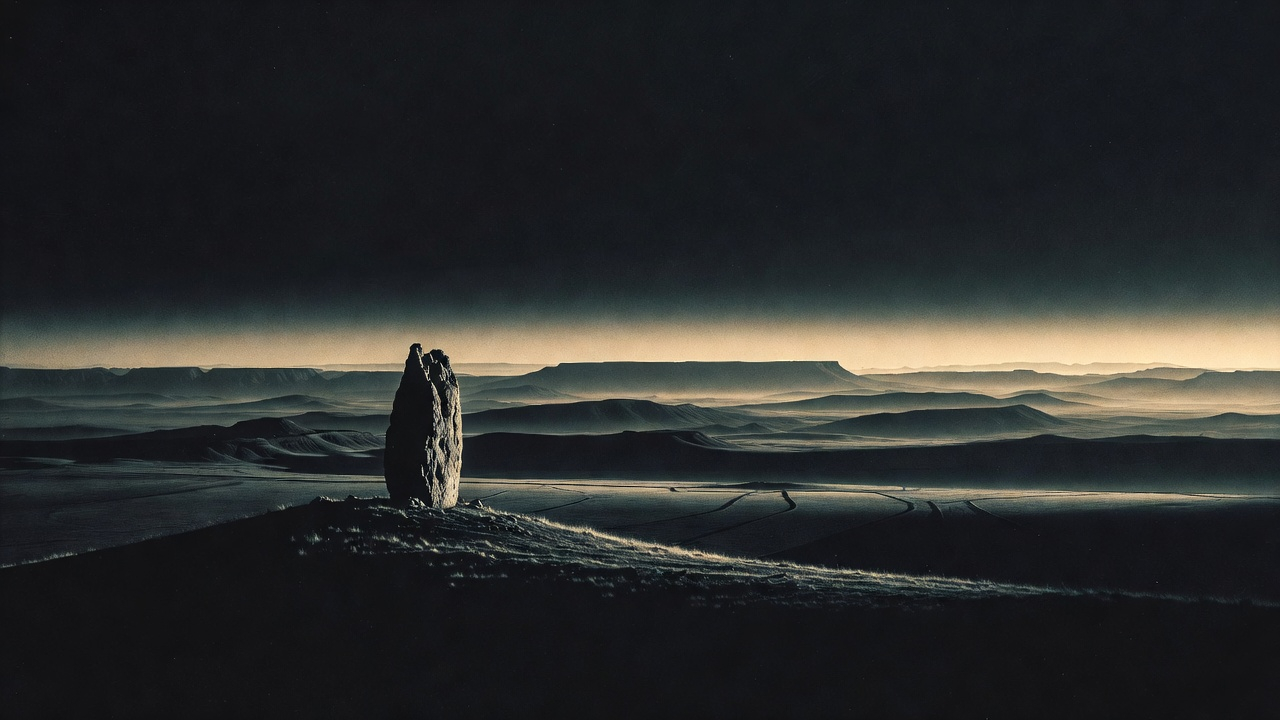
A lone megalith stands sentinel over a vast landscape, a testament to ancient human endeavors to mark and perhaps align with the subtle energies or celestial patterns of the earth. Such sites often form the nodes in proposed earth grids and ley lines.
Convergence Topic

Lines Across the Land: Sacred Geometry, Earth Grids, and the Human Impulse to Map the Sacred

From Alfred Watkins's prehistoric trackways to Aboriginal songlines and Chinese dragon veins, a global survey of how cultures have inscribed meaning onto landscape — and what the convergences actually prove.

British Antiquarianism / Ley HuntingAustralian Aboriginal Songlines / Dreaming TracksChinese Geomancy (Feng Shui / Dragon Veins)Ancient Egyptian Sacred ArchitectureGreco-Roman Classical ArchitectureAbrahamic Sacred Geometry (Judaism / Christianity)Andean Ceque System (Inca)Polynesian / Micronesian NavigationNew Age Earth Mysteries / Becker-Hagens GridPlatonic / Pythagorean Cosmological GeometryMesoamerican Sacred LandscapeWestern Esotericism / TheosophyArchaeoastronomy (cross-tradition)

Site owner · Own

61Convergence
Score
Quick Brief

Here is the central paradox this research cannot escape: virtually every complex civilization on record has organized its sacred sites, architecture, or travel routes according to some geometric or directional principle — and yet when you examine these systems closely, they are structurally incompatible with one another. That incompatibility is not a footnote. It is the finding.

The convergence score of 61 out of 100 is real, but it has been systematically misread. What converges across traditions is not evidence of a shared earth energy, a planetary grid, or a lost geometric science. What converges is something more interesting and more verifiable: a universal human drive to impose mathematical order on landscape and to encode cosmological meaning into built or traversed space. The geometry is in the minds doing the mapping, not in the ground being mapped.

Three flagship cases make this clear. Alfred Watkins, a Herefordshire businessman, proposed in 1921 that prehistoric standing stones, mounds, and hilltop notches in Britain were aligned along straight practical trackways — ancient trade routes marked by surveyors. His original hypothesis was archaeological and mundane. It was later authors, most influentially John Michell in 1969, who grafted 'earth energy' and sacred geometry onto Watkins's alignments, producing the modern mystical ley line. That transformation is historically documented and represents a clean case of a practical idea being retrofitted with metaphysics it was never designed to carry. No peer-reviewed geophysical survey has since confirmed that measurable phenomena correlate with proposed ley alignments.

Australian Aboriginal songlines are routinely cited alongside ley lines as evidence of a universal earth-grid intuition. This comparison collapses under scrutiny. Songlines — Dreaming Tracks — are non-linear, narrative-based, performative systems that encode geography, law, genealogy, and cosmology into song cycles describing the journeys of creator-beings. They are verifiable navigational routes confirmed by the landscape itself, and they function as sophisticated mnemonic technology with continuous use from the Pleistocene to the present. They are not straight lines. They are not geometric abstractions. Equating them with Watkins's leys is not a synthesis; it is an erasure of what makes them remarkable.

Chinese dragon veins — lóng mài — present a third structural variant. Classical feng shui texts, including the foundational Zangshu, describe dragon veins not as straight geometric lines but as sinuous, flowing channels of qi that follow mountain ranges and watercourses, analogous to a circulatory system. The Luopan compass confirms these principles had practical application in siting decisions. Dragon veins conform to natural topography; ley lines cut across it. The surface-level similarity — both involve 'lines' and 'energy' — dissolves on contact with the primary sources.

What remains genuinely unresolved is a question the evidence cannot yet settle: does the near-universal human tendency to geometrize sacred landscape reflect only shared neural architecture — a cognitive predisposition to find pattern and impose order — or does it also reflect independent discovery of real astronomical, topographic, or acoustic properties of specific sites? Archaeoastronomy has demonstrated that some alignments are real and intentional. The harder question is whether intentional astronomical alignment at individual sites scales up to anything resembling a planetary system. The Becker-Hagens icosahedral grid, the most ambitious version of that claim, was published in enthusiast magazines, not peer-reviewed journals, and the evidence base here contains no scientific test of it.

The honest summary is this: the convergence is human, the differences are structural, and the most popular version of the earth-grid hypothesis remains empirically untested. That is not a dismissal. It is an invitation to ask the right question.

ListenAudio Overview
The Evidence

What Should Surprise You

Ordered by how difficult each finding is to explain away.

05

Songs That Navigate Thousands of Kilometers of Desert

Australian Aboriginal songlines are not metaphors or spiritual poetry — they are functional navigational technologies accurate enough to locate specific waterholes across thousands of kilometers of featureless desert, transmitted entirely through oral performance across tens of thousands of years. Multiple independent findings in this evidence base converge on the same conclusion: the songs encode topography, resource locations, territorial boundaries, and trade routes into narrative and melody, using the landscape itself as an external hard drive. The cognitive achievement here is staggering — no writing, no maps, no instruments, yet the system is precise enough to be verified against physical geography today. This is arguably the most sophisticated mnemonic technology ever documented in a non-literate culture, and it predates any comparable system by orders of magnitude.

A navigator with no map, compass, or writing can locate a specific waterhole in the Australian desert by singing the correct verse of a song learned from their grandmother — and this has been verified against physical geography.

04

Alfred Watkins Proposed Trade Routes, Not Earth Energy

The modern mystical ley line concept — earth energy channels, chakra points, planetary grids — has almost no relationship to what Alfred Watkins actually proposed in 1921. Watkins, a practical Herefordshire businessman and amateur archaeologist, observed that prehistoric standing stones, mounds, and hill notches appeared to fall on straight lines and concluded these were ancient sighting markers for overland trade and navigation routes, a hypothesis entirely devoid of mystical content. The 'earth energy' overlay was added decades later, primarily by John Michell in 1969, synthesizing Watkins' alignments with Chinese feng shui concepts and Theosophical ideas. The finding is surprising because the popular version of ley lines is almost entirely a 1960s invention attributed to a 1920s source that said something completely different.

The mystical 'earth energy' interpretation of ley lines was invented in 1969 and retroactively attributed to a 1921 source that explicitly described prehistoric trade routes — the two theories share a name and almost nothing else.

04

Chinese Dragon Veins Follow Rivers, Not Straight Lines

The classical Chinese feng shui text 'Zangshu' (Book of Burial) describes 'dragon veins' (龙脉, lóng mài) not as straight geometric alignments but as sinuous, living channels of qi that follow the natural curves of mountain ranges and watercourses, explicitly analogized to the circulatory system of a living organism. This is structurally the opposite of Western ley lines, which are defined by their straightness. The popular conflation of these two systems — frequently cited as evidence of a universal human perception of earth energy — collapses on close reading of the primary sources. The convergence is real at the surface level (both involve lines on landscapes with cosmological significance) but the underlying philosophies are conceptually incompatible, and lumping them together is precisely the methodological error that makes ley line theory weak.

The primary Chinese source most often cited as parallel to Western ley lines explicitly describes energy channels that must curve and meander — straightness, in classical feng shui, is a sign of harmful rather than beneficial qi.

03

Egyptian Grid Ostraca: Applied Geometry Before Greek Theory

Ancient Egyptian artists used ostraca — limestone flakes and pottery sherds — as sketchpads, and a significant number of surviving examples are overlaid with precise grids used to scale and proportion sacred figures and architectural elements. This constitutes direct material evidence that a strict geometric canon was applied to sacred art and construction centuries before Greek philosophers formalized geometry as a theoretical discipline. The finding matters for the ley line debate because it demonstrates that ancient cultures genuinely did apply sophisticated geometric thinking to sacred space — the question is not whether ancient geometry existed (it clearly did) but whether that geometry extended to landscape-scale alignments between sites, for which the ostraca provide no evidence.

Egyptian craftsmen were using gridded scaling systems on limestone sketchpads to proportion sacred figures with mathematical precision at least a thousand years before Euclid wrote down the axioms that supposedly founded geometry.

02

The New Jerusalem Is Described as a Perfect Cube

The Book of Revelation describes the New Jerusalem as a city measured by an angel with a golden rod, with dimensions of 12,000 stadia on each side — and crucially, its length, breadth, and height are equal, making it a perfect cube. This directly mirrors the proportions of the Holy of Holies in Solomon's Temple, described in 1 Kings as a perfect cube of 20x20x20 cubits. The convergence between these two texts, separated by roughly a millennium, suggests that the perfect cube carried a specific and stable theological meaning in the Israelite and early Christian tradition — divine completeness, the dwelling place of God — and that sacred geometry in this tradition was eschatological as well as architectural, projecting ideal geometric form onto the end of history itself.

The innermost sanctuary of Solomon's Temple and the final city of Revelation share an identical geometric form — the perfect cube — suggesting this shape carried a precise and stable theological meaning across a thousand years of Israelite and early Christian tradition.

Tradition Deep-Dive

Each tradition tells the story through its own lens. Expand any card to read the full account. Filter by shared motif.

8 traditions documented · 0 shared structural motifs identified

Líneas de Nazca, Nazca, Perú, 2015-07-29, DD 55.JPG

Líneas de Nazca, Nazca, Perú, 2015-07-29, DD 55.JPG

Diego Delso · CC BY-SA 4.0

Research Summary

What the Pipeline Found

Here is the central paradox this research cannot escape: virtually every complex civilization on record has organized its sacred sites, architecture, or travel routes according to some geometric or directional principle — and yet when you examine these systems closely, they are structurally incompatible with one another. That incompatibility is not a footnote. It is the finding.

The convergence score of 61 out of 100 is real, but it has been systematically misread. What converges across traditions is not evidence of a shared earth energy, a planetary grid, or a lost geometric science. What converges is something more interesting and more verifiable: a universal human drive to impose mathematical order on landscape and to encode cosmological meaning into built or traversed space. The geometry is in the minds doing the mapping, not in the ground being mapped.

Three flagship cases make this clear. Alfred Watkins, a Herefordshire businessman, proposed in 1921 that prehistoric standing stones, mounds, and hilltop notches in Britain were aligned along straight practical trackways — ancient trade routes marked by surveyors. His original hypothesis was archaeological and mundane. It was later authors, most influentially John Michell in 1969, who grafted 'earth energy' and sacred geometry onto Watkins's alignments, producing the modern mystical ley line. That transformation is historically documented and represents a clean case of a practical idea being retrofitted with metaphysics it was never designed to carry. No peer-reviewed geophysical survey has since confirmed that measurable phenomena correlate with proposed ley alignments.

Australian Aboriginal songlines are routinely cited alongside ley lines as evidence of a universal earth-grid intuition. This comparison collapses under scrutiny. Songlines — Dreaming Tracks — are non-linear, narrative-based, performative systems that encode geography, law, genealogy, and cosmology into song cycles describing the journeys of creator-beings. They are verifiable navigational routes confirmed by the landscape itself, and they function as sophisticated mnemonic technology with continuous use from the Pleistocene to the present. They are not straight lines. They are not geometric abstractions. Equating them with Watkins's leys is not a synthesis; it is an erasure of what makes them remarkable.

Chinese dragon veins — lóng mài — present a third structural variant. Classical feng shui texts, including the foundational Zangshu, describe dragon veins not as straight geometric lines but as sinuous, flowing channels of qi that follow mountain ranges and watercourses, analogous to a circulatory system. The Luopan compass confirms these principles had practical application in siting decisions. Dragon veins conform to natural topography; ley lines cut across it. The surface-level similarity — both involve 'lines' and 'energy' — dissolves on contact with the primary sources.

What remains genuinely unresolved is a question the evidence cannot yet settle: does the near-universal human tendency to geometrize sacred landscape reflect only shared neural architecture — a cognitive predisposition to find pattern and impose order — or does it also reflect independent discovery of real astronomical, topographic, or acoustic properties of specific sites? Archaeoastronomy has demonstrated that some alignments are real and intentional. The harder question is whether intentional astronomical alignment at individual sites scales up to anything resembling a planetary system. The Becker-Hagens icosahedral grid, the most ambitious version of that claim, was published in enthusiast magazines, not peer-reviewed journals, and the evidence base here contains no scientific test of it.

The honest summary is this: the convergence is human, the differences are structural, and the most popular version of the earth-grid hypothesis remains empirically untested. That is not a dismissal. It is an invitation to ask the right question.

Líneas de Nazca, Nazca, Perú, 2015-07-29, DD 54.JPG

Líneas de Nazca, Nazca, Perú, 2015-07-29, DD 54.JPG

Diego Delso · CC BY-SA 4.0

The Debate

Two Cases. You Decide.

The Advocate

The strongest case for the significance of cross-tradition parallels in sacred landscape organization does not require defending mystical ley lines, earth energies, or the Becker-Hagens grid. It requires only that we take seriously what the primary evidence actually shows: independent human cultures, separated by oceans and millennia, repeatedly developed sophisticated, functional systems for encoding cosmological meaning into geometric spatial organization — and that this convergence demands a serious explanatory account.

The evidentiary foundation is solid. The Inca ceque system is not a modern projection: Brian Bauer's archaeological fieldwork and the colonial-era Spanish chronicles together confirm 41-42 ritual pathways radiating from the Coricancha temple in Cusco, connecting over 300 huacas across the Andean landscape. This is a documented, verifiable radial sacred geometry network built by an actual pre-Columbian civilization. It is the closest real-world analog to what ley line theorists imagine — except it is real, attested, and empirically confirmable. The Inca did not merely sense sacred lines; they administered them.

The architectural evidence is equally robust. The Hebrew Bible specifies Solomon's Temple's Holy of Holies as a perfect cube of 20x20x20 cubits (1 Kings 6:20). Ezekiel 40-48 describes an idealized sacred landscape divided into geometrically precise parallel strips centered on a measured Temple. Vitruvius's De architectura grounds Roman temple design explicitly in human-body proportions. Egyptian artists used gridded ostraca — physical artifacts in museum collections — demonstrating a strict geometric canon applied to sacred representation. Plato's Timaeus assigns the dodecahedron to the cosmos itself. These are not interpretations; they are primary textual and material records of intentional geometric design.

Australian Aboriginal songlines add a crucial dimension. Confirmed by cognitive scientists and cultural ecologists as a functional mnemonic technology, songlines encode geography, law, ecology, and ritual into navigable narrative routes at continental scale. This is an independently developed system — with no contact with Old World traditions — that treats the landscape as a structured, meaningful, traversable text. The convergent intuition that landscape can and should be organized as a repository of sacred and practical meaning appears independently on at least two continents.

Chinese feng shui dragon veins (lóng mài), attested in classical texts including the Zangshu, represent a third independent tradition. Critically, dragon veins are sinuous topographic channels, not straight lines — which distinguishes them structurally from Western ley lines and actually strengthens the convergence argument. The convergence is not on a specific geometric form but on the deeper proposition: that landscape has an invisible but consequential structure, and that human sacred sites should align with it. The Luopan compass is a material technology developed to operationalize this alignment — evidence of a civilization that took the proposition seriously enough to engineer instruments for it.

The meta-argument is this: we have at minimum five independent traditions — Inca, Aboriginal Australian, Chinese, Hebraic-Christian, and Greco-Roman-Egyptian — converging on the practice of geometrically organizing sacred space and landscape. The skeptic must explain why this specific cluster of behaviors emerges independently across cultures if it is merely random noise. The most parsimonious explanation is not a hidden geophysical truth about earth energies, but something arguably more interesting: a deep and recurring feature of human cognition — the drive to make landscape legible, ordered, and cosmologically meaningful. That this drive produces sophisticated, functional systems rather than mere superstition is precisely what makes the convergence significant.

What the advocate cannot yet prove is equally important to state honestly. There is no confirmed geophysical substrate underlying these systems. The structural incompatibilities between traditions — straight lines versus sinuous channels versus radial networks versus proportional architecture — mean they cannot all be describing the same phenomenon. The Becker-Hagens planetary grid lacks peer-reviewed archaeological confirmation. The modern mystical ley line synthesis is a 20th-century construction, not an ancient one. The confidence ceiling of 0.72 reflects these genuine gaps.

What remains above that ceiling is this: the cross-cultural pattern of geometric sacred landscape organization is real, independently attested, and functionally sophisticated. It demands interdisciplinary explanation — cognitive, anthropological, and archaeological — and it has not yet received one commensurate with its evidential weight.

The Skeptic

The strongest case against cross-tradition convergence in sacred geometry and earth grid theories rests on four interlocking arguments, each independently sufficient to undermine the convergence claim, and collectively devastating to it.

The first and most historically precise objection is that the apparent convergence is a documented modern construction, not an ancient parallel discovery. Alfred Watkins proposed leys in 1921 as a practical hypothesis about prehistoric trackways — he explicitly denied mystical content. The transformation into 'earth energy lines' is textually traceable to John Michell's 1969 synthesis in 'The View Over Atlantis,' a single authored work that deliberately assembled Chinese feng shui, Aboriginal navigation, and British antiquarianism into a unified esoteric framework. What looks like independent cultural convergence is, on examination, one mid-century writer performing a literary act of synthesis. Treating that synthesis as evidence of ancient parallel insight is circular: the convergence was manufactured by the very argument that cites it.

The second objection is statistical and has never been adequately answered by proponents. David Kendall's 1989 mathematical analysis demonstrated that the number of three-or-more-point alignments Watkins identified across the British landscape is precisely what random distribution of points predicts by chance alone. Britain has an extraordinary density of ancient sites, churches, hillforts, standing stones, and natural landmarks. Given this density, any researcher drawing straight lines across the landscape will find apparent alignments in abundance. The methodology has a structural flaw: researchers identify lines through sites that fit and disregard the far larger number of sites that fall on no proposed ley. No proponent has specified alignment parameters in advance, generated a null distribution from randomized site locations, and demonstrated that actual alignments exceed chance expectation. Until that test is performed and passed, the empirical foundation of ley line theory is uncontrolled selection bias.

The third objection addresses the structural incompatibility of the supposedly converging systems. Chinese dragon veins are explicitly sinuous, following natural topography — the feng shui literature consistently describes them as serpentine channels of qi that bend around hills and follow watercourses. They are the conceptual opposite of straight geometric lines. Aboriginal songlines are non-linear narrative routes, functionally verified as mnemonic navigational technologies, culturally embedded in specific kinship and ceremonial obligations, and not organized by geometric principles at all. Watkins' leys were straight. Forcing these three systems into a single category requires ignoring the defining characteristics of each. The shared feature — 'connecting significant sites' — is so broad that it describes every road, pilgrimage route, and trade network in human history. Generality at that level is not convergence; it is the absence of a meaningful claim.

The fourth objection is cognitive rather than statistical. Human neural architecture produces a well-documented tendency to impose pattern on landscape: apophenia, pareidolia extended to geography, and the clustering illusion all predict that any culture attending carefully to landscape will find meaningful alignments, correspondences, and geometric relationships. This is not a defect — it is the same cognitive capacity that enables genuine astronomical observation and architectural planning. But it means that cross-cultural pattern-finding in landscape organization is fully explained by shared human perceptual architecture without requiring any hypothesis about actual landscape properties. The convergence, to the extent it exists, may be telling us something true and important about human minds rather than about the earth.

The geophysical silence reinforces all of this. After more than a century of investigation, including the Dragon Project's multi-year instrumental program at British megalithic sites, no reproducible physical measurement has identified a measurable phenomenon — magnetic, electromagnetic, acoustic, or otherwise — that correlates systematically with proposed ley lines as straight-line corridors. The Dragon Project detected anomalies at specific stones, but anomalies at points are not the same as anomalies along lines, and the findings have not been replicated under controlled conditions. The Becker-Hagens planetary grid, meanwhile, was published in fringe magazines rather than peer-reviewed journals, and its site selections have been criticized as post-hoc adjustments to fit a predetermined geometric model. A grid with sufficient vertices overlaid on a sphere populated by thousands of ancient sites will always intersect with sites by chance; no proponent has fixed the grid's parameters in advance and tested clustering against a null distribution.

What the skeptic cannot fully explain away is more limited but genuine. Some astronomical alignments at megalithic sites — Newgrange's winter solstice illumination, the Stonehenge midsummer sunrise axis, certain Egyptian temple orientations — are statistically significant and clearly intentional. The Inca ceque system represents real, archaeologically documented landscape organization radiating from Cusco, with genuine functional and ceremonial significance. And the widespread independent development of geometric principles in sacred architecture is real, even if its explanation is practical rather than metaphysical. These facts are important. They demonstrate that ancient peoples were sophisticated observers of landscape and sky, capable of deliberate geometric and astronomical planning. What they do not demonstrate is that these independent developments reflect a single underlying earth energy, a global grid, or a shared esoteric tradition. Sophistication in landscape organization is not the same as convergence on a unified metaphysical truth. The skeptic's position, held at 0.82 rather than 0.95, acknowledges genuine astronomical intentionality and real landscape organization while maintaining that the convergence hypothesis adds nothing explanatory beyond what independent human ingenuity, shared cognitive architecture, and the practical constraints of construction and navigation already provide.

Debate Simulator

Both cases in full. Expand any argument to read the complete text.

The Advocate8 arguments
01

The strongest case for the significance of cross-tradition parallels in sacred landscape organization does not require defending mystical ley lines, earth energies, or the Becker-Hagens grid.…

02

The evidentiary foundation is solid.…

03

The architectural evidence is equally robust.…

04

Australian Aboriginal songlines add a crucial dimension.…

05

Chinese feng shui dragon veins (lóng mài), attested in classical texts including the Zangshu, represent a third independent tradition.…

06

The meta-argument is this: we have at minimum five independent traditions — Inca, Aboriginal Australian, Chinese, Hebraic-Christian, and Greco-Roman-Egyptian — converging on the practice of geometrically organizing sacred space and landscape.…

07

What the advocate cannot yet prove is equally important to state honestly.…

08

What remains above that ceiling is this: the cross-cultural pattern of geometric sacred landscape organization is real, independently attested, and functionally sophisticated.…

The Skeptic7 arguments
01

The strongest case against cross-tradition convergence in sacred geometry and earth grid theories rests on four interlocking arguments, each independently sufficient to undermine the convergence claim, and collectively devastating to it.

02

The first and most historically precise objection is that the apparent convergence is a documented modern construction, not an ancient parallel discovery.…

03

The second objection is statistical and has never been adequately answered by proponents.…

04

The third objection addresses the structural incompatibility of the supposedly converging systems.…

05

The fourth objection is cognitive rather than statistical.…

06

The geophysical silence reinforces all of this.…

07

What the skeptic cannot fully explain away is more limited but genuine.…

In Their Own Words

How Each Tradition Tells It

Andean Ceque System (Inca)

From the Coricancha — the Temple of the Sun in Cusco, the navel of the world — forty-one lines called ceques radiated outward across the landscape like spokes from a hub. Each ceque was a ritual sightline connecting a sequence of sacred places called huacas: springs, rocks, hills, battlefields, the tombs of ancestors. The Spanish chronicler Bernabé Cobo, writing in the seventeenth century from Inca informants, recorded that there were 328 huacas in the system, corresponding to the days of the lunar calendar. The ceques were maintained by specific kinship groups, the panacas and ayllus of Cusco, each responsible for the ceremonies at their assigned huacas throughout the year. The system was simultaneously a map of the landscape, a calendar, a social charter, and a cosmological diagram: the four great quadrants of Tawantinsuyu — the Four Quarters of the World — were defined by the ceque lines, and the empire's roads, irrigation systems, and ritual circuits all echoed the same radiating geometry. To walk a ceque was to perform the empire's relationship with its sacred landscape.

Greco-Roman Classical Architecture

The Greeks called it harmonia — the fitting together of parts into a whole that resonates with the order of the cosmos. Vitruvius, writing in the first century BCE, described the ideal temple as a body: its proportions derived from the human form, which itself mirrors the proportions of the universe. The column's height, the spacing of the intercolumniation, the subtle curvature of the stylobate — all were calculated according to ratios that the Pythagoreans had identified as the mathematical skeleton of reality. The Parthenon's dimensions encode the golden ratio; the Temple of Apollo at Delphi sat at what the Greeks called the omphalos, the navel of the world, where the two eagles Zeus released from opposite ends of the earth met in flight. Sacred sites were chosen not arbitrarily but because they were already charged — by oracle, by myth, by the felt presence of a deity. The templum was first a space marked out in the sky by the augur's staff, then projected onto the earth: the sacred precinct was a piece of heaven made terrestrial.

Polynesian / Micronesian Navigation

The navigator does not look at the ocean; he feels it. The Carolinian palu — master navigator — learns to read the stars not as points of light but as a rotating house that turns around the canoe, each star rising and setting at a fixed point on the horizon that corresponds to a named island or a named direction. The system called etak describes the voyage not as the canoe moving through space but as the islands moving past the canoe: the destination slides toward you as the reference island slides behind. Mau Piailug, the Satawalese navigator who taught the revival of traditional wayfinding, described the sea as a living thing to be read in its swells, its phosphorescence, the behavior of birds, the color of the water over a reef. The Marshall Islanders made stick charts — rebbelib and mattang — not as navigation instruments to be used at sea but as teaching tools, encoding the patterns of ocean swells around islands. The sacred geography of Polynesia is written in the ocean itself: the routes between islands are maintained in ch

Ancient Egyptian Sacred Architecture

The temple was not built for human convenience; it was built to house a god, and its proportions were not chosen but revealed. Egyptian sacred architecture operated through the concept of Maat — cosmic order, truth, right measure — and the act of founding a temple was called 'stretching the cord,' a ceremony in which the pharaoh and a priestess of Seshat, goddess of measurement and writing, aligned the building's axis by sighting on a circumpolar star. The Pyramid Texts speak of the king ascending along the 'roads of the sky'; the temples at Karnak, Luxor, and Abu Simbel are oriented to solar and stellar events with a precision that required sustained astronomical observation over generations. The hypostyle hall of Karnak is aligned so that at the winter solstice, the rising sun sends a shaft of light down the central axis to illuminate the sanctuary. The temple was a model of the cosmos — its floor the earth, its ceiling the sky, its innermost sanctuary the primordial mound of creation — and its geometry was the geometry of creation itself.

British Antiquarianism / Ley Hunting

Alfred Watkins did not begin with a theory. In June 1921, riding across the Herefordshire hills, he looked out across the landscape and saw it whole — a web of straight tracks connecting hilltops, standing stones, moats, beacon points, and old churches, all strung together like beads on invisible threads. 'I had no theory when, out of what I thought was a clear sky, the whole thing came upon me as a flood,' he wrote. He called them leys, borrowing a Saxon word for cleared ground. His 1925 book The Old Straight Track described a prehistoric surveying system: sighting marks set by 'dodmen' with their forked staves, aligning the land for trade and travel. Later, John Michell transformed Watkins's surveyors' paths into something more numinous: 'The whole country is a sacred landscape, and the ancient sites are the nodes of a vast geometric pattern' — a pattern he believed encoded a lost science of terrestrial energy.

Chinese Geomancy (Feng Shui / Dragon Veins)

The mountains breathe. Qi — the animating breath of heaven and earth — flows through the landscape as blood flows through a body, gathering in certain places and dispersing in others. The practitioner of feng shui reads the land as a physician reads a patient: the ridgelines are dragon veins, the spine of the mountain along which qi travels; where the vein pools in a sheltered hollow, cupped by hills on three sides and open to water in front, there is life, prosperity, and good fortune for the living and the dead alike. 'The dragon vein is the spine of the mountain; where it pools, there is life; where it disperses, there is death.' The classic text Zang Shu — the Book of Burial — attributed to Guo Pu of the Jin dynasty, teaches that the ideal site, the xue or 'cave,' is where the dragon pauses and the qi condenses. Cities, temples, tombs, and houses are all oriented to capture this breath, facing south toward the vermilion bird, backed by the black tortoise of the north.

Australian Aboriginal Songlines / Dreaming Tracks

In the beginning, the Ancestor-beings moved across a featureless world and sang it into existence. Where the Ancestor walked, he sang; and the song became the track, and the track became the land. Every hill, waterhole, rock formation, and tree is a frozen moment in an Ancestor's journey — a verse in a song that is still being sung. These Dreaming Tracks, or Songlines, crisscross the continent in networks that different language groups share and maintain. To travel a Songline is to perform it: you sing the verses that correspond to the country you are passing through, and in singing them you re-enact the creation. Bruce Chatwin described them as 'a labyrinth of invisible pathways which meander all over Australia.' But for Aboriginal peoples they are not invisible — they are the most real thing there is. The land is not a backdrop to the story; the land is the story, held in place by ceremony, memory, and voice.

Abrahamic Sacred Geometry (Judaism / Christianity)

God is a geometer. In the book of Wisdom, He 'arranged all things by measure and number and weight.' When Ezekiel, in Babylonian exile, receives his vision of the restored Temple, a divine messenger appears with a measuring rod of six cubits and proceeds to measure every wall, gate, court, and chamber with meticulous precision — the vision is as much architectural specification as prophecy. The Temple of Solomon was built to divine instructions transmitted through David: its proportions, its orientation toward the east, its graduated zones of holiness from outer court to Holy of Holies, all encoded a cosmology. In the New Testament, the heavenly Jerusalem descends in Revelation 21 as a perfect cube — 'The city lies foursquare, its length the same as its width' — twelve thousand stadia on each side, its walls measured by an angel. Medieval cathedral builders worked with the same conviction: the Gothic cathedral was a model of the New Jerusalem, its geometry derived from the vesica piscis and the ratios of sacred number, its orientation eastward toward the rising sun and the Holy Land.

Unresolved

Open Questions

What neither the Advocate nor the Skeptic can fully explain.

01

Do any proposed British ley alignments — specifically those connecting three or more Neolithic or Bronze Age monuments identified by Watkins in 'The Old Straight Track' — survive pre-registered statistical testing against null models that simulate random site distributions at empirically calibrated densities for the relevant landscape regions, and if not, what is the minimum number of sites per unit area at which chance alignment becomes indistinguishable from intentional design?

02

When geophysical survey methods — including magnetometry, ground-penetrating radar, and soil resistivity — are applied systematically along routes identified by feng shui practitioners as 'dragon veins' (龙脉) in a single well-documented regional landscape such as the Huizhou basin, do the results correlate with topographic ridgelines alone, or do subsurface geological discontinuities, aquifer boundaries, or magnetic anomalies provide an additional independent signal that practitioners may be responding to without explicit theoretical articulation?

03

Given that Aboriginal songlines are simultaneously navigational, legal, cosmological, and ceremonial systems, can a collaborative research program — designed with and governed by the relevant language-group custodians — distinguish empirically between the hypothesis that songlines encode traversable geographic routes accurate enough for inter-regional navigation and the hypothesis that their geographic specificity is a mnemonic byproduct of cosmological narrative, by mapping sung sequences against high-resolution landscape data in a region where custodians grant permission for such analysis?

04

Can the cognitive science hypothesis — that cross-cultural convergence on geometric landscape ordering reflects universal neural tendencies toward pattern-imposition rather than shared responses to real landscape properties — be tested by comparing the specific geometric forms imposed (straight lines in British ley theory, sinuous channels in Chinese feng shui, radial ceque lines from Coricancha in the Inca system) against the actual topographic affordances of each landscape, to determine whether the geometry chosen in each tradition is statistically independent of or correlated with the physical structure of the terrain?

05

To what extent did Neolithic and Early Bronze Age communities in the Stonehenge-Avebury corridor intentionally align monuments with one another across intervening landscape — as distinct from aligning individual monuments with astronomical phenomena — and can the directionality of monument entrances, avenue orientations, and cursus alignments be modeled as a network whose topology distinguishes deliberate inter-site sightline planning from the null hypothesis of independent, astronomically-motivated orientations that happen to point toward one another?

06

What are the ethical and epistemological limits of comparative analysis that places Aboriginal songline knowledge alongside Western ley line theory and Chinese dragon vein geomancy in a single analytical framework, and can a methodological protocol be developed — in genuine partnership with Aboriginal knowledge custodians and informed by existing frameworks such as the AIATSIS Code of Ethics — that allows scholars to identify structural similarities across traditions without flattening the distinction between a living, restricted, legally-operative Indigenous knowledge system and speculative antiquarian or New Age constructs?

07

The Becker-Hagens UVG-120 grid was published in 'Pursuit' magazine and 'The Ley Hunter' rather than peer-reviewed journals: has any subsequent study applied a rigorous, pre-registered spatial analysis to test whether the density of UNESCO World Heritage Sites, major prehistoric monuments, or ancient urban centers at or near the 120 grid vertices exceeds what would be expected under a null model of random global site distribution, controlling for the well-documented geographic biases in archaeological survey intensity and heritage designation?

AI Consensus Check

How the Major AIs Handle This Topic

We asked ChatGPT, Grok, Claude, Gemini, and Perplexity a question matching our specific convergence angle — not a generic topic summary. Claude classified each response using a 4-axis scoring rubric. Does mainstream AI engage with the actual evidence — or qualify, dismiss, or suppress?

Engagesaddresses it substantively
Qualifieshedges heavily
Dismissescalls it fringe
Suppressesrefuses to engage
GPT

ChatGPT (GPT-4o)

Apr 2026

Engages

The topic "Lines Across the Land: Sacred Geometry, Earth Grids, and the Human Impulse to Map the Sacred" touches on a fascinating intersection of history, mythology, geography, and metaphysics. This a

The response addresses the topic seriously and substantively by exploring the intersection of history, mythology, geography, and metaphysics, and begins explaining sacred geometry concepts without dismissive language or excessive hedging.

GRK

Grok (xAI)

Apr 2026

Engages

Let me dive into the topic of "Lines Across the Land: Sacred Geometry, Earth Grids, and the Human Impulse to Map the Sacred" by breaking it down into its core components, providing an overview of what

The response addresses the topic seriously and substantively by breaking down sacred geometry into its core components and providing factual information about ancient cultures' use of geometric patterns in architecture.

CLD

Claude (Anthropic)

Apr 2026

Qualifies

This topic sits at the intersection of archaeology, anthropology, religious studies, and what's often called "sacred geometry" - a field with both legitimate academic elements and significant pseudosc

The response engages with the topic substantively by discussing archaeological evidence and anthropological patterns, but immediately frames it with disclaimers about 'pseudoscientific fringe theories' and distinguishes between 'legitimate academic elements' and questionable aspects.

GEM

Gemini (Google)

Apr 2026

Engages

Okay, I can definitely delve into the topic of "Lines Across the Land: Sacred Geometry, Earth Grids, and the Human Impulse to Map the Sacred," keeping in mind the paradox you've highlighted. Here's w

The response addresses sacred geometry substantively with specific examples and historical contexts without dismissive language or excessive hedging.

Verbatim responses from each AI's API, analyzed by Claude. Generated April 2026.

Convergence Score Breakdown
0/100

Strong convergence

Extraordinary convergence
Strong convergence
Moderate convergence
Weak convergence
Insufficient convergence

13 independent traditions

British Antiquarianism / Ley HuntingAustralian Aboriginal Songlines / Dreaming TracksChinese Geomancy (Feng Shui / Dragon Veins)Ancient Egyptian Sacred ArchitectureGreco-Roman Classical ArchitectureAbrahamic Sacred Geometry (Judaism / Christianity)Andean Ceque System (Inca)Polynesian / Micronesian NavigationNew Age Earth Mysteries / Becker-Hagens GridPlatonic / Pythagorean Cosmological GeometryMesoamerican Sacred LandscapeWestern Esotericism / TheosophyArchaeoastronomy (cross-tradition)

Score measures structural agreement across geographically isolated traditions — not the probability the claim is true.

The convergence score measures how independently a pattern appears across unconnected traditions — weighted for cultural distance, source diversity, and structural similarity. A score above 70 indicates the pattern is statistically unlikely to be explained by diffusion or coincidence alone. How we score convergence →

Source Composition
18sources

Hover a segment to see sources

Sources

Primary References

01
Alfred Watkins. The Old Straight Track: Its Mounds, Beacons, Moats, Sites, and Mark Stones (1925), Preface and Chapters 1-3
02
Plato. Timaeus (-360), 55c
sacred text
03
Vitruvius. De architectura (On Architecture) (-25), Book III, Chapter 1
book
Share this research
Share on X
FacebookLinkedIn

Want to use this research? Everything here is free with attribution.

See how →
No ratings yet